
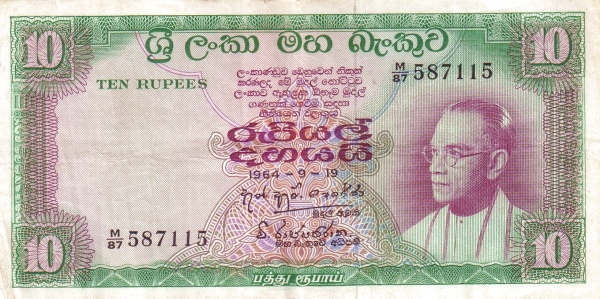
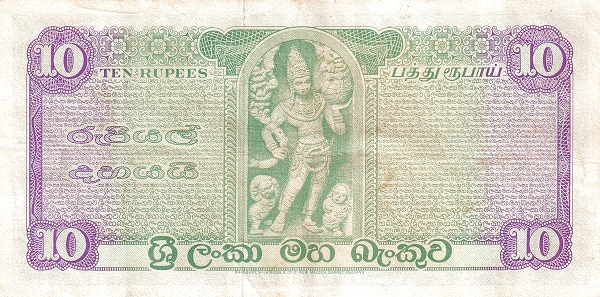
10 rupees Central Bank of Ceylon banknote (S.W.R.D. Bandaranaike portrait series)
£0.013113
1 LKR = £0.001311
10 Rupees Rupee (Issued 1964)
The year 1964 placed Ceylon under the government of Sirimavo Bandaranaike, the world’s first female Prime Minister, who had come to power in 1960 following the assassination of her husband, Solomon Bandaranaike, and whose administration pursued a policy of nationalisation, socialist economic reform, and the entrenchment of Sinhala as the official state language. It was a period of considerable political transformation on the island, as Ceylon distanced itself from its colonial past and forged a distinctly post-independence national identity. The Central Bank of Ceylon issued this ten-rupee note during that ideologically charged era, making it a tangible document of one of South Asia’s most consequential decades. The banknote series bears the name of the Bandaranaike government and reflects the cultural and political priorities of that administration through its imagery and inscription choices.
On the front, the note is printed predominantly in shades of mauve and violet against a pale background, with a border of fine green guilloché patterning running along all four edges, featuring repeating radiating fan motifs and intricate geometric latticework that demonstrate a high standard of intaglio engraving. At the upper left and right corners, and again at the lower left and right, the numeral “10” appears in bold print. The issuing authority is identified in Sinhala script at the top of the note as “ශ්රී ලංකා මහ බැංකුව” — the Central Bank of Ceylon — rendered in clear, authoritative lettering. The denomination “TEN RUPEES” is printed in English on the left-centre of the note, and Tamil and Sinhala script equivalents appear elsewhere on the face. A prominent central block of Sinhala text, printed in a larger decorative script in deep red-violet ink, dominates the middle field and carries the denomination inscription in that language. The serial number M/87 587115 appears twice — once in the upper right area and once in the lower left — printed in violet. A date of 1964-9-19 is visible just below the central text block, accompanied by two manuscript signatures in ink, one above the other, with printed designations beneath each in Sinhala script identifying the signatories’ official roles. To the right of centre, a portrait of W. Dahanayake — a prominent Ceylonese politician who served as Prime Minister briefly in 1959–1960 and held senior ministerial roles under subsequent governments — is engraved in finely detailed intaglio, showing him in a dark jacket and spectacles, facing left in a three-quarter profile, with close-cropped hair and a composed, formal expression. The lower edge of the note carries further Sinhala script denomination text reading “පත්තු රූපායි.”
The reverse is printed in a similar palette of mauve, violet, and green, with a decorative guilloché border repeating the fan and geometric patterns seen on the obverse. The denomination “TEN RUPEES” is printed in English at the upper left, with the Tamil equivalent “பத்து ரூபாய்” at the upper right, and the numeral “10” appears in each of the four corners. A large central vignette, engraved with considerable sculptural detail, depicts a standing Hindu deity rendered in the style of classical South Asian temple sculpture — a multi-armed divine figure shown in a formal stance upon a decorative plinth, with smaller figures or attendants visible at the base, the whole image framed by an ornate architectural border suggesting a shrine or temple niche. To the left of the central vignette, Sinhala script text repeats the denomination in the same large decorative lettering as the front. At the foot of the reverse, the Central Bank of Ceylon’s name is again inscribed in Sinhala script. The background of the reverse field is filled with fine repeated microtext or guilloché wave patterns in pale violet ink, providing a security substrate beneath all the primary printed elements.
Whether it is a single 1964 Ceylon Ten Rupees banknote or a mix of leftover currency, Webuyallcurrency.com exchanges Sri Lankan Rupees banknotes and other foreign coins and notes for cash in one straightforward process.
• Indicate the quantity of 10 Rupees Rupee banknotes you want to exchange
• Click the ‘Add to your account’ button
• Your online account now shows the exchange value
Webuyallcurrency.com brings all your foreign currency together: exchange or sell Sri Lankan Rupees banknotes and other old, withdrawn or modern coins and notes for cash, with no specialist knowledge needed.
Other Sri Lankan Rupees you can exchange: 0.1, 0.25, 0.5, 1, 2, 5, 20, 50, 100, 200.
Fast turnaround
We send your money within 5 working days of receiving your currency.
We’ll send your money by bank transfer, PayPal or cheque. You can also donate your exchange to a charity of your choice.
Easy and convenient
Get paid quickly
After counting your leftover coins and banknotes we’ll pay you within 5 working days. Get your payment quickly via PayPal or bank transfer.
No hidden charges
We don’t have any hidden charges, you will see our rates before you send any notes or coins. You receive the full value of the calculated exchange.
Get rid of currency that’s no longer in circulation
We also exchange discontinued foreign money. You can cash in all pre-euro currency as well as most obsolete currencies from outside the Eurozone.
Benefit from the best exchange rates online
Exchange rates change daily, that’s why we stay on top of the rate fluctuations so we can offer you the best rates for foreign money.
Happiness guarantee
We check your foreign currency and produce a formal quote, if you’re not happy we guarantee to send your currency back to you, absolutely free of charge.
Help out a charity with your exchange
We partner with many of the UK’s amazing charities. If you’d like to turn your old foreign money into a charitable donation, we can help.