
10 Pound Note Scotland: Identify & Exchange Your £10
Posted by: Ian Stainton • 9 Apr 2026
A Scottish £10 note often causes the same reaction. You pull it from your wallet, glance at the design, and wonder if it is spendable, collectible, or awkwardly stuck in a drawer.
That confusion is normal. Scottish banknotes look different from Bank of England notes, and older paper versions can raise even more questions. If you have been searching for 10 pound note scotland because you want to identify one, check if it is genuine, or work out what to do with an old note, this guide will make it simple.
Your Guide to the Scottish £10 Note
A common scenario goes like this. You are in England, pay for lunch, and get change back that includes a colourful £10 note you do not recognise. The cashier says, “It’s Scottish.” You nod, but you are still left wondering whether it will be accepted elsewhere.
That moment matters because Scottish notes are familiar in Scotland and unfamiliar to many people outside it. The result is hesitation, both from the person spending the note and from the person receiving it.

Scottish £10 notes are still pound sterling, but they come from Scottish banks with their own designs and long histories. That is why one note may show a writer, another a scientist, and another a completely different scene on the reverse.
Older versions add another layer. Some people have modern polymer notes. Others have paper notes tucked into books, travel wallets, charity tins, or inherited collections. Those notes may still hold spending value, exchange value, or collector interest depending on the version.
Tip: If a Scottish note looks unfamiliar, do not assume it is fake or worthless. Start by identifying the issuing bank and whether it is a current polymer note or an older paper issue.
Readers usually need practical help, not jargon, at this point. You want to know who issued it, what details to check, and what options you have if a shop or bank says no.
Who Prints the Scottish £10 Note?
Scotland has a different banknote system from the one many people expect. Instead of one central bank design for every £10 note in everyday use, three Scottish banks issue their own notes: Royal Bank of Scotland, Bank of Scotland, and Clydesdale Bank.
That single fact explains a lot of confusion. A Scottish £10 note can be genuine and spendable, yet look completely different from another Scottish £10 note in your wallet.
The three issuing banks
Each issuing bank produces its own design, with its own colours, portraits, themes, and security features.
| Issuing bank | What this means in practice |
|---|---|
| Royal Bank of Scotland | Issues its own Scottish-style £10 notes |
| Bank of Scotland | Issues its own Scottish-style £10 notes |
| Clydesdale Bank | Issues its own Scottish-style £10 notes |
A useful way to remember it is this. The value stays the same, but the issuer changes the appearance. It works a bit like three publishers printing different covers for books with the same title. The outside looks different. The denomination is still £10 sterling.
Why Scotland has more than one banknote issuer
This arrangement is rooted in Scottish banking history. The Bank of Scotland issued its first £10 note in 1695, according to the Bank of Scotland £10 note reference. The Royal Bank of Scotland also has a long record of issuing £10 notes, according to the Royal Bank of Scotland £10 note history.
That history matters because it explains why Scottish notes still appear in several official designs today. They are not novelty notes or souvenir money. They come from authorised Scottish banks with established issuing rights.
What often trips people up
People are used to seeing Bank of England notes, so they expect one standard look for each denomination. Scottish notes break that pattern.
A Scottish £10 note may be:
- from one of three issuing banks
- printed as a current polymer note or an older paper note
- unfamiliar to shop staff or even some bank counters outside Scotland
That last point is where practical problems start. An older Scottish paper £10 note, for example, may still have exchange value even if a retailer or high street bank refuses it. This is often the part people miss. Identifying the issuer is only the first step. Knowing where you can exchange the note is just as important.
So the rule is straightforward. If the note is issued by one of Scotland’s authorised banks, it is part of the Scottish £10 family. Then the next question is condition and version. That helps you work out whether it can still be spent, paid into a bank, or exchanged through a specialist service like We Buy All Currency, including older Scottish notes that other places may turn away. Our process is simple, secure, and backed by a 100% guarantee, which gives you a clear option if you are holding notes that feel difficult to use.
How to Spot a Genuine Scottish £10 Note
You are at the till, hand over a Scottish £10 note, and the cashier hesitates. In that moment, the useful question is not just whether the note looks unfamiliar. It is whether it is genuine, and if it is an older version, where you can still exchange it without hassle.

The simplest way to check a Scottish £10 note is to use your eyes, your fingers, and a small movement of the note in the light. You do not need specialist equipment for a sensible first check. You just need a calm routine.
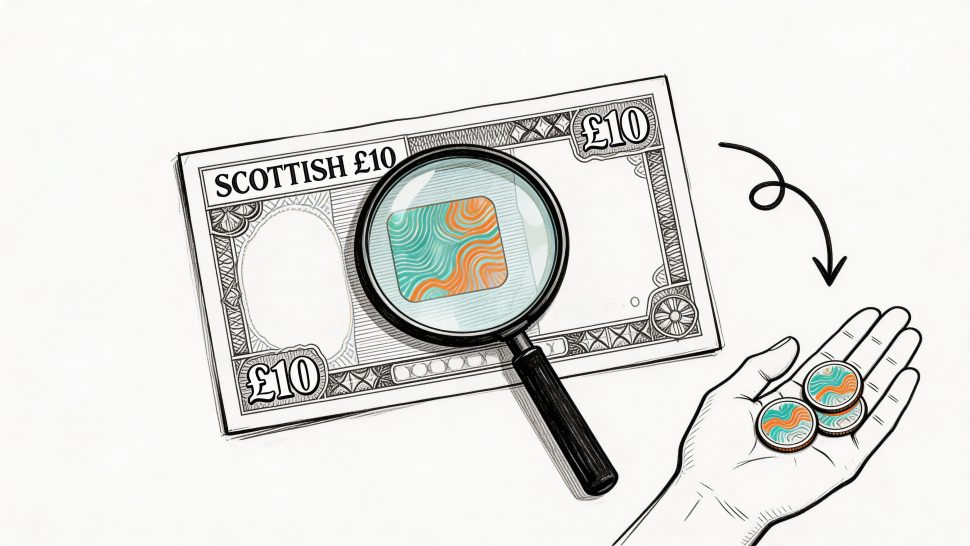
On the Royal Bank of Scotland polymer £10 note, the colour-shifting ink patch changes from copper to green when tilted, and the note also includes tactile raised dots, microlettering, and a simulated security thread rather than a traditional watermark, according to the IBNS note description.
A practical check involves three questions:
Which bank issued it?
Start with the bank name printed on the note. A genuine Scottish £10 note should come from one of Scotland’s authorised issuing banks. If the bank name is unclear or missing, that is an obvious warning sign.Is it polymer or paper?
Polymer notes feel smooth and flexible, with built-in modern features such as transparent or reflective elements. Older paper notes feel more like traditional banknotes. That does not make them fake. It means you should judge them by the features of that version, not by what you expect from a newer plastic note.Do the security features behave properly?
Tilt the note and look for colour changes. Feel for raised print or dots. Hold it in good light and check whether the fine detail looks sharp rather than blurred. Counterfeit notes often get the general design roughly right but struggle with the small details.
This works much like checking a passport. The overall picture matters, but the small security features are what confirm the note is what it claims to be.
Good light helps a lot. Fine lines should look clean, not fuzzy. Tiny lettering should appear deliberate, not smeared together. If you have a magnifying glass, even better, but many people can spot a suspicious note just by slowing down and looking carefully.
Some polymer notes also show features more clearly under ultraviolet light. Transparent areas should look built into the note itself, not added on top. If anything feels flat, oddly glossy, or poorly printed, treat the note with caution.
People often get caught by two common mistakes. One is rejecting a real Scottish note because it does not look like a Bank of England note. The other is trusting a note too quickly because the colours and portrait look convincing from a distance.
If your note passes the basic checks, the next practical step is deciding what to do with it. Current notes may still be easy to spend or bank. Older Scottish paper £10 notes can be harder, even when they are genuine, because some banks and shops refuse them. That is where a specialist exchange service helps. We Buy All Currency can exchange current and older Scottish £10 notes, including versions other places may turn away, with a simple process and a 100% guarantee.
A Closer Look at Each Bank's £10 Note Design
You can often identify a Scottish £10 note in seconds once you know what to look for. Start with the bank name at the top. Then check the main portrait or scene, much like matching a book cover with its title.

Each Scottish issuing bank gives its £10 note a different personality. That matters for two reasons. It helps you work out what you have, and it helps you decide the easiest way to exchange it if a shop or bank is unsure, especially with older paper versions.
Royal Bank of Scotland
Royal Bank of Scotland £10 notes are usually easy to spot because the current polymer design features Mary Somerville on the front and otters on the reverse. It stands out from English notes straight away, which is why some people hesitate when they first receive one.
The design mixes science and nature. Mary Somerville represents Scottish learning and discovery, while the otters give the note a distinctly Scottish wildlife theme. If you are checking one in your hand, the bank name remains the quickest clue.
Bank of Scotland
Bank of Scotland £10 notes have a different look again. The current polymer version shows Sir Walter Scott on the front, with the Glenfinnan Viaduct and a steam locomotive on the back.
That combination makes this note one of the more recognisable Scottish designs. The portrait links to literature. The reverse scene links to travel, engineering, and natural scenery. If you need help with current or withdrawn versions, our guide to Bank of Scotland bank notes explains what people commonly bring in for exchange.
Clydesdale Bank
Clydesdale Bank also issues Scottish £10 notes, and these can cause the most uncertainty because the artwork changes more noticeably across different series.
A simple rule helps here. If the note says Clydesdale Bank, treat that as your starting point, then look at the rest of the design to place the series. The exact image may vary, but it is still a genuine Scottish banknote type if the security features and print quality are right.
Why the design differences matter
The designs are not just decorative. They are practical markers that help you sort your note quickly.
A Scottish £10 note works a bit like a train ticket from a different station. It still has value, but the appearance can make staff pause if they do not see it often. That is why identifying the issuing bank first saves time.
It also helps with older notes. Polymer notes are usually easier for people to recognise, while older paper Scottish £10 notes are more likely to be questioned or refused even when genuine. We Buy All Currency solves that problem by exchanging all Scottish £10 note types, including older paper issues that other services may turn away, with a simple process and a 100% guarantee.
A quick comparison
| Bank | Front design | Reverse design |
|---|---|---|
| Royal Bank of Scotland | Mary Somerville | Otters |
| Bank of Scotland | Sir Walter Scott | Glenfinnan Viaduct and steam locomotive |
| Clydesdale Bank | Varies by series | Varies by series |
Key takeaway: Check the bank name first. Then match the portrait or reverse scene. If the note is older, unusual, or hard to spend, you can still exchange it safely through a specialist service.
Are Scottish Banknotes Accepted Everywhere in the UK?
This is the question people ask most often after receiving one in change. The short answer is not always in practice.
A Scottish note is pound sterling, but that does not mean every shop, café, taxi driver, or self-service till will accept it without hesitation. Outside Scotland, staff may be less familiar with the designs. Some businesses choose to accept them. Others refuse because they are unsure.
Why the confusion happens
Many people use the term “legal tender” as if it means “must be accepted in every shop.” Real life is more complicated than that.
For day-to-day spending, a business can usually decide what forms of payment it will take. That is why one place may accept a Scottish £10 note without a blink, while another asks for a different note or a bank card.
What this means for you
If you are in Scotland, acceptance is usually straightforward because the notes are familiar. If you are in England, Wales, or Northern Ireland, acceptance can depend on the business and the confidence of the person at the till.
That is frustrating, but it is common enough that many travellers and households end up with Scottish notes left over.
A practical rule helps:
- Using it locally in Scotland: Usually simpler.
- Using it elsewhere in the UK: Often possible, but not guaranteed.
- Using an older paper version: More likely to create questions.
If you need certainty, relying on shop acceptance is often the least predictable route.
Exchange Your Scottish £10 Notes Fast and Easy
Scottish £10 notes become awkward when they are no longer easy to spend. That can happen because you are outside Scotland, because the note is an older paper issue, or because a bank branch does not want to deal with it.
The practical problem is bigger than one note. Many people also have leftover foreign currency, mixed holiday cash, obsolete notes, and coins sitting together in a tin or drawer. That is where a specialist exchange service becomes useful.

Why old and mixed currency gets stuck
Banks and retailers tend to work best with current, familiar notes. Once a note is withdrawn, obscure, mixed with other currencies, or accompanied by unsorted coins, the process often becomes much less convenient.
That is why people search for ways to:
- exchange foreign coins
- exchange foreign coins and notes
- convert foreign coins and banknotes
- deal with leftover foreign currency
- donate foreign coins to charity
Scottish notes often sit in the same category as all those “too awkward for the high street” items.
What a good exchange service should offer
If you are sending currency away, the process should feel simple rather than risky.
Look for these basics:
- Clear rates before sending: You should know what is being offered.
- No need to sort coins: Mixed collections should not turn into a counting exercise at your kitchen table.
- Support for old and obsolete currency: Not just today’s standard notes.
- A stated guarantee: So you are not forced to accept an outcome you dislike.
- A straightforward postal process: Pack, send, verify, receive payment.
A dedicated service can be especially helpful if your Scottish £10 note is only one part of a larger bundle of old British notes, foreign coins, or holiday leftovers.
One especially useful option
If your note is an older issue, it helps to use a service that specifically handles withdrawn banknotes. This page on exchanging old bank notes shows the kind of specialist route many people need when ordinary spending or banking channels are no longer practical.
Tip: If you have one Scottish note, check the rest of your drawer as well. People often find old Irish punts, pre-euro coins, foreign holiday cash, and obsolete British notes in the same place.
A good exchange process should remove effort, not create it.
The Value of Old and Collectible Scottish Notes
An old Scottish £10 note can fall into two very different categories. It may be an older note that is awkward to spend, or it may have extra appeal to collectors because of its series, condition, or how rarely it turns up.
That distinction matters.
A withdrawn paper note from Royal Bank of Scotland, Bank of Scotland, or Clydesdale Bank is not automatically rare. In the same way, an old note is not automatically worth only face value. The details decide the answer, and small details can make a real difference.
What gives an old Scottish note extra value?
Collectors usually look at a few practical points:
Issuing bank
Notes from the three Scottish note-issuing banks are collected differently, so the bank name is the first clue.Series and design
Castles, portraits, bridges, animals, and commemorative styles can help place the note in a specific issue.Age and withdrawal status
Older paper notes often raise more questions because many shops and banks no longer want to handle them.Condition
A crisp note kept flat is usually more attractive to a collector than one with folds, stains, writing, or tears.Scarcity
Some issues are seen less often, which can increase interest.
A simple way to check what you have
Start with the bank, then the material, then the design.
That order helps because it narrows the options quickly. The bank tells you which family of notes you are dealing with. The material tells you the era. The design then helps identify the exact issue.
For example, a paper Scottish £10 note is already a sign that you should pause before treating it like ordinary spending money. Paper notes are often the ones people struggle with most, especially if they have been withdrawn from everyday use.
Collector item or exchange item?
Some notes are best viewed as collector pieces. Others are better treated as exchangeable currency.
A useful comparison is this. A collectible note is a bit like a first edition book. Its appeal depends on edition, condition, and buyer interest. An exchangeable old note is more like an out-of-date travel voucher. It may still hold value, but the challenge is finding the right place to redeem it.
That is where people often get stuck. A high street bank may refuse an older paper note. A local shop is even less likely to help. If the note has no special collector premium, you still need a practical way to turn it into money.
We Buy All Currency solves that problem directly. If your Scottish £10 note is an older paper issue, a current polymer note, or part of a mixed bundle of obsolete banknotes, we offer a simple route to exchange it. That includes notes many banks and other services reject. Our process is designed to be straightforward, and every order is backed by our 100% guarantee.
So the sensible approach is simple. Check whether the note may interest collectors. If it does not, do not assume it is worthless. It may still be exchangeable through a specialist service that handles all versions of Scottish notes, including the awkward older ones.
Frequently Asked Questions About Scottish £10 Notes
Can I spend Scottish notes in England?
Sometimes, yes. Some businesses accept them with no problem. Others decline because staff are unfamiliar with the design or store policy is restrictive.
Are old paper Scottish notes worthless?
No. Some old notes may interest collectors, and others may still be exchangeable through specialist services even if they are no longer convenient to spend.
How do I know if my note is modern or old?
Start with the material. Polymer notes feel smooth and flexible in a distinctive way. Older notes are paper. Then check the issuing bank and the main design details.
What if I have more than just one Scottish note?
That is common. People often find Scottish notes mixed with leftover foreign currency, old British coins, pre-euro money, and holiday cash. In that situation, it usually makes sense to deal with the whole bundle at once rather than one item at a time.
Can I donate Scottish notes or foreign currency to charity?
Yes. If a service allows currency exchange proceeds to be directed to a charity, that can be a practical way to donate foreign coins to charity and turn unused notes and coins into something useful.
How do I avoid hassle with mixed coins and notes?
Choose a service that lets you convert foreign coins and banknotes together and does not require you to sort every coin first. That saves time and reduces mistakes.
What is the simplest next step?
Gather your notes and coins, separate anything obviously damaged, and identify any Scottish £10 notes by issuing bank. After that, compare your exchange options and choose the one that gives you clarity, convenience, and a proper guarantee.
If you have a Scottish £10 note, old paper banknotes, or a pile of leftover foreign currency, We Buy All Currency makes the process simple. You can exchange foreign coins and notes, convert obsolete banknotes, and even donate foreign coins to charity through one fast, easy, hassle-free service. There is no need to sort coins, rates are shown up front, the process is 100% guaranteed, and the service is trusted by major brands including charities, supermarkets, airports, and police forces.