
Your 10 Rupee Note: A Guide to Value and Exchange 2026
Posted by: Ian Stainton • 23 Jun 2026
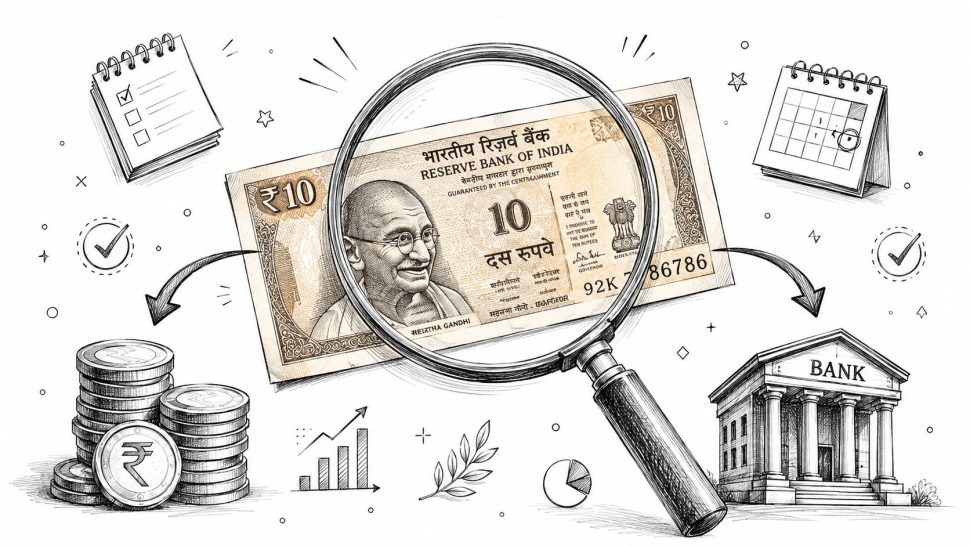
You open a drawer, find an old travel wallet, and there it is. A single Indian 10 rupee note, or maybe a small bundle of them from a trip years ago. For those in the UK, a common first question emerges: Is this still worth anything, or is it just a souvenir now?
The short answer is that a 10 rupee note can still be exchangeable, but the route matters. High street banks and standard travel money counters usually aren't the best place for low denomination foreign notes, older designs, mixed leftover foreign currency, or foreign coins. Specialist services are usually the practical option, especially if you also want to exchange foreign coins and notes, deal with leftover foreign currency, or send in older and withdrawn money together.
What to Do with Your 10 Rupee Note
If you've found a 10 rupee note in the UK, don't assume it's useless just because it's a small denomination or an older design. Indian notes have changed over time, and that often confuses people. Some versions look modern and brown. Others look older, greener, or more worn. All of that affects how you identify the note and where you try to exchange it.
Quick answer
Can you exchange a 10 rupee note in the UK?
Yes, often you can, especially through specialist online currency buyers that handle foreign banknotes, coins, and older or withdrawn currency. Standard banks and exchange bureaux usually focus on current, higher-demand travel money and may refuse small foreign notes.
That matters if your 10 rupee note is part of a bigger pile. Many people don't just have one Indian note. They also have euro coins, old dollars, a few dirhams, or mixed coins and notes from several trips. In that case, it often makes more sense to exchange leftover currency in one go instead of trying to sort every item yourself.
First checks to make
Before you do anything, look at three simple things:
- Check the series: Older and newer Indian 10 rupee notes look different.
- Check the condition: A clean, intact note is easier to process than one with heavy damage.
- Check what else you have: If you've got other Indian notes too, this guide to an Indian 50 rupees note can help you sort another common denomination at the same time.
A lot of frustration comes from going to the wrong place first. People try a bank, get turned away, then assume the note has no value. Usually, the actual issue isn't the note itself. It's that the service they're asking doesn't handle this type of currency.
A Brief History of the 10 Rupee Note
The Indian 10 rupee note has been through several redesigns, and that history matters because it explains why two notes with the same denomination can look quite different.
Older Indian notes featured earlier national imagery, including designs associated with the Ashoka Pillar Lion Capital. Later versions introduced different reverse motifs and updated layouts. For many UK holders, the most familiar older type is the Mahatma Gandhi series, followed by the newer version in the Mahatma Gandhi (New) Series.

Why note designs change
Governments redesign banknotes for practical reasons. They improve security, update national symbols, make denominations easier to recognise, and sometimes shrink or alter notes to fit new printing standards.
In India, one of the clearest recent changes was the move to the newer chocolate-brown ₹10 note in the Mahatma Gandhi (New) Series. That newer note introduced a different colour scheme and updated security styling. For UK holders, that means an old greenish or orange-brown note and a newer brown note may both be 10 rupees, even though they don't look alike.
Currency design changes don't make older notes meaningless on sight. They just make identification more important.
A useful UK parallel
A British example helps. The UK 10-shilling note was first issued on 22 November 1928 and withdrawn in 1970 to help the move to decimal currency. It had a 42-year lifespan and was ultimately replaced by the 50p coin, a useful parallel for how denominations and note series change over time in many countries, including India.
That same pattern appeared in the modern UK £10 note. The Bank of England introduced the polymer Jane Austen £10 note on 14 September 2017, replacing the previous paper £10 note that had circulated since 17 February 1975. The polymer note measures 132 mm × 71 mm, costs around 3p to produce compared with roughly 10p for paper, and is expected to last at least 2.5 years in circulation, about two to three times longer than paper notes, according to the Bank of England information summarised here and related note-history references. That redesign also added features such as a see-through window, holographic foil, and a crown image that changes colour when tilted.
The point isn't that a 10 rupee note works like a UK £10 note. It doesn't. The point is that withdrawn and redesigned currency is normal. That's why specialist exchange routes exist.
Why this history matters in practice
If you're trying to convert foreign coins and banknotes, note history affects two things:
- Recognition: You need to know which version you have.
- Exchange route: Older or less familiar versions often need a specialist buyer, not a mainstream travel money desk.
Collectors may also care about different variants, especially when note colours and design elements change. Charities and businesses handling donated mixed currency care for a simpler reason. Accurate identification helps them record and process what they've received.
How to Identify Your 10 Rupee Note Version
The easiest way to identify a 10 rupee note is to ignore the fine print at first and focus on what your eyes notice immediately. The main clues are colour, size, and the picture on the reverse.

The fastest visual clues
If the note is chocolate brown, you're likely looking at the current Mahatma Gandhi (New) Series ₹10 note. The verified size for that note is 63 mm × 123 mm, and that compact format is one reason it's efficient to store in bulk, as noted in this Indian 10-rupee note reference.
If the note looks older in style, with a different shade and different reverse artwork, it's likely from an earlier Mahatma Gandhi issue. Those older notes are the ones that most often leave people unsure whether they can still exchange them.
Indian 10 Rupee Note Comparison Old vs New Series
| Feature | Mahatma Gandhi (Old) Series | Mahatma Gandhi (New) Series |
|---|---|---|
| General colour | Older greenish or orange-brown appearance | Chocolate-brown base colour |
| Front portrait | Mahatma Gandhi | Mahatma Gandhi |
| Reverse motif | Older motif style, often recognised as different from the current design | Konark Sun Temple motif |
| Size | Larger-looking than the current note | 63 mm × 123 mm |
| Typical first impression | Looks dated or from an earlier trip | Looks more modern and compact |
What often confuses people
People usually expect all current-looking notes from one country to look broadly similar. Indian banknotes don't always fit that expectation if you've got a mix from different years.
Three mistakes are common:
- Assuming colour fading means age category: A faded note isn't automatically an old series. It may just be worn.
- Focusing only on Gandhi's portrait: Both older and newer versions can feature Mahatma Gandhi, so the portrait alone won't identify the series.
- Ignoring the back of the note: The reverse design is often the quickest way to tell versions apart.
Practical rule: Turn the note over before you decide what you've got. The reverse motif often settles the question faster than the front.
Why the note's small size matters
The current ₹10 note's compact size sounds like a trivial detail, but it matters when you're posting a batch of currency. Smaller notes are easy to stack and store. They also slip, fold, or get lost inside packaging more easily if you send loose items.
That matters for anyone trying to exchange foreign coins together with banknotes, or post a mixed bundle of leftover foreign currency. A good packing routine helps avoid miscounts and delays.
A simple approach works best:
- Bundle similar notes together: Keep Indian notes in one group.
- Separate coins from notes: Coins can shift in transit and crease paper notes.
- Use an inner envelope or sleeve: Small notes shouldn't float loose inside a parcel.
- Add a clear list: If you're sending mixed currencies, your own list helps you keep track.
For businesses, charities, and attractions that collect mixed money from donation boxes or tills, these little handling details make a real difference. They reduce counting errors and make the whole currency buy back process smoother.
Checking Condition and Authenticity Features
Once you've identified the note, the next step is to decide two things. Is it genuine, and what condition is it in?
For exchange purposes, you don't need to become a professional grader. You just need a practical eye. A note that's clearly authentic and reasonably intact is easier to process than one that's torn, heavily marked, or suspicious.

Simple authenticity checks
Start with features you can inspect without tools.
- Watermark: Hold the note up to the light and look for the watermark area. Genuine notes usually reveal hidden portrait or denomination details more clearly.
- Security thread: Look for the embedded thread running through the paper. It shouldn't look like something printed on the surface.
- Printing detail: Real banknotes usually have sharper text and cleaner line work than copies.
- Feel of the paper: Genuine banknote paper tends to feel distinct from ordinary paper. It shouldn't feel glossy like a leaflet.
If one feature looks odd, don't panic. Worn notes can hide details. Check several features together before deciding.
A plain-English way to judge condition
Collectors use technical grades, but others don't require them. A simpler scale is enough.
Crisp and clean
A note that still feels fresh, lies fairly flat, and has no major folds, tears, stains, or writing usually sits at the top end of condition.
Used but decent
This is the most common category. The note has folds, soft corners, or light handling wear, but the design is still clear and the paper is complete.
Heavily worn
These notes may have dirt, pinholes, edge splits, tape, handwriting, or obvious weakness in the paper. They may still be exchangeable, but expectations should be lower.
If the serial area, denomination, or key security details are badly damaged, the note becomes harder to process.
Damage that causes problems
Some wear is normal. Some damage creates real issues.
- Tears through important areas: Especially where numbers or security features sit.
- Missing pieces: Even small missing corners can matter if they affect identification.
- Tape repairs: These can obscure details or make counting harder.
- Ink marks or scribbles: Mild marks may be acceptable, but heavy defacement raises questions.
If you're planning to exchange foreign coins and notes together in one batch, don't throw damaged notes in loosely with metal coins. Coins rub, crease, and mark paper quickly in transit.
How to Exchange Your 10 Rupee Notes for Cash
An obstacle often arises. Individuals assume a bank, Post Office, or airport bureau will exchange any foreign note. In practice, those places usually prioritise popular travel currencies, current notes, and denominations they can resell easily.
A 10 rupee note often falls outside that model. It's low value, not widely traded in the UK, and may be part of a mixed or older batch. That's why specialist exchange services exist.

Why banks and bureaux often say no
Their limits are usually practical, not personal.
- Low-demand denominations: Small foreign notes aren't convenient for standard resale.
- Foreign coins: Most banks won't handle them at all.
- Older or withdrawn notes: Mainstream counters may reject anything outside current circulation.
- Mixed bags of currency: Sorting costs time, and many high street services don't want that job.
The UK has its own version of this problem. When the Bank of England introduced the polymer Jane Austen £10 note in 2017, the older paper version was withdrawn from circulation. Withdrawn money can still have value, but people often need a specialist route when shops or ordinary banking channels won't take it.
How the process usually works
If you want a straightforward way to exchange leftover currency, the process is typically simple.
Get a quote online
Use a specialist service calculator or rate tool to see what your currency may be worth.Pack your currency securely
Include your 10 rupee notes, plus any other foreign coins, notes, or withdrawn currency you want to send. Keep small notes contained inside an inner envelope.Post the parcel
Send it to the currency buyer for verification and counting.Receive payment
Payment is usually made after the contents are checked. With some specialist services, payment is issued within five working days by bank transfer or PayPal.
For a more detailed overview of the general process, this guide on how to exchange foreign currency is useful.
Real-world scenarios
One old note from a holiday
You find a single 10 rupee note in a travel wallet. On its own, it may not be worth sending unless you add other leftover money from home.
A family tin of mixed coins and notes
This is common. A few Indian notes, euro cent coins, US coins, and old paper money from several trips. In this case, a service that lets you convert foreign coins and banknotes together is much easier than trying to visit several counters.
Charity or business collections
Charities, supermarkets, airports, and police forces often receive mixed foreign money that ordinary banks won't process efficiently. A specialist route makes more sense because it can handle coins, notes, and withdrawn currency in one stream.
Common mistakes to avoid
- Sending notes loose: Small notes can slip inside packaging.
- Expecting a travel money desk to take everything: They usually won't.
- Assuming old means worthless: Older and withdrawn currency can still be accepted by specialists.
- Sorting too aggressively: If a service accepts unsorted currency, don't create extra work for yourself unless asked.
Frequently Asked Questions About Exchanging Old Currency
Can I exchange a 10 rupee note in the UK?
Yes, often you can. The most practical route is usually a specialist online currency exchange service that accepts foreign banknotes, including low denominations and older issues. High street banks and bureaux often won't handle this kind of note.
Can I exchange foreign coins as well as notes?
Yes, with the right specialist service. Many people don't just have one note; they have mixed leftover foreign currency, including coins that banks won't touch. If you want to exchange foreign coins alongside notes, look for a service built for mixed currency rather than standard travel cash.
Do UK banks accept foreign coins?
Usually, no. Foreign coins are one of the biggest sticking points in the UK exchange market. Banks and travel money counters often reject them because they're difficult to process and resell. That's one reason specialist services are useful for people trying to exchange foreign coins and notes in a single parcel.
Do older or withdrawn Indian notes still have value?
They can. Value depends on the note version, condition, and whether the buyer accepts older or withdrawn issues. People often assume a note loses all value once it's old or no longer seen in daily circulation, but specialist buyers may still accept it.
How do I know whether my 10 rupee note is old or new?
Look first at the colour and reverse design. The current version is chocolate brown and uses the Konark Sun Temple motif. Older versions look different in both style and colouring. If you compare front and back carefully, the differences are usually easy to spot.
Can I send mixed currencies together?
Yes, many specialist services allow that. If you've got Indian rupees mixed with euros, dollars, dirhams, or old British and Irish coins, sending everything together can save time. That's especially useful if you want to exchange leftover currency without sorting every item into separate small transactions.
Can I donate foreign coins to charity instead of taking cash?
Yes. Some services let you donate foreign coins to charity by converting the proceeds on your behalf. That's helpful if the amounts are small, sentimental, or collected in fundraising tins, airport collections, school drives, or shop counters.
How long does payment take?
It depends on the service, but some specialist platforms issue payment within five working days after the currency is received and verified. Always check the payment method options before sending, especially if you prefer bank transfer or PayPal.
Is there any point sending just one low-value note?
Sometimes yes, but often it's better to combine it with other money you have at home. One 10 rupee note on its own may not be the most efficient item to post. A mixed envelope of old notes, current notes, and coins is usually more practical.
What if I don't want to sort coins by country?
Look for a service that accepts unsorted currency. That's one of the main advantages of specialist exchange platforms. You can convert foreign coins and banknotes without turning your kitchen table into a sorting office.
If you've got a 10 rupee note, a jar of holiday change, or a bundle of old foreign banknotes that banks won't accept, We Buy All Currency offers a simple way to exchange foreign coins, notes, and withdrawn currency by post. It's a practical option for individuals, charities, and businesses that want to exchange leftover currency without sorting everything by hand.