
100 Egyptian Pounds: What It’s Worth & How to Exchange It
Posted by: Ian Stainton • 17 Apr 2026
TL;DR: 100 egyptian pounds is worth about £1.62 at mid-market rates in mid-April 2026, although a practical dealer buy-back rate is often lower once handling and verification are factored in. In the UK, banks often won’t take smaller or less commonly traded leftover notes, so a specialist foreign currency buy-back service is usually the simplest way to exchange it, especially if you also want to convert foreign coins and banknotes from mixed holiday collections.
A lot of people only notice a 100 Egyptian Pound note when they’re unpacking after a holiday, clearing out a drawer, or sorting a pile of old travel money for charity. It might be one crisp note from Cairo or Sharm El Sheikh, or part of a mixed bundle of leftover foreign currency collected over several trips.
The note looks substantial. The value in pounds is far less dramatic. That gap catches people out.
The bigger frustration is practical rather than mathematical. You might know roughly what 100 egyptian pounds should be worth, but turning it into sterling in the UK is where things become awkward. High street banks usually focus on major current currencies, not low-value leftover notes, mixed foreign change, or older withdrawn money. That’s why specialist exchange services exist.
Your Guide to the 100 Egyptian Pound Note
You empty a travel wallet, find a 100 Egyptian pound note, and assume changing it back into sterling will be straightforward. In practice, this is the point where many UK holders hit friction. The note still has value, but it sits in exactly the category that high street exchange counters often avoid: low-value leftover foreign cash, sometimes mixed with coins, older notes, or money from several trips.
That is why this note turns up so often in specialist exchange work. I see it in single holiday leftovers, mixed charity donations, shop tills, airport collections, and old envelopes of travel money that have not been touched for years.
Quick answer
A 100 EGP note is a small amount in sterling terms, but still worth dealing with if it forms part of a wider batch of foreign currency. On its own, it is often too minor for a bank branch to bother with. As part of a collection, it makes more sense. Specialist buy-back services are set up for that practical reality, including mixed notes, coins, and older currency that standard providers usually decline.
One note rarely justifies a tour of bank branches.
Why this note matters in the UK
The 100 EGP denomination is common in Egypt and common enough in UK homes after holidays, especially from Cairo, Hurghada, and Sharm El Sheikh. Yet it is not a note that mainstream UK banks actively handle in small casual amounts. That gap matters. People know the note is real money, but they often discover there is no obvious place to convert it.
The issue is not only exchange rate value. It is processing cost, demand, verification, and what the provider can do with the note after buying it. Banks and Post Offices tend to prioritise actively traded currencies and cleaner retail workflows. A single Egyptian note, or a mixed handful of foreign cash, does not fit that model well.
There is also a second layer of value that many guides skip. A 100 Egyptian pound note can matter in three different ways. It has exchange value if it is current and accepted by a buyer. It can have collector interest if it is an older design, unusual issue, or part of a discontinued set. It can also have charitable value when people combine small leftover amounts from several countries into one donation or exchange batch. The right route depends on what you have, not just on the headline rate.
If you are holding other currencies as well, euros, dollars, dirhams, withdrawn notes, or foreign coins, sorting the full bundle together is usually the more efficient choice. That saves time and usually avoids the dead end of trying to place each item separately.
How to Identify a Genuine 100 Egyptian Pound Note
You get back from a trip, empty a wallet or drawer, and find a 100 Egyptian pound note folded in with other foreign cash. Before trying to exchange it, identify exactly what you have. That means checking whether it is genuine, whether it matches a current or older design, and whether its condition is good enough for a buyer to handle without extra delays.

Check the overall look first
Start with a plain visual inspection under good light. A genuine 100 Egyptian pound note should look professionally printed, with sharp detail, consistent colouring, and no obvious blur in the fine lines or Arabic text. If the note appears washed out, badly trimmed, unusually glossy, or printed off-centre, it deserves closer scrutiny.
Condition matters too. Notes that are heavily torn, missing corners, taped up, or badly stained can still be genuine, but they are often harder to process. That is a handling issue rather than an authenticity issue, and it often affects whether a standard bank counter will want to deal with the note at all.
Security features to inspect
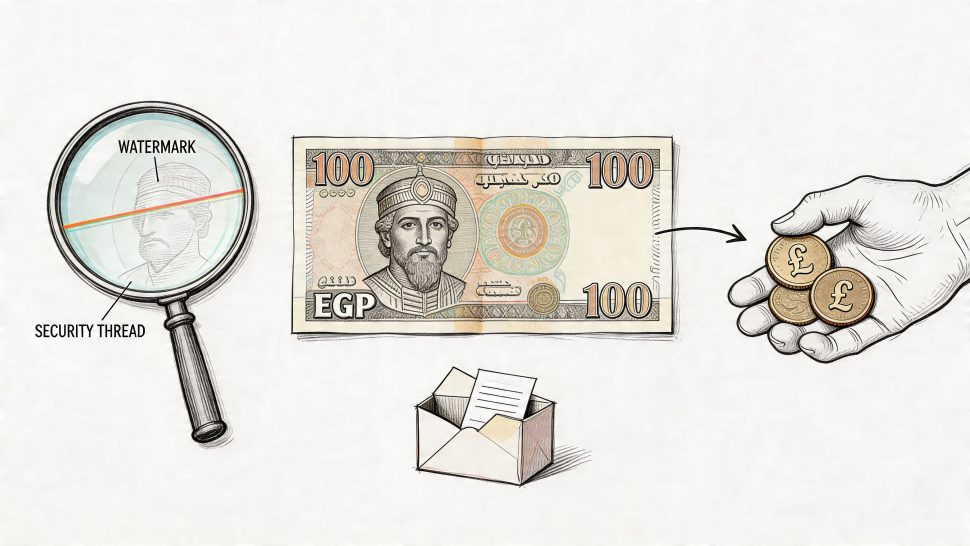
The quickest checks are visual and tactile. According to Wikipedia’s Egyptian pound entry, Egyptian banknotes include standard security elements such as watermarks and security threads, and modern issues also use raised printing and detailed design work that is difficult to copy cleanly.
Use this routine:
- Hold the note up to the light and check for a proper watermark and embedded security thread.
- Tilt the note and look for changes in reflective elements, where present on the issue you hold.
- Feel the surface for raised print, especially around the main design and denomination markings.
- Check the fine detail in borders, patterns, and text. Genuine notes usually have crisp lines rather than fuzzy edges.
- Compare both sides for consistency. Counterfeits often get one side roughly right and the other side wrong.
A real note usually feels deliberate in the hand. Paper quality, print texture, and fine detail tend to give it away faster than colour alone.
Older notes and design variation
Confusion can arise. A note can be genuine and still look different from the first image result online. Egypt has issued different banknote designs over time, and circulation wear can change the appearance further. Colour tone, portrait clarity, and reflective features may vary by series.
For that reason, a single image comparison is weak evidence. It is better to check for a combination of security features and overall print quality than to rely on one online photo.
What to do if you are unsure
Do not write on the note, tape it further, laminate it, or try to clean it. Those actions reduce the chance of a successful exchange review.
Set it aside with any other foreign notes you have and get it checked as part of the full batch. That is often the practical route from the UK, especially if the note is older, mixed in with other currencies, or no longer in perfect condition.
Understanding the Real Value of 100 Egyptian Pounds
You come back from Egypt, empty your travel wallet, and find a single 100 Egyptian pound note. The first thing many people do is check an online converter. The problem is that the converter answer is only one version of the note’s value.
For a UK holder, 100 Egyptian pounds usually needs to be judged in three separate ways: what it converts to on a live rate screen, what a buyer is prepared to pay for a physical note, and whether the note has any premium as a collectible. Those figures are often different, and the gap matters more on lower-value notes like this one.
Three ways to judge a 100 EGP note
A live exchange rate is a pricing reference, not a guaranteed payout. It does not include the cost of checking the note, handling a small-value foreign banknote, sorting by currency, or moving it through a buy-back process.
The second figure is the practical exchange amount. This is the one that matters if you want sterling in your account. Specialist buyers price for the actual work involved, especially where the note is less commonly handled in UK retail channels.
The third figure is collector value. That only applies in a narrower set of cases.
Exchange value versus collector value
An ordinary circulated 100 EGP note is usually an exchange item, not a collector piece. Age alone does not make it rare. Condition, issue type, serial number pattern, and whether the note is uncirculated make much more difference.
That is why many notes that look old or unusual to the owner still trade only at their exchange value. On the other hand, a crisp note from an older issue, or one sitting in a mixed foreign currency collection, may deserve a closer look before it is grouped in with everyday travel leftovers.
Why the amount you receive can feel lower than expected
Physical currency is not priced the same way as a digital transfer. A £ value shown on a converter assumes a clean market rate between currencies. A paper 100 EGP note has to be verified, counted, sorted, and processed, and the note itself has limited resale demand in the UK compared with major currencies.
That is the practical reason many people get less than the headline rate suggests. It is not unusual. It is how low-value foreign note buy-back works.
If you are comparing options, it helps to start with providers that specifically handle foreign currency exchange from the UK rather than assuming your bank will treat Egyptian pounds like euros or US dollars.
Comparing your options
| Exchange Option | Accepts 100 EGP Notes? | Accepts Foreign Coins? | Best For |
|---|---|---|---|
| High street bank | Sometimes, but often no for less commonly exchanged currencies | Usually no | Current major currencies and standard travel money |
| Post Office or standard bureau | Sometimes, policy varies by branch and currency | Usually no | Straightforward holiday exchange |
| Specialist currency buy-back service | Usually yes | Often yes | Leftover travel money, mixed notes, old currency, charity collections |
Does it make sense to hold onto it?
Usually, no. If your aim is to turn the note into pounds sterling, waiting rarely improves the result on a single modern foreign note of low face value. The gain, if there is one, is often too small to justify years of keeping it in a drawer.
A collector may take a different view, but that only makes sense where the note has something extra going for it.
For a standard used 100 Egyptian pound note, judge it first as exchange currency. Treat any collector premium as a possibility, not an assumption.
That approach is more accurate, and it saves a lot of wasted time with small foreign notes that never become more valuable than they are today.
Why Your Bank and Post Office Won't Exchange It
You come back from Egypt with one 100 Egyptian pound note, walk into a bank branch, and expect a quick swap into sterling. In practice, that is often where the process stops.
UK banks and Post Office counters do not aim to handle every foreign note in circulation. They focus on currencies with steady customer demand, simple branch procedures, and clear resale routes. A single 100 EGP note sits outside that model. The face value is modest, branch staff may not see the currency often, and the cost of checking, storing, and sending it on can outweigh the return.
The business reason behind the refusal
From an exchange desk perspective, Egyptian pounds are awkward retail stock.
- Staff need to recognise and check the note properly, even if they only see it occasionally.
- Branches need a route to move the note on, and that route is weaker for less commonly traded currencies.
- Low-value notes are poor economics because the handling cost is high relative to what the note is worth in pounds.
- Coins, older issues, and mixed bundles create even more manual work, which standard branch systems are not built for.
That is why a genuine note can still be refused. The problem is usually not authenticity. It is volume, process, and margin.
Specialist buy-back services work differently because they are set up for leftover travel money, mixed currency lots, old notes, and foreign coins. If you have already been turned away, it helps to check a clear guide on where to exchange foreign currency in the UK before trying another branch.
A bank sees one small note as an exception to process. A specialist service sees it as standard work.
A Simple Step-by-Step Guide to Exchange Your Currency
If your 100 EGP note is part of a mixed bundle, don’t separate everything into neat piles unless a provider specifically asks you to. For many people, the easiest route is a postal specialist process that handles current and older foreign money together.

Step 1 Check what you have
Pull together all your leftover foreign currency first. That includes:
- Current notes from recent travel
- Foreign coins you’ve never been able to use again
- Old or withdrawn notes from earlier trips
- Mixed charity collections from tins, tills, or office drives
This first step matters because small-value notes like 100 egyptian pounds make more sense when processed alongside the rest of your unused travel money.
Step 2 Get a quote or use a mixed-currency tool
Use a service that lets you value banknotes clearly and deal with coins without unnecessary sorting. If your collection is mixed, a weight-based wizard is often the easiest option because it removes the need to identify every last coin by hand.
A clear process matters more than squeezing out a theoretical headline rate you can’t access.
Step 3 Pack securely and post
Use a sturdy envelope or small box, keep the contents flat where possible, and send it with tracking. Don’t use loose packaging that allows notes or coins to move around.
A lot of avoidable problems start here. Good packing is part of good exchange practice.
Step 4 Receive payment or donate the value
Once the currency is checked and verified, payment is typically issued by bank transfer or PayPal. Some services also let you donate foreign coins to charity, which is useful if the amount is small or comes from a shared collection.
Verified travel commentary notes that £100 might convert to over 6,000 EGP, but the Egyptian pound depreciated by 14% between 2022 and 2024, which is why holding onto leftover notes for too long can erode value in practical terms, as discussed in this YouTube travel analysis on Egyptian pound volatility.
The best time to deal with leftover holiday money is usually when you notice it, not months later.
If you want a practical walk-through of the postal process, this guide on how to exchange foreign currency is a useful reference.
Common Mistakes to Avoid When Exchanging Foreign Money
Most losses here don’t come from dramatic scams. They come from ordinary assumptions that turn usable currency into forgotten clutter.

Mistake one assuming it’s too small to matter
One 100 EGP note doesn’t sound like much in sterling. But people rarely send only one note. They send one Egyptian note, a few euros, some dollars, a handful of coins, and maybe older currency from previous trips. The value sits in the combined total.
That’s especially true for charities and businesses collecting foreign money over time.
Mistake two holding old notes in the hope they’ll rise
This is one of the most persistent myths. Verified historical data shows the 100 EGP note became prominent after devaluations shifted the exchange rate from 0.357 EGP per USD pre-1952 to over 50 EGP per USD by 2026, which supports the practical point that holding ordinary notes in the hope they appreciate is usually the wrong move, based on Trading Economics data on Egypt’s currency.
For standard circulated notes, delay usually helps no one.
Mistake three trying the wrong outlet repeatedly
A traveller may try a bank branch, then a bureau, then the Post Office, only to hear that the note isn’t accepted. A charity volunteer may spend time sorting coins by country, only to discover local outlets won’t take foreign coins at all. A business may leave mixed currency in a safe because nobody internally wants to deal with it.
Those aren’t unusual stories. They’re the normal path when people use mainstream channels for specialist problems.
A better approach
- Treat mixed currency as one job rather than several separate errands.
- Check acceptance before sending or visiting so you don’t waste time.
- Use tracked post when mailing physical money.
- Focus on transparent quotes rather than headline rates with unclear deductions.
The simple rule is this: exchange leftover currency while it’s still on your mind and while the notes are still easy to identify and verify.
Frequently Asked Questions About Exchanging Currency
Can I exchange 100 egyptian pounds in the UK
Yes, but not always through a bank or walk-in bureau. A 100 EGP note is the sort of lower-value, less commonly traded banknote that specialist services are generally better equipped to handle, especially if it forms part of a larger bundle of leftover foreign currency.
How much is 100 Egyptian pounds worth in pounds sterling
Mid-market value and payout value are not the same thing. A live market reference may put the note at around the mid-market level discussed earlier, while an actual buy-back figure can be lower once handling and verification are included. That’s normal with smaller foreign denominations.
Can I exchange foreign coins as well as notes
Usually not at a bank. Specialist services are the practical option if you need to exchange foreign coins and notes together, especially if you have unsorted holiday change, charity collections, or mixed international currency.
Do banks accept Egyptian pounds
Sometimes they won’t, especially for small amounts or currencies with lower branch demand. Banks tend to prioritise high-volume, mainstream travel money. Egyptian pounds often fall outside what a local branch wants to process.
What if my Egyptian note is old or withdrawn
Old or withdrawn notes can still hold value, but you need a service that deals with obsolete currency rather than only current banknotes. This is one of the biggest reasons people use specialist providers rather than standard bureaus.
Do I need to sort mixed foreign currency before sending it
Not always. Some services allow mixed coins and notes to be handled without the customer doing all the sorting. That’s especially useful if you’re dealing with a charity bucket, an office collection, or a drawer full of old travel money from several countries.
Is it worth exchanging just one 100 EGP note
On its own, the amount is small. But many people don’t stop at one note once they start looking. They find more leftover holiday money elsewhere in the house. If you’re already sending other currency, adding the note often makes sense.
Can I donate foreign coins to charity instead of taking payment
Yes. Some specialist exchange services let you direct the proceeds to a UK charity partner. That works well for small balances, shared collections, school drives, airport collections, and retail fundraising campaigns.
How long does payment usually take
With a specialist postal service, payment is typically made after the currency has been received and verified. The publisher information for this article states that payments are issued within five working days by bank transfer or PayPal once verification is complete.
What if I’m not sure the quote is fair
Look for a service that shows the rate clearly before you send and explains how the process works. The strongest sign of a fair setup isn’t the biggest headline promise. It’s transparency, especially when dealing with mixed notes, coins, and older foreign currency.
What’s the best option for a charity or business with mixed foreign cash
Use a specialist service that can process volume, mixed denominations, and coins without demanding branch-level sorting. That’s usually the cleanest way for charities, attractions, retailers, airports, and other organisations to turn foreign cash into usable sterling or charitable funds.
If you’ve got 100 egyptian pounds, mixed holiday money, old notes, or a jar of overseas coins you’ve never managed to use, We Buy All Currency offers a straightforward way to exchange foreign coins, exchange leftover currency, and convert current or withdrawn banknotes without the usual hassle. It’s designed for individuals, charities, and businesses that need a practical currency buy back service when banks and standard bureaus fall short.