
1000 Taiwan Dollar to GBP: A 2026 Conversion Guide
Posted by: Ian Stainton • 14 Jul 2026
1,000 New Taiwan Dollars usually comes to about £24.34 at the mid-market rate. That's the useful benchmark, but the amount you receive for physical cash depends on who handles the exchange and whether you've got notes, coins, or older currency.
If you've just come back from Taiwan and found a 1,000 TWD note in a jacket pocket, this is probably the number you wanted first. The confusing part starts after that. The rate you see online is one thing. Turning leftover foreign currency into pounds in practice is something else, especially if your travel money is mixed with coins or older banknotes.
A lot of people assume the hard part is the maths. It usually isn't. The harder part is finding a UK option that will exchange foreign coins and notes, rather than only fresh banknotes in popular currencies. That gap between the online rate and the reality of cashing in physical money is where most frustration happens.
Your 1000 TWD to GBP Quick Conversion Guide
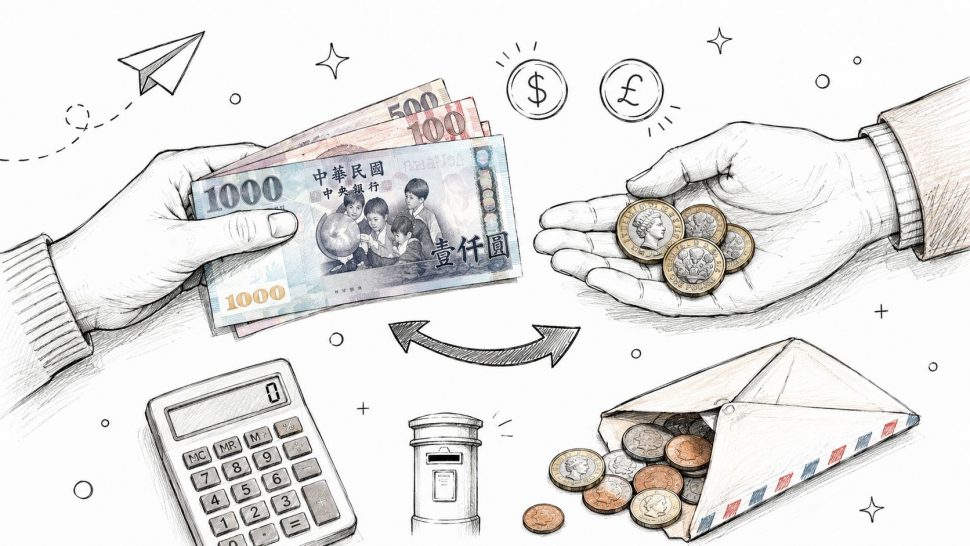
You're home, you empty your wallet, and there it is. One 1,000 Taiwan dollar note, maybe with a few coins from Taipei night markets or the airport. At first glance it looks simple. As of mid-2026, 1,000 New Taiwan Dollars converts to approximately £24.34 British Pounds using the mid-market exchange rate, which is the benchmark people use to estimate value before any retail handling or service differences apply, as shown by today's exchange rate reference.
That figure is helpful because it gives you a fair starting point. It tells you what the currency is worth in the market before any provider decides what they will or won't accept. If all you have is a current banknote, you're in a better position than someone holding a handful of coins. If you've got a mixed pile of leftover holiday money, the practical side matters more than the headline rate.
What most people expect
Many travellers think this works like a quick online conversion:
- You search the rate: Google shows a neat pound amount.
- You visit a bank or bureau: You expect roughly the same value.
- You hand over the cash: You assume coins and notes will be treated alike.
That's where expectations often break down.
What actually happens
Physical currency creates extra hurdles. High street providers often prefer major circulating banknotes, and they commonly avoid coins, unusual currencies, or older series. So the key question isn't only “what is 1000 Taiwan dollar to GBP?” It's also “who will handle what I've got?”
Practical rule: Use the online rate as a benchmark, not as a promise of your final payout.
If your Taiwanese money is part of a larger bag of foreign cash, it helps to think in categories:
- Current notes are usually the simplest to value.
- Foreign coins can still have value, but many mainstream outlets won't take them.
- Withdrawn or older notes may still be exchangeable through specialist routes when banks and travel counters say no.
Why the Rate You See on Google Is Not What You Get
The online number isn't wrong. It's just incomplete.
When you search 1000 Taiwan dollar to GBP, you're usually seeing the mid-market rate. Xe recorded 1 TWD = £0.0236, which works out at about £23.60 for 1,000 TWD, and that rate is the benchmark financial institutions use before any retail spread or fees are added, according to Xe's TWD to GBP converter.

What the mid-market rate really means
Think of the mid-market rate as the neutral reference point. It's the rate used to compare currencies in a clean way, without adding the costs of serving retail customers, handling physical cash, or processing small-value exchanges.
That's why it's good for understanding value, but not enough for choosing where to exchange your money.
The rate on a search result is a benchmark. The payout for physical cash reflects handling, risk, and whether the provider even wants that type of currency.
Why physical cash gets treated differently
A provider handling a digital transfer and a provider handling mixed holiday cash are dealing with different jobs. Notes have to be checked. Coins have to be sorted or weighed. Older issues may need specialist knowledge. Physical cash also has postage, verification, storage, and banking costs behind it.
That's one reason banks and exchange bureaux often draw a hard line around what they accept.
The role of the spread
The other key term is spread. In plain English, it's the gap between the benchmark market rate and the rate a retail customer receives. That gap covers commercial costs and risk.
For travellers, the important lesson is simple:
- The benchmark rate helps you judge fairness.
- The provider's rate tells you what you'll receive.
- The acceptance policy decides whether your money can be exchanged at all.
If you're trying to convert foreign coins and banknotes, acceptance can matter more than a tiny difference on a screen. A perfect online rate is useless if the counter refuses your coins or won't take an older Taiwanese note.
Comparing Your TWD to GBP Exchange Options
Not all exchange routes solve the same problem. If you only have one current note, you may have several choices. If you want to exchange foreign coins and notes, or you've got money left from multiple trips, the list gets shorter quickly.
The range itself tells you why shopping around matters. The mid-market exchange rate for 1,000 TWD to GBP can vary between £23.23 and £24.42 depending on the provider, and that spread can create a difference of over £1 on a simple 1,000 TWD conversion, as shown by provider comparisons for 1,000 TWD to GBP.

Comparison of Currency Exchange Options in the UK
| Feature | High Street Bank | Exchange Bureau | We Buy All Currency (Specialist) |
|---|---|---|---|
| Accepts Taiwanese banknotes | Sometimes | Often for current notes | Yes |
| Accepts foreign coins | Usually no | Usually no | Yes |
| Accepts old or withdrawn currency | Often no | Often no | Yes |
| Best for small mixed bags | Rarely | Rarely | Yes |
| Convenience | Branch visit needed | In person, location dependent | Postal process |
| Rate transparency | Varies | Varies | Quote shown before sending |
| Handles unsorted currency | Usually no | Usually no | Yes |
Why banks often aren't the answer
Banks work well for mainstream banking. They're often less helpful for odd amounts of travel cash. Many won't handle foreign coins at all. Some also limit which note series they accept, especially if the currency is less commonly requested in the UK.
That's frustrating if your money is perfectly real, just not convenient for a bank branch.
Why bureaux can disappoint
Airport and high street bureaux are easy to spot, but they're built around speed and convenience for travellers who need cash immediately. They're often less suitable for someone trying to exchange leftover currency after the trip is over.
Typical pain points include:
- Coins excluded: Many bureaux only want notes.
- Older issues refused: Withdrawn or less familiar notes can be rejected.
- Small values overlooked: A mixed pouch of travel leftovers may not fit their model.
When a specialist route makes sense
A specialist service fills the gap that banks and bureaux leave behind. It's particularly useful if you need to:
- exchange foreign coins
- exchange foreign coins and notes
- handle leftover foreign currency from several countries
- send in old, withdrawn, or unusual money
- avoid sorting every coin by hand
That last point matters more than people expect. If your Taiwan dollars are mixed with euros, US cents, yen, and old notes from earlier trips, convenience stops being a luxury and starts being the main reason to choose one option over another.
How to Exchange Leftover Taiwanese Dollars Step by Step
When people delay exchanging holiday money, it's usually because the process sounds fiddly. It doesn't need to be. If you use a specialist postal route to exchange leftover currency, the practical steps are straightforward.
Start with the currency you actually have
Before doing anything else, separate your Taiwanese money into broad groups:
- Current notes
- Coins
- Older or withdrawn notes if you have them
- Any other foreign money mixed in the same bag
You don't need to turn this into a museum catalogue. A rough sort is enough to understand what you're sending.

Check the quote before you post
A good process shows you the exchange value before you commit. That matters because physical cash isn't the same as a live card payment or app-based transfer. You want to know where you stand before packaging anything.
Good habit: Treat the quote as your decision point. If the value works for you, continue. If it doesn't, pause there.
Send the money securely
Once you're happy, the next step is packing and posting the currency. Specialist services distinguish themselves from banks and kiosks in this regard: they're set up for posted cash, mixed coins, and notes that ordinary retail channels don't want to process.
A simple flow looks like this:
- Find your currency online: Select Taiwanese dollars from the list.
- Enter the amount: Add the note value or estimate what you're sending.
- Fill in your details: Include payment information carefully.
- Post the currency: Package it securely and send it to the stated address.
Receive payment after verification
After the currency is checked, payment is issued. For many users, this is the point where the whole process becomes easier than chasing branch visits, queueing at kiosks, or being told that coins can't be accepted.
The big advantage isn't just convenience. It's that a specialist route can accept what other outlets reject, including coins, mixed currencies, and older money.
Common Mistakes to Avoid and What to Do Instead
The biggest loss with leftover foreign currency usually isn't exchange rate movement. It's inaction. People leave money in drawers, throw coins in a souvenir box, or assume old notes are worthless because one counter said no.

Throwing away foreign coins
This happens more often than people admit. Coins feel low value, especially after a trip, and many travellers think nobody in the UK will take them.
A better move is to look for a specialist that can exchange foreign coins or help you donate foreign coins to charity instead of wasting them.
Assuming old notes are useless
A note can be awkward to exchange without being worthless. That distinction matters. Mainstream providers often reject older or withdrawn issues because they don't want the admin burden, not because the note has no possible value.
If you've got Taiwanese notes from an earlier series, it's worth checking specialist acceptance rather than relying on one quick “no” at a counter.
Only checking your bank
Banks are many people's first call. They shouldn't be the only one. A branch may offer convenience for standard banking, but that doesn't mean it's the best place to convert foreign coins and banknotes.
Some of the most useful exchange options aren't on the high street. They're built specifically for leftover travel money, coins, and withdrawn currency.
Missing the charity option
If you don't need the pounds yourself, donation can be a practical alternative. A 2025 Charity Commission UK data set reported that 42% of UK charities received foreign coin donations in 2024, but only 11% had a structured currency-exchange-and-donate process, leaving £8.7 million in unconverted foreign change unused across the sector. The same data also notes that directing proceeds to a charity partner can enable a 25% Gift Aid uplift, according to this foreign currency donation reference.
That's especially relevant for:
- Travellers with spare coins they won't use again
- Charities receiving mixed overseas donations
- Airports, airlines, attractions, and retailers collecting leftover change from the public
- Businesses that end up with foreign notes and coins taken in error
Waiting too long out of uncertainty
People often postpone because they're unsure whether sorting is required or whether small amounts are worth sending. In practice, specialist services are designed for these awkward situations. That's why they appeal to individuals, charities, and businesses alike, especially where ordinary exchange channels fall short.
Frequently Asked Questions about Exchanging Currency
Can I exchange foreign coins in the UK
Yes, but not everywhere. This is the part that catches people out. Many banks and travel bureaux won't accept coins, even when they still accept banknotes. If you need to exchange foreign coins and notes, you'll usually need a specialist service rather than a standard branch counter.
Will my bank accept Taiwanese dollars
It might accept current banknotes, but banks often have narrow acceptance rules. Coins are commonly excluded, and older or withdrawn note series may be refused. If your Taiwan dollars are mixed with coins or older cash, a specialist route is usually more practical.
Do old or withdrawn Taiwanese notes still have value
Sometimes, yes. “Withdrawn” doesn't automatically mean “worthless.” It usually means the note no longer fits mainstream retail exchange channels. Specialist currency buyers may still handle types of money that banks and bureaus won't touch.
Why does the online rate differ from the cash rate I'm offered
Because the online figure is generally a benchmark rather than a retail payout. Physical currency has handling costs, verification requirements, and acceptance limits. That's why the amount shown by a search engine won't always match the amount offered for actual notes and coins.
Is 1000 Taiwan dollar to GBP usually a stable conversion
Relatively speaking, yes. Historically, the TWD/GBP exchange rate has fluctuated between 0.0230 and 0.0245 GBP over a 12-month period, which supports reliable quoting for postal exchange services, according to historical TWD to GBP rate data.
What if I have a mixture of currencies, not just Taiwanese dollars
That's common. Many people don't just have one 1,000 TWD note. They also have euro coins, US cents, old kuna, or withdrawn notes from earlier trips. Specialist services are often set up for mixed bags of leftover foreign currency, which is useful if you want one process instead of visiting multiple providers.
Do I need to sort every coin before sending it
Not always. Some specialist services are designed to handle unsorted currency, which is one of the main advantages over banks and kiosks. That's especially helpful if you've kept everything together in a travel jar, purse, or drawer.
How long does payment take
Payment timing depends on the provider's process, but specialist postal services typically pay after the currency has been received and checked. The key thing to look for is clarity. You want to know when verification happens, how you'll be paid, and what happens if the quote doesn't suit you.
Can I donate leftover foreign currency instead of exchanging it for myself
Yes. This is often a smart option for low-value coins or mixed travel leftovers. Some services let you direct the value to a UK charity, which can be especially useful for travellers, charities, airports, and businesses collecting public donations. If that suits your situation, it can turn hard-to-use cash into a straightforward contribution.
If you're ready to turn leftover foreign currency into something useful, We Buy All Currency offers a simple way to exchange foreign coins, exchange foreign coins and notes, or convert foreign coins and banknotes that banks and bureaux often refuse. It accepts coins, banknotes, and withdrawn currency, with no need to sort coins first, making it a practical option for travellers, charities, and businesses that want a fast, hassle-free currency buy back service.