
20p Coins Value: A UK Guide to Rare Finds & Cashing In
Posted by: Ian Stainton • 1 Jun 2026
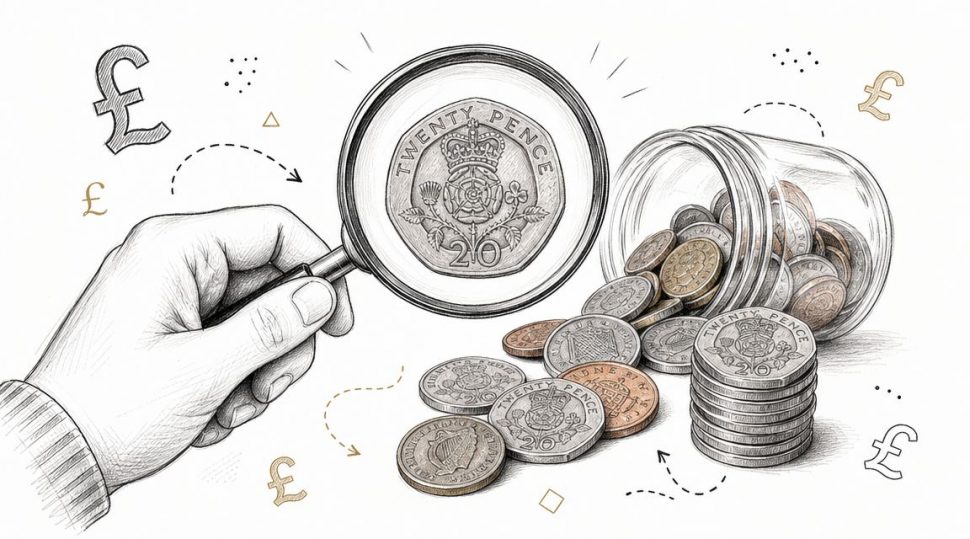
Most 20p coins are worth 20p, but the famous undated 2008 error 20p can sell for around £50 to £70, with some examples reported at up to £90. For everything else sitting in drawers, jars, travel wallets, or old money tins, the practical route isn't chasing collector hype. It's using a specialist service that can convert mixed coins and notes, including leftover foreign currency and older issues that banks usually won't handle.
A lot of people arrive at this question the same way. They spot an odd-looking 20p in change, search its year, then realise they've also got a pile of euros, dollars, withdrawn notes, and random coins from old trips. That's where the topic gets more useful.
The exciting part is real. Some 20p coins do attract collector demand. But most coin problems aren't about one lucky find. They're about what to do with ordinary coins, mixed cash, and unsorted leftover currency without wasting time. That's where a specialist exchange process makes more sense than hoping every old coin is rare.
Your Guide to 20p Coin Value and Leftover Currency
The UK 20p coin has been part of everyday cash use for decades. It was introduced on 9 June 1982, and by March 2014 there were an estimated 2.765 billion 20p coins in circulation, with a total face value of £553.025 million, according to the Royal Mint's history of the 20p coin.
That scale matters because it explains why most 20ps aren't rare. They were made for heavy everyday use. The denomination was created to make small transactions easier and reduce reliance on 10p coins when cash payments were still central to daily spending.
What people usually mean by 20p coins value
When someone searches for 20p coins value, they usually mean one of three things:
- A coin found in change: They want to know if it's spendable only, or collectible.
- An older coin kept for years: They're checking whether age alone adds value.
- A mixed money stash: One unusual British coin leads them to ask what to do with all the rest, including foreign coins and notes.
Only the first question sometimes produces a pleasant surprise. The second usually doesn't. The third is the one that saves people the most hassle.
Practical rule: Age on its own doesn't make a coin valuable. A collector usually wants a specific rarity, a recognised error, or strong condition.
The broader problem most people actually have
In practice, the underlying issue isn't one 20p coin. It's the bag of change around it. People often have:
- Leftover foreign currency from holidays
- Withdrawn or obsolete notes they forgot to exchange
- Coins that banks won't touch
- Mixed denominations they don't want to sort by hand
That's why it helps to separate two jobs. First, check whether a standout coin has collector value. Second, convert the rest through a specialist that can exchange foreign coins and notes, handle unsorted batches, and process currency that ordinary banks or bureaux de change often reject.
Understanding Why Not All Coins Are Equal
A 20p coin has two different kinds of value. The first is face value, meaning what you can legally spend it for. The second is collector value, meaning what someone may pay because the coin is scarce, unusual, or known in the hobby.
That sounds technical, but the easiest comparison is a postage stamp. A normal stamp does its job at printed value. A misprinted stamp may still be a stamp, but collectors can value it very differently because the mistake makes it unusual.

Face value and resale value are not the same
Many people are often mistaken. The Royal Mint confirms that the undated 20p is still legal tender at 20p face value, even though the minting error is what creates demand in the secondary market, as explained in the Royal Mint's note on the undated 20p coin.
So if you walk into a shop with an undated 20p, it spends as 20p. If you sell it to a collector, the resale value can be far higher. Those are two separate systems.
Why physical specs matter in the real world
For standard circulation pieces, the coin itself is tightly specified. The UK 20p coin has a mass of 5.0 g, diameter of 21.4 mm, thickness of 1.7 mm, and is made of cupro-nickel, according to the Royal Mint's twenty pence coin specifications.
Those fixed specs matter for a practical reason. Machines and specialist exchange services can process large quantities efficiently because the coins are consistent. If you're curious about that side of the process, this guide on 20p coin weight is useful.
A coin can be physically ordinary and still be commercially useful to process in bulk. That's a different question from whether it's collectible.
For anyone clearing jars, tills, donation tubs, or mixed travel money, that distinction matters more than collector jargon. A rare coin is a selling job. A pile of everyday money is an exchange job.
Valuable 20p Coins to Look For
If you want the short list, start with the 2008 undated mule 20p. That's the one people mean when they ask whether a 20p is “worth anything”.
The reason it matters is simple. A mismatch between obverse and reverse dies led to a coin with no date on either side. Estimates suggest between 50,000 and 200,000 entered circulation, and recent market prices have settled around £50 to £70 for good examples, based on this guide to the twenty pence piece.
How to identify the famous undated 20p
A genuine undated 2008 mule isn't just a worn coin where the date has faded. You're looking for a coin that lacks a date because of the die combination used when it was struck.
Check these points:
- No date on either side: That's the core feature.
- Normal wear is fine: Wear doesn't create the rarity, but heavy wear can affect resale value.
- Damage is not an error: Scratches, corrosion, or machine damage don't turn an ordinary 20p into a valuable one.
A lot of online listings confuse these issues. The right question isn't “does it look odd?” It's “does it match a recognised variety that collectors buy?”
Realistic values versus fantasy listings
The internet is full of wild asking prices. Ignore them. One of the clearest examples of real-world pricing comes from coverage of the undated error coin, which notes a face value of 20p, observed collector prices up to £90, and typical sales in the £50 to £70 range in the UK market, as described in this rare 20p overview.
That gap between face value and sale price is exactly why rare-coin headlines spread so easily. But the keyword there is typical. Most collectors don't buy on hype. They buy on known error types, authenticity, and condition.
Valuable 20p coin variants and realistic prices 2026
| Year/Variant | Reason for Rarity | Realistic Value |
|---|---|---|
| 2008 undated mule 20p | Recognised minting error caused by mixed dies | £50 to £70 is typical for good examples, with reports up to £90 |
| Most other “rare-looking” 20p coins | Often damage, wear, or speculative listings rather than proven rarity | Usually face value or only a modest premium |
| Some newer advertised variants | Market is fragmented and often driven by listings rather than clear resale evidence | Some examples sell for about £1 to £6, while highly promoted listings can be speculative |
What actually drives value
Collector pricing usually comes down to three things:
- Recognised rarity: The market knows what the coin is.
- Condition: A sharper, cleaner example is usually easier to sell.
- Proof of authenticity: Buyers want confidence they're not paying rare-coin money for an ordinary coin with damage.
Recent collector commentary also suggests that many “special” or newer 20p varieties are still hard to judge in practical resale terms. Some common rare 20ps sell for around £1 to £6, while the faulty undated coin still sits around £50 in expert commentary, even as some sellers advertise far higher figures, according to recent discussion of newer 20p variants.
If you've got one coin, it's worth checking carefully. If you've got a whole jar, don't assume each unusual-looking piece belongs in the same category.
Common Mistakes to Avoid When Valuing Your Coins
The fastest way to lose money on coins is to trust the wrong signals. Most bad valuations come from excitement first and verification second.
People see an odd edge, a weak strike, or a strange-looking date and assume they've found a rarity. Often they've found dirt, wear, or post-mint damage.

Four mistakes that cost people most often
- Cleaning the coin: Polishing might make it shinier, but collectors often prefer an untouched surface. Cleaning can hurt resale appeal.
- Using asking prices as if they were sold prices: A listing can say almost anything. That doesn't mean a buyer paid it.
- Ignoring condition: Even a recognised variety can sell poorly if it's heavily worn or damaged.
- Misidentifying a rarity: Many ordinary coins look unusual at first glance. That isn't the same as being a known collectible variety.
Check what people actually pay, not what optimistic sellers hope to get.
Why eBay screenshots aren't enough
Auction platforms are useful, but they also create confusion. Sellers can post dramatic prices for common coins. Those listings get shared in social posts and family chats, and suddenly every old 20p looks like a retirement plan.
The safer approach is boring, which is usually a good sign. Compare the coin against known features. Look at condition objectively. Treat extraordinary claims with caution.
Don't let one possible rarity distract you from the bigger pile
This is the mistake I see most often in practice. Someone spends ages inspecting one 20p while ignoring the fact they've also got bags of leftover foreign currency, old notes, and mixed change that could be exchanged without the collector gamble.
That's the useful trade-off. If a coin matches a recognised rarity, separate it and assess it properly. If the rest is ordinary money, stop treating it like a treasure hunt and use the easiest route to convert it.
How to Exchange Foreign Coins and Banknotes Easily
A common real-life scenario goes like this. One coin gets all the attention because it might be a rare 20p, while a drawer full of euros, dollars, old notes, and loose foreign change keeps getting ignored. In practice, the larger pile is often the easier money to deal with.
It is often difficult to exchange foreign coins through a high street bank. The same problem comes up with withdrawn notes, mixed coin jars, and small balances from several countries. Standard banks and bureaux are built for current banknotes in a limited range of currencies. They are not set up for the awkward leftovers people do bring home.
Specialist exchangers fill that gap. They handle the categories mainstream providers regularly refuse, including foreign coins, banknotes, old issues, and mixed batches that are not sorted neatly in advance.

Why banks and bureaux often say no
The problem is simple. Coins are expensive to process relative to their face value, and old or withdrawn notes create extra checking work.
A high street branch wants straightforward transactions it can handle quickly at the counter. A mixed bag of coins from five countries, plus older notes from past trips, does not fit that model. Specialist services can accept that kind of batch because their process is built around sorting, verification, and bulk handling rather than quick over-the-counter exchange.
How the exchange process usually works
If you want to exchange coin for cash, the practical route is usually straightforward:
Gather the full batch
Put together your foreign coins, banknotes, old travel money, and any withdrawn notes you still have.Set aside anything that may be collectible
A possible error coin or a clearly unusual piece should be assessed separately from ordinary spendable currency.Check what the service accepts
A specialist exchange service will show which currencies, coins, and notes it can process before you send anything.Pack the currency securely
You usually do not need to pre-sort every piece by hand unless the service asks for it.Send it for counting and verification
Payment is made after the contents are checked and valued.
What works best in practice
Different routes suit different jobs. The trade-off is usually convenience versus acceptance.
| Option | Good for | Common limitation |
|---|---|---|
| High street bank | Current banknotes in selected currencies | Often refuses coins, mixed leftovers, and withdrawn issues |
| Airport bureau | Last-minute note exchange before or after travel | Limited acceptance and weaker rates are common |
| Specialist online exchanger | Mixed coins and notes, leftover travel money, old and withdrawn currency | You need to post the currency |
| Charity donation route | People who prefer to give foreign money away | You do not receive the cash value personally |
Practical advice before you send anything
Keep the rare-coin mindset and the exchange-service mindset separate. If one 20p looks unusual, hold it back and check it properly. If the rest is ordinary travel money, treat it like exchangeable currency, not a collector puzzle.
A few habits save time:
- Do not over-sort unless the service asks you to: Mixed batches are normal.
- Do not assume old notes are useless: Some can still be exchanged through specialist processing.
- Do not leave small balances sitting for years: They are easier to lose than to convert.
For households, frequent travellers, charities, and businesses, the easiest win is often the obvious one. Separate any coin with real collector potential, then cash in the ordinary leftovers through a service built for exactly that job.
Real-World Examples of Cashing In Your Currency
A single coin and a mixed money box need different decisions. That's why it helps to look at ordinary situations rather than collector headlines.
One standout 20p in a purse
A shopper notices a 20p with no visible date and checks it against recognised features. Instead of assuming every online asking price is real, they verify the variety first. If it matches the undated 2008 error, that's a coin worth treating separately from ordinary change.
The useful move is simple. Pull it out of circulation, avoid cleaning it, and assess it as a collector item rather than spending it.
A jar of mixed travel money in the kitchen
Another person has the more common problem. They've got euros, dollars, odd coins, a few old notes, and random UK change from years of trips. None of it is organised, and no bank wants the coin portion.
Specialist exchange is far easier than DIY sorting. Instead of trying to match every piece to a branch policy, they can exchange leftover currency, convert foreign coins and banknotes together, and clear the whole batch in one go.
A charity collection full of unusable coins
Charities, attractions, retailers, airports, and community groups often end up with donation pots full of foreign money and odd denominations. That money can still be useful even when it can't go into an ordinary till.
A specialist route lets them convert mixed collections or choose to donate foreign coins to charity through a structured process. That's especially helpful when volunteers don't have time to sort coins country by country.
The best outcome depends on the type of money you have. A rare coin needs identification. A pile of everyday leftovers needs efficient exchange.
Frequently Asked Questions About Coin and Note Exchange
A rare 20p and a bag of leftover holiday money need different treatment. One might deserve collector pricing. The other usually needs a practical exchange route that accepts mixed coins and notes without forcing you to sort every piece by hand.
Can I exchange foreign coins at a UK bank
Usually not. Most UK banks and standard bureau counters deal with current banknotes rather than coins, because coins are bulky, costly to handle, and harder to process through ordinary banking channels.
Can I exchange foreign coins and notes together
Yes, through a specialist exchange service. That is often the simplest option if you have a mixed batch from travel, donations, or a drawer full of old currency and want it handled in one submission.
Is old or withdrawn currency worthless
No. Some old or withdrawn notes and coins still hold exchange value, even after banks stop taking them. What matters is whether the service you use accepts that type of currency and has a route for processing it.
Do I need to sort coins before sending them
Often, no. Specialist services are designed for the kind of loose, mixed currency that banks tend to refuse, which saves time and avoids the usual country-by-country sorting job.
How long does payment usually take
According to the publisher information provided for this article, payment is issued within five working days after verification, by bank transfer or PayPal.
What if I'm unhappy with the valuation
The publisher states that customers who are not happy with the valuation can have their currency returned free of charge under a happiness guarantee. That gives you a clear fallback, which matters with mixed or older currency that can be difficult to price upfront.
Can businesses and charities use this kind of service
Yes. This type of exchange works well for charities, attractions, retailers, travel businesses, and other organisations that collect foreign coins and notes through donations or customer payments.
Should I spend a rare 20p or sell it
Treat the coin according to what it is. A standard 20p is face value currency. A recognised rarity, such as the undated 2008 mule, should be checked and handled as a collector piece because collector value and spending value are two different things.
If you've found a possible rare 20p, check it carefully before doing anything else. For standard coins, old holiday cash, mixed foreign money, and withdrawn notes that are just sitting at home, We Buy All Currency offers an easy way to exchange foreign coins, convert leftover currency, or turn it into a charity donation.