
20 Pound Note Dimensions: A Complete UK Guide (2026)
Posted by: Ian Stainton • 21 Apr 2026
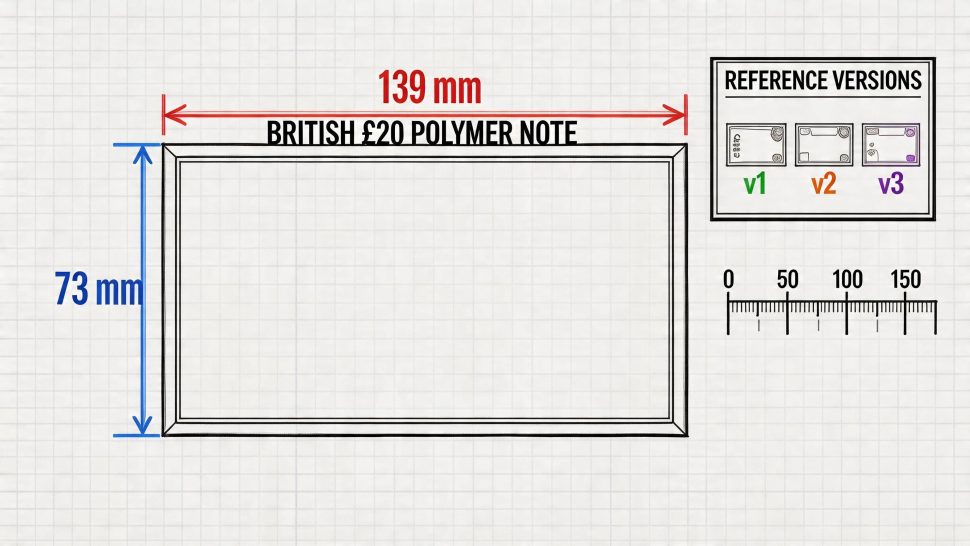
TL;DR: The current UK £20 polymer note measures 139 mm × 73 mm, which is about 5.47 × 2.87 inches, and it has used that size since its issue on 20 February 2020. Older paper £20 notes are larger, and if you're holding withdrawn versions, they can still be worth exchanging.
You usually notice 20 pound note dimensions when something practical forces the issue. A note won’t fit a wallet section properly, a bundle looks slightly off, or you’ve found older paper notes in a drawer and want to know whether they’re genuine, current, or still exchangeable.
In currency exchange, size isn’t trivia. It helps identify the note series, spot obvious problems quickly, and avoid sending the wrong item to the wrong place. That matters even more if you're sorting old sterling alongside leftover foreign currency, trying to convert foreign coins and banknotes, or dealing with mixed cash that a bank or bureau has already refused.
The Current Polymer £20 Note Dimensions in Detail
The current polymer £20 note measures 139 mm × 73 mm and was issued by the Bank of England on 20 February 2020, according to the International Bank Note Society reference on the current polymer £20. In inches, that works out to about 5.47 inches long and 2.87 inches high.

What that size tells you
That measurement isn’t random. The Bank of England moved to a more compact polymer format, and the same IBNS reference notes that the note is approximately 11% smaller in length and 9% in width than the previous Series F paper note.
For anyone handling cash regularly, that smaller footprint changes three practical things:
- Wallet fit: The note sits more neatly in modern card-and-cash wallets.
- Sorting: Mixed bundles are easier to spot when an older paper note is sitting among polymer notes.
- Verification: A note that looks noticeably oversized or undersized deserves a closer check.
Practical rule: If a £20 note’s size looks wrong before you even inspect the print and windows, stop there and compare it with a known genuine example.
Current design continuity
The current polymer design is the J.M.W. Turner note, and the later King Charles III update keeps the same dimensions, so size alone won’t distinguish those two modern variants. If you need the official current-note reference for exchange purposes, the current 20 pound Bank of England JMW Turner banknote is the right series to compare against.
What works in practice is simple. Start with size, then move to material and tactile detail. What doesn’t work is relying on colour alone, because wear, lighting, and circulation can all make genuine notes look slightly different.
Dimensions of Older and Withdrawn £20 Notes
If you’ve found an older £20 note, the dimensions often identify the era faster than the artwork does. That matters because many people still have withdrawn notes tucked into books, tins, travel wallets, or probate clear-outs.
Here’s the quick comparison.
| Series Name | Dimensions (mm) | Dimensions (inches) | Key Feature | Status |
|---|---|---|---|---|
| Current Polymer £20 (Turner) | 139 × 73 | 5.47 × 2.87 | Polymer note featuring J.M.W. Turner | Current format |
| Series F Paper £20 (Adam Smith) | 149 × 80 | 5.87 × 3.15 | Paper note featuring Adam Smith | Withdrawn |
| Series D Paper £20 | 160 × 90 | 6.30 × 3.54 | Earlier paper format with larger footprint | Older withdrawn series |
| Early “White” note | 211 × 133 | 8.31 × 5.24 | Large one-sided monochrome design | Historic withdrawn issue |

The withdrawn Adam Smith paper £20
The most common older note people still ask about is the Series F paper £20. It measured 149 mm × 80 mm and ceased to be legal tender on 30 September 2022, after circulating alongside the polymer version for over two years, as set out in the Bank of England £20 note history on Wikipedia.
That note is easy to recognise in handling because it feels larger and softer than polymer. If someone says, “I’ve got the purple Adam Smith one,” this is usually the note they mean.
Why size matters when a note is withdrawn
Withdrawn doesn’t mean worthless. It means the note has fallen out of day-to-day spending use.
That distinction trips people up. High street banks and exchange counters often focus on current, easily processed cash. Specialist currency buy back services exist because real-world holdings are messier than that. People bring in older sterling, mixed foreign notes, pre-euro coins, and bags of leftover holiday money all in one go.
A withdrawn note still has exchange value. The main issue is where you take it, not whether it exists.
What doesn’t work is assuming every old paper note can still be spent in a shop. What does work is identifying the series correctly first, then using the right route to exchange it.
How to Measure and Verify Your Banknotes Accurately
Someone sorting cash from a drawer, safe, or house clearance usually wants a quick answer. Is this £20 note the right size for its series, and is it likely to exchange cleanly? A careful measurement helps answer both.

A practical measuring method
Use a hard, flat surface and a ruler marked in millimetres. Tape measures and worn plastic school rulers often introduce small errors, which matters when you are trying to tell one series from another.
Check the note in this order:
- Flatten it gently so creases do not shorten the reading.
- Measure the length first from outer edge to outer edge.
- Measure the height second at the tallest point.
- Check for trimming or damage around the border before assuming the note was printed incorrectly.
- Compare it with another genuine note of the same series if one is available.
For home checking, close is usually enough. The useful question is whether the note matches the expected format, or whether it is far enough off to justify a second look.
What to verify beyond size
Dimensions are one screening step, not the whole test. A genuine £20 should also feel right in the hand and show the expected print and security details for its series.
On polymer notes, look for clear windows, sharp print, and areas of raised ink. On older paper notes, check the paper quality, print alignment, and whether the note has been heavily cut down at the edges. In exchange work, I treat a note with the right measurements but poor texture or blurred detail as one that still needs closer inspection.
A note can also measure slightly short because of wear, folding, or edge damage. That is a real trade-off in practice. Small handling damage does not automatically make a note suspicious, but inconsistent size plus weak security features is where problems usually appear.
Why Note Dimensions Matter for Exchanging Currency
A common exchange problem starts with a simple mismatch. Someone sends in a bundle of old £20 notes, assumes they will be treated like current cash, and then finds the notes need extra checking because the size, series, or condition does not fit standard counter processing.
In day-to-day exchange work, dimensions affect more than identification. They influence how quickly notes can be sorted, whether they fit expected machine settings, and whether a mixed batch can be verified without being pulled aside for manual review. That matters if you are sending old sterling together with travel money, coins, or other leftover notes.
Where standard channels fall short
Banks and high street exchange desks are usually set up for current, familiar notes in clean condition. Older paper £20 notes create more handling questions because they belong to withdrawn series, and mixed-size bundles slow the process further. A note can be genuine and still fall outside the workflow a standard counter is built for.
The same issue comes up with coin exchanges. Services that exchange foreign coins are handling formats that many mainstream channels do not want to process at all. The problem is practical, not only policy-based.
Why specialists pay attention to dimensions
Size helps separate several real exchange cases quickly:
- Current polymer notes from older withdrawn paper issues
- Ordinary wear from trimming, tearing, or shape changes that affect acceptance
- Single-series bundles from mixed holdings gathered over time
That is why dimensions have direct exchange value. They help decide what the note is, what checking route it needs, and whether it is likely to be accepted through a standard bank route or a specialist old Bank of England note exchange service.
For anyone holding leftover cash from travel, a house clearance, a charity collection, or old business takings, note dimensions are not trivia. They are part of working out whether the money is still spendable, whether it needs specialist processing, and how to turn it into cash without unnecessary delays.
A Simple Guide to Exchanging Your Old £20 Notes
If you’ve confirmed that a note is old, withdrawn, or not spendable over the counter, the exchange process should stay straightforward.
How the process works
- Get a quote first. Use an online calculator or exchange tool so you know the value before sending anything.
- Pack the currency securely. This applies whether you’re sending only old £20 notes or a mixture of leftover foreign currency, coins, and banknotes.
- Post it for verification. Specialist services verify what arrives and match it against the quoted exchange route.
- Receive payment. Payment is then made by the available method, typically bank transfer or PayPal.
What makes the process easier
The smoothest exchanges usually have one thing in common. The sender doesn’t try to force the money into a bank route that was never designed for it.
If you need to exchange leftover currency, especially old sterling mixed with coins or foreign notes, specialist processing is usually far more practical than starting at a branch counter. It’s also useful when you don’t want to sort every denomination by hand.
The best exchange process is the one that accepts the currency you actually have, not the currency a bank wishes you had.
Common Mistakes to Avoid When Exchanging Leftover Currency
A common scenario is a drawer full of mixed cash: an old paper £20 note, a few current notes, foreign coins from past trips, and no clear idea what can still be exchanged. Value is usually lost at the decision stage, not the payment stage.
The first mistake is treating every item as if it belongs in the same channel. A current polymer £20 can follow one route. A withdrawn Bank of England note, damaged note, or mixed bundle of leftover travel money may need a different one. If the route does not match the currency, delays start immediately.
Mistakes that cause problems
- Assuming any bank or exchange counter will accept the full lot: High street banks and travel money desks often deal with limited categories of cash. Mixed coins, withdrawn notes, and older foreign issues are where refusals usually happen.
- Mistaking "no longer spendable" for "worthless": A £20 note that a shop will not accept can still retain exchange value, depending on the issuer and condition.
- Over-sorting before you know the acceptance rules: Some people spend an hour separating every denomination, only to find the chosen service would have accepted a mixed submission anyway.
- Using a travel kiosk for specialist currency: Airport and holiday exchange counters are set up for current circulating money. They are rarely the right fit for obsolete or leftover holdings.
- Leaving condition checks too late: Notes stored damp, tightly folded, or loose in a bag are harder to verify and may need extra review.
One practical check saves a lot of wasted effort. Identify whether the note is current polymer, older paper, or withdrawn before deciding where to send it.
The other mistake is assuming all exchange services do the same job. Some only handle standard travel cash. Others are set up to process old sterling notes, foreign banknotes, coins, and mixed household collections together. That difference affects what gets accepted, how quickly it is verified, and whether you need to sort it in advance.
Packaging and Sending Your Currency Safely
A parcel that arrives with loose coins, bent notes, or torn packet edges is slower to process and harder to verify. Good packing protects the cash and helps the exchange team count it accurately on arrival.
Use packaging that matches the contents. A small, sturdy envelope can work for a few notes, but mixed currency or heavier coin bags should go in a padded mailer or compact box. Keep notes flat in one stack. Put coins in sealed bags or small inner packets so they stay contained and do not split the outer packaging in transit.
For £20 notes and other banknotes, avoid folding them down to fit an envelope that is too small. A sleeve or compartment slightly larger than the note itself is the safer choice, especially if you are sending several together. That reduces edge wear and makes inspection easier when the parcel is opened.
Clear internal separation also saves time. Group notes by currency or series where practical, and keep any old paper £20 notes apart from current polymer ones if you are sending both. For household clear-outs, charity collections, or business takings, a simple label on each inner packet helps the receiving team check the contents without unnecessary handling.
Tracked post is usually the sensible option for anything with exchange value. Keep your proof of posting and note what you sent before sealing the parcel. That extra minute of record-keeping is useful if the parcel needs to be traced or the contents need to be matched against your submission.
Real-World Scenarios What We Exchange
A charity fundraiser finishes an appeal and ends up with tins full of mixed overseas coins, a few old UK paper notes, and assorted banknotes from holidays. A normal bank route won’t handle that well. A specialist route will.
A family clearing a relative’s house finds a wallet containing Adam Smith paper £20 notes, pre-euro cash, and loose change from multiple countries. None of it is useful in a shop, but that doesn’t mean it’s worthless.
A business traveller keeps returning with leftover foreign currency from airports, taxis, meals, and expense trips. The pile grows because standard bureaux usually focus on current notes only, not coins or older issues.
These are ordinary scenarios. They’re also exactly why specialist services exist for people who need to exchange foreign coins and notes, convert foreign coins and banknotes, or turn mixed cash into a charity donation instead of leaving it unused.
Frequently Asked Questions About Currency Exchange
A common call to our team starts the same way. Someone has found a few old £20 notes, some euros in a drawer, and a pot of mixed coins, and they want to know what can still be turned into cash. The answers depend on the type of currency, its condition, and whether the exchange service handles current money only or older and mixed holdings as well.
Can you exchange foreign coins in the UK?
Yes, though specialist buyers are usually the practical option. High street banks and travel money counters tend to focus on current banknotes, while foreign coins are harder to process and resell.
Do banks accept foreign coins?
Often no, especially over the counter. Coins from overseas, withdrawn notes, and mixed currency lots usually fall outside standard retail exchange services.
Can I exchange foreign coins and notes in one parcel?
Usually yes. That is often the most efficient route for holiday leftovers, charity collections, or house-clearance finds because it avoids splitting the contents into separate exchanges before you even know what is worth sending.
Do old or withdrawn £20 notes still have value?
They often do. A withdrawn note may no longer work in shops, but it can still carry exchange value if the service accepts older sterling issues. With £20 notes, dimensions help identify the series quickly, which matters if you are sorting polymer notes from older paper ones before sending them.
Why won’t a normal exchange bureau take older currency?
Their systems are built around current travel money. Older notes need manual checking for series, size, condition, and authenticity, and many mainstream counters do not have the process for that.
Can I convert unsorted foreign coins and banknotes?
Yes, with some specialist services. That is useful for jars, tills, envelopes, and collection tins where the contents are mixed by country and denomination.
Can I donate foreign coins to charity instead of taking the cash?
Yes. Some exchange services let you send mixed coins and notes and direct the proceeds to a charity instead of receiving payment yourself.
How long does payment usually take?
It varies by provider. Postal exchange services normally inspect the parcel after arrival, verify the contents, and then pay by bank transfer or PayPal according to their stated turnaround times.
What should I do before I send old notes or foreign cash?
Check what you have first. For old £20 notes, confirm the note series and dimensions so you know whether you are holding a current polymer note or an older paper issue. Then pack notes flat, keep coins secure, and review the quote, fees, and payment method before posting anything.
A specialist service can make sense if you are holding mixed travel money, withdrawn sterling, or small batches that a bank will not handle. The main job is identifying what still has exchange value and using a route that accepts it.