
5 Euro Note: Your Guide to Value, Security & Exchange 2026
Posted by: Ian Stainton • 21 May 2026
A 5 euro note is the smallest euro banknote at 120 × 62 mm, and in the UK the most practical way to turn it into money is usually a specialist exchange service that accepts low-value foreign notes. Because a €5 note is only worth a small amount in pounds, traditional exchange routes often aren't the most efficient option.
Individuals don't typically find a 5 euro note when they're planning a trip. They find it later, in a drawer, an old wallet, a handbag pocket, or mixed in with leftover holiday money from years ago. On its own it feels too small to deal with, but it still has value, and it often comes with other foreign coins and banknotes that are just sitting there unused.
That's where the primary question starts. Not “what is a 5 euro note?” but “what should I do with it in the UK?” If you want to exchange leftover currency, including small euro notes, mixed coins, or older foreign cash, the answer usually comes down to using a service built for exactly that kind of low-value, awkward bundle.
What to Do with a 5 Euro Note in the UK
You get back from a trip, empty a coat pocket months later, and find a 5 euro note folded behind an old receipt. On its own, it does not feel worth a special journey to a bank or high street exchange counter. In practice, that is exactly why small foreign notes tend to sit unused for years.
In the UK, a €5 note cannot be spent as normal cash, but it still has exchange value. The practical question is how to turn that value into pounds without wasting more time and effort than the note is worth. The euro entered cash circulation on 1 January 2002, and notes like the €5 remain a standard part of leftover travel money, as noted in the history of the euro.
The practical answer
A 5 euro note creates a familiar problem for UK households:
- It still has value
- It is usually not enough to justify a separate trip
- Traditional exchange options often work poorly for small amounts
That is why many people leave it in a drawer with other unused travel cash.
Practical rule: Do not assess a €5 note on its own if you also have coins, old holiday cash, or notes in other currencies. Gather the full bundle first and deal with it in one go.
What usually works
The easiest approach is usually to sort everything before choosing how to exchange it:
- Check what else you have. Euros, other foreign notes, coins, and older travel money often add up more than expected.
- Keep the 5 euro note flat and dry so it stays easy to inspect and process.
- Use a specialist route if you want to exchange small or awkward amounts without depending on a branch or bureau that may decline low-value items.
The key challenge is not whether the note exists or is real. It is whether the exchange method makes financial sense for such a small amount. Specialist services are useful here because they are set up for leftover currency, while traditional options often focus on larger, cleaner transactions.
Anatomy of the 5 Euro Note
The 5 euro note is the lowest denomination euro banknote and the smallest by physical size. It measures 120 × 62 mm, and the first series uses a Classical architecture motif. The newer Europa series keeps the same architectural theme while adding stronger security features, and both versions remain legal tender across the euro area, as described in this 5 euro note reference.

What to look for at a glance
If you're identifying a 5 euro note quickly, these are the easiest markers:
- Colour: grey remains the key denomination colour.
- Theme: classical-style architectural imagery.
- Size: it's the smallest euro note in circulation.
- Series: you may have either the first series or the Europa series.
That consistency helps when people are sorting mixed euro cash. Even if notes come from different print runs or years, the denomination stays easy to recognise.
Why this matters in practice
For exchange purposes, identification matters more than collectors often assume. A person posting leftover cash doesn't need to become a banknote expert, but they do need to know whether they're holding:
- a current euro denomination
- a damaged note that may still be accepted for processing
- a mix of notes and coins that should be sent together
The 5 euro note is also engineered for handling. The euro cash management specifications list it at 120 × 62 mm, 0.12 mm thick and about 0.6 g, which is useful for machine sorting and consistent processing, as shown by the Oesterreichische Nationalbank euro banknote specifications.
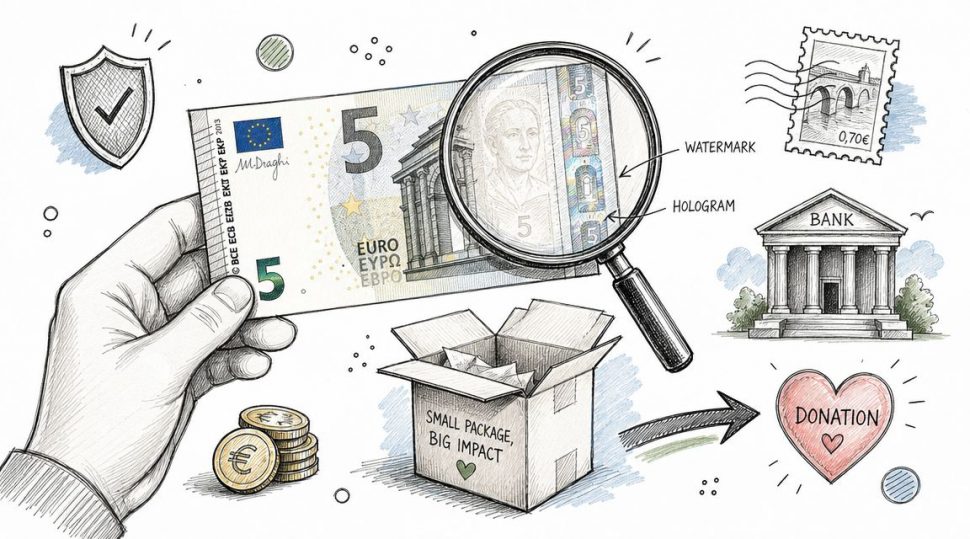
How to Check Your 5 Euro Note Is Genuine
A low-value note still needs proper security features. That matters because a small denomination is exactly the kind of thing people tend to glance at rather than inspect.
A practical check is to use a simple feel, look, tilt routine. You're not trying to prove banknote authenticity like a forensic lab. You're trying to spot obvious warning signs before you send the note for exchange.

Feel it
Start with touch. The Europa series €5 includes tactile raised lines on the front edges, a feature highlighted by the ECB and Bundesbank for visually impaired users and as an immediate authenticity cue in the Bundesbank guide to €5 Europa security features.
What you're checking for:
- Raised edge lines that you can feel with your fingertips
- Paper texture that feels like banknote paper, not ordinary print stock
- Crisp print areas rather than flat, blurry ink
If the note feels oddly smooth, waxy, or flimsy, it deserves a closer look.
Look at it
Hold the note up to the light. A proper banknote should reveal layered features rather than a single printed trick.
Check for:
- A watermark
- Value details visible when held to light
- Clear printed detail rather than muddy lines
If one feature seems present but the rest don't line up, don't rely on that single feature alone.
That's a common mistake. Genuine notes are designed as systems, not one-off effects.
Tilt it
Tilting helps you spot features that change with movement and light. On a genuine note, those effects should look intentional and integrated into the design.
Use movement to check:
- Holographic elements
- Reflective or changing effects
- Clean transitions, not crude foil stuck on top
If you want to compare denomination styling with another euro banknote, this guide to the 20 euro note is useful for seeing how euro security design stays consistent while denomination details change.
Why Exchanging Low-Value Notes Is Difficult
The awkward truth is that a 5 euro note isn't hard to identify. It's hard to exchange efficiently.
The core issue for UK consumers is the economics. Because a €5 note is only worth a few pounds, fees, minimum handling limits, or low-interest service models can wipe out most of the value, which is why mainstream routes often don't work well for this kind of currency exchange problem, as outlined on the ECB euro banknotes pages.
Why banks and bureaux often fall short
Banks and high street exchange counters are built around convenience for mainstream transactions. They tend to work better when someone is buying travel money or changing larger note values. They are not usually designed around one small note, a handful of coins, or a mixed bag of old foreign currency.
In practice, the friction comes from several places:
- Handling cost. Small-value items still need staff time, verification, storage and accounting.
- Minimums. A low-value note may fall below what a bureau wants to process.
- Limited acceptance. Coins, withdrawn notes and mixed currencies are often where standard channels stop helping.
- Branch inconsistency. One counter may say yes to current notes, another may refuse small amounts entirely.
Comparing your currency exchange options
| Currency Type | High Street Bank | Exchange Bureau | Specialist Service |
|---|---|---|---|
| Current foreign banknotes | Sometimes | Usually | Yes |
| Low-value notes like a 5 euro note | Often impractical | Often impractical | Yes |
| Foreign coins | Rarely | Usually no | Yes |
| Mixed coins and notes | Limited | Limited | Yes |
| Withdrawn or obsolete currency | Usually no | Usually no | Yes |
| Unsorted leftover currency | Usually no | Usually no | Yes |
The gap is even clearer when you want to exchange foreign coins. That's where traditional routes usually stop being useful altogether.
Small foreign balances don't fail because they lack value. They fail because ordinary exchange channels aren't set up to process them efficiently.
How to Exchange Your Leftover Currency Hassle-Free
The easiest exchange process is usually the one that doesn't ask you to separate every denomination, count every coin, or visit multiple branches just to be told the amount is too small.
For people holding a 5 euro note alongside other travel leftovers, the practical route is straightforward.

Step 1
Use an online quote tool and identify what you're sending. If you've got a single euro note, that's easy. If you've got mixed leftovers, a specialist service can usually handle foreign coins and banknotes together rather than forcing you to split everything out first.
One option is how to exchange foreign currency, which explains the postal process for sending notes, coins and older currency for verification and payment.
Step 2
Pack the currency securely. Keep notes flat where possible, and don't overcomplicate the package.
Useful habits include:
- Group similar items together if that helps you stay organised
- Leave damaged but recognisable notes in the parcel rather than discarding them
- Include mixed currencies if the service accepts them
Specialists differ from ordinary exchange counters. They're built for awkward bundles, not just clean stacks of current notes.
Step 3
Post the currency using a secure method, then wait for verification and payment. According to the publisher information provided, payment is issued within five working days after verification by bank transfer or PayPal.
That's also the point where specialist processing can make a clear difference. We Buy All Currency accepts current, withdrawn and obsolete foreign money, including coins and unsorted bundles, and it's used by individuals, charities and businesses that need a postal route for leftover currency rather than a retail travel-money counter.
What works better than the usual alternatives
What usually works:
- Sending one combined batch instead of trying to separate every country
- Including small notes rather than waiting until years later
- Using a service that accepts coins, notes and withdrawn currency
What usually doesn't:
- Holding out for a bank branch to take coins
- Making a special journey for a note worth only a few pounds
- Ignoring old travel money because the amount feels too small
Donating Your 5 Euro Note and Other Currency
Sometimes a 5 euro note isn't worth the effort to claim for yourself, but it still feels wasteful to leave it unused. That's where donation becomes a practical option.

Three common situations
A holidaymaker comes home with one €5 note, a few coins, and some other small change from another trip. On their own, none of the items feels worth much. Sent together, or donated together, they become useful again.
A charity fundraiser ends up with foreign coins and notes in a collection tin. Volunteers can't spend them locally, and most ordinary banking routes won't want the mix. A specialist foreign currency route lets the charity convert or receive proceeds without treating the money as unusable.
A small business receives foreign cash in error from customers, especially in tourist areas. That pile often includes low euro denominations. Instead of storing it indefinitely, the business can convert it or direct proceeds to a cause it supports.
When donation makes sense
Donation is often the cleaner choice when:
- The amount is small
- You've got a mix of coins and banknotes
- You'd rather support a cause than chase a tiny personal return
That's also why some people specifically look for ways to donate foreign coins to charity rather than trying to spend or exchange each item individually.
A small note can feel insignificant in a drawer. Combined with other leftovers, or turned into a charity donation, it becomes useful again.
Frequently Asked Questions About Currency Exchange
Can you exchange a 5 euro note in the UK?
Yes. A 5 euro note can be exchanged in the UK, but the practical option is usually a specialist service rather than a bank branch or shop. Euros are common leftovers from travel, yet they are not legal tender in Great Britain, so the question is less about whether the note has value and more about which route will accept it without fuss.
Do banks accept foreign coins and notes?
Some banks will accept selected foreign banknotes for existing customers, especially current notes in major currencies. Coins, mixed bags of holiday change, and older or withdrawn notes are where the usual banking route often falls short. This is why people who want to turn foreign coins and notes back into pounds often end up using a specialist service instead.
Is my old 5 euro note still valid?
Yes, provided it is a genuine €5 note from either the first series or the Europa series. Both remain legal tender across the euro area. Condition still matters. A heavily damaged note may be harder to process, and acceptance can vary depending on who handles the exchange.
Can I exchange foreign coins in the UK?
Yes, although standard high street options are often limited. In practice, coins are the part that causes the most frustration because many banks and bureaux focus on notes only. A specialist service is often the simpler route when you want to send coins and notes together instead of splitting everything up.
Do I need to sort my leftover currency first?
Not always. Some specialist services will take mixed currency as it is, which saves time when a 5 euro note is sitting alongside coins, old notes, and cash from other trips. That matters because the sorting job is often more effort than the amount justifies.
What if I have currency from several countries?
That is very common. Drawers and travel wallets rarely contain one neat stack of euros. They usually hold a mix from different holidays, business trips, charity collections, or cash left by relatives. A specialist route is often the most practical way to deal with the lot in one go.
How long does payment take?
According to the publisher information provided for this article, once the currency has been verified, payment is issued within five working days by bank transfer or PayPal.
What if I'm not happy with the quote?
The publisher information states that if a customer is not happy with the quote, the currency is returned free of charge under a happiness guarantee. That gives you a clear decision point before you give up the money permanently, which is useful with mixed or unusual foreign cash.
Can I donate the proceeds instead of being paid?
Yes. That option makes sense when the amount is small and you would rather not spend time chasing a modest return. It can also be a practical answer for charity tins, community groups, or anyone clearing out old travel money and wanting it to do some good.
Is a 5 euro note worth keeping?
It can be, if you travel to the euro area regularly and will use it soon. Otherwise, a single €5 note often sits untouched for years, usually with other leftover coins and notes beside it. In the UK, the better result is usually to exchange it as part of a larger batch or donate the value rather than let it gather dust.
If you have a 5 euro note tucked away in a drawer, it is often part of a bigger pile of unusable travel money. We Buy All Currency offers a practical postal route for handling foreign coins, notes, and older currency, or for turning the value into a charity donation instead.