
5 Pound Banknote: History, Value, & Exchange 2026
Posted by: Ian Stainton • 10 Apr 2026
You find an old £5 note in a drawer, a coat pocket, or a travel wallet and pause for a second. Can you still spend it, bank it, or is it now just a souvenir?
That moment is more common than many might assume. Travellers bring sterling home and forget about it. Retailers receive older notes in error. Charities, attractions, airports, and airlines often end up with mixed donations that include old British notes alongside leftover foreign currency.
The good news is simple. An old 5 pound banknote is not automatically worthless just because a shop will not accept it. The tricky part is knowing what you have, what it is likely worth, and when a collector route is not worth the effort.
What To Do With Your Old £5 Notes
The first thing to know is this. Do not assume an old £5 note has no value just because it is no longer legal tender. Many people confuse “not spendable in shops” with “worthless”. They are not the same thing.

For many non-collectors, the practical question is not whether the note is historically interesting. It is whether it can still be turned into usable money without hassle. The answer is often yes, if you use the right exchange route.
Start with three quick checks
Before you do anything else, look at:
- The material. If it feels like traditional paper rather than smooth polymer, it may be a withdrawn paper issue.
- The person shown on the note. Older £5 notes commonly feature figures such as Elizabeth Fry or George Stephenson.
- The condition. A folded or worn note may still exchange well, but condition matters if you are wondering about collector appeal.
If you also have coins, foreign notes, or mixed travel money, keep it together for now. Many people think they must sort everything by country and denomination before sending it off. Specialist exchange services are designed to handle mixed, unsorted money, including people who want to exchange foreign coins, deal with leftover foreign currency, or convert foreign coins and banknotes in one go.
Tip: If your old £5 notes came from a charity tin, till tray, airport collection point, or travel wallet, treat them as exchange items first and collector items second.
Why a collector approach is often not the best route
Collector markets can be useful for rare notes. They can also be slow, confusing, and full of inflated expectations.
If your goal is to unlock value from common old notes, the straightforward route is usually better:
- Identify the note
- Check whether it is withdrawn
- Use a transparent exchange service
- Get paid or donate the proceeds
That matters most for organisations handling volume. Charities and businesses often receive a mix of obsolete sterling and foreign money. A practical exchange route helps them exchange foreign coins and notes without turning the process into a sorting project.
Some people also choose to donate foreign coins to charity rather than cashing everything out personally. That can be useful for leftover holiday money and donation collections.
A Journey Through Time The History of the £5 Note
A £5 note found in a charity tin or an old travel wallet can look unfamiliar and still be perfectly real. The reason is simple. The £5 has had a long working life, and its design has changed again and again over the centuries.

Where the story begins
According to a published history of the £5 note, the Bank of England introduced banknotes in 1694 as receipts linked to gold, and the first £5 note followed in 1793 during the war with France. That first note was the White Fiver. It was far larger than a modern note and very plain in appearance, which can surprise anyone used to today’s detailed designs.
That early format helps explain an important point for non-collectors. Old money does not all look remotely alike. A withdrawn £5 note may differ in size, colour, artwork, and paper quality, yet still sit on the same historical timeline.
Why older £5 notes can look unrelated
The easiest way to understand the history is to picture a tool that gets redesigned for each generation. The job stays the same. The build changes to suit new needs.
For the £5 note, those needs included:
- Making notes easier to recognise
- Making forgery harder
- Reflecting the public figures and symbols of the period
One major turning point came in 1963, when Series C introduced the first £5 note with Queen Elizabeth II’s portrait. For many people, that is the point where the note starts to look more like the banknotes they remember from everyday life.
A note shaped by practical change
Each version of the £5 tells you something about the period that produced it. The White Fiver reflected wartime financial pressure. Later notes became more standardised, more visual, and more secure. Over time, the note shifted from a simple promise on paper to a familiar piece of modern currency design.
This long timeline explains why notes held by charities, families clearing a house, or travellers sorting old cash often vary so much. One bundle may contain notes from very different eras, and only a small minority have collector value that justifies the slower, more uncertain specialist market.
For ordinary holders, the practical lesson is straightforward. A note can be genuine, clearly British, and no longer usable in shops. In many cases, the sensible route is not to research auction prices for every design. It is to identify the note, separate rare examples from common withdrawn ones, and exchange the everyday pieces through a simple service.
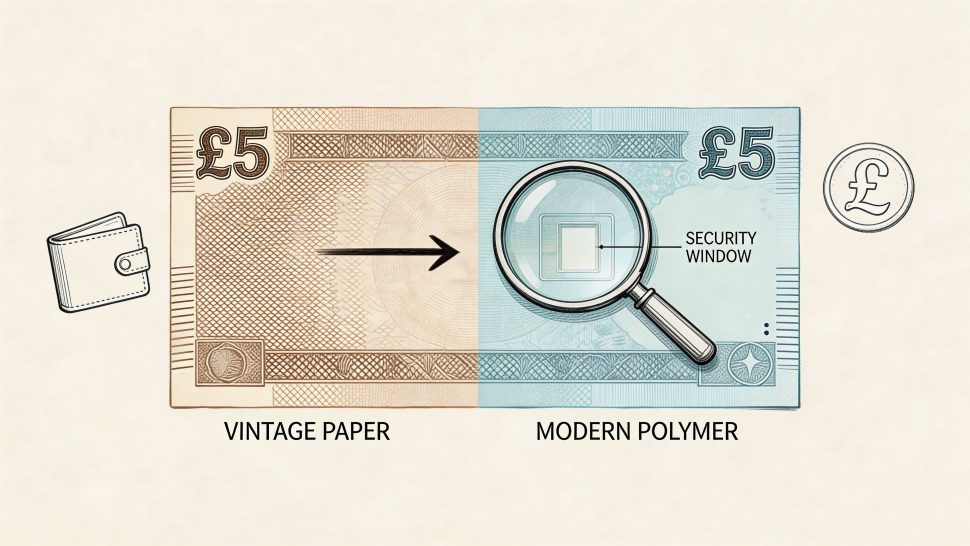
From Paper to Polymer Meet the Modern £5 Banknote
You open a kitchen drawer before a trip, or sort a charity cash tin after an event, and there it is. A £5 note that looks familiar, but not quite current. The practical question is simple. Can you still use it, or does it need to be exchanged?
The answer depends on which version you have. According to the Bank of England’s £5 banknote page, the paper £5 featuring Elizabeth Fry lost legal tender status on 5 May 2017, the polymer £5 featuring Sir Winston Churchill was first issued on 13 September 2016, and a new series featuring King Charles III was introduced on 5 June 2024.

The version that causes the most confusion
For ordinary holders, the note that causes the most uncertainty is the Elizabeth Fry paper £5. People still find it in wallets, donation boxes, desk drawers, and travel money envelopes because it remained common for years. Yet it no longer works like everyday cash in shops.
That change can feel odd at first. A genuine Bank of England note still has value, but once it is withdrawn from circulation, it stops behaving like spendable money at the till. It becomes more like a ticket that is still valid for exchange, even though it no longer gets you straight through the door.
Why polymer changed the £5 note
The move from paper to polymer was not only a design update. It changed the note’s material, durability, and the way security features could be built into it.
A paper note wears out more like a paperback book. It creases, softens, and damages more easily with daily handling. A polymer note behaves more like a laminated card. It is smoother, tougher, and better suited to modern anti-counterfeit features.
That is why the Churchill £5 feels so different in the hand from the older Fry note. The portrait changed, but so did the whole construction of the note.
| Version | Material | Main figure | Everyday status |
|---|---|---|---|
| Elizabeth Fry £5 | Paper | Elizabeth Fry | Withdrawn |
| Churchill £5 | Polymer | Winston Churchill | Current polymer issue people commonly recognise |
| King Charles III series | Polymer | Updated monarch portrait | Newer issue |
What this means for non-collectors
For travellers, families, and charities, the key point is not the fine detail of banknote design. It is knowing which route fits the note in your hand.
If you hold a polymer £5, you are usually dealing with a modern note designed for current circulation. If you hold a paper Elizabeth Fry £5, you are dealing with old currency that needs to be exchanged through the right channel.
That distinction matters because the collector market and the exchange process are two different worlds. A small number of notes attract specialist interest, but common withdrawn £5 notes are usually handled more sensibly through a straightforward exchange service. For someone clearing out old cash, that is often faster, clearer, and less effort than trying to judge auction value for an everyday note.
Practical rule: If your £5 note is paper and shows Elizabeth Fry, treat it as withdrawn currency to exchange, not as current cash to spend.
Spotting a Genuine Note Key Security Features
If you hold a polymer 5 pound banknote, the simplest way to check it is to treat the security features like a built-in identity check. You are not looking for one magic detail. You are looking for a small group of details that work together.
What to examine first
Start with the see-through window. The current Bank of England polymer £5 includes a window with a portrait of the monarch and text around it. A fake often fails here because the window looks cloudy, flat, or poorly finished.
Then look at the serial numbers. Genuine notes have a clear layout, with one serial number running horizontally and another vertically. You just need to check that the printing looks sharp and deliberate rather than smudged or careless.
Features that are easy to miss
The polymer £5 also includes a 3D crown and a UV-reactive “5” that appears under ultraviolet light. These are not decorative extras. They are part of the note’s anti-counterfeit design.
If you are checking a note at home, use simple common sense:
- Feel the surface. Genuine polymer notes should feel crisp, not papery.
- Tilt the note. Some features become clearer when the light changes angle.
- Check print quality. Text and images should look clean, not fuzzy.
- Use a UV light if available. This is useful, but not essential for a first pass.
Why raised print matters
Many people focus on the window and forget touch. That is a mistake. Raised print gives a genuine note a distinct feel, and counterfeit notes often miss that tactile quality.
The easiest test is slow, not fast. Run your finger lightly over the printed areas rather than scrunching the note in your hand.
Expert tip: If a note fails on feel, print quality, and the window, do not try to talk yourself into it being genuine. Multiple weak signs matter more than one reassuring detail.
For older paper notes, authentication is less straightforward because the features differ by series. If you are holding mixed old currency, a professional exchange check is often the least stressful option.
Is Your Old £5 Note a Treasure or Just Pocket Money
You find an old £5 note in a travel wallet, a charity cash tin, or the back of a drawer. The first question is simple. Should you treat it like a collectible, or just convert it and move on?
Often, the practical answer wins.
An article in The Week on rare £5 notes and their value reports that more than 90% of enquiries relate to ordinary circulated notes, not standout rarities. The same article says only a small share of circulated paper £5 notes rise far above face value, and many sell for little more than the amount printed on them.
That matters because the collector market works like a specialist auction room. A few notes draw real interest. Common withdrawn notes usually do not. If you are a traveller clearing leftover sterling, or a charity sorting mixed donations, that difference saves time and frustration.
What can lift a note above face value
A note has a better chance of attracting collector interest if it has one or more of these features:
- An unusual serial number
- A genuine printing error
- Very strong condition
- A scarcer issue or variant
Without those features, an old £5 note is usually best treated as exchangeable currency rather than a collector item.
A quick reality check
Use the same logic you would use with a second-hand book. A standard reading copy has value, but a signed first edition in pristine condition belongs in a different category.
Ask yourself:
- Does the serial number stand out immediately?
- Is there a real printing mistake, rather than folds, stains, or wear?
- Is the note crisp enough to interest a collector?
- Do you want to photograph it, list it, answer questions, and wait for a sale?
If the answer is no to most of those, the note is probably pocket-money value in practical terms. That is not bad news. It means you can skip the collector route and choose a straightforward exchange instead.
If you want a clearer sense of what different withdrawn notes may be worth, this guide to old £5 note values is a useful starting point.
£5 Banknote Value Guide Examples
| Banknote Description | Typical Condition | Estimated Value Range |
|---|---|---|
| Common withdrawn paper £5 | Circulated | Around face value to a small premium |
| Common paper £5 in stronger condition | Light wear | A modest premium in some cases |
| Rare serial or error note | Varies | Can exceed ordinary exchange value |
| Typical mixed old £5 from drawers or tills | Circulated | Usually better suited to practical exchange than collector sale |
The main point is expectation. A rare note needs rarity, condition, and buyer demand to command more. A common old £5 note still has value, but its value is usually best recovered through a simple exchange process rather than a collector listing.
The Fast and Easy Way to Exchange Your £5 Notes
When people hold one old £5 note, the process feels manageable. When they hold a pile of mixed sterling, foreign coins, travel cash, and donation money, it quickly becomes messy.
That is why specialist exchange services matter. This is especially true for charities and businesses. Many fundraising currency donations include obsolete UK notes, highlighting the need for practical exchange services for mixed currency holders.
Why mixed currency needs a practical route
A collector approach breaks down fast when you are handling volume. Charities, airports, airlines, retailers, and attractions often receive unsorted money from many sources.
The practical route works better because it lets people:
- Send mixed holdings together
- Avoid sorting every note and coin by hand
- Choose cash payment or charitable donation
- Use a service built for obsolete and foreign currency
That is useful not just for old £5 notes, but also for people who want to exchange foreign coins, clear out leftover foreign currency, or convert foreign coins and banknotes from multiple trips.
What a straightforward process looks like
A good exchange process is simple:
Get a quote or estimate
You should be able to see the rate before sending your currency.Pack and post the money
This is far easier than trying to sell small-value notes individually.Verification and payment
The publisher information for this article notes payment is issued within five working days after verification, with options such as PayPal or bank transfer.
For the specific route covering old Bank of England notes, use this page: https://www.webuyallcurrency.com/bank-of-england-old-notes-exchange/
When donation is the better choice
Not everyone wants the proceeds personally. Many people and organisations prefer to donate foreign coins to charity instead.
That works well for:
- Airline collections
- Airport donation points
- Retail charity campaigns
- Leftover holiday change
- Fundraising tins with mixed UK and foreign currency
A service with a weight-based system is especially helpful when notes and coins arrive unsorted. It removes the slowest part of the job and gives ordinary holders a realistic way to turn idle money into something useful.
Conclusion Your Old Currency Has Value Dont Let It Go to Waste
An old 5 pound banknote can be confusing at first glance. It may no longer work at the till, but that does not mean it has stopped having value.
The key is to separate history from practicality. The £5 note has a long story behind it, from the large White Fiver to modern polymer designs. For many, though, the important point is much simpler. Common old £5 notes are usually best treated as money to exchange, not treasures to speculate on.
That same logic applies beyond sterling. Drawers, travel wallets, charity tins, and office cash boxes often contain more than one kind of leftover money. Old British notes, foreign coins, obsolete banknotes, and holiday change can all sit unused for years when they could be converted or donated.
If you want the easiest route, choose a service built for mixed and obsolete currency, one that is clear about rates, quick with payment, and simple to use even when your money is unsorted.
If you are ready to turn old £5 notes, leftover foreign currency, or mixed coins and banknotes into usable money, visit We Buy All Currency. It offers a fast, easy, hassle-free, 100% guaranteed way to exchange foreign coins and notes, with transparent rates, no hidden charges, no need to sort coins, and the option to donate foreign coins to charity.