
Explore 5 shillings 1953: Value, History, and Grading Guide
Posted by: Ian Stainton • 8 Feb 2026
The 5 shillings 1953 coin, often called the Coronation Crown, is a special commemorative piece issued to celebrate the coronation of Queen Elizabeth II. It's an interesting one because its value comes more from its history than its metal content. This coin was minted as a national keepsake rather than for day-to-day circulation, making it a tangible link to a major moment in British history.
What's the Story Behind the 1953 Coronation Crown?
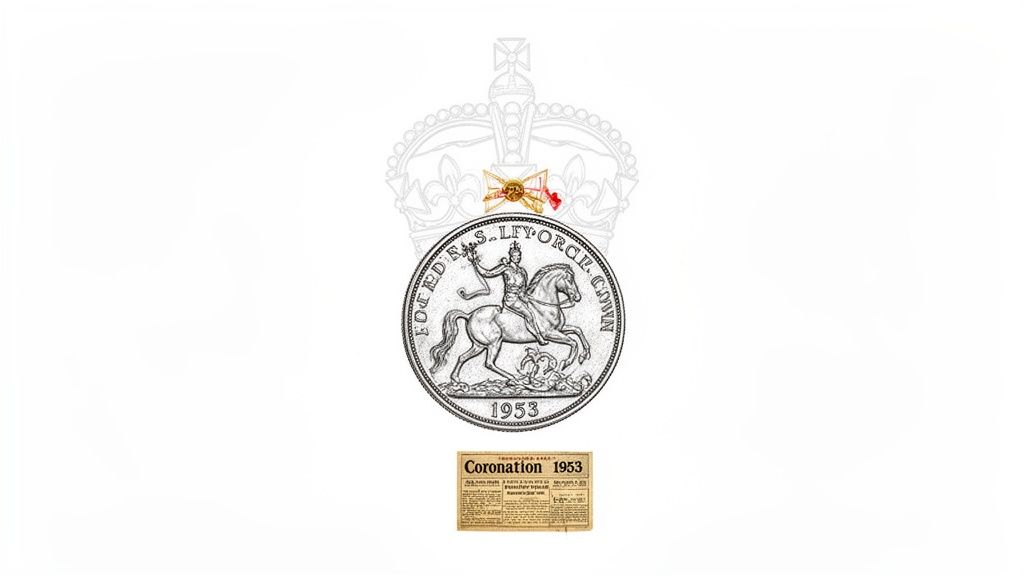
Cast your mind back to 1953. The UK was shaking off the gloom of the post-war years, and a wave of optimism was sweeping the nation. At the heart of it all was the crowning of a new, young monarch, Queen Elizabeth II. The Coronation Crown was created to capture this momentous spirit.
Unlike the coins rattling around in people's pockets, this 5 shillings piece was designed purely as a memento. It was a piece of history that families could buy and keep—a souvenir from a day that brought the whole country together. Its release was perfectly timed to coincide with the coronation festivities on June 2nd.
This special commemorative crown was the very first of Queen Elizabeth II's reign, and it's captivated collectors ever since. It's made of cupro-nickel, weighs 28.28 grams, and has a diameter of 38.61 mm. The obverse features a striking equestrian portrait of the young Queen on horseback, a unique design choice.
The reverse is just as impressive, displaying four shields with the arms of England, Scotland, and Ireland. These are separated by the national emblems—a rose, a thistle, a shamrock, and a leek—all surrounding a central crown.
Why This Coin Still Matters Today
Decades later, the 1953 5 shillings coin remains a popular find, whether you're a seasoned collector or just stumbled upon one in a forgotten tin. It’s more than just old currency; it's a direct line to a bygone era. For many, it brings back memories passed down through generations.
But holding onto this piece of history doesn't mean its monetary value is lost. If you have a 1953 Coronation Crown, perhaps as part of a bigger collection of old British coins, turning it into cash is surprisingly simple.
Our service is designed to be fast, easy, and completely hassle-free. We offer a 100% guaranteed way to exchange foreign coins and notes, with no need for you to sort through them beforehand. We're trusted by major brands, including charities, supermarkets, airports, and police forces, to handle their currency exchange needs efficiently.
Whether you want to exchange foreign coins you've collected or convert foreign coins and banknotes into spending money, our process is straightforward. We even offer the option to donate foreign coins to charity, turning your old money into a valuable contribution for a good cause.
To see how this coin fits into the bigger picture, check out our guide to British Crown coin values. It’s a perfect example of how historical keepsakes can find new life and value today.
Getting to Know Your 5 Shillings Coin Design
Every mark and image on the 1953 5 shillings coin tells a story. It’s more than just a piece of metal; it’s a tiny historical document celebrating a monumental event. To really understand what you have, you need to look closely at the symbolism packed into its design, with each element chosen to honour the coronation and bring the nation together.
The first thing you’ll probably notice is its hefty size and weight. Unlike the silver coins from years gone by, this one is made of cupro-nickel—a tough, practical blend of copper and nickel. This wasn't an artistic choice but a reflection of post-war Britain's economic reality, where precious metals were needed elsewhere. Even so, the craftsmanship is undeniable.
The Queen on Horseback: The Obverse
Flip the coin to the 'heads' side, or the obverse, and you’ll see something special. It features a stunning equestrian portrait of Queen Elizabeth II riding her horse, Winston. This design, by sculptor Gilbert Ledward, shows the Queen in her uniform as Colonel-in-Chief of the Grenadier Guards, sitting elegantly side-saddle.
This wasn't the typical head-and-shoulders portrait you see on most coins. The choice was deliberate, meant to project strength, tradition, and a sense of continuity, connecting the new Queen to a long history of British monarchs shown on horseback. It's a regal, powerful image that perfectly captured the optimism of the new Elizabethan age.
A Story in Symbols: The Reverse
Turn the coin over to the reverse, and you'll find a tapestry of national symbols designed by Edgar Fuller and Cecil Thomas. This side is a masterclass in heraldry, designed to represent the unity of the United Kingdom.
You can't miss the four shields at the centre, each displaying a coat of arms:
- The Three Lions of England appear twice.
- The Lion Rampant of Scotland sits in the top-right.
- The Harp of Ireland is in the bottom-left.
These shields are beautifully separated by floral emblems of the UK's nations: the English rose, Scottish thistle, Welsh leek, and Irish shamrock. It's a powerful visual statement of a unified kingdom welcoming a new monarch, with St Edward's Crown right in the middle.
Here's a detail many people miss: the inscription around the coin's edge. It reads, 'FAITH AND TRUTH I WILL BEAR UNTO YOU'. This is a direct quote from the Coronation Oath, the solemn promise the Queen made to her people. Its inclusion elevates the coin from a simple souvenir to a tangible symbol of that vow.
What To Do With Your Coins
Understanding the history behind your 1953 5 shillings coin is one thing, but what if you want to turn it, or any other leftover foreign currency, into cash? That's where we come in.
We provide a fast, trusted, and hassle-free service to exchange your leftover foreign coins and banknotes. You don't need to sort through them or figure out what's what. Just send us your collection of old and foreign money, and we’ll take care of it. Our process is 100% guaranteed, and we're trusted by major brands like charities, supermarkets, airports, and police forces across the UK.
Ready to get started? Visit our homepage today to learn more about how easy it is to convert foreign coins and banknotes into cash.
How to Determine Your 1953 5 Shillings Coin Value
Understanding the history behind your 5 shillings 1953 coin is one thing, but let's be honest—the big question on most people's minds is, "What's it actually worth?" The answer almost always boils down to one critical factor: its condition. A coin that looks like it just left the Royal Mint will naturally be worth far more than one that’s been knocking about in a drawer for decades.
Figuring out a coin's condition, or 'grade', might sound like something only an expert can do, but you don't need to be a seasoned numismatist to get a good idea. By looking for a few simple visual clues, you can easily estimate where your coin lands on the scale. Forget the confusing jargon; we’ll break down the most common grades in plain English.
A Simple Guide to Coin Grading
To get a proper look at your coin, hold it under a good, bright light. If you have a magnifying glass, now’s the time to use it. You’ll want to pay close attention to the high points of the design—think of the Queen's hair, the intricate mane on the horse, and the delicate details on the shields. These are the first places to show signs of wear and tear.
Here are the main conditions you're likely to come across:
- Uncirculated (UNC): This is a coin in pristine, mint condition. It has absolutely no signs of wear, scratches, or handling marks. The original shine (or lustre) is bright and looks just as it did the day it was struck.
- Extremely Fine (EF): A coin in this condition has seen very little circulation, if any. You might spot the faintest hints of wear on the very highest points of the design, but nearly all the original detail remains sharp and crystal clear.
- Very Fine (VF): This is a common condition for many surviving Coronation Crowns. A VF coin shows light to moderate wear on those high points, but the main design features and lettering are still distinct and easy to make out.
- Fine (F): A 'Fine' grade means the coin has seen a good deal of circulation. The entire design will show wear, and some of the finer details, like the floral emblems or the horse's features, will have started to look a bit flat.
This chart gives you a quick rundown of the coin's physical specifications.
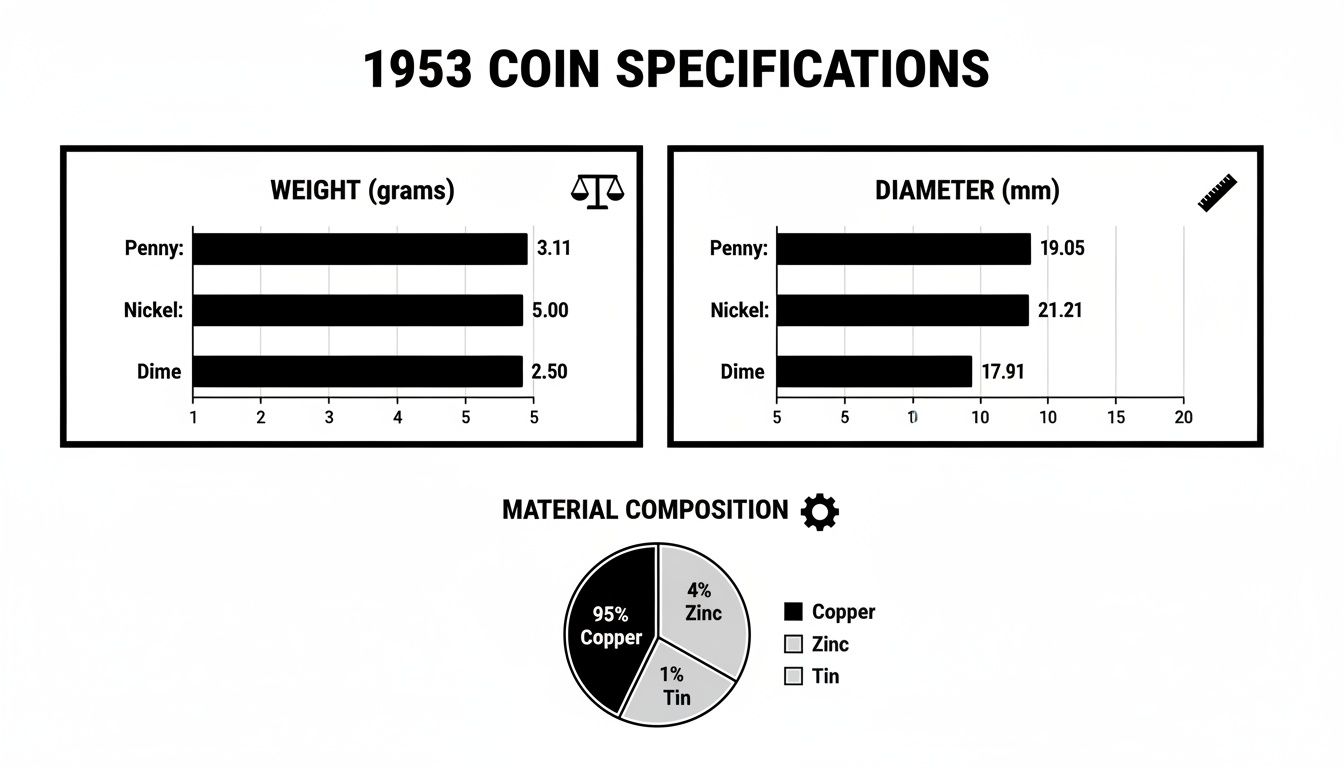
Its hefty weight and large size immediately tell you this was meant to be a special commemorative 'crown', not a coin for everyday shopping.
Understanding Market Values
The value of the 1953 Coronation Crown depends almost entirely on its grade. While these coins are not incredibly rare—a whopping 5,963,000 were minted—collector demand keeps their value above their original 5 shillings face value (which is roughly £8.50 in today's money).
The table below gives you a clearer picture of what you might expect based on your coin's condition.
Estimated Value of the 1953 5 Shillings Coin by Grade
| Coin Grade | Key Visual Characteristics | Estimated Value Range (GBP) |
|---|---|---|
| Uncirculated (UNC) | Perfect, with original mint lustre and no visible wear. | £10 – £20+ |
| Extremely Fine (EF) | Sharp details with only very light wear on the highest points. | £5 – £10 |
| Very Fine (VF) | Clear design, but with noticeable wear on high points. | £3 – £6 |
| Fine (F) | Significant wear across the entire coin; details are softer. | £1 – £3 |
As you can see, a pristine, uncirculated coin can command a much higher price than one that’s been heavily handled over the years.
The Special Case of Proof Coins
On top of the standard coins, the Royal Mint also produced a limited number of 'proof' versions, made especially for collectors. These are the supermodels of the coin world. They were struck using specially polished dies, which gives them a stunning finish—a mirror-like background with a frosted, matte look on the raised design.
Proof versions are much rarer and, as a result, significantly more valuable. If you suspect you have one, it's definitely worth getting it professionally appraised. For a deeper dive into identifying different coin types, you might find our guide to shilling coin values helpful.
Ultimately, whether you have a single Coronation Crown or a whole jar of leftover foreign currency, turning it into cash is simple. Our service lets you convert foreign coins and banknotes quickly and securely, without any fuss.
Spotting the Difference Between Standard and Proof Coins
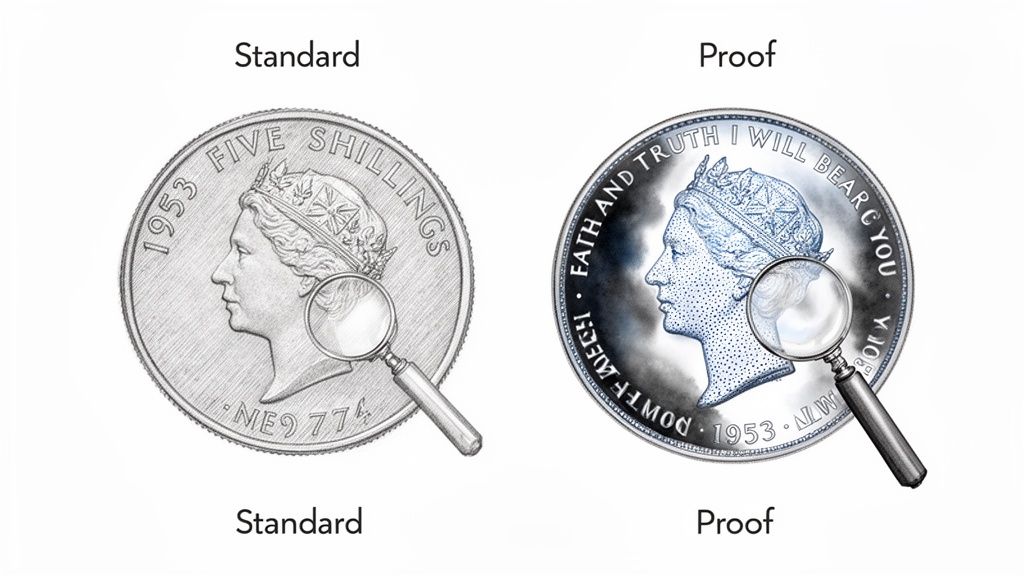
When you look at your 5 shillings 1953 coin, you might be holding one of two very different beasts. The Royal Mint churned out a huge number for general commemoration, but they also struck a much smaller, exclusive batch of 'proof' coins just for collectors.
Figuring out which one you have is the key to its potential value. The difference between the two can be massive.
A standard, or 'circulation strike', coin was made for the masses. It has a fairly uniform, slightly matte look across the whole surface. A well-kept one can still look fantastic, but its finish is consistent. A proof coin, on the other hand, is a little work of art. It’s been crafted with serious care to create a stunning visual pop. Think of it like a professional gallery print versus a standard photograph—the difference is all in the sharpness and finish.
Key Visual Cues to Look For
The most obvious tell-tale sign of a proof coin is its dramatic, almost cameo-like appearance. This effect comes from a special minting process where the dies and the coin blanks are hand-polished. The result? A coin with two distinct finishes that create a beautiful contrast.
To spot a potential proof coin, keep an eye out for these features:
- A Mirror-Like Background: The flat background of the coin, known as the 'field', will be so highly polished it’s practically a mirror. If you can see your reflection in it, that's a brilliant sign you've got a proof.
- Frosted, Sharp Details: The raised parts of the design—the Queen's portrait, the horse, the shields—will have a frosted, matte finish. This contrast makes the design almost 'float' above the shiny background.
- Exceptional Detail: Proof coins are struck multiple times at low speed, which brings out incredibly sharp, well-defined details. Every tiny line of the Queen's uniform and every petal on the floral emblems will be crisp and clear.
A standard 5 shillings 1953 coin just won't have this dramatic effect. Its surface will have an even lustre all over, without those mirrored fields or frosted designs.
Why Mintage Numbers Matter
A quick look at the production numbers really drives home how special a proof coin is. The Royal Mint's 1953 output for the coronation crown was a massive 5,962,621 circulation coins. Compare that to the tiny run of just 40,000 proof sets, which included the crown as the main attraction.
These sets were often sold in special protective packaging, which helped preserve their pristine condition over the years. You can get a better sense of how these numbers influence collectors by exploring the history behind the 1953 mintage.
A Note on Handling: If you think you might have a rare proof coin, handle it very carefully. Those mirrored surfaces are magnets for fingerprints and tiny scratches, which can seriously knock down its value. Always hold it by its edges.
Whether your coin is a standard issue or a rare proof, it holds value. The same goes for any other leftover foreign currency you have lying around. Instead of letting it gather dust in a drawer, you can easily convert foreign coins and banknotes into cash.
Our service is fast, easy, and 100% guaranteed. We’re trusted by major UK organisations like supermarkets, airports, and police forces, so you know you’re in safe hands. There's no need to sort your coins—just send them to us, and we’ll handle the rest.
Exchange Your Old Coins for Cash the Easy Way
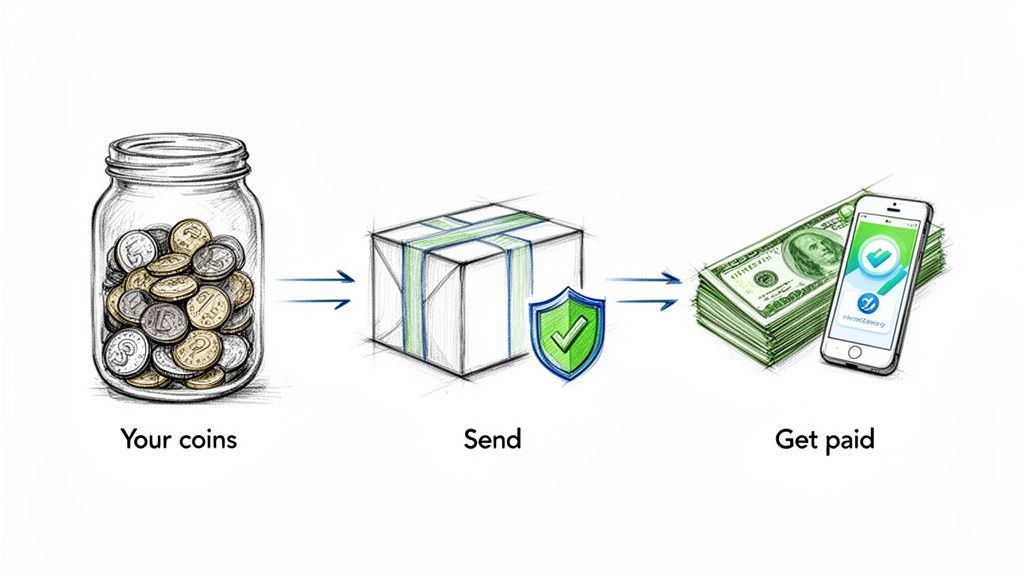
So, you’ve found a 5 shillings 1953 coin, or maybe you have a whole bag of mixed currency from old holidays. Turning it back into real money shouldn't be a chore. Trying to sell old coins one by one means a lot of research, tricky grading, and hunting for buyers. We’ve built a service that cuts out all that hassle, giving you a fast and simple way to get value from your old currency.
Going the traditional route through online marketplaces or local dealers often comes with its own headaches. If you’re thinking of selling on a site like eBay, you’ll need great photos to get the best price. That might mean looking into things like professional product photos for eBay to make your listings stand out. Frankly, that’s a lot of effort for every single coin. We offer a much more direct path.
A Service Built on Trust and Simplicity
We think exchanging currency should be simple and honest. That’s why our process isn’t just easy—it’s backed by a 100% satisfaction guarantee. You don’t need to be a coin expert or spend your weekend sorting through a mountain of shrapnel.
Our reputation speaks for itself. We’re the trusted currency exchange partner for some of the biggest names in the UK, including:
- Major Supermarkets: We handle all the leftover foreign currency they collect at the checkout.
- National Charities: We turn public donations of foreign coins into much-needed funds.
- UK Airports: We process the currency from those big collection globes and donation boxes.
- Police Forces: We manage seized or found foreign cash securely and efficiently.
Working with these organisations shows we can handle all types of currency with real professionalism. You can trust you’re getting a fair and honest service every time.
We’ve removed the biggest barrier to exchanging old money: the need to sort it. Simply gather all your leftover foreign currency—coins and notes, old and new—and send it to us. We’ll handle the identification, sorting, and valuation for you.
How Our Hassle-Free Process Works
Getting cash for your old coins and notes is as easy as posting a parcel. We’ve fine-tuned our system to be quick, secure, and straightforward from the moment you get in touch.
- Get a Free Online Quote: Pop your details into our simple online calculator for an instant estimate.
- Send Us Your Currency: Pack up your coins and notes—no sorting needed!—and post them to us using a secure, tracked service.
- Receive Your Payment: As soon as we get and verify your currency, we’ll process your payment. You’ll get the full quoted value sent right to your bank account or via PayPal.
There are no hidden fees or sneaky charges. The value we quote is the exact amount you’ll receive. That transparency is a key part of our promise.
More Than Just an Exchange
Our service is flexible. If you’re feeling generous, you can donate foreign coins to charity. We partner with several UK charities, letting you turn forgotten cash into a meaningful contribution. It's a popular choice for people and businesses who want to make a difference with their unwanted money.
Whether it’s a single commemorative 5 shillings 1953 piece or a heavy jar of mixed world coins, we’re here to help you unlock its hidden value. For more details on getting your items ready, check out our in-depth guide on how to sell old coins. It’s the easiest way to convert foreign coins and banknotes into cash with a service you can count on.
Ready to Turn Your Coronation Crown into Cash?
That 1953 5 shillings coin in your hand is more than just old metal; it’s a direct link to a pivotal moment in British history. We've walked through its unique story, explored its stunning design, and looked at what it might be worth. Now, it's time to decide what to do with it.
You could exchange foreign coins for cash, or you could even donate foreign coins to charity if you prefer. Either way, our service is designed to be the simplest path to unlocking that value. Don't let your old or leftover foreign currency just sit in a drawer gathering dust when it could be put to far better use. Our process is fast, easy, and completely hassle-free.
A Service You Can Genuinely Trust
We know that trust is paramount when you're sending money. That's why we’re proud to be the chosen partner for major UK organisations, from national supermarkets and airports to charities and even police forces. They count on us for our security, efficiency, and transparent approach.
Our promise is simple: a 100% guaranteed service with no hidden fees. The best part? You don't even need to sort through your coins or notes. Just send them all to us, and we'll take care of everything from identification to valuation.
From a Single Coin to a Jar Full
Whether you have one Coronation Crown or a heavy jar overflowing with mixed foreign currency, we make it effortless to exchange foreign coins and notes. It's the perfect solution for anyone who's found old holiday money or inherited a coin collection. Our system ensures you get paid quickly and fairly, turning forgotten currency into real, spendable money.
Ready to see what your old currency is worth? Get a free, no-obligation quote by visiting our homepage now. You’ll discover just how easy it is to exchange your coins and notes with a service you can count on.
Your 1953 5 Shillings Coin Questions Answered
Even after getting to know its history and design, you might still have a few questions about the 5 shillings 1953 coin. Here are some quick, clear answers to the most common queries we hear, helping clear up any lingering doubts about this fascinating piece of British history.
Is the 1953 5 Shillings Coin Made of Silver?
This is the number one question people ask, and the short answer is no. The 1953 Coronation Crown is made from cupro-nickel, a hard-wearing and practical alloy of copper and nickel.
By this time, the UK had mostly stopped using silver in its everyday coins. The post-war economy was under immense pressure, and precious metals were needed for other priorities. The Royal Mint switched to more affordable materials, even for special commemorative coins like this one.
Can I Still Use a 1953 5 Shillings Coin in a Shop?
You can’t use a 1953 5 shillings coin in a shop today. While it was technically worth 25 pence when the UK went decimal, all pre-decimal coins like the Coronation Crown were officially taken out of circulation decades ago.
Besides, its value to a collector is now far higher than its original face value. Exchanging it is a much smarter move than trying to spend it, as you’ll unlock its true historical and numismatic worth. That’s where a service like ours can help you easily convert foreign coins and banknotes into cash.
How Can I Tell if My Coin Is a Valuable Proof Version?
Spotting the difference between a rare and valuable proof coin and a standard one is easier than you might think. You don't need to be an expert—just look for a few tell-tale visual clues.
Here’s a simple checklist to follow:
- Check the background: A proof coin has a highly polished, mirror-like finish on its flat surfaces. You should be able to see a clear reflection in it.
- Examine the design: The raised parts, like the Queen's portrait and the horse, will have a frosted, matt appearance that stands out sharply against the shiny background.
- Look at the overall finish: If your coin has the same uniform, slightly dull lustre across both the background and the design, it's a standard circulation coin.
If you have a collection of old coins, including a 5 shillings 1953, and want to unlock their value without the stress, we offer a fast, easy, and 100% guaranteed solution. There’s no need to sort your coins; just send them to us. We’re trusted by major UK brands, including charities, supermarkets, and airports, to handle their currency needs efficiently.
Ready to unlock the value of your old currency? We Buy All Currency makes it simple. Visit https://www.webuyallcurrency.com to get your free, no-obligation quote and see how easy it is to convert your coins into cash today.