
50 Australian Cents: Value, Rarities, and Exchange Guide
Posted by: Ian Stainton • 11 May 2026
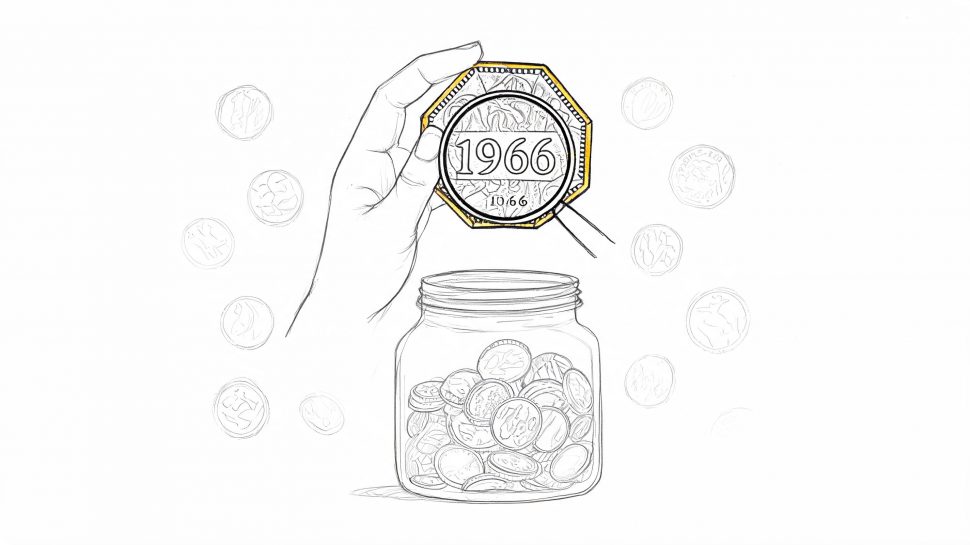
A 50 Australian cent coin can be worth very different amounts depending on what it is. A standard dodecagonal coin is usually an exchange item, while the 1966 round silver version contains 80% silver and its bullion value alone can be over £8, so even common-looking pieces deserve a quick check before you cash them in.
That's why this coin causes so much confusion in the UK. You find one in a holiday money tin, an airport donation bag, or a drawer with old banknotes, and it looks substantial enough to be valuable. Sometimes it is. Sometimes it's part of a batch of leftover foreign currency that can still be converted into cash through a specialist online service, even when a bank won't touch it.
Your Guide to the 50 Australian Cent Coin
The Australian 50 cent piece is one of those coins people remember. It's large, easy to spot, and its 12-sided shape stands out straight away. If you've got one mixed in with euros, US quarters, or old travel money, the first question is simple. Can you exchange it in the UK?
Yes, you can. The practical answer is that 50 australian cents can be exchanged, but the route matters. Banks and travel money counters usually focus on notes, not coins, and they rarely want older foreign coinage. Specialist postal exchange services are built for exactly this kind of leftover foreign currency, including coins, banknotes, and even withdrawn issues.

What matters most when you check one
Three things decide what you should do next:
- The shape and date. A round 1966 coin is the one to separate first because it's the silver issue.
- Whether it's a common circulation piece or a scarcer date. Some years are ordinary exchange items, while others attract collector interest.
- Its condition. A worn coin and a sharp uncirculated coin from the same year can belong in very different categories.
Practical rule: If you have Australian coins and notes together, don't treat them all as simple face-value leftovers until you've checked the 50 cent pieces.
People often search for ways to exchange foreign coins and notes, but the better question is whether any part of the pile deserves to be handled differently first. The 50 cent coin is a good example because it sits on the line between everyday exchange value and collector or bullion value.
That makes it a useful case study for anyone trying to convert foreign coins and banknotes without wasting time, missing a better return, or assuming old foreign money is worthless.
From Silver Bullion to a 12-Sided Icon
A lot of people in the UK find out the hard way that an Australian 50 cent coin is not always just 50 cents. One version is a silver coin that can carry bullion and collector value. The other is the familiar 12-sided piece that usually sits in the face-value exchange category unless the date or condition makes it better.
The story starts in 1966, when Australia changed to decimal currency. The first 50 cent coin was round, large, and struck in 80% silver, as explained in this guide to collecting round 50 cent coins. It used the Commonwealth Coat of Arms on the reverse and Queen Elizabeth II on the obverse. In practical terms, that original metal choice is why this denomination still deserves a second look before you send any foreign coins off for exchange.

Why the round coin disappeared so quickly
The round coin created a problem almost as soon as it entered circulation. Its silver content pushed the underlying metal value above the face value, so people pulled it out of everyday use and kept it.
That matters for two reasons. First, the 1966 round 50 cent coin often belongs in a bullion or collector conversation, not a routine foreign coin exchange. Second, it explains why the round version is the one dealers and experienced buyers check first when a parcel of Australian coins arrives.
I see this trade-off often with leftover travel money. A customer sends in a mixed bag assuming every 50 cent piece is ordinary change, but the round 1966 coin needs to be separated before any exchange decision is made. That simple check can prevent a low-value outcome.
The switch to the 12-sided version
Australia replaced the silver round coin with the now-standard 12-sided 50 cent piece and moved to a base-metal format. The redesign solved the silver problem and made the denomination cheaper to produce for circulation.
From an exchange point of view, this is the version that turns up most often. It is the coin people bring back from holidays, find in old drawers, or discover mixed in with banknotes from past trips. Some dates and commemorative issues still attract collector demand, which is why our guide to foreign coins that are worth money is useful before you treat every dodecagonal 50 cent coin as standard change.
The practical rule is simple. If it is round and dated 1966, stop and check it properly before grouping it with ordinary exchange coins.
Round versus 12-sided at a glance
| Type | What to look for | Why it matters |
|---|---|---|
| 1966 round coin | Circular shape, 1966 date | Silver content can give it bullion value and stronger collector interest |
| Later 12-sided coin | Dodecagonal shape | Usually handled as a standard exchange or collector coin depending on date and condition |
This shift from silver round coin to cupro-nickel 12-sided coin is what makes the Australian 50 cents piece unusually useful as a case study. It shows the difference between a coin that may deserve individual pricing and a coin that can often be handled through a simple foreign currency exchange service.
How to Identify Valuable 50 Cent Coins
Once you've separated the round silver coin from the 12-sided pieces, the next job is to decide whether any of the dodecagonal coins deserve a closer look. Most don't need a magnifying lamp or specialist equipment. Date, design, and overall sharpness tell you a lot.
Start with the obvious checks
Look at these first:
- Year of issue. Some years are common circulation coins. Others are scarcer because they had lower mintages or weren't released for general circulation.
- Special design or variety. Certain commemoratives and errors attract collector demand.
- Condition. A coin with crisp detail and little wear can sit in a very different value bracket from a heavily circulated example.
The easiest trap is to assume that all 12-sided 50 cent pieces are equal. They aren't. According to this overview of foreign coins that are worth money, some modern-looking coins can carry a premium because fewer entered circulation or because collectors chase a specific variety.
Key dates collectors watch
Verified data shows that 1981 had a mintage of about 49.9 million, making it a common year in circulation, while 1985 had a much lower circulation mintage and can be worth over £20 in uncirculated condition. The same verified source also states that 1986, 1987, and 1992 were not issued for general circulation, which makes them collector pieces from the outset. That information comes from this video-based reference on Australian 50 cent coin values.
There's also a modern variety that stands out. The 2000 Millennium Incused Flag 50-cent piece had an estimated 200,000 pieces released into circulation, and circulated examples trade for $50 to $100 AUD, while MS65 specimens can exceed $1,000 AUD, according to PCGS on the Australian 2000 Millennium 50-cent with Incused Flag.
Australian 50c Key Dates & Potential Value
| Year / Variety | Distinguishing Feature | Potential Value Guide |
|---|---|---|
| 1966 round | Round shape, silver issue | Bullion value alone can be over £8, often more than standard exchange value |
| 1981 | Common circulation year | Usually treated as a standard exchange coin unless in exceptional condition |
| 1985 | Lower circulation mintage | Can be worth over £20 in uncirculated condition |
| 1986 | Not issued for general circulation | Collector value rather than ordinary face-value treatment |
| 1987 | Not issued for general circulation | Collector value rather than ordinary face-value treatment |
| 1992 | Not issued for general circulation | Collector value rather than ordinary face-value treatment |
| 2000 Millennium Incused Flag | Incused flag variety | Collector value, with circulated and high-grade pieces trading far above face value |
What works in practice
If you're sorting a handful of coins, it's worth checking dates one by one. If you're dealing with a donation bucket, shop till sweep, or mixed family collection, a quick triage works better:
- Pull out any round 1966 coin immediately
- Set aside any 12-sided coins from scarcer years
- Look for unusual commemorative or error-style designs
- Group the ordinary remainder as exchange currency
A good sorting habit saves time twice. You avoid underselling the better pieces, and you don't waste effort overchecking common ones.
What doesn't work is treating every Australian 50 cent piece as a collectable. Most are not rare. What also doesn't work is doing the opposite and throwing every coin into a bulk exchange bag without checking the obvious standouts first.
Why You Cannot Exchange Coins at a Bank
People are often surprised by this, especially after a trip to Australia. They've got a perfectly real coin, it's legal currency in its home country, and yet the local bank says no. The reason isn't mystery or stubbornness. It's economics and handling.
Why banks say no
Banks and high street exchange counters are set up for quick, standardised transactions. Foreign coins are the opposite.
- They're heavy and low value. Coins cost more to store, count, package, and transport than notes.
- They're harder to repatriate. Sending foreign coins back into the proper banking system is a specialist logistics task.
- They slow branch operations. Staff can process notes quickly. Bags of mixed foreign coins take far longer.
- They create verification issues. Older or withdrawn coins need knowledge that most general exchange desks do not have.
That's also why many places that accept notes won't accept coins, and why old or withdrawn issues are usually refused altogether.
Why specialist exchange exists
Specialist services work because they're built around the awkward categories that everyone else rejects. That includes people trying to exchange foreign coins, families clearing out leftover foreign currency, and organisations that want to donate foreign coins to charity rather than leave them unused.
A charity, airport, supermarket, or retailer doesn't want branch-counter rules. It wants a practical route for mixed overseas money, whether that's holiday change, till mistakes, donation collections, or obsolete notes found during a clear-out.
Coins aren't rejected because they have no value. They're rejected because most exchange channels aren't designed to handle them efficiently.
That distinction matters. If a bank says no to your 50 australian cents, that doesn't mean the coin is worthless. It usually means you're using the wrong route.
A Simple Process to Exchange Foreign Coins and Notes
The easiest way to handle Australian 50 cent coins in the UK is to treat them as part of a wider foreign currency exchange process. That matters because travelers often possess more than just one coin. They have a small pile of Australian change, a few notes, maybe some euros, and often older currency mixed in as well.

Pack your currency
Start by separating anything obviously special, such as the round 1966 silver coin or scarcer dates you want checked more carefully. The rest can usually stay as mixed currency.
That's where a specialist exchange foreign coins service is different from a bank. You don't need to spend an evening rolling coins, counting every piece, or sorting by country if the system is designed to handle unsorted parcels.
Send it securely
Once packed, the parcel goes by post for verification. This works well for individuals, but it's especially useful for charities and businesses that collect foreign money in volume.
The handling side is easier when the service uses known coin specifications. The Australian 50 cent coin weighs 15.55 grams, and a kilogram of unsorted 50 cent coins contains approximately 64 coins, according to Wikipedia's entry on the Australian fifty-cent coin. Those physical metrics are what make weight-based valuation practical for bulk parcels.
Get paid after verification
After receipt and checking, payment is issued through the service's available methods. The process is designed for coins, notes, and withdrawn currency, which is the part traditional exchange channels usually don't support.
A useful feature here is that the quote can reflect what's in the parcel. If your lot includes standard Australian 50 cent pieces, old banknotes, and miscellaneous foreign coins from other countries, the result is far more practical than trying to force each item through a retail exchange desk that only wants current notes.
Where this works best
This approach is especially useful for:
- Holiday leftovers that have sat untouched since the trip ended
- Donation collections from schools, airports, retailers, or charity campaigns
- Mixed household finds where coins and banknotes from several countries have ended up together
- Older withdrawn currency that a normal bureau won't accept
The best exchange process is the one that fits the currency you actually have, not the one a high street counter wishes you had.
Common Mistakes to Avoid With Old Currency
A typical problem looks like this. Someone finds a small pile of Australian coins in a drawer, assumes each 50 cent piece is worth the same, then either spends hours asking bank branches that will not take them or sends everything off without checking whether one coin should have been separated first.
That is where value gets missed.
Mistake one: treating every 50 cent coin the same
The Australian 50 cent coin has two very different value stories. Some pieces are ordinary exchange items. One early version, the round 1966 issue discussed earlier, can carry far more value because of its silver content and collector demand.
For practical handling, start with the fastest check. Look at the shape, then the date. If the coin is round and dated 1966, do not mix it into a bulk foreign coin parcel until you have assessed it separately. If it is the familiar 12-sided type, it is usually handled as standard exchange stock unless condition or rarity suggests otherwise.
That one habit prevents the most common avoidable loss.
Mistake two: assuming old means worthless
People often bring us coins and notes that were rejected years ago by a bank counter and left untouched ever since. A refusal from a bank does not mean the currency has no value. It usually means the bank does not have a process for foreign coins, older issues, or mixed parcels.
Old currency falls into two broad categories. It may have collector value, or it may still have practical exchange value through a specialist service. The mistake is assuming it has neither without checking.
Mistake three: cleaning or over-handling coins
Collectors care about original surfaces. Rubbing, polishing, or soaking a coin can reduce its appeal even if the date is useful. I have seen perfectly decent finds turned into lower-value pieces because someone wanted to make them look shiny before asking for a quote.
If a coin might be collectible, leave it as found. A light wipe with a dry cloth is still too much for some buyers.
Mistake four: chasing the wrong route for too long
Trying multiple banks and travel counters usually ends the same way, especially with foreign coins. That wastes time and often delays the simple option. Use a service built for foreign coins and notes, especially if the parcel is mixed or includes withdrawn currency.
The trade-off is straightforward. A high street counter is convenient only if it accepts what you have. A specialist postal service takes longer than walking into a branch, but it is designed for the currencies banks refuse.
A better checklist
- Check shape and date first. Separate any round 1966 Australian 50 cent coin before doing anything else.
- Do not clean potentially collectible coins. Condition matters.
- Keep ordinary mixed currency together. That makes practical exchange easier when the coins are not special pieces.
- Do not assume a bank refusal is the end of the road. It often just means you need the right exchange channel.
- Ask two questions before sending anything. Is this a collector coin, or is it exchange currency?
What works best is simple triage. Pull out anything clearly unusual, keep the rest together, and use the route that matches the currency you have.
Frequently Asked Questions
FAQ Section
| Question | Answer |
|---|---|
| Can I exchange 50 australian cents in the UK? | Yes, but usually not at a bank branch. Specialist postal exchange services are the practical option for foreign coins. |
| Are Australian 50 cent coins worth more than face value? | Some are. The standout is the round 1966 silver coin, and certain scarcer dates or varieties can also carry collector value. Many standard 12-sided coins are simply exchange items. |
| How do I know if mine is the valuable silver one? | Check the shape and date. The key coin is the round 1966 issue. The ordinary later type is 12-sided. |
| Do UK banks accept foreign coins? | Usually no. Banks and bureaus generally avoid foreign coins because they're costly to handle and difficult to process compared with notes. |
| Can I exchange foreign coins and banknotes together? | Yes. Specialist services can usually handle mixed parcels of coins, notes, and even some withdrawn currency, which is much more useful than separate trips to different counters. |
| Do I need to sort everything before sending it? | Not necessarily. Many specialist services are designed for unsorted or mixed currency parcels, especially where weight-based processing is available. |
| What if I've got leftover foreign currency from several trips? | That's common. Mixed travel money from different countries can usually be sent together through a specialist service, rather than left sitting in jars or drawers. |
| Can I donate foreign coins to charity instead of cashing them in? | Yes. That's often a sensible route for businesses, airports, retailers, and households with mixed low-value foreign change that would otherwise go unused. |
A final point matters here. People often think the problem is the coin. It usually isn't. The problem is trying to use a standard exchange channel for non-standard currency.
If you've got Australian coins, old holiday notes, withdrawn money, or a mixed collection that banks won't handle, use a specialist route that can exchange leftover currency properly. That's faster, simpler, and far more realistic than hoping a high street counter will make an exception.
If you've got 50 Australian cents, mixed foreign change, old banknotes, or travel money a bank won't accept, We Buy All Currency gives you a straightforward way to turn it into cash or a charity donation. You can send coins, notes, and withdrawn currency by post, get them verified by specialists, and avoid the usual hassle of trying to force unusual currency through the wrong exchange channel.