
Bank Al Maghrib 100 Dirhams: Your 2026 UK Exchange Guide
Posted by: Ian Stainton • 18 Jun 2026
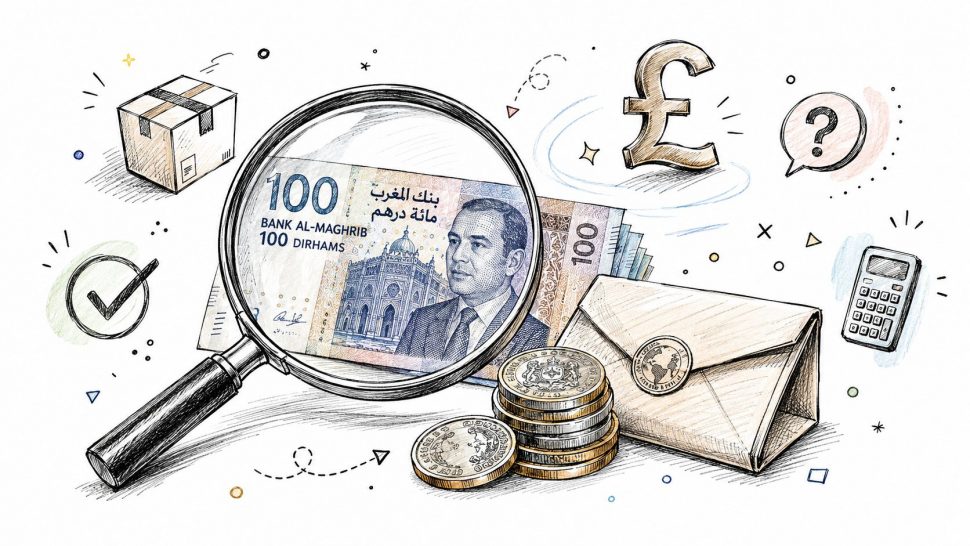
A Bank Al-Maghrib 100 dirham note is current Moroccan currency and is worth roughly £7 to £8.50, with Bank Al-Maghrib's own foreign-banknote rates implying about £7.28 to £8.45 before fees. In the UK, high street banks generally won't exchange Moroccan dirhams, especially older or withdrawn notes, so a specialist service is usually the simplest route if you want cash rather than keeping it as a souvenir.
That's a common situation to be in. You've come back from Morocco, emptied a travel wallet, or found an old note in a drawer, and now you want one clear answer. Is it spendable, exchangeable, collectible, or just dead paper?
With a Moroccan 100 dirham note, the answer depends on which note you have, whether it's still in circulation, and whether you're valuing it for exchange or for collecting. The practical path is straightforward once you separate those three questions.
How to Identify Your Bank Al Maghrib 100 Dirham Note
The first job is simple. Don't start with value. Start with identification.
Bank Al-Maghrib, Morocco's central bank, formally put a new 100-dirham banknote into circulation in 2023, confirming that the denomination remains an active, official part of Moroccan cash circulation rather than a withdrawn face value, as stated in Bank Al-Maghrib's 2023 circulation announcement.
If you're holding a 100 dirham note in the UK, that matters because many people assume any unfamiliar foreign note must be old or obsolete. That isn't true here. The denomination itself is current. What you need to pin down is the series or type.

Check the basic physical details
One reliable reference point is the long-running 2002 series. Bank Al-Maghrib lists that 100-dirham banknote as 150 × 78 mm, with brown as the dominant colour and a first issuance date of 2002, and it also notes that a commemorative 100-dirham banknote was issued on 22 December 2025 in limited quantities alongside existing 100-dirham notes on its 100 DH banknote page.
That immediately gives you a practical sorting method:
- Brown standard note: often points you toward the 2002 circulation issue.
- Different design language or presentation: may indicate the 2023 redesign.
- Unusual presentation or commemorative appearance: could be a later commemorative issue rather than an everyday circulation note.
Sort before you value
People often bundle all “100 dirhams” notes together. That's where mistakes start.
Use this checklist before you do anything else:
- Check the year or series markers: Older circulation notes, newer redesigns, and commemorative issues shouldn't be treated as identical.
- Look at condition: A crisp note and a heavily folded note may have the same face value for exchange, but not the same appeal to a collector.
- Separate standard and commemorative pieces: A commemorative note may circulate, but it isn't automatically priced the same way as an ordinary travel leftover.
- Don't rely on memory: If the note came from a drawer or mixed holiday money, assume nothing until you compare design, colour, and issue details.
Practical rule: Identify first, price second. Most bad valuations happen because someone treats every Moroccan 100 dirham note as the same item.
Security features matter for acceptance
If you're posting the note to a specialist or offering it for sale, the note needs to be identifiable and genuine. That's why visible security features matter. A specialist handles this regularly. A bank clerk in a UK branch usually doesn't.
That difference is one reason people looking to exchange foreign coins and notes often find specialist channels easier than high street ones. The issue usually isn't that the note has no value. It's that the person at the counter doesn't handle that currency often enough to assess it confidently.
Face Value vs Collector Value What Is My Note Worth
There are really two separate questions here.
The first is exchange value. The second is collector value. They are not the same, and mixing them up leads to disappointment.
Bank Al-Maghrib's official foreign-banknote table quotes a purchase rate of 11.8220 MAD per 1 GBP and a sale rate of 13.7380 MAD per 1 GBP, which puts a 100 MAD note at roughly £7.28 to £8.45 before handling or service costs, according to the bank's foreign banknotes exchange rate table.
Face value for exchange
If your note is a standard circulation note and still exchangeable, face value is your baseline.
That's the number most travellers care about. It tells you what the note is broadly worth as currency, not as a collectible. In practice, any actual payout can differ because customer-facing services apply their own processing logic, and posting or handling costs may also matter.
For ordinary leftover foreign currency, this is the right mindset. Start with face value. Treat anything extra as a bonus, not an assumption.
Collector value for specialists
Collector value only comes into play when the note has something beyond spendable currency status.
That usually means factors like:
- Condition: cleaner, crisper notes tend to attract more collector interest.
- Series distinction: standard circulation and commemorative issues shouldn't be lumped together.
- Unusual desirability: some buyers care about presentation, issue type, or how recently the note was withdrawn or redesigned.
A 100 dirham note can be worth less than expected as exchange stock and more than expected as a collectible. The note itself hasn't changed. The buyer's purpose has.
A practical way to think about it
If you've got one note from a recent trip, assume currency value first.
If you've got an unusual version, a crisp example, or a commemorative issue, pause before cashing it out at face-value logic. That doesn't guarantee a premium, but it's enough reason to have it assessed properly.
Many people who want to convert foreign coins and banknotes often go wrong. They either assume every foreign note is rare, or they assume every old note is worthless. Neither is a safe assumption.
Why High Street Banks Wont Exchange Your Moroccan Dirhams
Most UK banks aren't refusing your Moroccan dirhams because the note is fake or because you've done something wrong. They're refusing because their system isn't built for low-volume physical foreign cash.
That's especially true with currencies like the dirham, and it becomes even harder once older series are withdrawn. For UK residents, that matters because withdrawn Moroccan notes generally aren't accepted by UK high street banks, which pushes holders toward specialist exchange routes or collector channels instead.

Why banks say no
The refusal usually comes down to operational friction:
- Low handling volume: Branches don't see enough Moroccan cash to justify routine processing.
- Verification burden: Staff may not be trained to identify less common foreign notes and variants.
- Repatriation hassle: Physical notes have to go somewhere. For niche currencies, that process isn't attractive.
- Coins are even harder: Many banks won't touch foreign coins at all, even when they still have local face value abroad.
- Withdrawn notes create extra risk: Once a note is no longer standard circulation stock, the bank has little reason to handle it.
What actually works better
Specialists exist because they're set up for exactly this problem. They handle leftover foreign currency, mixed notes, old series, and often coins too. That matters if you've got more than one type of money in the same envelope, or if you aren't fully sure which note version you hold.
Banks are built for mainstream transactions. Specialists are built for odd pockets of travel money, old notes, and currencies that don't fit a branch counter process.
That's also why people trying to exchange foreign coins or donate foreign coins to charity usually get further with a dedicated currency service than with a current account provider.
How to Exchange Your Leftover Currency Hassle-Free
The cleanest process is the one that removes sorting, guessing, and branch-counter arguments.
If you're dealing with a Bank Al-Maghrib 100 dirhams note in the UK, the practical route is usually to use a specialist that accepts current and withdrawn currency by post. That matters because multiple valid versions may exist at the same time, including standard circulation notes and commemorative issues, and a specialist can separate them properly rather than treating everything as one generic note type.

A simple working method
Here's the process that usually causes the fewest problems:
Identify the note clearly
Check whether it's a standard circulation issue, an older series, or something commemorative. Don't mix all Moroccan notes together mentally.Get a rate or quote before posting
Use a dedicated Moroccan dirham exchange service so you know the route you're taking before sending the note.Package notes carefully
Keep the banknote flat and dry. If you're sending mixed travel money, group notes sensibly so handling is easier on receipt.Include other leftover money if you have it
This is often the moment people realise they also have euros, coins, old notes, or other travel leftovers. Specialist services are better suited when you want to exchange leftover currency in one go instead of dealing with each country separately.Choose payment and send
Once verified, payment is usually made by bank transfer or PayPal through specialist providers.
What works and what doesn't
What works is a process built around real travel leftovers.
That means:
- Mixed currency accepted
- Coins and notes accepted
- Withdrawn currency handled
- No need to argue with a branch that doesn't want the note
What doesn't work is treating specialist exchange like airport money changing. It's not the same use case. Airport desks focus on active travel exchange. Specialist postal services focus on turning awkward, leftover, or obsolete money into cash after the trip is over.
One common advantage people overlook
You often don't need to sort every item perfectly.
That's especially useful if your Moroccan note is sitting alongside coins from other countries, old holiday cash, or mixed family travel leftovers. For anyone trying to exchange foreign coins and notes without spending an evening categorising a jar of change, that's a genuine practical benefit.
Comparing Your Exchange Options and Common Mistakes
The right option depends on what you possess. One current note is different from a mixed bag of coins, old banknotes, and withdrawn travel cash.
Here's the simplest comparison.
Currency exchange options compared
| Feature | High Street Bank/Post Office | Online Marketplace (e.g. eBay) | Specialist Service (We Buy All Currency) |
|---|---|---|---|
| Current Moroccan banknotes | Sometimes limited or unavailable | Possible to list | Yes |
| Withdrawn Moroccan notes | Typically no | Possible to list as collectible | Yes |
| Foreign coins | Usually no | Possible, but effort-heavy | Yes |
| Mixed unsorted currency | No | No practical handling support | Yes |
| Speed and convenience | Low if currency is uncommon | Slow, manual, buyer-dependent | Designed for postal processing |
| Collector upside | No | Potentially, if demand exists | Exchange-focused, with specialist handling |
| Risk of mispricing | High if staff don't handle the currency | High if seller overestimates value | Lower for straightforward exchange cases |
If your main goal is primarily to turn leftover money into pounds, a specialist route is usually the most practical option. If your main goal is to test collector demand, a marketplace can make sense, but it comes with more work, more uncertainty, and more room for pricing mistakes.
For a broader side-by-side view of how different routes handle awkward travel money, this foreign currency exchange comparison is useful background.
Common mistakes to avoid
The biggest errors are usually avoidable.
- Assuming all 100 dirham notes are identical: They aren't. Series and commemorative status matter.
- Confusing face value with numismatic value: A note can have exchange value without being collectible, and vice versa.
- Trying a bank first and stopping there: A branch refusal doesn't mean the note has no value.
- Ignoring coins in the same drawer: If you also want to exchange foreign coins, handle the whole batch together rather than solving one note at a time.
- Overestimating marketplace demand: Listing a note online only works if a buyer wants that exact item.
- Packaging carelessly: Bent, damp, or poorly protected notes create unnecessary problems.
Worth remembering: A bank rejection is often a channel problem, not a value problem.
If you're focused on a straightforward currency buy back, clarity beats optimism. Identify the note, choose the right route, and don't assume a collectible premium unless there's a genuine reason.
Frequently Asked Questions About Moroccan Currency Exchange
Can I exchange Moroccan dirhams in the UK?
Yes, but usually not through a normal high street branch. Moroccan dirhams are the sort of currency many travellers need to handle through a specialist service rather than a bank counter.
Can I exchange Moroccan coins as well as notes?
In many cases, yes, through a specialist. This is one of the big differences between banks and dedicated foreign-currency services. If you want to exchange foreign coins and notes together, use a route that accepts both rather than splitting the job.
Do UK banks accept old or withdrawn Moroccan notes?
Generally, no. That's one of the main reasons people end up looking for specialist help after a trip or after finding old holiday money at home.
Is a Bank Al-Maghrib 100 dirhams note still valid currency?
The denomination is current, but individual notes can belong to different series. That's why identification matters. A current denomination doesn't mean every version will be accepted through the same channel in the UK.
What if my note might be collectible?
Pause before treating it as ordinary exchange stock. If it looks commemorative, unusually well preserved, or clearly different from a standard travel note, get it assessed on that basis first. Don't assume premium value, but don't ignore the possibility either.
Can I send mixed leftover holiday money in one go?
Usually yes with a specialist service. That's often the easiest route if your Moroccan note is mixed with euros, coins, old notes, or other leftover foreign currency from several trips.
What if I don't want the money and would rather give it away?
Many people choose to donate foreign coins to charity rather than cash them personally. That can be a practical option when you've got small mixed amounts that would otherwise sit unused in a jar or drawer.
How long does payment take with a specialist service?
According to the publisher information provided for this article, payments are issued within five working days after verification, using bank transfer or PayPal. That timetable is one of the practical advantages of using a service built for postal currency handling rather than ad hoc branch processing.
Do I need to sort everything first?
Not always. Some specialist systems are designed for unsorted or mixed currency, which is far easier for households clearing travel leftovers or for charities and businesses collecting miscellaneous foreign cash.
Can businesses and charities use the same kind of service?
Yes. This kind of service isn't only for holidaymakers. It's also used by charities, businesses, and organisations that receive foreign notes and coins through donations, tills, collections, or customer mistakes.
If you've got a Bank Al-Maghrib 100 dirham note sitting unused, the simplest next step is to turn it into cash through a specialist that handles current notes, old series, coins, and mixed travel money properly. We Buy All Currency makes it easy to exchange leftover currency, convert foreign coins and banknotes, or clear out a whole bundle of holiday money in one go.