
Best Place to Sell Old Coins UK: Our 2026 Guide
Posted by: Ian Stainton • 24 May 2026
For rare or collectible UK coins, specialist auction houses or dealers are usually the best place to sell. For leftover foreign currency, old British money, and mixed unsorted coins, an online exchange service like We Buy All Currency is the most convenient and complete route.
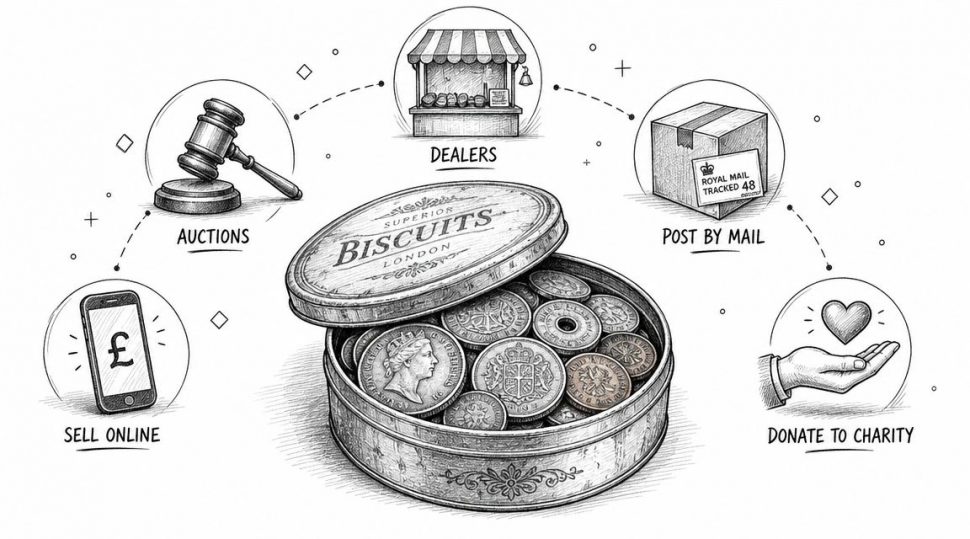
A lot of people start in the same place. You clear a drawer, loft, or family home and find a biscuit tin full of coins. Some are old British pennies, some look foreign, a few might be silver-coloured commemoratives, and none of it is labelled. The hard part isn't finding somewhere that will buy coins. It's choosing the right buyer for the type of coins you have.
That's what decides the best place to sell old coins in the UK. A rare Victorian or milled British coin belongs in a specialist channel. A bag of leftover euros, pre-euro coins, withdrawn banknotes, or mixed holiday change doesn't. Sellers lose money when they treat all coins the same.
Before You Sell A 3-Step Preparation Checklist
Start with a quick sort. Separate UK coins from foreign coins, then split obvious collectibles from bulk change. If you've got old British coins, commemorative sets, proof coins, or anything inherited in albums, keep those apart from loose mixed bags.
Check condition next, but don't clean anything. Rubbing, polishing, or washing old coins can reduce collector appeal and make specialist buyers more cautious. Even dirt that looks ugly can be less damaging than an over-cleaned surface.
Take clear photos before making enquiries. Front, back, and any packaging or certificates help a dealer or auction house decide whether it's worth a proper valuation.
Practical rule: If a coin might be collectible, treat it like an antique, not loose change.
1. We Buy All Currency

A common situation is a tin of mixed coins from holidays, old Irish punts, withdrawn notes, and loose foreign change from several countries. That type of holding usually needs a currency exchange service, not a coin auction house.
We Buy All Currency fits that job well. It is geared towards leftover foreign coins and notes, obsolete currency, old British and Irish money, and mixed bags that high street banks, bureaux de change, and specialist numismatic firms often have little interest in handling.
That distinction matters if you want the best result. Rare UK coins should be assessed for collector value first. Mixed spendable or obsolete currency needs a buyer set up to process volume, identify denominations, and pay on exchange value rather than rarity. If you are sorting older domestic pieces, their guide on selling old British coins is a useful starting point.
Why it works for bulk and mixed currency
The practical advantage is straightforward. You can send coins and banknotes together, including current and withdrawn issues, without having to identify every item to auction standard.
For households clearing drawers, memory boxes, or inherited tins, that saves time. I would point this kind of seller away from a specialist coin dealer unless there are clearly collectible pieces in the mix. Dealers and auctioneers are strongest when rarity, grade, and provenance drive the price. Exchange services are stronger when the problem is volume, variety, and inconvenience.
The process is postal rather than counter-based. You submit what you have, send it in, and payment follows verification by bank transfer or PayPal. That will suit people who want a clear route for awkward currency, even if it is less immediate than walking into a branch.
Best for
- Leftover travel money: Foreign coins and notes that have sat unused since past trips.
- Withdrawn or obsolete currency: Older issues that banks and travel money providers often decline.
- Mixed family holdings: Jars, envelopes, and boxes containing coins from different countries and time periods.
- Charity and business collections: Accumulated foreign change that needs a repeatable postal process.
Trade-offs to know
Convenience is the main strength, but there is a trade-off. You need to package the currency securely and wait for it to be checked, so this is not the fastest option if speed matters more than flexibility.
It is also the wrong route for scarce or high-grade British coins. A Victorian crown, a proof set, or a rare pre-decimal piece deserves specialist review because collector demand can matter far more than face value or exchange value.
Use this service for bulk currency that is awkward to bank. Use a specialist venue for coins that may be rare.
If your coins are interesting because of age, rarity, or condition, send them to a numismatic specialist. If they are awkward because they are foreign, mixed, or withdrawn, a currency exchange buyer is usually the better fit.
2. The Royal Mint – Collector Services and Auctions

If your coins look historically important, neatly presented, or potentially rare, The Royal Mint Collector Services deserves a place near the top of your list. This is not the route for bulk change. It's for coins that may benefit from authentication, valuation, provenance support, and a collector-facing sales environment.
The useful distinction here is between collectible coins and metal-value coins. The Royal Mint's consignment guidance makes clear that rarity, condition, and provenance drive collectible values, while bullion-style pricing follows metal markets through a very different logic, as outlined on The Royal Mint auction and consignments guidance. That's why a mixed inheritance should rarely be sold through one single route.
When Royal Mint services make sense
This is a strong option for pre-decimal British coins, better collections, presentation sets, or individual items that need trust and expert review behind them. Brand credibility matters when a buyer is paying for more than face value or metal content.
It's also useful if you want a specialist opinion before deciding whether to sell outright, consign, or hold. For old UK pieces that may have collector appeal, that extra layer of scrutiny can stop you from taking a commodity-style offer on something more interesting.
Where it falls short
- Selective route: It won't be the answer for every old coin lot.
- Not ideal for bulk leftovers: Mixed low-value bags are better handled elsewhere.
- Auction path brings uncertainty: A coin still has to be accepted and sell to the right audience.
If your coins turn out not to be collector material, and are old circulating pieces, selling old British coins through a specialist exchange service is often faster and easier.
3. Spink & Son (London)

Spink & Son is where serious numismatic material goes when presentation, cataloguing, and international collector exposure are the priority. If you've inherited an advanced collection, a high-end British coin, an ancient coin group, or a specialist banknote holding, this is the type of venue that can surface the right buyer.
A practitioner's view is simple. Spink is not where you go for speed. It's where you go when the coin deserves a market.
Why sellers choose Spink
The main advantage is audience quality. Auction houses at this level don't just list coins. They frame them, market them, and place them in front of collectors already comfortable buying specialist material. That matters most for rarities and pieces whose value can't be captured by a basic dealer bid.
Private treaty can also make sense for coins that need discretion or a targeted buyer rather than open bidding. Sellers with top-end material often benefit from having both routes available.
Best fit and limits
- Best fit: Rare British coins, world rarities, ancient coins, medals, and important collections.
- Good for: Sellers who care more about realised value than immediate payment.
- Less suitable for: Small mixed lots, common pre-decimal coins, and household leftovers.
The trade-off is time. Consignment, cataloguing, and sale schedules mean this isn't a quick-cash route. For ordinary sellers, that can feel slow. For high-grade or specialist material, it's often worth the wait.
4. Noonans Mayfair (formerly Dix Noonan Webb)
Noonans Mayfair sits in a very practical middle ground for specialist selling. It has the auction-house structure needed for valuable coins and banknotes, but it's also approachable for sellers who aren't lifelong collectors and need a professional evaluation.
For inherited holdings, that matters. You may not know whether you've got a single standout coin or a collection best sold in grouped lots. Noonans is well suited to that sorting process.
What stands out
Noonans regularly handles coins, banknotes, and medals, which is useful if a family collection spans more than one category. That breadth means you don't need to force everything through a coin-only buyer who may be weaker on notes or militaria.
Their regular live and online sales also help sellers who want established auction infrastructure without waiting for a very narrow niche event. If the collection is solid but not museum-level, that can be a practical balance.
If you suspect collector value but can't identify it confidently, ask a specialist auction house for an initial view before accepting a generic cash offer.
The real trade-off
Auction selling always means costs and timing affect your net result. You're buying expertise, cataloguing, and market access. That can raise the final sale outcome, but you won't be paid instantly, and the headline hammer result isn't the same as what lands in your account.
For good-quality collections, that's usually acceptable. For small low-value lots, it often isn't.
5. A.H. Baldwin & Sons (Baldwin's)

A.H. Baldwin & Sons is one of the better choices if you want flexibility rather than a single selling model. Some sellers want an outright purchase and quick certainty. Others want the upside of auction. Baldwin's can accommodate both, which makes it useful when the value of a collection is uneven.
That's common in practice. One tray might contain ordinary pieces a dealer can buy immediately, while a few stronger coins are better placed into auction.
Why that flexibility helps
A dealer-only route can undervalue better coins if the buyer has to protect margin across the board. An auction-only route can be too slow or too expensive for the ordinary material in the same collection. Baldwin's works well when you need both judgments made under one roof.
That makes it a good fit for estate clearances, inherited albums, and mixed British or world collections. Photo pre-assessments can also help if you're still trying to understand what deserves further attention.
Who should use it
- Sellers with mixed-quality collections: Some pieces may suit direct purchase, others consignment.
- Owners of British, world, and ancient material: Broad category coverage matters here.
- Anyone wanting a specialist opinion before deciding on route: Useful if certainty is more valuable than speed.
The main catch is that terms are bespoke. You'll need to ask, compare, and decide whether the convenience of one relationship outweighs shopping parts of the collection around.
6. London Coins (Auctioneers)
London Coins is one of the most practical specialist auction options for ordinary UK sellers who have decent coins but not necessarily trophy pieces. It's particularly appealing if you care about fee clarity and don't want to guess how the consignment process will work.
That transparency matters more than people think. Sellers often focus on headline prices and ignore whether the route itself is predictable.
What makes London Coins useful
London Coins is set up for regular specialist sales and online bidding, so it can handle mixed collections more comfortably than ultra-selective top-end auction rooms. If you've got British or world coins with real collector interest, but not a marquee rarity, this is often a better fit than aiming too high and getting rejected.
One useful point from the wider UK selling environment is that some auctioneers operate on a no-sale, no-fee basis, including Dawsons in its coins category, which helps highlight how sale structure affects risk for consignors through Dawsons auction selling guidance. London Coins appeals for a similar practical reason. Sellers want to understand what happens if a lot underperforms or needs straightforward handling.
Where it sits in the market
- Stronger than a general marketplace: Better specialist audience.
- More accessible than a flagship prestige house: Easier for solid mid-tier material.
- Less suitable for bulk foreign change or old travel money: That isn't its lane.
For many people asking about the best place to sell old coins in the UK, London Coins is close to the sweet spot if the coins are collectible but not elite.
7. Chards (Dealer – direct buy-in and postal service)

Chards is the practical choice when your coins are really bullion or bullion-adjacent rather than collector-led rarities. If you've got sovereigns, silver bullion pieces, or commonly traded modern issues and you want quick liquidity, direct dealer buy-in is often more sensible than waiting for auction.
Many sellers often get confused. Not every old coin is collectible in the numismatic sense. Some are valued mainly for metal content or a straightforward dealer market.
Best use case
Chards is strongest when pricing can follow bullion logic and the buyer can move quickly. Postal selling is useful for people who don't want to travel, and direct purchase avoids the long wait and uncertainty of consignment.
The APMEX guidance on selling routes helps explain why this distinction matters. Specialist dealers focus on collectible coins, while auction houses become more relevant when an over-the-counter sale would understate the coin's worth, as summarised by Coincraft's UK coin selling overview. In practice, if your coins are common bullion pieces, the direct dealer route is often the cleaner option.
Main downside
Rare coins can be undersold if they're treated as bullion first and collectibles second. That's why sovereigns, old gold, and silver crowns should always get at least a quick sense-check before sale. If a piece has date rarity, unusual condition, or collector demand, auction may still beat direct buy-in.
Top 7 UK Places to Sell Old Coins, Comparison
| Service | 🔄 Process / Complexity | 💡 Resource requirements | ⚡ Speed / Efficiency | 📊 Expected outcomes | ⭐ Key advantages |
|---|---|---|---|---|---|
| We Buy All Currency | Low, fully online wizard, simple posting process | Low, pack and post parcel; basic ID/AML checks | ⚡ Fast, payment verified within ~5 working days after receipt | 📊 Good for converting unsorted/obsolete change; predictable quoted rate (subject to verification) | Accepts ANY currency/age; transparent quotes; donation option |
| The Royal Mint – Collector Services & Auctions | High, selective consignment, expert valuation and provenance checks | High, documentation, expert appraisal, auction consignment requirements | Slow, auction cycles and settlement timelines | 📊 Very high for historically significant UK rarities when provenanced | Exceptional credibility and provenance; curated international collector audience |
| Spink & Son (London) | High, detailed cataloguing and specialist sale routes | High, expert marketing, cataloguing and seller commissions | Slow, premium treatment and auction scheduling | 📊 Strong realisations for high-end or specialist consignments | Deep numismatic expertise; global bidder base and high-profile sales |
| Noonans Mayfair | Medium–High, specialist departments and regular auction workflow | Medium, complimentary evaluations but auction fees apply | ⚡ Medium, frequent auctions shorten time-to-market | 📊 Good outcomes for a range from single rarities to full collections | Frequent sales, international bidders and free initial evaluations |
| A.H. Baldwin & Sons (Baldwin's) | Medium, flexible (direct buy-in or consignment) with bespoke handling | Medium, photo pre-assessment or in-person consultation for top lots | Variable, immediate buy-ins available; consignments follow auction timelines | 📊 Variable: immediate sale yields liquidity; consignments can achieve higher premiums | Flexible sell routes; long-established retail + auction presence; lifetime guarantees |
| London Coins (Auctioneers) | Medium, clear lotting guidance and standard auction processes | Low–Medium, published fees and straightforward consignment steps | ⚡ Medium, regular sales and online bidding | 📊 Reliable realisations for mixed and mid–high value lots; certainty on fees | Published, transparent commissions and guaranteed-to-sell policy |
| Chards (Dealer – direct buy-in & postal) | Low, postal distance buy-in with insured delivery | Low, insured postage; items graded on receipt for final offer | ⚡ Very fast, rapid quotes and settlement after verification | 📊 Good for bullion and commonly traded modern issues; lower for rare trophies | Quick liquidity, market-linked bullion pricing and insured postal service |
Making the Right Choice for Your Coins
Auction vs. Dealer vs. Online Exchange
The right route depends on what your coins are.
If you're selling a rare UK collectible coin, auction houses usually offer the strongest market exposure. If you want convenience and certainty, specialist dealers are often easier. If you're dealing with leftover foreign currency, withdrawn notes, or mixed unsorted coins, an online exchange service is in a different category altogether and usually the better answer.
A useful UK rule of thumb comes from established trade guidance. The American Numismatic Association notes that local dealers are one of the easiest options because they avoid shipping and hassle, coin shows let sellers compare multiple offers in one place, and high-value pieces are often better consigned to larger auction houses. Warwick & Warwick also warns that pawn brokers typically pay only a fraction of a coin's true value in its guide to how to sell rare coins in the UK.
For practical decision-making, think in terms of outcome:
- Auction houses: Best for stronger collector coins where exposure matters.
- Dealers: Best for speed, convenience, and immediate bids.
- Online exchange services: Best for foreign change, old banknotes, obsolete currency, and mixed household money.
What About Leftover Foreign Currency & Holiday Money?
You get back from a trip, empty your coat pockets, and find a mix of euros, US cents, old kuna, and a few foreign banknotes in a drawer. That is a different selling problem from a Victorian sovereign or a rare 50p.
Specialist coin dealers focus on collectible value. They assess rarity, condition, provenance, and buyer demand. Leftover travel money is usually about exchange value instead, especially if it is mixed, low denomination, withdrawn, or no longer accepted by banks and high street bureaux.
That distinction matters. If the coins might interest collectors, use a numismatic buyer. If they are ordinary foreign circulation coins or old holiday notes, use a service built to process currency rather than collectables.
Independent market context supports that split. Dealer networks and auction houses remain the right route for collectible coins, which is reflected in NGC's UK dealer locator. That helps if you have numismatic material. It does not solve the practical problem of turning mixed travel money and obsolete notes into pounds.
How It Works
We Buy All Currency is set up for foreign coins, banknotes, old British money, pre-euro currency, and withdrawn issues. The process is straightforward.
- Check what you have: Mixed coins and notes can usually be submitted together.
- Review the quoted rate: You can see the expected value before you send anything.
- Pack and post the currency: Follow the sending guidance so the contents arrive safely.
- Verification happens on receipt: The submission is checked against what was declared.
- Receive payment: Payment is then issued by bank transfer or PayPal after verification, based on the publisher information provided earlier in this article.
The practical advantage is simple. You do not need to force a collector-market solution onto non-collector money. For households clearing travel leftovers, charities handling donated foreign cash, or businesses dealing with accumulated notes and coins, that usually means less friction and a clearer outcome.
Old money can still hold value after it stops being spendable. The key is identifying what kind of value it has, collector value, metal value, or exchange value, and choosing the buyer that matches it.
Common Mistakes to Avoid
Cleaning coins is the biggest self-inflicted mistake. Collectors and specialists usually prefer original surfaces, even if they look dull or dirty.
Sending valuable items uninsured is another common error. If you're posting collectible coins to an auction house or dealer, insure them properly and follow the buyer's packing guidance.
A third mistake is using one route for everything. Mixed holdings should be separated.
- Collectible UK coins: Send to a specialist dealer or auction house.
- Bullion-oriented coins: Use a dealer that buys on metal and trading value.
- Foreign coins and notes: Use a service that can convert foreign coins and banknotes, not a numismatic buyer.
- Low-value mixed lots: Focus on net convenience, not just theoretical top price.
Finally, don't accept the first quick cash offer if the coins might be rare. Warwick & Warwick warns that some quick-sale routes can pay 20–40% below true market value in its UK guide on selling rare coins. That's exactly why pawnbrokers and general cash-buying outlets are rarely the best place to sell old coins in the UK.
Frequently Asked Questions
Can you exchange foreign coins in the UK?
Yes, but usually not through standard banks or high street travel money counters. You normally need a specialist service that accepts coins as well as notes, including older or withdrawn currency.
Do banks accept foreign coins?
Usually, no. Some banks may handle selected banknotes, but foreign coins, obsolete issues, and mixed holiday money are generally outside their process. A specialist exchange service is often the practical route.
What's the best place to sell rare old British coins?
Specialist dealers and auction houses are usually the right choice for rare or collectible UK coins. Auctions can achieve better results when buyer competition matters. Dealers are often better if you want a firm offer and a quicker sale.
Should I sell old coins as collectibles or as metal?
It depends on what drives the value. Some coins are worth more because of rarity, condition, demand, or provenance. Others trade mainly on metal content. If you have an inherited or mixed group, separate anything that looks unusual before treating the rest as bullion-type material.
Are pawn shops a good place to sell old coins?
Usually not if price matters. They can be fast, but they are rarely the best route for collectible coins and often suit distress selling more than careful valuation.
What should I do with leftover foreign currency from holidays?
Use a specialist service that handles foreign coins and notes together. That is usually far easier than trying banks, coin dealers, and general marketplaces for small mixed amounts.
Can I donate foreign coins to charity instead of cashing them in?
Yes. Some currency exchange services let you donate the value of foreign coins and banknotes to supported UK charities. It can be a sensible option for modest amounts that are not worth much effort to sell privately.
How long does payment take with an online currency exchange service?
Payment times vary by provider. As noted earlier, this service states that payment is typically issued within five working days after verification, by bank transfer or PayPal. That is slower than an over-the-counter cash sale, but the process is clear.
What if I have a mixed tin with UK coins, foreign coins, and old notes?
Sort it first. Potentially collectible UK coins should go to a specialist dealer or auction house for review. Foreign currency, withdrawn notes, and low-value mixed cash can then go to a currency exchange service. That split usually gives a better result than sending everything to one buyer.
Turn Your Forgotten Coins into Real Cash Today
You open a drawer, find a biscuit tin of coins, and realise the contents fall into two very different categories. A few UK pieces may need a proper numismatic appraisal. The rest may be leftover euros, obsolete notes, pre-decimal coins, or mixed foreign change that a coin auction house will not want.
That distinction matters. Specialist numismatic venues are built to assess rarity, grade, and collector demand. Bulk currency exchange services are built to process mixed money efficiently. Using the wrong route usually costs either time, value, or both.
If you have heirloom British coins, proof sets, sovereigns, or anything that looks scarce, get specialist advice first. If you have jars, bags, envelopes, or business holdings of leftover currency, keep the process simple and use a service set up for non-collector material.
If your coins are collectible, choose a specialist dealer or auction house. If they are leftover holiday money, old British coins, withdrawn notes, or mixed foreign cash, We Buy All Currency is the practical route for turning them into cash or charity value without unnecessary effort.