
The Biggest Euro Note: Validity & Exchange Tips
Posted by: Ian Stainton • 14 Jun 2026
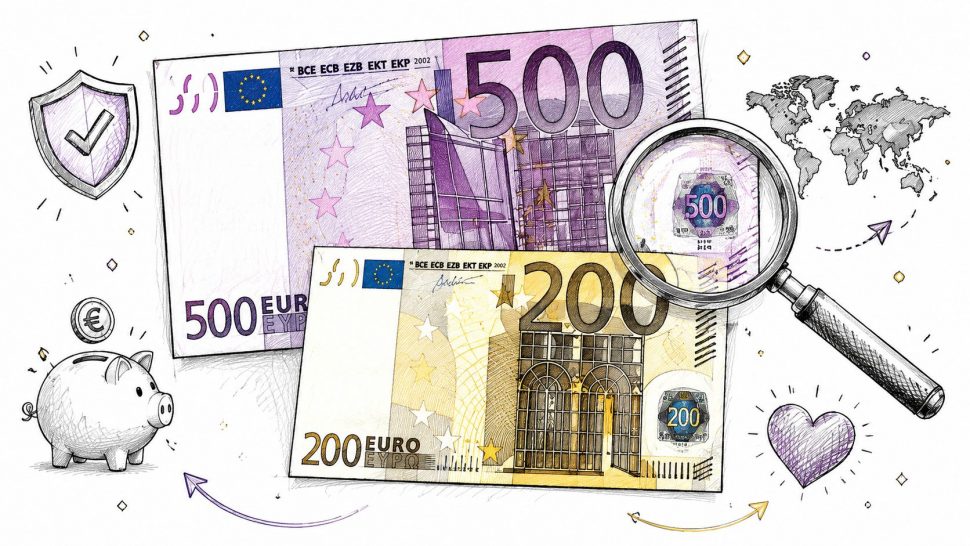
The biggest euro note by value was the €500 note. It is no longer issued, but it remains legal tender and can still be exchanged, while the biggest euro note currently in production is the €200 note.
That distinction matters more than is broadly understood. In the UK, many people asking about the biggest euro note aren't just curious about denominations. They've found a large purple note in a wallet, a drawer, a holiday purse, a charity cash tin, or a business float, and they want to know one thing. Can I still turn this into pounds?
The short answer is yes, but the practical route matters. A €500 note isn't the kind of foreign cash most high street banks or standard travel money desks want to handle. If you're holding one, the primary concern isn't whether it has value. It does. The issue is finding a straightforward way to exchange it, especially if it's mixed in with other leftover foreign currency, coins, or older withdrawn notes.
What Is the Biggest Euro Note
A common UK scenario is finding a large purple euro note in an old wallet or travel purse and wondering whether it can still be turned into pounds. In almost every case, that note is the €500 note.

The direct answer
The biggest euro note by face value was the €500 note. It sat at the top of the euro banknote range and was also the physically largest note in the original series.
For practical purposes, there are really two answers. If you mean the highest denomination ever issued, it is the €500 note. If you mean the highest euro note still being issued today, it is the €200 note.
That difference matters for anyone holding old travel money in the UK. A discontinued note can still hold full face value, but it often becomes harder to exchange through the usual high street channels.
Why people ask this question
This question usually comes from a real problem, not a trivia search. The note has turned up at home, in a till, among holiday leftovers, or in a relative's belongings, and the holder wants a clear answer on what to do next.
The usual concerns are straightforward:
- Is my €500 note still valid? You need to know whether it still has value.
- Can I exchange it in the UK? You want pounds, not another explanation of euro denominations.
- Why did a bank or travel money desk refuse it? You need the reason, not guesswork.
The practical point is simple. A note can remain valid while still being awkward to exchange. That is exactly why the €500 note catches people out. The challenge is rarely its value. The challenge is finding a service willing to handle a high-value, no-longer-issued foreign banknote without sending you from one counter to the next.
The Story of the €500 Note
A common UK scenario is simple. Someone finds a single purple €500 note in a drawer, assumes it is either rare or worthless, then gets a surprise when a bank or travel money counter refuses it.

What made it distinctive
The €500 note stood out because it combined three things in one banknote. It carried the highest face value in the euro range, it used a distinctive purple design, and it was larger than the other notes in the original series.
That made it memorable, but not especially common in everyday spending. In practice, many people encountered one only occasionally, often through travel money, cash-based businesses, or older savings kept aside in euros.
Why it was stopped
The European Central Bank decided to stop issuing the €500 note because high-denomination notes are harder to monitor in circulation and less useful for normal retail payments than smaller denominations. The phase-out happened over time rather than overnight, which is one reason the note still causes confusion.
The practical point is the one UK holders need to know. The note was discontinued, but it was not cancelled.
A genuine €500 note still retains its face value and remains legal tender within the euro area. National central banks in the euro system can still exchange it. That legal status matters, because many refusals in the UK are based on policy and risk controls, not because the note has become invalid.
Why that matters in the UK
For someone in Britain, the problem is usually access, not value.
High street banks often do not want to handle a discontinued foreign note with a high face value. Some no longer offer foreign cash exchange at all. Others only deal with existing account holders, current travel money stock, or notes they can place easily through their own channels. A €500 note fails that test in many branches because it is large, uncommon, and outside normal day-to-day demand.
The euro banknotes page from the Central Bank of Ireland explains that euro banknotes are legal tender across the euro area. That confirms the note still matters as money. It does not mean every UK counter is willing to buy it.
That gap between legal validity and practical acceptance is what catches people out.
Typical examples include:
- a traveller finding an old €500 note after several trips
- a family sorting a relative's belongings and uncovering stored euros
- a charity receiving one in a foreign currency donation
- a retailer or cash handler spotting one among mixed notes
In each case, the sensible next step is to use a specialist currency exchange route that accepts discontinued and harder-to-place foreign banknotes, rather than relying on a standard bank counter.
Comparing the Highest Value Euro Banknotes
The easiest way to clear up confusion is to compare the old top denomination with the current top denomination in circulation.
The note still in production
The largest physical euro note in the current Europa series is the €200 note, which measures 153 × 77 mm and weighs about 1.1 g, according to the European Central Bank's euro banknotes information. That makes it smaller than the old €500 note.
So if someone says, “What's the biggest euro note now?”, the answer is €200. If they ask, “What was the biggest euro note ever?”, the answer is €500.
€500 vs €200 note comparison
| Feature | €500 Note | €200 Note |
|---|---|---|
| Face value | €500 | €200 |
| Status | No longer issued | Currently in production |
| Original / current series role | Highest denomination in first euro series | Highest denomination in current Europa series |
| Physical size | 160 × 82 mm | 153 × 77 mm |
| Colour | Purple | Yellow-brown |
| Typical UK exchange experience | Often harder to place on the high street | Usually easier than a €500, though policies vary |
What this means in practice
If you're holding a €200 note, you're dealing with a current denomination. If you're holding a €500 note, you're dealing with a valid but discontinued denomination.
That difference affects:
- Acceptance because some desks don't want non-issued notes
- Checking because staff may be less familiar with a note they rarely see
- Processing because larger denominations often trigger extra handling care
The denomination isn't the only issue. Familiarity matters. Staff are more comfortable with notes they still see regularly.
For people trying to exchange leftover currency, this is why mixed batches can be awkward. A standard exchange counter might be fine with current notes, less comfortable with old notes, and not interested in foreign coins at all. A specialist service is useful because it treats the whole bundle as one exchange task instead of making you split it into “easy money” and “problem money”.
Why Banks Wont Exchange Your High-Value Euros
People often assume banks are the safest and simplest place to take a €500 note. In practice, they're often the least helpful option for awkward foreign cash.
Why the high street says no
At a system level, euro cash handling is huge. Giesecke+Devrient reports euro circulation rising from 7.8 billion notes in 2002 to 27.6 billion notes by November 2021, with estimated value rising from €246 billion to about €1.5 trillion. The broader euro cash system also includes more than 30 billion banknotes in circulation worth more than €1.5 trillion, which helps explain why handling and verifying phased-out denominations is complicated, as described in this overview of euro cash circulation growth.
A local branch or standard bureau doesn't operate at that system level. It usually wants simple, fast, low-friction transactions.
A discontinued high-value note creates the opposite:
- Extra verification needs because staff may not see that denomination often
- Operational friction because the note may need specialist routing
- Low appetite because many banks no longer want to process unusual foreign cash at branch level
It's not just about €500 notes
The same pattern shows up with other awkward currency types:
- foreign coins
- old series banknotes
- withdrawn notes
- mixed unsorted holiday cash
- obsolete currencies from before a currency change
That's why many people end up searching for where can I exchange foreign currency after trying a bank first.
What works better
Banks work best when you have common, current notes in a currency they actively handle. They don't work well when you have edge cases.
A specialist exchange route is usually better if your cash is any of the following:
- Unsorted: a pouch of coins and notes from several trips
- Older: notes no longer commonly seen
- Withdrawn: still valid or exchangeable, but not current issue
- Mixed source: charity collections, airport collections, or business takings in error
The practical lesson is simple. Don't treat unusual foreign cash like standard travel money. It needs a different workflow.
A Simple Way to Convert Foreign Coins and Banknotes
If you've got a €500 note plus other leftover holiday cash, the easiest route is usually to handle the whole lot together instead of trying to place each item separately.

A practical step-by-step process
Gather everything first
Put all your foreign cash in one place. Include euro notes, foreign coins, old notes, and any withdrawn currency you've been meaning to deal with; people often focus on one standout note and forget the rest of the value sitting in drawers and travel bags.Check whether you need a specialist service
If your currency includes coins, older notes, or a discontinued denomination such as the €500 note, don't assume a bank will want it. Specialist providers are particularly useful in such cases.Use a service that accepts mixed currency
The practical advantage is simplicity. You don't want to sort every coin by country and denomination if you can avoid it. A service built for mixed cash makes it much easier to convert foreign coins and banknotes in one go.Send the currency for verification
With postal exchange, the provider checks the contents, verifies what can be exchanged, and applies the relevant rates or handling rules.Choose payment or donation
Some people want cash back into their bank account or PayPal. Others prefer to donate leftover foreign coins to charity, especially when the amount is too fiddly to manage note by note.
What a specialist route looks like
One practical option is exchange foreign coins and notes through a specialist service that accepts current, withdrawn, and obsolete currency, including mixed batches sent by post. That suits people who have one awkward euro note as well as anyone trying to exchange foreign coins, exchange leftover currency, or clear out a long-ignored collection of travel money.
Who uses this kind of service
It isn't just holidaymakers. In practice, specialist currency exchange is useful for:
- Individuals clearing out drawers, piggy banks, and travel wallets
- Charities receiving donated coins and notes from many countries
- Businesses that receive foreign cash in tills or donation points
- Airports and retailers handling traveller change that ordinary banking channels don't want
Useful habit: deal with leftover currency while you still know what it is. Once old notes and coins sit around for years, they become easier to forget and harder to sort.
The biggest benefit is removing friction. You don't need to turn unusual foreign cash into a project.
Common Mistakes to Avoid With Leftover Currency
People lose value on foreign money in very ordinary ways. It usually isn't fraud or counterfeit trouble. It's delay, assumptions, and using the wrong exchange route.
Mistakes that cost people money
Assuming a €500 note is worthless
It isn't. A note can stop being issued and still retain exchange value. Throwing it in a drawer forever, or worse, binning it, is the wrong call.Trying the same high street option repeatedly
If one bank or travel desk won't take it, trying three more similar counters often leads to the same outcome. The problem is the model, not just the branch.Sorting only the “good” money
People often separate current banknotes and leave the coins, older notes, and odd currencies behind. That leaves a lot of leftover foreign currency untouched.
Better habits
A more useful approach is:
- Identify standout items early such as high-value notes or withdrawn banknotes
- Keep mixed currency together until you know which service can handle all of it
- Act while exchange routes are clear rather than letting cash sit for years
Don't let coins become a dead pile
A common UK mistake is assuming foreign coins can't be converted at all. Many banks won't accept them, so people jump from “my bank won't take these” to “nobody will”. That isn't the same thing.
If you want to exchange foreign coins and notes, or even donate foreign coins to charity, the practical answer is to use a service designed for non-standard cash rather than a standard travel money counter.
Frequently Asked Questions
Can I still spend a €500 note in Europe?
Yes, in principle. The €500 note still holds its face value, but everyday acceptance is another matter. Many shops, hotels, and small businesses are reluctant to take it because it is a high denomination, staff may struggle to check it confidently, and few tills carry enough change. For a UK holder, spending it on a trip is possible, but it is rarely the easiest route.
Can a €500 note still be exchanged?
Yes. As noted earlier, the note remains valid and can still be redeemed through euro-area national central banks. That matters because discontinued does not mean worthless. The problem in the UK is access, not value. Many people have a perfectly valid note but no straightforward local place to change it.
Do UK banks accept foreign coins or older foreign notes?
Usually not. Most banks and standard travel money counters focus on current banknotes in actively traded currencies. Coins from other countries, withdrawn notes, and unusual denominations often sit outside their process because they are harder to verify, store, and resell. That is why specialist services are often the practical option for mixed or non-standard cash.
Can I send coins and notes together?
Often, yes, if you use a specialist provider that handles mixed currency. That saves time if you have a drawer full of travel leftovers and one €500 note sitting alongside small euro coins or older notes from past trips. A standard high street counter will usually want only clean, current notes. A specialist route is built for the awkward stuff.
What if my leftover currency includes withdrawn or obsolete money?
It may still be worth something. Some older notes can still be redeemed, and some withdrawn currencies can still be handled through specialist channels depending on the issuing country and note type. The practical step is to check before assuming the money has no value.
Do I need to sort the coins myself?
Not always. Some services accept unsorted bags of mixed currency, which is useful if you have coins from several countries and do not want to spend an evening separating them by denomination. That is often the easiest answer for families who keep all their holiday money together and just want it turned into pounds.
Can I donate leftover foreign currency to charity instead of receiving the money myself?
Yes. For small amounts, donation can make more sense than claiming the proceeds. People often choose this for jars of travel change, old holiday coins, or mixed notes that have been sitting at home for years.
How long does payment take with an online specialist service?
It depends on the provider and the payment method you choose. In most cases, the service needs to receive the currency, count and verify it, then release payment. That extra handling is the trade-off for being able to deal with cash that banks and travel desks often refuse.
If you are holding a €500 note in the UK, the useful question is not whether it is still valid. It is how to turn it into pounds without wasting time on counters that were never set up to handle it.
If you want a straightforward way to deal with euro notes, foreign coins, old banknotes, or mixed travel cash, We Buy All Currency offers a practical route to exchange leftover currency or turn it into a charity donation without needing to rely on a bank that may not accept it.