
British Half Pennies Their Value History and How to Exchange Them
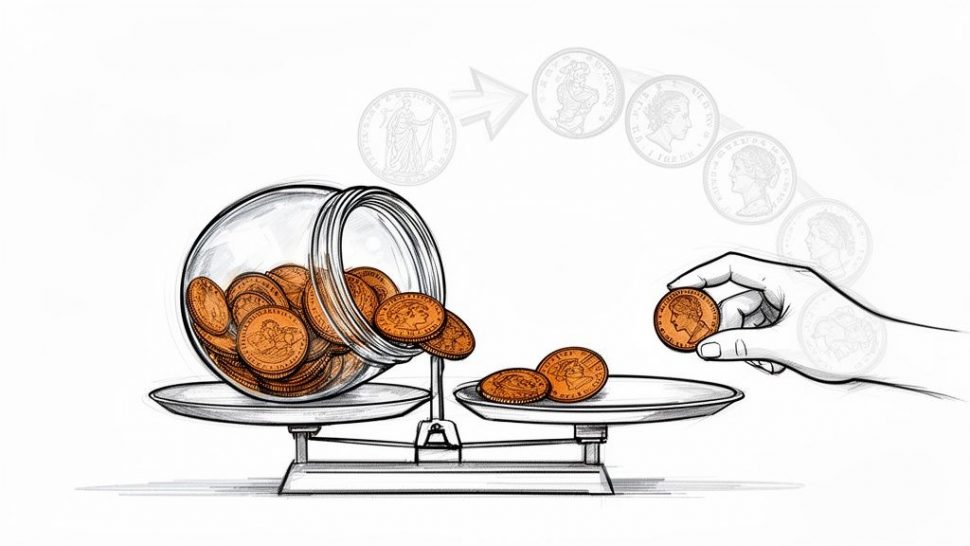
Posted by: Ian Stainton • 24 Feb 2026
Ever found a forgotten jar of old, heavy copper coins tucked away in a drawer or attic? There’s a good chance you’ve stumbled upon a stash of old British halfpennies. It’s a common discovery, and it immediately begs the question: are they worth anything?
While most are quite common, a few rare varieties can be genuine hidden gems. The real challenge, though, is telling them apart. Sifting through hundreds of coins can feel like a mammoth task for anyone who isn't a seasoned collector.
What Should I Do with My Old British Halfpennies?

Discovering a collection of old halfpennies is like unearthing a little piece of history. For centuries, these coins were part of daily life across the UK. But since they were withdrawn from circulation, countless millions now sit in jars and boxes, their value a mystery. While the idea of hunting for that one rare date is exciting, the reality is often a complicated and very time-consuming process.
Thankfully, there’s a fast, easy, and hassle-free way to find out what they’re worth and turn them into cash. Our service is designed specifically for these kinds of unsorted collections, which means there’s no need to sort your coins by date, monarch, or condition.
From Pocket Change to Payout
We offer a 100% guaranteed service to exchange foreign coins, leftover foreign currency, and obsolete currency like the British halfpenny. The process couldn't be easier: just gather your coins, use our online calculator for an instant estimate based on their weight, and send them to us. We do all the hard work of sorting and checking.
Our credibility is built on trust and transparency. We are the chosen currency exchange partner for major UK brands, including well-known charities, supermarkets, airports, and even police forces who trust us to handle their collected currency.
This guide will give you a bit of background on the fascinating history of the British halfpenny, helping you understand what you're holding. More importantly, it will show you the most straightforward way to turn that forgotten change into real money. Whether you want to exchange foreign coins and notes or donate foreign coins to charity, we provide a secure and efficient solution.
To get started, it helps to know the basic eras these coins fall into. The table below gives you a quick overview to help you broadly categorise what you might have.
A Quick Guide to British Halfpenny Eras
This table summarises the main periods of the halfpenny, the monarchs of the time, and the key features to look for.
| Era | Reigning Monarch(s) | Key Characteristics & Metals |
|---|---|---|
| Early Modern (1672-1799) | Charles II to George III | Primarily copper; early issues included tin with a copper plug to deter counterfeiters. |
| The 'Cartwheel' Era (1797) | George III | Famous for its large size and raised rim, produced at the Soho Mint using steam power. |
| Victorian Era (1838-1901) | Queen Victoria | Transitioned from copper to smaller, lighter bronze coins from 1860 onwards. |
| 20th Century (1902-1967) | Edward VII to Elizabeth II | Bronze coins featuring iconic reverse designs like Britannia and later, the Golden Hind. |
Knowing these basic categories can give you a rough idea of the age of your coins, but remember, you don't need to be an expert. Our weight-based system handles all the details for you, making the exchange process as simple as possible.
The Story of the British Halfpenny Through Time
Every British halfpenny you hold is a miniature time capsule, telling a small part of Britain's long and fascinating story. These coins were far more than just pocket change; they were a direct reflection of the nation's economy, its technological leaps, and even its social struggles. The journey of the halfpenny began not as a coin in its own right, but as a physically cut silver penny—literally chopped in half to make smaller change.
This makeshift solution eventually made way for dedicated coinage. The first copper halfpennies arrived under Charles II in the late 17th century, a huge step towards creating a reliable currency for everyday transactions. However, these early coins were plagued by a persistent and frustrating problem: forgery. To fight back, the Crown experimented with some truly innovative designs.
From Tin Plugs to Steam Power
One of the most interesting early experiments was the tin halfpenny, issued between 1685 and 1692 under James II and William & Mary. These unusual coins featured a central copper plug, making them much harder for counterfeiters to replicate. Curiously, the dates weren't stamped on the front or back but were inscribed along the edge—a security feature that was quite advanced for its time.
Despite these efforts, forgery remained rampant. By the 18th century, the problem had spiralled into a full-blown crisis. The Royal Mint simply couldn't produce enough small change to keep up with a growing population, creating a vacuum that counterfeiters were only too happy to fill.
Halfpennies from the 18th and early 19th centuries tell a dramatic story of forgery epidemics and the minting innovations that followed. While George II's official issues from 1729-1754 were common, the period after was chaotic. It's estimated that by the 1770s, a staggering 80% of halfpennies in circulation were fakes, prompting industrialist Matthew Boulton to design new, harder-to-forge coins. You can learn more about the minting challenges that shaped UK coinage by reading about sovereign mintage history.
The Industrial Revolution brought not only a greater need for coins but also the solution to the forgery crisis. The entrepreneur Matthew Boulton, working with engineer James Watt, developed a steam-powered coining press at his Soho Mint in Birmingham. This incredible technology allowed for the mass production of coins with a quality and consistency that was simply impossible for counterfeiters to match.
The Famous 'Cartwheel' and Beyond
The most famous product of Boulton's mint was the 1797 George III "Cartwheel" halfpenny. Its large size, heavy weight, and distinctive raised rim made it instantly recognisable and incredibly difficult to fake. It was a powerful statement of industrial might and a symbol of Britain's newfound commitment to a stable currency.
The 19th century saw another major change. In 1860, during Queen Victoria's reign, the halfpenny transitioned from heavy copper to a lighter, more durable bronze. This new, smaller coin, often nicknamed a "bun penny" because of the Queen's hairstyle, set the standard for the next hundred years. In fact, the metal composition would remain largely unchanged until the coin was finally demonetised.
Each of these shifts—from cut silver to plugged tin, from hand-struck copper to steam-pressed bronze—was driven by the practical needs of the British people and their economy. Wartime metal shortages, economic booms, and technological breakthroughs all left their mark on the humble British halfpenny. When you look at these coins, you're not just seeing old money; you're seeing a direct link to the history that shaped the modern world.
This historical weight is part of what makes even a large, unsorted collection of leftover foreign currency so interesting. Whether you want to convert foreign coins and banknotes or explore other options, understanding their past adds a whole new layer to their story.
How to Identify Your British Half Pennies
So, you’ve stumbled upon a pile of old copper-coloured coins. They might all look the same at first glance, but each one holds a piece of British history. Figuring out what you have is a bit like being a coin detective, and it’s much easier than you might think. Let's walk through the simple steps to identify your British halfpennies.
The whole process just boils down to looking at both sides of the coin for a few key details. You don't need to be an expert. We’ll break it down into manageable chunks, and you won’t need any special tools, though a magnifying glass can definitely help bring worn, older coins back to life.
This image shows just how much the halfpenny changed over the centuries, from a simple piece of cut silver to the familiar bronze coin we know today.

As you can see, the coin’s production evolved dramatically over time, often to meet the growing needs of the economy or to outsmart counterfeiters.
Step 1: Look at the Head Side
Start with the obverse, or the 'heads' side, which features the monarch's portrait. This is your first and most important clue, as the ruler’s face will instantly narrow down the coin's era.
Many of the halfpennies you’ll find will feature Queen Victoria. Because her reign was so long, her portrait changed over time, giving you even more clues:
- 'Young Head' (1838-1860): This shows a youthful Queen with her hair tied in a neat bun. These coins are made of copper.
- 'Bun Head' (1860-1894): Here, you’ll see a more mature Victoria, but she still has her hair in a bun. These were the first bronze halfpennies.
- 'Veiled Head' or 'Old Head' (1895-1901): This portrait depicts an elderly, veiled Queen, marking the final years of her reign.
Other common monarchs you'll come across include George V (1911-1936), George VI (1937-1952), and a young Queen Elizabeth II (1953-1967).
Step 2: Find the Date
Once you know the monarch, flip the coin over to the reverse (the 'tails' side). The date is almost always at the bottom, tucked below the main design—be it Britannia or the Golden Hind. On many Victorian coins, for instance, you'll find the date directly beneath Britannia’s shield.
On some really worn coins, the date might be faint or rubbed off completely. That's perfectly normal and doesn't make the coin worthless, especially if you plan to exchange foreign coins and notes in bulk. Our service is designed for exactly this situation, where individual dates aren't important.
Sometimes, a tiny detail near the date tells a much bigger story. For example, when the Royal Mint was under pressure, the Heaton Mint in Birmingham stepped in to help. These coins are marked with a small 'H' below the date. The Heaton Mint produced all 1876 halfpennies and also helped out in 1874-1875 and 1881-1882, making that little mark a fascinating piece of minting history.
Step 3: Examine the Reverse Design
The picture on the back is another great identifier. For over 200 years, the seated figure of Britannia was the iconic image on the British halfpenny, a powerful symbol of the nation's naval strength.
This classic Britannia design is a hallmark of British currency, but it wasn't the only one. In 1937, a bold new design was introduced for the halfpenny of King George VI: Sir Francis Drake's famous ship, the Golden Hind. This celebrated England's maritime heritage and remained on the coin until it was last minted for circulation.
Even if you can’t make out every last detail, just identifying these three things—the monarch, the date, and the reverse design—will give you a fantastic idea of what’s in your collection.
And remember, while this process is great for satisfying your own curiosity, you don't need to do any of it to exchange your coins with us. There's absolutely no need to sort anything. If you want to see just how simple we make it for large, mixed collections, check out our UK coin weight calculator. It’s a fast and hassle-free way to turn your old coins into cash.
Understanding the Value of Your Halfpenny Collection
So, you’ve sorted through your coins and figured out which halfpennies you have. Now for the big question: what are they actually worth? The value of any old coin really comes down to a simple mix of three things: rarity, condition, and what collectors are looking for. Getting your head around these will show you why one halfpenny might be a collector's prize while another is mostly worth its weight in bronze.
Rarity is just a classic case of supply and demand. If a coin had a very small production run, or if only a handful have survived the test of time, it's going to be in high demand. On the flip side, a coin that was minted in the hundreds of millions is going to be common as muck and less valuable on its own.
The British halfpenny has a really interesting story here. The number of coins made often jumped up and down depending on what was happening in the country—like big increases to keep up with growing trade and cities. After you've identified your halfpennies, figuring out their market worth is the next step. A big part of learning how to price items for resale is getting a feel for this rarity and condition.
Rarity and Mintage Numbers
Most of the halfpennies you’ll find from the 20th century were made in absolutely massive numbers. Take 1943, for example—over 240 million were struck to keep the wartime economy going. This is why pulling a random halfpenny out of a jar probably won't make you rich overnight.
But don't lose hope! Certain dates and odd variations are incredibly scarce. One of the most famous is the 1902 'Low Tide' halfpenny. On some coins from this year, the sea around Britannia is noticeably lower, showing more of the rock she’s perched on. It’s a tiny detail, but it’s exactly the kind of thing that gets collectors excited and pushes the price way up.
Other rarities include years with tiny mintages, like 1876, or coins with obvious minting errors. It’s important to be realistic, though—the vast majority of coins in any big, unsorted pile will be the common ones.
Here’s a quick look at how wildly the production numbers could swing over the years.
| Year | Monarch | Approximate Mintage | Historical Context |
|---|---|---|---|
| 1876 | Victoria | 1,568,000 | A notoriously low mintage year, making these coins scarce. |
| 1902 | Edward VII | 26,645,000 | Includes the rare 'Low Tide' variety sought by collectors. |
| 1943 | George VI | 240,480,000 | Massive production to meet the demands of the WWII economy. |
| 1967 | Elizabeth II | 146,491,200 | The last year of general circulation before decimalisation. |
This table shows the dramatic fluctuation in halfpenny production numbers for selected years, illustrating how historical events influenced coin supply and rarity.
As you can see, a coin from 1876 is naturally going to be a lot harder to find than one from 1943, which has a direct impact on its value.
Condition Is King
Even the rarest coin in the world won’t be worth much if it’s in terrible shape. Collectors are sticklers for condition and use a grading scale to describe how well-preserved a coin is. This ranges from 'Poor' (so worn you can barely tell what it is) to 'Uncirculated' (looks like it just rolled off the press).
- Fine (F): You can see most of the main details, but it's clearly been around the block a few times.
- Very Fine (VF): More detail is visible, and some of the highest points of the design are still quite sharp.
- Extremely Fine (EF): Shows just a tiny bit of wear on the very highest points.
- Uncirculated (UNC): Perfect. It never saw a pocket or a cash register and has its original mint lustre.
The price difference between these grades can be staggering. A common halfpenny in Fine condition might only be worth a few pence, but find that same coin in Uncirculated condition, and it could be worth a surprising amount to someone trying to complete a pristine collection. For a deeper dive into how this affects pricing, you might find our guide on pre-decimal coin values helpful.
The Power of Bulk Value
So, what do you do with that giant jar full of common, circulated halfpennies? While they might not be worth much one by one, they absolutely have value when you put them all together. This is where their metal content becomes the star of the show. A big pile of bronze coins, when weighed, can add up to a tidy sum.
This is the secret to turning what looks like a pile of old change into a meaningful payout. You don't need to find a rare date. The combined weight of hundreds or thousands of common coins creates its own value, and our service is specifically designed to make cashing in on this easy.
It’s a simple, no-fuss way to turn a tedious sorting job into a quick and profitable task. Instead of squinting at dates for hours, you can simply exchange foreign coins and old currency based on their total weight. It's fast, easy, and 100% guaranteed. We are trusted by major UK brands, including leading charities, supermarkets, and airports, to handle their currency needs.
The Easiest Way to Exchange Your Old Coins for Cash

So, you’ve dived into the fascinating world of British half pennies and now you're wondering what to do with your collection. It’s one thing to identify a few interesting coins, but the thought of sorting through hundreds, maybe even thousands, can feel like a mammoth task. That’s where we come in with a refreshingly simple way to turn that old currency into cash, minus the stress.
Our service is built to be fast, easy, and completely hassle-free. We know your time is precious, so we’ve done away with the most tedious part of the whole process. There is absolutely no need to sort your coins by date, monarch, condition, or even country. Just pop them all in together.
We specialise in unsorted collections, making our service the perfect fit for that heavy jar of coins you’ve had tucked away for years. Whether it’s a pile of old halfpennies, a bag of leftover foreign currency, or any other obsolete currency, we handle it all with ease.
Our Hassle-Free Exchange Process
We’ve created a system that lets you stay in control while we do all the heavy lifting. It’s built on transparency and simplicity, so you know exactly what’s happening from start to finish. Plus, our 100% satisfaction guarantee means you can send your currency to us with complete confidence.
Here’s how our straightforward process works:
- Get an Instant Quote Online: Our unique online currency wizard is designed for mixed, unsorted coins. Simply weigh your whole collection of British half pennies and any other currency, pop the weight into our calculator, and get an immediate estimate.
- Send Us Your Currency: Once you're happy with the quote, just pack up your coins and notes and post them to us. We give you clear instructions to make sure everything arrives safely.
- Verification and Payment: As soon as your parcel lands with us, our expert team gets to work verifying and sorting it all for you. We then confirm the final value and send your payment, typically within five working days.
It really is that simple. No hidden fees or charges, just a clear and efficient way to get cash for your old money. For a more detailed look, check out our full guide on the easy way to exchange old British coins and notes.
A Service Trusted by Major UK Brands
Building trust is at the heart of everything we do. We’re proud to be the official currency exchange partner for some of the UK’s most well-known brands. Our partners include major supermarkets, airports, national charities, and even police forces—all of whom rely on our secure and professional service.
This trust is earned through our commitment to providing a transparent and reliable service. When you choose to exchange foreign coins, you’re using the same credible platform that major organisations depend on for their own currency handling needs.
This credibility gives you peace of mind, knowing your currency is in safe hands.
More Than Just an Exchange
Our service is about more than just cashing in. Many of our customers use their old currency to make a real difference. Through our platform, it’s incredibly simple to donate foreign coins to charity. You can send in your collection and choose to direct the proceeds to one of our partnered charities, turning forgotten change into a valuable donation.
Whether you want to convert foreign coins and banknotes for yourself or use them to support a good cause, we provide a secure and effective solution. Our goal is to make the entire experience feel effortless, rewarding, and completely risk-free. Ready to get started? Visit our homepage and see what your old currency could be worth.
Your Questions About British Half Pennies Answered
Stumbling across a forgotten tin of old coins is always exciting, but it usually comes with a lot of questions. Are they worth anything? How do I even begin to figure out what to do with them? Is it going to be a massive hassle? We get it. Here are some straightforward answers to the questions we hear most often about British halfpennies.
Our aim is to show you just how simple and worthwhile it can be to turn that old metal into proper cash. These FAQs cover the practical stuff and hopefully put your mind at ease about using a professional exchange service like ours.
Do I Need to Sort My Half Pennies by Date or Monarch Before Sending Them?
Absolutely not! In fact, that's one of the best parts of our service. We know that sifting through hundreds, maybe thousands, of old coins looking for dates and monarchs is a huge, tedious job. Our entire process is designed to save you from that headache.
You can send us your British halfpennies and any other leftover foreign currency all mixed together. Don't worry about separating anything. Our online wizard is built to give you an instant quote based on weight, which is perfect for mixed collections.
Just pop all your coins on the scales, get your quote, and send them off. Our team of experts does all the sorting and checking for you when they arrive, saving you hours of painstaking work. It really is the easiest way to exchange foreign coins and notes.
Are My Old, Worn British Half Pennies Worth Anything?
Yes, they definitely are. While serious coin collectors are usually looking for coins in near-perfect condition, the bronze in even the most worn-out halfpennies has real metallic value. A single grubby coin might not seem like much, but a whole bag or jar of them can add up to a surprisingly hefty payment.
We exchange pre-decimal British coins no matter what condition they're in. Because we value common coins like these by weight, you don't need to stress about the scuffs, scratches, and general wear from decades of rattling around in people's pockets.
This is what makes our service so useful for converting foreign coins and banknotes that might otherwise be seen as worthless. We take what looks like a pile of old metal and turn it into real money in your bank account, quickly and securely.
How Can I Turn My Half Pennies into a Charitable Donation?
We love this question, and we've made it incredibly easy to support fantastic causes with your old currency. Many of our closest partners are major UK charities who rely on donations of foreign and obsolete coins to fund their amazing work.
When you use our service, you’ll see an option to donate foreign coins to charity. All you need to do is select one of our charity partners, and we'll direct the value of your exchange straight to them.
You send your currency to us just like you normally would, and we handle the rest. We make sure the full value of your old halfpennies gets to the charity you've chosen, making a real difference. It’s a fast, secure, and wonderfully simple way to give back.
What Happens If I'm Not Happy with the Final Exchange Value?
Your trust is the most important thing to us, which is why we offer a 100% happiness guarantee. After we've received your currency, sorted it, and verified everything, we'll confirm the final exchange value with you.
If, for any reason at all, you're not completely happy with our offer, just let us know. We will send your currency straight back to you, completely free of charge.
There are no hidden fees, no catches, and zero risk. This guarantee is why major UK brands—from charities and supermarkets to airports and even police forces—trust us. We've built our service to be fast, easy, and totally secure from start to finish, giving you complete peace of mind.
Ready to turn that old collection into cash or a valuable donation? With We Buy All Currency, it's fast, simple, and guaranteed. Forget about sorting—just weigh your coins and get an instant quote online. Join thousands of happy customers and major UK brands who trust our hassle-free service.