
Canadian 50 Dollars: A UK Guide to Exchange & Value 2026
Posted by: Ian Stainton • 27 Jun 2026
The easiest way to deal with a Canadian $50 bill in the UK is to use a specialist online service that accepts both current polymer notes and older paper notes. That matters because the modern note was introduced in 2004, and older versions can be harder to place through ordinary exchange routes.
You might have found one in a travel wallet, a drawer, a charity collection tin, or mixed in with leftover holiday money from a long-forgotten trip. At first glance it looks simple enough. It's cash, so surely a bank or bureau will take it.
In practice, a Canadian 50 dollar bill can be more awkward than people expect. Some places don't handle foreign coins at all. Others only want current notes in perfect condition. Older or less familiar notes often get refused outright, even when they still have value.
That's why it helps to know exactly what you're holding, how to check it, and which exchange route works in the UK.
Your Guide to the Canadian 50 Dollar Bill
A crisp red note turns up while you're clearing out a drawer. You remember it from a Canadian trip, but not much else. Is it still valid? Is it current? Can you pay it into a UK bank account? And if it's old, has it become just a souvenir?
The best answer is often simple. A specialist online currency service is usually the most practical way to exchange foreign coins and banknotes, especially if you've got a mix of current notes, older issues, or leftover foreign currency from several countries.
Practical rule: If your money is foreign, older, mixed, or includes coins, don't assume a high street bank will help.
That's especially relevant with Canadian 50 dollars. This denomination looks straightforward, but readers often get stuck on two points:
- Which version do I have
- Will a normal exchange counter accept it
The confusion is understandable. Canada has issued different note series over time, and UK exchange options tend to be selective. If you're trying to exchange leftover currency, the easiest path is usually a specialist route that can handle coins, notes, and withdrawn money together.
A few common situations bring people here:
- Leftover travel money after a holiday or work trip
- An older note found among family papers
- A mixed bag of foreign cash that includes Canadian dollars
- Charity or business collections that contain notes and coins from several countries
If your goal is to convert the note into pounds without a lot of back and forth, the key is identification first, exchange second. Once you know which Canadian $50 you have, the rest becomes much easier.
A Visual History of the Canadian 50 Dollar Note
You pull a Canadian $50 from a drawer, glance at the portrait, and assume the job is simple. Then the practical question appears. Is this the current note, an older paper issue, or the kind of bill a UK exchange counter may hesitate over because of age or counterfeit concerns?
That question matters more with a Canadian $50 than many people expect. Canada has issued several versions over time, and the material changed from paper to polymer. If you identify the series first, you avoid the common mistake of treating every Canadian $50 as equally easy to exchange.
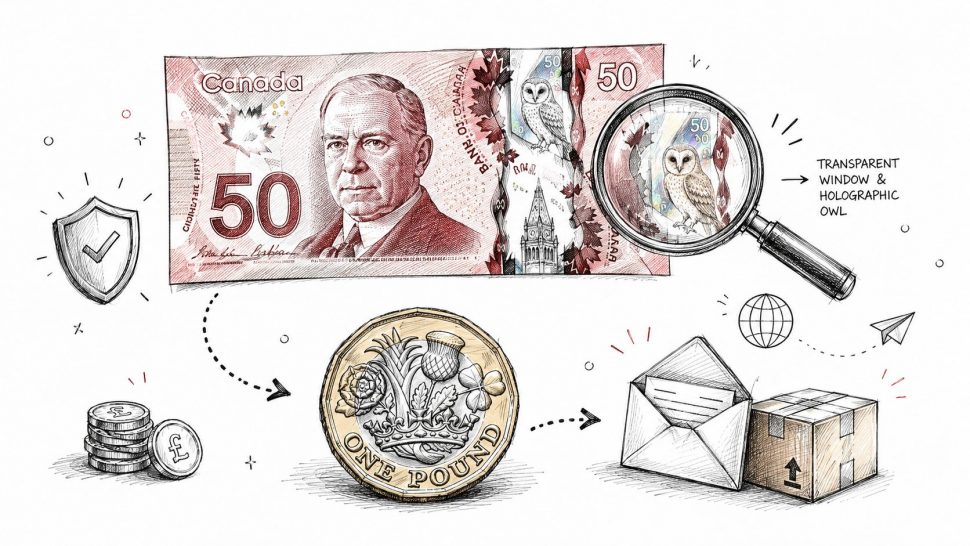
The current Canadian $50 still shows William Lyon Mackenzie King, but the polymer version of the note was issued in 2012, not 2004. The 2004 $50 belonged to the earlier Canadian Journey paper series. The later Frontier series introduced polymer notes, and the $50 entered that series in March 2012.

How to recognise the current note
The easiest first check is the material. A polymer note feels smooth and flexible, more like a durable film than traditional banknote paper. An older paper note feels fibrous and more familiar if you have handled older cash before.
The current Canadian $50 is usually identified by:
- A red overall colour
- A polymer body rather than paper
- The portrait of William Lyon Mackenzie King
- Built-in modern security features, including transparent elements
If you want a side-by-side reference, this page for the Canadian 50 dollar bill polymer banknote issued 2012 helps confirm whether your note matches the current style.
Why older versions cause exchange problems
Older Canadian $50 notes can still look official, clean, and perfectly usable at first glance. That is where people get tripped up. A note can be genuine and still be harder to exchange in the UK if it belongs to an older series or if a cashier is cautious about higher-denomination foreign notes.
The $50 denomination also attracts more scrutiny than small notes. For an exchange desk, an older paper $50 can raise two separate questions at once. First, is it still a valid issue? Second, is it easy to authenticate? That combination is one reason a specialist service is often more practical than a standard counter.
A Canadian $50 can keep its value while becoming less convenient to exchange through ordinary retail channels.
The visual clues that help most
Start with the obvious clues before you worry about fine details. You are sorting the note into the right family first, much like identifying the model of a car before checking the engine.
| Feature to check | What it usually means |
|---|---|
| Smooth, plastic-like material | Current polymer issue |
| Paper texture | Older paper series |
| Red overall tone | Standard colour for the denomination |
| Portrait of William Lyon Mackenzie King | Matches modern and several later historical issues |
| Clear window or integrated modern security elements | Newer polymer design |
That quick check does not replace an authenticity test, but it gives you a much clearer starting point. Once you know whether you have a 2012-era polymer note or an older paper version, the exchange route becomes easier to judge.
How to Check if Your Canadian 50 Dollars Is Real
You are at an exchange counter in the UK, the clerk pauses over your Canadian $50, and suddenly a simple note feels like a problem. That hesitation usually comes down to one concern. A $50 note is worth enough to attract closer scrutiny, especially if the cashier is unsure whether it is genuine or from an older issue.
The good news is that you do not need specialist equipment to do a sensible first check. You are looking for a small group of features that work together, much like checking a passport. One detail on its own proves very little. Several details lining up is what builds confidence.
Start with the features that are hardest to fake
For the current polymer $50, the Bank of Canada advises a simple method often described as feel, look, and tilt. The note should not feel like ordinary paper, and its security features should be built into the note rather than sitting on top of it.

Run a finger lightly over the printed areas. Genuine notes have raised ink in places, so the surface should not feel completely flat. Then check the large clear window. On a real polymer note, that window is part of the note itself. It should look clean and integrated, not glued on like a strip of packaging film.
Next, inspect the print and window
A counterfeit often gets the general colour right but struggles with the fine details. Sharp print matters.
Look for:
- Clean, precise lines around the portrait and numbers
- A transparent window that is smooth and properly embedded
- Metallic details inside the window
- No bubbling, peeling, cloudy patches, or layered plastic
The Bank of Canada explains the security elements used on Canadian polymer notes in its overview of bank note security features. That guidance is useful because it focuses on what a genuine note should physically do in your hand, not just how it looks in a photo.
Then tilt the note slowly
This step catches a lot of problem notes.
Hold the $50 under normal light and tilt it from side to side. The metallic elements in the transparent area should change appearance as the angle changes. If everything stays dull and static, treat that as a warning sign. A real note is designed to react to movement, which is one reason exchange counters pay close attention to this denomination.
If you have an older paper $50 rather than a polymer one, the check is different. Older notes will not have the same clear window, so trying to judge them by polymer features only creates confusion. In that case, focus on print quality, alignment, overall condition, and whether the note matches a known Bank of Canada design.
A quick rule for uncertain notes
Do not rely on just one test.
A note can feel convincing and still be wrong. It can also look old and unusual while still being genuine. If the texture, print quality, and tilt features do not agree with each other, pause before exchanging it. That is often why a Canadian $50 is harder to exchange than a smaller foreign note in the UK. The issue is not only value. It is how easy the note is for a cashier to authenticate with confidence.
Common points of confusion
Two mistakes come up often.
The first is assuming that a plastic feel means the note must be real. Counterfeiters know people expect polymer notes to feel different, so surface feel alone is not enough.
The second is comparing the note to memory. If you have not handled Canadian cash recently, memory is a weak test. A careful check of the built-in features is much more reliable and gives you a better chance of getting the note accepted at full value.
Is Your Old Canadian 50 Dollar Note Still Valuable
If your Canadian $50 is an older paper note rather than the polymer version, the answer is often yes, it may still be valuable. The harder question is what kind of value it has.
Face value and collector value aren't the same
Commonly, “value” refers to one of two things:
- Face value means the amount the note represents as money
- Collector value means what a buyer might pay because the note is unusual, old, scarce, or in exceptional condition
That difference matters. An older Canadian note may be awkward to exchange in the retail market but still worth converting through a specialist route. In some cases, collectors may care more about rarity and condition than ordinary exchange value.
What affects collector interest
You don't need to be a banknote expert to make a basic assessment. Start with the physical note in front of you.
Look at:
Condition
Crisp notes with fewer folds, tears, stains, or writing usually attract more interest than damaged ones.Series and design
Older designs can draw attention from collectors, especially if they belong to a recognised earlier issue rather than a recent common series.Serial number features
Unusual or memorable serial numbers can matter in collecting circles.Whether it's current or withdrawn in practice
A note that ordinary counters won't touch may still be exchangeable through a specialist or saleable to a collector.
Sometimes the best first question isn't “what's this worth?” but “who will actually handle it?”
Why UK banks often aren't the answer
High street banks and ordinary exchange desks usually focus on straightforward, current, resellable travel money. Older foreign paper notes fall outside that comfort zone. If you also have coins, mixed currencies, or worn notes, the chances of refusal go up further.
That's why many people looking to convert foreign coins and banknotes end up needing a specialist service instead of a familiar walk-in option. The note may still have value. The issue is access, not necessarily worth.
If you suspect your note may be collectible, don't fold it further, tape it, or write on it. If your goal is to exchange leftover currency rather than chase collector demand, keep it flat and send it through a route that handles older notes properly.
Common Mistakes to Avoid When Exchanging Currency
People often lose time, and sometimes money, by treating foreign cash like ordinary UK notes. A Canadian $50 can be current, older, collectible, or high risk from an anti-counterfeit point of view. That mix creates avoidable mistakes.

Assuming every bank accepts every note
This is probably the most common misunderstanding. In the UK, even domestic withdrawn notes can become awkward to place. After the Bank of England withdrew paper £20 and £50 banknotes on 30 September 2022, people could no longer spend them in shops or deposit them at most banks, as explained by Scotiabank's note on withdrawn paper sterling notes.
If that happens with familiar UK money, it's easy to see why older foreign notes face even more friction.
Taking foreign coins to a normal bureau
Many exchange counters don't want coins. Others only want mainstream current banknotes in selected currencies. If you've got Canadian dollars mixed with euros, US coins, or leftover holiday cash from several trips, the standard travel-money desk is usually a poor fit.
Common missteps include:
- Turning up with unsorted mixed currency and expecting a walk-in bureau to count everything
- Assuming coins have no value because one place refuses them
- Leaving old notes in a drawer for years because the first exchange attempt failed
Choosing convenience over suitability
Airport kiosks and quick-stop counters feel easy, but easy isn't always suitable. The main issue with a Canadian $50 isn't just speed. It's whether the place in front of you accepts that note type at all.
The wrong exchange route doesn't just slow you down. It can turn usable money into a long-running hassle.
A better approach is to identify the note, avoid casual assumptions, and use a route designed for exchange foreign coins and notes, including withdrawn or older currency. That's also why some people choose to donate foreign coins to charity rather than leave them unused.
How to Exchange Canadian 50 Dollars and Other Currency in the UK
If you're in the UK and holding a Canadian $50, your options aren't all equal. Banks, bureaux, and specialist postal services solve different problems. The key difference is what they'll accept.
For UK residents, the Bank of England does not exchange foreign currency. People with old or withdrawn foreign notes usually need to contact the original issuer or use a specialist exchange service, as outlined in Wise's guide to what to do with old foreign currency.
Comparing your currency exchange options
| Currency Type | High Street Bank | Exchange Bureau | We Buy All Currency |
|---|---|---|---|
| Current foreign banknotes | Sometimes | Often | Yes |
| Foreign coins | Usually limited or unavailable | Often not accepted | Yes |
| Older or withdrawn foreign notes | Often refused | Often refused | Yes |
| Mixed unsorted currency | Usually unsuitable | Usually unsuitable | Yes |
| Leftover holiday money from several countries | Limited | Limited | Yes |
That difference matters if you want to exchange foreign coins, exchange foreign coins and notes, or deal with leftover foreign currency in one go rather than splitting it into separate piles.
How the process works
A specialist postal exchange service is usually designed for convenience, especially when banks and bureaux fall short.
Get a quote online
You check what currencies are accepted and see the offered rate before sending anything.Pack your currency
You send coins, notes, and older currency together. There's no need to sort coins into perfect little stacks first.Verification takes place after receipt
The service checks the contents, authenticity, and exchange eligibility.Choose payment
Payment is made by bank transfer or PayPal.Receive funds within five working days
For this publisher, payment is issued within five working days after verification, using the methods described in the service information provided by the publisher.
Why specialist services fill the gap
Banks and exchange bureaux are built around standard travel money. They're not usually set up for:
- Withdrawn foreign notes
- Obsolete currency
- Charity collections
- Business takings received in error
- Mixed bags of coins and banknotes
That's where a specialist route becomes useful. It's also why many charities, businesses, and organisations choose dedicated services when they need to exchange leftover currency or run collections that include foreign cash.
If you want a broader explanation of the process, this guide on how to exchange foreign currency covers the basics clearly.
Frequently Asked Questions
Can I exchange Canadian 50 dollars in the UK?
Yes, usually through a specialist service. That's often the easiest route if the note is older, mixed with other currencies, or not something a standard bureau wants to handle.
Can I exchange foreign coins in the UK?
Yes, but not everywhere. Many banks and bureaux don't accept coins, which is why specialist providers are often the practical option for people trying to convert foreign coins and banknotes together.
Will my bank accept a Canadian $50 note?
It might not. Banks tend to be selective about foreign cash, and older or less familiar notes are more likely to be turned away.
Do old or withdrawn Canadian notes still have value?
Often, yes. They may still hold exchange value through a specialist route, and some older notes may also interest collectors depending on condition and type.
Can I send mixed leftover foreign currency together?
Yes. Specialist services often accept mixed currency, which is useful if you want to exchange leftover currency from several trips without sorting every coin first.
What if my Canadian note is damaged?
A damaged note may still be accepted, but it depends on its condition and whether key security features remain identifiable. Keep it flat and avoid taping or writing on it.
Can I donate foreign coins to charity instead of exchanging them?
Yes. Many people choose to donate foreign coins to charity when the amount is small or part of a wider collection of leftover travel money.
How long does payment take?
For this publisher's service, payment is issued within five working days after verification, by bank transfer or PayPal.
If you've got Canadian 50 dollars, old foreign notes, or a jar of mixed holiday money, We Buy All Currency offers a simple way to exchange foreign coins, banknotes, and withdrawn currency without the usual hassle. You can convert leftover travel money, send mixed coins and notes without sorting them, or turn unwanted cash into a charity donation, all through one specialist service built for the currencies that banks and bureaux often refuse.