
Clydesdale Bank 20 Note: Your 2026 Exchange Guide
Posted by: Ian Stainton • 15 Jul 2026
A Clydesdale Bank £20 note is valid UK currency, but it's often harder to spend outside Scotland because shops and payment systems may refuse it. If you want the simplest route, a specialist online exchange service is usually the easiest way to turn it into usable cash without the back-and-forth at tills.
You might be here because you found a Scottish note in a jacket pocket, a travel wallet, or a drawer of leftover holiday money and now you're wondering whether it still works, whether it's rare, or whether you should just exchange it. That confusion is common, especially in England, where a perfectly genuine Scottish note can still trigger hesitation at a checkout.
The good news is that this doesn't have to be complicated. Once you understand what the note is, why people sometimes reject it, and what your realistic exchange options are, the next step becomes straightforward.
Your Clydesdale Bank £20 Note Explained
You hand over a Clydesdale Bank £20 note at a till in England, and the cashier pauses. The note is genuine, but the hesitation is still common. That moment catches people off guard because many assume any UK note will work the same way everywhere in the UK.

A Clydesdale Bank £20 note is a Scottish banknote issued by Clydesdale Bank, now part of Virgin Money. It is legal currency in the UK, but that does not mean every shop, machine, or staff member has to accept it. Many people therefore get confused by the phrase "legal tender."
In everyday life, "legal tender" is often used as shorthand for "must be accepted in shops." That is not how retail transactions work. A shop can usually choose which payment methods and which notes it accepts, in the same way a café might refuse a £50 note or a card-only business might refuse cash altogether. So if your Scottish £20 note is refused in England, that usually reflects store policy or unfamiliarity, not a problem with the note itself.
That distinction matters. It explains why a valid note can still be awkward to use.
Why this one note causes so much friction
Scottish notes sit in an unusual position. They are familiar in Scotland, but less familiar elsewhere, especially at self-checkouts, in chain stores, and in places where staff are trained around Bank of England designs. A Clydesdale note can therefore feel a bit like a perfectly good key that fits fewer locks than expected.
People often end up setting these notes aside rather than arguing at the till. The same thing happens with old paper notes, leftover travel cash, and mixed coins from drawers or holiday wallets. The money may still have value, but using it in day-to-day life can be more trouble than it is worth.
Practical rule: If a note is hard to spend in ordinary shops, that does not mean it is worthless.
When exchanging it is the easier option
A specialist exchange can make sense if you want a simpler route than trying shop after shop. It is especially useful when you need to:
- Avoid repeated refusals outside Scotland
- Exchange a mix of awkward currency rather than deal with each item separately
- Convert withdrawn or older notes that high street services may not handle
- Deal with travel leftovers and loose coins in one go
For many people, that is the most straightforward answer. Instead of proving the note is valid every time you try to spend it, you exchange it through a service that already understands Scottish notes and other hard-to-place currency.
The Story and Design Behind the Note
The modern Clydesdale Bank £20 note is more than a spendable piece of plastic. It's also a small piece of Scottish identity, which is part of why people often keep one as a souvenir long after a trip ends.
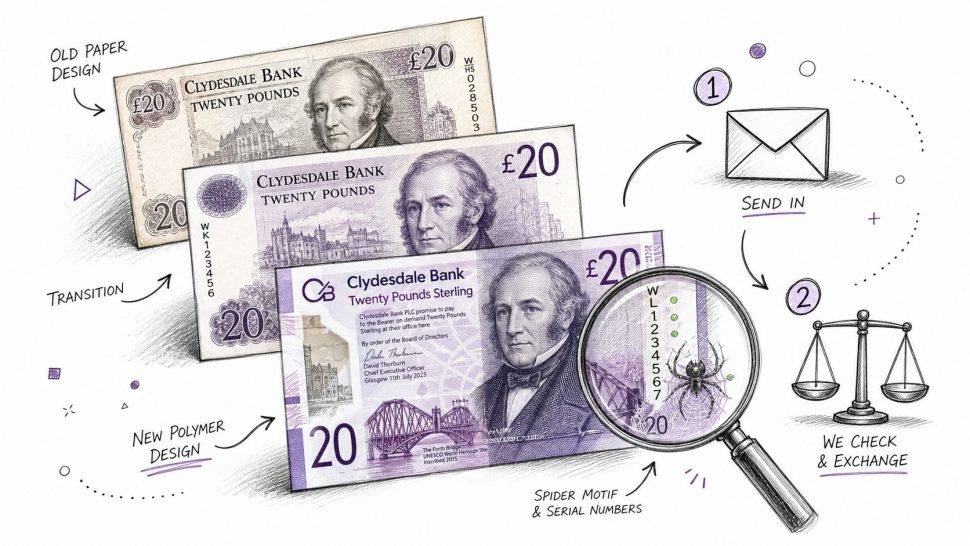
The polymer Clydesdale Bank £20 note, featuring Robert the Bruce and a spider motif, was officially launched into circulation on Thursday, 27 February 2020, as noted in this report on the note's release. It arrived during the wider move from paper to polymer notes across the UK.

Why Robert the Bruce appears on the note
Robert the Bruce is one of the most recognisable figures in Scottish history. His appearance on the note gives the design immediate cultural weight. Even if someone doesn't know every historical detail, they usually recognise that the note is meant to reflect Scottish heritage rather than copy a standard Bank of England format.
That matters for collectors and casual holders alike. A note with a strong national theme often gets kept, not spent.
What the spider motif means
The spider and web imagery adds another layer of meaning. In Scottish storytelling, the spider is associated with persistence and trying again after setbacks. That makes the design memorable, and it helps explain why the note stands out to people who aren't used to Scottish currency.
Some notes get remembered because of rarity. Others get remembered because the design is distinctive. The Clydesdale £20 often falls into the second group.
Why polymer changed the feel of the note
Polymer notes feel different in the hand. They're smoother, more durable, and more resistant to daily wear than old paper notes. For many people, this is the first clue that they're holding a newer issue rather than an older withdrawn one.
If you're assessing what you've got, that physical difference helps:
- Polymer note usually means a modern plastic-style issue
- Paper note usually means an older issue that may need a different exchange route
- Clean, crisp condition may make the note more appealing to a collector, although the primary consideration should be exchange value rather than speculation
Assessing Your Note's Value and Rarity
You pull a Clydesdale Bank £20 note from a drawer and ask the question that matters first. Is this still just twenty pounds, or is it something more?
Generally, the answer starts with use, not rarity. A genuine, current note is usually worth its face value for exchange. In other words, it should be treated first as money that needs the right exchange route, especially if you are trying to use or convert it outside Scotland.
That distinction matters because unfamiliarity often gets mistaken for rarity. A Scottish note can feel unusual in England for the same reason a regional train ticket feels awkward at the wrong station. It may still be valid, but that does not automatically make it scarce or collectible.
Face value and collector value are not the same thing
There are really two separate questions:
Exchange value asks, "What can I realistically get for this note through a normal deposit or exchange process?"
Collector value asks, "Would a specialist buyer pay more than £20 because of something unusual about this specific note?"
Collector interest usually depends on a small set of details. Condition matters. Serial numbers matter. Older branded issues can matter too, particularly if they connect to a note series that collectors want to preserve. But none of that should be assumed from the bank name alone.
The Clydesdale name adds interest, not automatic premium.
A practical checklist before you do anything else
Start with the basics. They tell you far more than guesswork does.
- Material. Polymer notes are modern issues. Paper notes are older and can be harder to place through ordinary channels.
- Condition. Heavy folds, tears, pen marks, stains, and missing corners can reduce collector appeal and sometimes complicate exchange.
- Series and branding. A Clydesdale-branded note may attract curiosity, but branding on its own rarely settles value.
- Serial number. Very low numbers, repeated digits, ladders, or strong patterns are the features collectors tend to notice.
- Your goal. If you want spendable money quickly, judge the note as an exchange item first. If something clearly stands out, then it may be worth checking collector interest.
A good rule is simple. Ordinary notes should be handled as ordinary notes until there is a clear reason to treat them differently.
When rarity is realistic
Rarity is possible, but it is narrower than many holders expect.
Seeing few Clydesdale notes in England does not make a note rare. It usually means distribution is regional and day-to-day acceptance is patchy outside Scotland. That is a usability issue, not a scarcity test. If you want a clearer picture of how Scottish banknotes work across the UK, that background helps explain why a perfectly valid note can still feel awkward to use.
Collector value becomes more plausible when the note has one or more standout features, such as exceptional condition or an unusual serial number. Without those, face value is the safer starting point.
Current, older, and legacy notes
Confusion often comes from mixing several types of note together. They do not behave the same way in practice.
| Type of note | What it usually means | Best next step |
|---|---|---|
| Current polymer note | Modern issue still recognised as valid currency | Exchange or deposit if accepted |
| Older paper note | Earlier issue that may be harder to use in shops or branches | Check replacement or specialist exchange options |
| Legacy branded note | Note from branding no longer seen on the high street | Assess exchange value first, then check collector interest if anything stands out |
That order matters. People sometimes spend time hunting for a premium that is not there, while the actual problem is much simpler. The note is valid, but awkward to use in the wrong place.
If you are holding a standard Clydesdale £20 with no unusual features, the practical value is usually straightforward. Treat it as £20 that may need the right exchange method, rather than as a hidden collectible.
Why Exchanging Scottish Notes Can Be Difficult
The biggest misunderstanding around the Clydesdale Bank 20 note is the phrase legal tender. People hear it and assume a shop anywhere in the UK must accept the note. That isn't how it works in practice.
Scottish denominations are legally issued under the Banknotes (Scotland) Act 1845, granting them legal tender status only in Scotland, though they remain valid for payment across the entire UK if the recipient accepts them, as explained on Numista's entry for the note.
What that means at a till
A cashier in England can refuse the note. So can a self-checkout, a vending machine, or a business with internal rules about which banknotes staff should accept. The problem is practical, not mysterious.
People often assume refusal means the note is fake or invalid. Usually, it means the business doesn't want the hassle of handling a note staff don't know well.
For a fuller explanation of this issue, it helps to read about what Scotland's currency is and how Scottish banknotes work.
Comparing your exchange routes
Here's where each option tends to sit in practice.
| Exchange Option | Accepts Clydesdale £20? | Accepts Old Paper Notes? | Accepts Foreign Coins? | Convenience Level |
|---|---|---|---|---|
| High street retailer | Sometimes | Rarely | No | Low outside Scotland |
| Bank branch | Sometimes, often depends on policy or account status | Sometimes | Usually no | Mixed |
| Post Office | For withdrawn banknote exchange in the right circumstances | Yes, for eligible withdrawn banknotes | No | Good for specific UK notes |
| Specialist online currency service | Typically yes, depending on service scope | Usually broader acceptance | Often yes | High |
Why banks and bureaux often fall short
Banks and travel money counters are set up for common transactions. They usually work best when the currency is current, sorted, familiar, and easy to process. That's why they often struggle with situations like these:
- Scottish notes in England
- Old or withdrawn paper currency
- Coins from foreign trips
- Mixed bags of notes and coins
- Leftover currency from multiple countries
That gap is exactly why people search to exchange leftover currency through specialist routes instead of trying branch after branch.
How to Exchange Your Clydesdale Note Online
The easiest online process is usually the one that reduces decisions. You check what's accepted, get a quote, send the money securely, and wait for payment after verification.

If you're ready to act, you can start by using an online service that lets you exchange foreign currency online.
A simple step by step process
Identify what you've got
Separate your Clydesdale note from any other cash you've found. If you've also got foreign notes, coins, or withdrawn currency, keep them together if the service accepts mixed submissions.Check whether the note is polymer or paper
That helps you understand whether you're dealing with a current issue or an older one that may need a more specialist route.Get your quote before posting
A strong service shows the rate or expected value upfront, so you know where you stand before anything leaves your hands.Package the currency carefully
Use the provider's instructions. Tracked post is the sensible option for anything valuable or difficult to replace.Receive payment after verification
Once the currency arrives and is checked, payment is sent using the method you chose.
Why mixed currency is easier online
Online specialists stand out. You might start with one Scottish note and then realise you've also got:
- Leftover euros from a city break
- US coins from an airport tray
- Old Irish coins
- Withdrawn UK paper notes
- A charity tin or business float with mixed money
Instead of splitting everything into separate trips and separate policies, one service can often handle the lot. That's especially useful if you want to exchange foreign coins and notes without sorting every piece by hand.
A good process feels boring in the best way. You shouldn't need to argue at a counter, explain Scottish banknotes to staff, or visit multiple places to deal with one pile of money.
Common Mistakes to Avoid When Exchanging Currency
People lose time and value when they make assumptions about what banks, shops, and bureaux will do. The mistakes are predictable, which means they're easy to avoid once you know where the friction sits.
Mistakes that cause the most hassle
Assuming hard to spend means worthless
A Scottish note may be awkward to use outside Scotland without being valueless. The same goes for old banknotes and small amounts of travel cash.Going straight to an airport kiosk
Airport exchange points are built for convenience in the moment, not awkward leftovers, coins, or specialist note issues.Trying a shop after one refusal
One declined note often turns into several more attempts. That wastes time and doesn't solve the underlying issue.Ignoring coins because banks won't take them
Many people leave foreign coins at home for years because they think there's no route to exchange foreign coins. Specialist services exist precisely because standard routes usually don't want coins.Sending money without clear instructions
If you post currency, use the provider's packaging and delivery guidance. Cash should never be treated like an ordinary letter.
Better habits that save time
Try this instead:
- Group everything together if you've got leftover foreign currency, old notes, and coins from several trips.
- Check accepted currency types first so you know whether the service handles withdrawn notes and coins.
- Use transparent quotes before you send anything.
- Keep charity in mind if the amount is small and you'd rather donate foreign coins to charity than leave them unused.
Why specialist services exist at all
They solve the problems mainstream channels avoid. Banks tend to focus on account services. Bureaux focus on popular travel currencies. Specialist providers sit in the middle ground where most awkward money ends up.
That includes people, charities, and businesses dealing with mixed cash collections, old currency, and money received in error through trading. It's a practical niche, but it matters because that's where ordinary exchange options usually stop being helpful.
Frequently Asked Questions
Can you use a Clydesdale Bank £20 note in England?
Sometimes. A staffed till may accept it, while the shop next door or a self-checkout may not. That uncertainty is the main problem, which is why many people swap the note rather than rely on spending it.
Is a Clydesdale Bank £20 note legal tender?
This term causes a lot of confusion. In everyday shopping, what matters is whether the business chooses to accept the note. A Clydesdale Bank £20 note can be valid money but still be refused by a retailer in England, so "legal tender" does not guarantee you can spend it easily.
Can I still exchange an old paper note?
Often, yes. The route depends on the note's issue and condition, and some official options may ask for identification or require you to visit in person. If convenience matters more than trying several places, a specialist exchange can be simpler.
Do banks accept Scottish notes?
Some do, some do not. Policies vary by bank, branch, and whether you have an account there. It helps to treat a Scottish note a bit like an out-of-area cheque. It is genuine money, but the person handling it may still need a process their branch does not offer.
Why do Scottish notes cause more friction in England?
Because acceptance is based on familiarity as much as validity. Staff in England see Bank of England notes every day, so they recognise them immediately. A Scottish note can prompt hesitation, manager checks, or a refusal from a machine that is not programmed for it.
What is usually the easiest option if I just want the value in pounds?
For many people, it is using a specialist exchange service online. That avoids the back-and-forth of asking shops or branches one by one, and it is often the clearest route if you have awkward items that ordinary travel money counters do not want.
What if I have other leftover currency as well?
That is common. A Clydesdale note often sits in the same drawer as euros, dollars, old notes, and coins from past trips. In that case, one service that handles mixed currency can save time compared with sorting each item through different providers.
How long does payment usually take?
It varies by provider. Check the quote, the posting instructions, any ID checks, and the stated payment window before you send anything.
If you want a simple route for a Clydesdale Bank £20 note and other hard-to-use currency, We Buy All Currency offers one place to send notes and coins that banks and retailers often make difficult to deal with.