
Coins from Poland: Value & Exchange Guide
Posted by: Ian Stainton • 19 May 2026
Most coins from Poland found in the UK are modern groszy and złoty from the 1995 currency system, and UK banks or exchange bureaus typically won't take them because small foreign coins are awkward and costly to process. If you want to turn them into pounds, the practical route is a specialist online service that accepts coins, banknotes, and even withdrawn currency.
That's the situation many people are in. A holiday purse gets emptied into a drawer. A charity tin turns up with mixed foreign change. A business finds Polish coins in a till, even though nobody meant to accept them. The coins aren't rare enough to frame, but they're too useful to throw away.
The good news is that coins from Poland are usually straightforward once you separate two questions. First, is this ordinary leftover currency or a genuine collector's item? Second, if it's ordinary currency, where can I exchange it in the UK without wasting time?
The answer is simple. Keep collectible coins separate if they look unusual, precious-metal, boxed, or clearly commemorative. Everything else is usually best treated as leftover foreign currency and converted in bulk through a specialist service rather than trying to spend it, list it individually, or persuade a bank counter to take it.
What to Do with Coins from Poland
If you've found a handful of Polish coins in a coat pocket, travel wallet, charity bucket, or old money box, start by assuming they're spendable currency in Poland but awkward currency in Britain. That sounds obvious, but it matters, because many people lose time trying the wrong route first.
Start with the practical decision
Most holders of coins from Poland want one of three outcomes:
- Turn them into GBP if they're ordinary travel money
- Keep them if they have sentimental or collecting value
- Donate them if the amount is small and convenience matters more than maximising return
What doesn't usually work is treating loose foreign coins like notes. Notes are easier for mainstream exchange desks to handle. Coins are bulky, low-value per piece, and expensive to sort, count, and verify. That's why people looking to exchange foreign coins and notes often discover that notes are accepted more readily than coins.
Practical rule: If your Polish money is loose change rather than a presentation coin or a clearly special issue, treat it as currency first, not as a treasure hunt.
What works and what doesn't
A simple approach saves effort:
- Check whether you have coins, notes, or both. Mixed lots are common after holidays and family clear-outs.
- Separate obviously modern money from obviously unusual pieces. Standard groszy and złoty usually belong in the exchange pile.
- Don't clean old-looking coins. Cleaning can make a potentially collectible item less attractive to buyers.
- Don't spend hours sorting tiny denominations by hand unless a service requires it. For many people, that labour costs more than it saves.
If your aim is to exchange leftover currency, convenience matters. The best specialist services let you send coins and notes together, including old or withdrawn money, so you don't need to guess what every piece is before doing anything useful with it.
The simplest route for most UK holders
For ordinary travellers, families, charities, and businesses, the practical answer is to use a specialist service to convert foreign coins and banknotes into cash. That's especially true when the money includes low-value coins, mixed denominations, or older Polish issues that high street operators don't want to handle.
That turns a familiar annoyance into something useful. The coins stop being clutter and start becoming money in your bank, or a charity donation if that suits you better.
A Brief History of Polish Currency
Polish currency has changed shape many times, which is why people in the UK often end up with a mixture of unfamiliar coins that don't all belong to the same monetary era. The history goes back much further than the modern złoty. A historical overview published by the National Bank of Poland notes that the first Polish ruler to strike coins was Bolesław I Chrobry (992–1025), and later reforms under Sigismund the Old in 1526–1530 and Sigismund II Augustus in 1564 helped establish the złoty as a formal monetary unit within a more standardised system of value across the kingdom, as outlined in this history of Polish coins.

Why this matters to UK holders
The history isn't just academic. It explains why Polish money found in Britain can look so inconsistent. Poland's currency passed through major reforms, and older coins may belong to systems that no longer circulate in the same form.
One useful summary for exchange purposes is the sequence of later złoty reforms. The złoty returned as a national currency in 1924, divided into 100 groszy, and a major redenomination happened in 1950, when the third złoty replaced the old currency at 100 old złote to 1 new złoty, as described in this history of the Polish złoty.
Why old Polish money still turns up
Polish communities, travellers, charity collections, and inherited tins of mixed foreign money all help explain why older Polish currency still surfaces in the UK. Some people brought coins back years ago and never exchanged them. Others receive them mixed in with donations or collections from multiple countries.
That's why you'll often see three broad categories:
- Current-era money that looks modern and familiar
- Older złoty issues from earlier reforms
- Commemorative or collector pieces that were never ordinary pocket change in the first place
Older Polish currency isn't automatically worthless. It may be obsolete for spending, but specialist services can still handle withdrawn money in a way mainstream counters usually won't.
The point most people miss
Polish currency history is a chain of reforms, not one continuous set of coins. That matters because a coin can be Polish, real, and still no longer fit the current system. For someone trying to exchange foreign coins, that's the difference between “can I spend this in Poland?” and “can I still convert this in the UK through a specialist?”
Identifying Modern Polish Coins and Banknotes
If your Polish money looks fairly modern, there's a good chance it belongs to the current series introduced after the later redenomination. In practical terms, that's the money most travellers bring home and most charities receive in mixed foreign bags.

The current Polish coin denominations
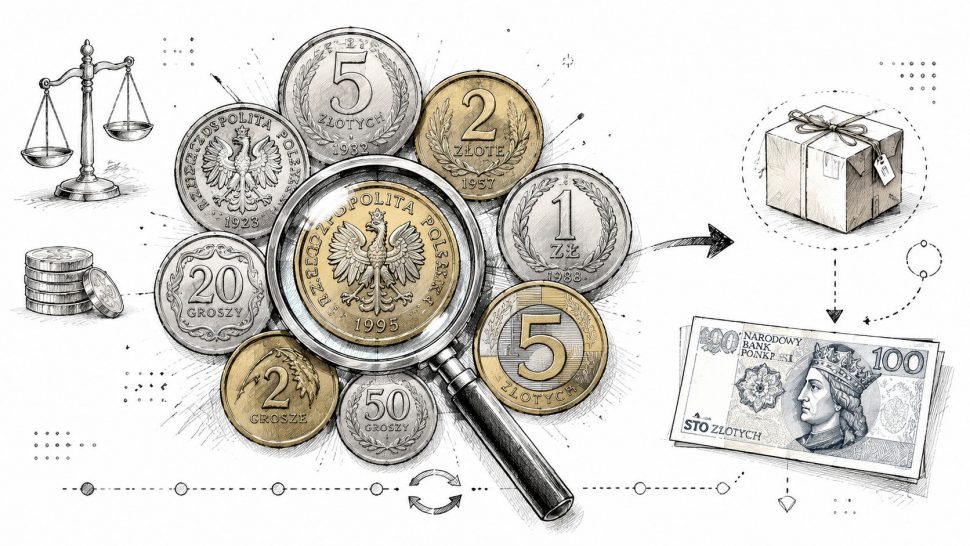
The National Bank of Poland lists the circulating coin denominations as 1, 2, and 5 groszy; 10, 20, and 50 groszy; plus 1, 2, and 5 złoty, with different metals and constructions by denomination in its coin specifications.
A practical field guide looks like this:
- 1, 2 and 5 groszy are manganese-brass
- 10, 20, 50 groszy and 1 złoty are cupronickel
- 2 and 5 złoty are bi-metallic
That matters because material differences help with identification. Higher denominations aren't just larger versions of the smaller ones. They're physically distinct, which makes them easier to separate when you're handling unsorted money.
For anyone specifically handling current Polish currency, it helps to compare against a dedicated polish zloty exchange page so you can match what you have with the denominations most often received from travel.
The current banknotes
Polish banknotes in circulation are concentrated in 10, 20, 50, 100, and 200 złoty, and each note has a distinct tactile embossed symbol for the visually impaired. Poland's official travel information identifies the symbols as square, circle, diamond, plus sign, and triangle respectively in its guide to money in Poland.
That detail helps in two ways. It makes notes easier to verify by feel as well as sight, and it means worn notes can still be easier to identify than many people expect.
Quick identification habits that help
When sorting a mixed pile, use this order:
- Pull out all notes first
- Separate bi-metallic coins
- Group brass-coloured small groszy together
- Keep anything boxed, proof-like, silver-coloured but unusually presented, or clearly commemorative out of the exchange pile
A mixed bag of Polish cash is easier to handle once you stop looking at it as “foreign money” and start looking at it as notes, small brass coins, standard cupronickel coins, and bi-metallic higher values.
Collector's Item or Leftover Currency
Many individuals encounter a common misconception. They search for coins from Poland, find pages about rare pieces, and start wondering if every older coin might pay for a weekend away. In practice, that's not how most holdings work.
Poland has a serious numismatic tradition. The National Museum in Warsaw says its coins-and-medals department holds around 58,000 Polish coin items, and the Mint of Poland issues unique commemoratives, including a 3D egg-shaped “Trans-Siberian Railway Egg” coin struck in fine silver, as noted on the museum's collection page. That tells you two things at once. Poland produces genuine collector material, and it's a completely different market from ordinary circulation money.
A simple decision framework
Ask these questions in order.
Does it look like ordinary pocket change
If yes, it usually is. Standard groszy and złoty from travel wallets, drawers, till trays, and donation boxes are normally leftover foreign currency, not specialist collectibles.
Is it clearly a commemorative or presentation item
Signs include:
- Presentation packaging
- A capsule or display case
- Proof-like finish
- Precious-metal appearance
- A design that doesn't resemble normal circulating money
Those pieces may need a collector route rather than a bulk exchange route.
Did it arrive in a realistic context for rarity
Context matters. A handful of mixed holiday change is different from an inherited collection with albums, sleeves, certificates, or labelled envelopes.
What usually happens in the real world
Most UK holders fall into one of these groups:
Traveller with modern coins
Best outcome is usually to exchange foreign coins in bulk.Family clearing a drawer or coin jar
Best outcome is often to send mixed coins and notes together, including withdrawn money.Charity or business with pooled foreign change
Bulk handling matters more than chasing individual premiums.Collector or heir with organised material
Some items may deserve separate review before any currency exchange.
If you need to ask whether a loose Polish coin from a holiday purse is collectible, it probably isn't. Genuine collector coins usually announce themselves through context, finish, packaging, or metal.
The practical split
The right answer is not typically “research every coin individually”. It's this:
- Exchange ordinary circulation money
- Set aside anything clearly special
- Don't assume age alone creates value
That's the cleanest way to avoid two common mistakes. One is undervaluing a true collector piece by treating it as scrap-style bulk currency. The other is overvaluing ordinary złoty change and wasting time trying to sell it coin by coin.
How to Exchange Coins from Poland in the UK
Once you know you're dealing with ordinary currency rather than a collector item, the next question is where to take it. Here, many people hit the same wall. Mainstream exchange options are built for notes, not loose foreign coins.
A practical guide aimed at expats and travellers notes that modern Polish złoty and groszy coins have been in circulation since 1995, but UK banks and exchange bureaus typically refuse them because the coins have low individual value and high processing costs, as explained in this guide to money in Poland.
Comparing Your Polish Currency Exchange Options
| Exchange Option | Accepts Polish Coins? | Accepts Old Złoty? | Best For |
|---|---|---|---|
| Bank | Usually no | Usually no | Mainstream note customers with simple, current currency needs |
| High street bureau | Often no | Rarely | Current banknotes in popular currencies |
| Specialist online service | Usually yes | Usually yes | Mixed lots, coins, notes, leftover foreign currency, and withdrawn money |
Why banks and bureaus usually say no
Their problem isn't that Polish coins are fake or unusable in Poland. Their problem is workflow.
- Sorting costs time and loose coins are slow to process
- Storage and transport are awkward for low-value metal currency
- Demand is limited because most customers don't want to buy foreign coins for travel
- Older currency creates extra friction if it's withdrawn or unfamiliar
That's why someone trying to exchange foreign coins and notes often gets a partial yes. Notes may be accepted. Coins are rejected. Old coins are rejected faster.
What specialist services do differently
Specialist services are set up for the problem mainstream providers avoid. They're designed to handle:
- Loose coins
- Mixed coin and note bundles
- Withdrawn or obsolete currency
- Unsorted foreign cash from travel, charity, or business intake
If you're looking to exchange foreign coins, this is the category that usually makes sense. It removes the need to find a counter that treats low-value foreign coinage as worth the effort.
Real-world scenarios
A few examples show where this works best:
- A family after a city break returns with pockets of small change and a couple of notes. Sending the lot together is usually easier than keeping it for a future trip that may never happen.
- A charity receives mixed European and non-European coins in donation boxes. A specialist route makes more sense than sorting denomination by denomination.
- A retailer or airport operator finds foreign money in tills or collection points. Bulk processing is more efficient than individual exchange attempts.
For ordinary leftover Polish money, the winning trade-off is simple. Less sorting, less friction, fewer dead ends.
Your Step-by-Step Guide to Getting Paid
For many, the hardest part isn't identifying the money. It's deciding to stop putting it off. Once you use a specialist route, the process is usually much more straightforward than people expect.

A practical send-in process
Gather everything in one place
Put all your Polish coins, banknotes, and any older currency together. Don't waste time making it look tidy unless the provider asks for specific separation.Use the provider's online quote or wizard
The better services let you choose exact currency types or use a mixed-currency option if the pile is unsorted.Pack the money securely
Use a sturdy envelope or small parcel. Keep coins contained so they don't split packaging in transit.Send it using the recommended postal method
Follow the provider's instructions carefully. That keeps the process traceable and reduces avoidable delays.Wait for verification
The currency is checked and valued against the quoted terms.Receive payment
According to the publisher information provided for this article, payment is issued within five working days after verification via bank transfer or PayPal.
Common mistakes to avoid
These are the errors that cause the most unnecessary hassle:
Trying a bank first and assuming all exchange routes are the same
They aren't. Mainstream desks and specialist services solve different problems.Over-sorting low-value coins by hand
If a service accepts unsorted mixed money, your time is usually better spent packing it properly.Listing ordinary coins individually online
That creates admin, postage, and buyer-risk for very little practical gain.Ignoring old or withdrawn Polish money
Withdrawn doesn't always mean valueless in a specialist exchange context.Cleaning coins before sending
This is especially unhelpful if one or two pieces turn out to have collector interest.
Send ordinary currency as currency. Set aside only the items that are clearly special.
What a good service should offer
Look for a provider that makes it easy to:
- Exchange leftover currency without branch visits
- Convert foreign coins and banknotes together
- Handle withdrawn money
- Pay by bank transfer or PayPal
- Offer a clear quote before you send
- Allow charity donation if you'd rather donate foreign coins to charity
That's the model that tends to work best for individuals, charities, and businesses alike.
Frequently Asked Questions
Can I exchange Polish coins in the UK?
Yes, but usually not through mainstream banks or high street exchange counters. Specialist currency services are the practical route for Polish coins, especially small denominations and mixed lots.
Do UK banks accept coins from Poland?
Usually not. Foreign coins are expensive to process and awkward to resell, so banks tend to focus on mainstream banknotes instead.
Can I exchange old or withdrawn Polish currency?
Often, yes through a specialist service. That includes older złoty issues that are no longer current for everyday spending.
Do I need to sort Polish coins by denomination?
Not always. Many people assume they must separate every coin first, but some specialist services accept unsorted currency by weight or mixed-lot process.
Are coins from Poland worth more as collectibles?
Sometimes, but only if they're commemorative, precious-metal, proof, boxed, or part of a proper collection. Most holiday change is ordinary circulation money.
Can I exchange Polish notes as well as coins?
Yes. If you have both, it usually makes sense to use a service that can exchange foreign coins and notes together in one send-in process.
Can I donate foreign coins to charity instead of exchanging them?
Yes. That's often a good option for small balances, especially when convenience matters more than the final return.
How long does payment take?
Based on the publisher details for this article, payment is issued within five working days after verification, with payment available by bank transfer or PayPal.
If you're ready to stop storing coins from Poland in a drawer and turn them into something useful, We Buy All Currency offers a simple way to exchange foreign coins, notes, and withdrawn money without the usual hassle. It's built for the situations banks and bureaus don't handle well, whether you want to exchange leftover currency for yourself or donate the value to charity.