
Coins in Mexico: UK Guide to Value & Exchange 2026
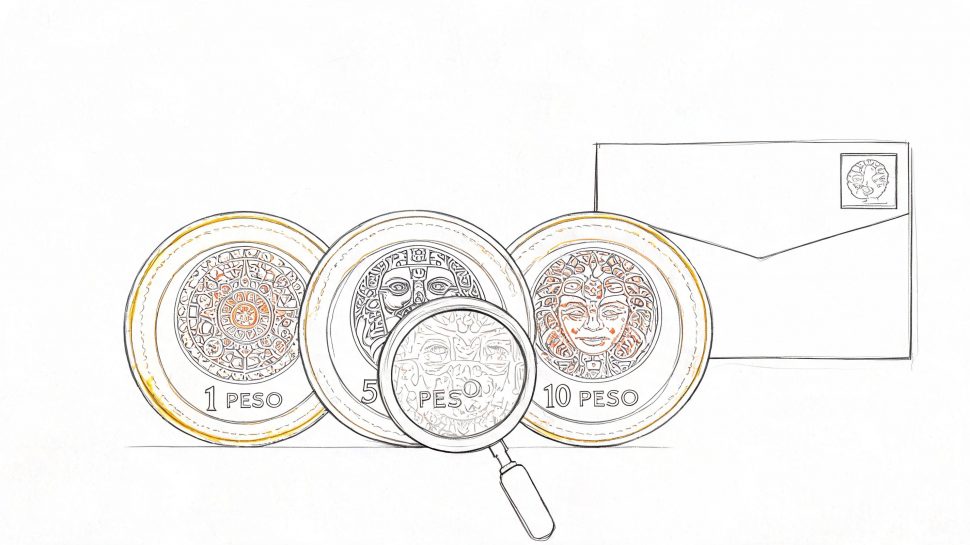
Posted by: Ian Stainton • 9 May 2026
A lot of people end up with Mexican coins the same way. They come back from Cancún, Mexico City or a cruise stop with a few pesos in a wallet, some centavos in a jar, and one simple question: can I do anything with these in the UK?
The short answer is yes, but not usually through the places people try first. Mexican coins are one of those awkward forms of leftover foreign currency that often fall between normal holiday exchange and specialist currency recovery. Notes are sometimes accepted. Coins usually aren't. Older pesos can be even more confusing, especially if you don't know whether they're current, withdrawn, silver, or low-value change.
If you're trying to understand coins in Mexico, identify what you have, and work out the most practical way to turn them into pounds, this guide walks through it in plain English.
Your Guide to Exchanging Mexican Coins from the UK
You don't need to be a coin collector to get stuck with Mexican change. A handful of centavos, a few peso coins, maybe an older coin from years ago. It all looks like money, but in practice it doesn't behave like the banknotes travelers typically exchange after a trip.
Quick answer
If you want to exchange Mexican coins from the UK, the most practical option is usually a specialist service that accepts foreign coins by post. High street banks and airport bureaux typically don't take foreign coins, especially low-value centavos or older withdrawn currency. If you've got mixed holiday money, the simplest route is to use a service built to exchange foreign coins, including unsorted coins and notes.
That matters because Mexican loose change often includes coins with very low face value. Even when a coin is still technically part of the Mexican currency system, that doesn't mean a UK bank wants to process it.
What most UK holders should do
For many individuals, the practical sequence is simple:
- Gather everything together. Don't just look at the larger peso coins. Small centavos can still be worth including in a bulk exchange.
- Separate “travel money” from “possibly collectible” coins. If something looks much older or silver-coloured in a different way, it may need a closer look.
- Use a specialist route for coins. That's especially useful if you want to exchange foreign coins and notes in one go instead of dealing with multiple providers.
A lot of readers get caught by one assumption. They think, “If it was legal tender in Mexico, my UK bank should take it.” In reality, banks focus on mainstream note exchange, not coin handling, sorting, storage, shipping, and verification.
Identifying Your Mexican Coins A Visual Guide
The first job is simple. Work out whether your coins are modern circulation coins, older series, or something that might be collectible.

Mexico currently has seven actively circulating coin denominations, covering 5, 10, 20, 50 centavos and 1, 2, 5, 10 pesos. The 10-peso coin is the highest-value circulating coin, and it has anti-counterfeiting features including a 28.0 mm diameter and a weight of 10.329 grams, while the 50-centavo coin is rarely seen in daily transactions according to Arq Finance's overview of Mexican coin denominations.
Modern coins you're most likely to have
If your coins came from a recent holiday, you'll usually find a mix of centavos and peso coins.
Common clues include:
- Centavo coins tend to be the small change. These are the coins that often sit untouched in trays, pockets and travel jars.
- Peso coins are the ones most travellers notice and keep. These usually make up the main value in modern change.
- Higher denomination coins are easier to recognise because they're larger and more distinctive.
The confusing bit is that not all coins in your hand carry equal practical value in the UK. A current Mexican coin may still be hard to exchange through ordinary channels, while an older coin might be easier to place through a specialist because it falls into a “collectible or obsolete” category.
A simple way to sort them
Use this quick reference:
| Denomination | Key features | Status |
|---|---|---|
| 5 centavos | Very low-value centavo coin | Current denomination, but low practical exchange value |
| 10 centavos | Small change coin | Current denomination |
| 20 centavos | Small change coin | Current denomination |
| 50 centavos | Rarely seen in daily use | Technically current, but functionally less common |
| 1 peso | Common circulation coin | Current denomination |
| 2 pesos | Peso coin used in circulation | Current denomination |
| 5 pesos | Higher everyday coin value | Current denomination |
| 10 pesos | Highest-value circulating coin | Current denomination |
Older Mexican coins
Older coins often confuse people because they still say “peso” but don't match current styles. If you inherited them, found them in an old travel pouch, or brought them back years ago, they may belong to an earlier series.
Older Mexican coins aren't automatically worthless. They may be obsolete for everyday spending, but they can still hold exchange, historical, or metal value depending on the type.
The key is not to assume all old-looking coins belong in the same category. Some are just old base-metal circulation pieces. Others can be much more interesting, especially if they date from earlier monetary systems or the silver era covered later in this guide.
What about commemorative coins
Mexican commemorative coins add another layer of confusion because they may look unusual even when they are legal tender. Some people keep them because they seem “special”, while others spend them without noticing.
For a UK holder, the practical question isn't whether the design is attractive. It's whether the coin should be treated as ordinary spending money, older withdrawn currency, or something that deserves individual checking before you convert foreign coins and banknotes.
From 'Pieces of Eight' to Modern Pesos A Brief History
Mexican coinage has one of the richest histories in the world, and that history explains why some old coins turn up so often in family collections and mixed foreign currency tubs.

The Mexican Mint was established in 1535, making it the oldest mint in the Americas. It became a major centre of world coinage and produced the famous silver 8 Reales, or pieces of eight, which circulated widely, influenced the design of the U.S. dollar, and served as a trade standard in British ports during the 18th and 19th centuries, as explained in this history of the Casa de Moneda de México.
Why that history still matters
This isn't just a nice bit of trivia. It tells you why Mexican coins show up in several very different forms:
- Colonial coins can have historical appeal far beyond their face value.
- Republic-era coins reflect the move from older systems into the peso structure people recognise today.
- Modern decimal coins are ordinary circulation money, but they sit on top of a very old minting tradition.
If you find an old Mexican coin in a family collection, don't judge it by size alone. A worn coin can still be historically significant. The opposite is also true. A shiny coin isn't necessarily rare.
The shift to the peso
Mexico's money changed over time from colonial coinage into the peso system. That matters because many people in the UK hold coins from different periods without realising they're not part of the same monetary story.
A practical rule for old Mexican coins is simple. If it looks much older than modern travel change, treat it as an identification job first and an exchange job second.
That approach saves people from two common mistakes. They either dismiss an old coin too quickly, or they assume every older coin is valuable. Most sit somewhere in between.
Why Banks and Bureaus Wont Exchange Mexican Coins
This is the part that frustrates people most. They have real foreign money, but a bank cashier or exchange desk still says no.

The main reason is operational. Foreign coins are expensive to handle. They need sorting, checking, storing, packing, and often shipping in ways that don't make sense for mainstream banks or bureaux that mostly focus on current banknotes.
Coins are harder than notes
Banknotes are flatter, easier to count, and more standardised for retail exchange. Coins are different.
Banks and bureaux usually run into problems such as:
- Low individual value. Small centavo coins often aren't worth the handling effort for standard providers.
- Mixed batches. Travellers rarely bring neatly sorted rolls of one denomination.
- Authentication complexity. Coins can vary by series, metal, age, and condition.
That last point is more important than many people realise. As of late 2025, Mexico began transitioning its 1-peso coins from a bronze-aluminium alloy to bronze-coated steel, and that change creates authentication challenges because older and newer coins have different magnetic and density profiles, according to the Bank of Mexico's 1-peso coin information.
Why that matters to a UK customer
A non-specialist cashier isn't set up to test coin metallurgy. They also don't want the risk of accepting something they can't easily verify or resell.
Most high street exchange providers don't reject foreign coins because they have no value. They reject them because the process around those coins doesn't fit a standard retail model.
That's also why older or withdrawn Mexican currency can be even harder to place through ordinary channels. Once a coin falls outside simple current-note exchange, you're usually in specialist territory.
A quick comparison
| Exchange option | Mexican notes | Mexican coins | Older or withdrawn Mexican currency |
|---|---|---|---|
| High street bank | Sometimes | Usually no | Usually no |
| Airport bureau | Sometimes | Usually no | Usually no |
| Specialist postal currency service | Often yes | Yes, including mixed coins | Yes, often including obsolete issues |
How to Exchange Mexican Coins from the UK A Step-by-Step Guide
If you've got a jar, envelope or tin of Mexican money, the best process is usually the simplest one. Gather it, check for anything obviously unusual, then send it through a specialist postal exchange route.

A specialist model is especially useful because obsolete Mexican centavo coins such as 5¢, 10¢ and 20¢ often build up in UK charity tins, and a service that accepts unsorted bulk currency by weight can turn what would otherwise be discarded into a meaningful payout, including mixed low-value coins, as noted in the Bank of Mexico accessibility page used in the verified data set.
Step 1 Gather everything together
Don't over-sort too early. Put all your Mexican coins in one place, then add any notes you still have.
People often waste time in this situation. They try to separate every denomination perfectly, or they leave out the small coins because they assume they don't matter.
- Include centavos if you have them.
- Add peso coins and notes from the same trip or collection.
- Keep old-looking coins aside only if you suspect they may need special identification.
Step 2 Check whether you have everyday currency or something older
Most holders can make a simple first pass.
Ask yourself:
- Does this look like normal recent travel money?
- Is anything clearly much older?
- Do any coins seem silver-era or unlike modern circulation pieces?
If the answer is mostly “normal travel money”, you can move straight to the exchange process. If not, identify the unusual items first.
Step 3 Use a specialist quote process
The easiest route is usually an online quote system designed for mixed and unsorted currency, including coins by weight. That matters because many people don't just want to exchange foreign coins. They want to deal with coins, notes, and old leftover travel money in one transaction.
For Mexican pesos specifically, a dedicated route to exchange Mexican pesos can make the process more straightforward than trying separate providers for notes and coins.
Step 4 Pack securely and post
Once you've accepted a quote, pack the currency carefully. Use secure packaging that prevents coins moving around too much in transit.
A few practical habits help:
- Use a sealed inner bag for loose coins.
- Add a clear reference so your parcel matches your order.
- Avoid flimsy envelopes for heavier batches.
Step 5 Receive payment or choose donation
After verification, payment is usually made by bank transfer or PayPal. Some services also let you donate the value instead, which is particularly useful for charities, schools, airports, retailers and travel-related businesses that collect leftover currency.
That turns a drawer full of unused pesos into something useful without needing to spend them on a future trip that may never happen.
Common Scenarios and Mistakes to Avoid
Mexican currency tends to arrive in the UK in a few familiar ways.
The holidaymaker's jar
You came back with mixed pesos and centavos, spent the notes, and left the coins behind. Months later, the money is still sitting in a kitchen drawer because no bank wants the coins.
In that case, the sensible move is to exchange leftover currency through a specialist service that takes coins and notes together, rather than waiting for another holiday or trying to force a bank branch to accept them.
The charity collection tin
This is common in travel, retail and fundraising settings. A collection tin ends up with all sorts of foreign change, including Mexican centavos that are too awkward for mainstream exchange.
Bulk foreign coin services solve that problem because they accept mixed deposits that normal retail channels won't touch.
The family inheritance
A relative leaves behind envelopes of old world coins. Some are modern travel leftovers. Some are much older. Mexican coins often appear in these lots because of the country's long minting history.
The mistake here is treating every old coin the same. Some are just obsolete change. Some may deserve individual attention first.
Mistakes that cost people money
- Throwing away low-value coins. Small denominations may look pointless on their own, but mixed bulk lots can still be worth converting.
- Assuming old currency has no value. Old pesos may be obsolete for spending, but that doesn't mean they should be binned.
- Trying the airport first. Airport exchange is built for speed and convenience, not awkward coin deposits.
- Over-sorting mixed currency. If a specialist accepts unsorted currency, you don't need to turn your dining table into a coin-counting station.
If you're holding foreign change because “it probably isn't worth the hassle”, that's usually the exact situation specialist exchange services were built for.
Frequently Asked Questions About Mexican Currency
Can you exchange Mexican coins in the UK?
Yes, but usually not through ordinary banks or airport exchange desks. Specialist foreign currency services are typically the practical route for Mexican coins, especially if you want to exchange foreign coins and notes together.
Do UK banks accept Mexican coins?
In most cases, they don't. Banks may deal with selected foreign banknotes, but coins are a different category because they are harder to sort, authenticate and process.
Are old Mexican pesos still worth anything?
Sometimes yes. It depends on whether they're current, withdrawn, silver-based, or collectible. One especially important group is the last circulating silver 1-peso series, minted between 1957 and 1967, which had intrinsic silver value and marked the end of a long silver-coin tradition in Mexico, as described in this overview of Mexico's coin history and silver peso era.
What if I have Mexican centavo coins with very low face value?
They can still be worth including in a bulk exchange, especially if you have a mixed lot. Low-value foreign coins are exactly the kind of leftover holiday money that mainstream providers tend to reject but specialist services are built to handle.
Do I need to sort my Mexican coins before sending them?
Not always. Some specialist services accept unsorted currency and use a weight-based process for mixed coins. That's helpful if you've got a small pile of travel change rather than neatly organised denominations.
Can I exchange Mexican notes at the same time?
Usually yes. If you've got notes as well as coins, it's often simpler to send everything together so you can convert foreign coins and banknotes in one process.
Is it safe to post foreign currency?
It can be, provided you follow the provider's packing and postage instructions carefully. The key is using secure packaging, including your order details, and choosing the recommended sending method.
Can I donate Mexican coins to charity instead of getting paid?
Yes, with the right service. This is a useful option for people who want to donate foreign coins to charity, and it's especially practical for organisations that collect mixed overseas currency from supporters, customers or travellers.
What if I'm not happy with the quote?
Look for a provider that explains rates clearly before you send and offers a straightforward return process if you're unhappy after verification. Transparency matters more than flashy promises.
If you've got coins in Mexico left over from a holiday, sitting in a charity tin, or tucked away in an old collection, there's no reason to leave them unused. We Buy All Currency lets you exchange foreign coins, banknotes, and withdrawn currency through a simple postal process, with clear rates, no need to sort everything by hand, and the option to turn leftover money into cash or a charity donation.