
Mastering Coins of the Swiss Franc: Identification & Value
Posted by: Ian Stainton • 13 Apr 2026
A small pile of Swiss coins can sit in a drawer for years because it doesn’t look urgent. A few rappen from Geneva, a chunky 5 franc from Zurich, maybe an older silver-coloured piece from a relative’s travel box. Many assume it’s just leftover foreign currency and not worth the trouble.
That assumption is where value gets missed. The coins of the swiss franc sit in an unusual middle ground. Some are current spending money. Some older pieces carry silver value beyond face value. A few gold issues are globally recognised bullion coins. Even ordinary-looking Swiss change is often better made, more consistent, and more widely trusted than people expect.
If you’re in the UK and wondering whether to keep them, spend them on a future trip, or exchange foreign coins and notes properly, the first job is simple. Identify what you have. Once you can separate modern circulation coins from older silver francs and any gold pieces, the right decision becomes much clearer.
Your Guide to Swiss Franc Coins and Their Hidden Value
Swiss coins turn up in all sorts of places. Holiday wallets. Airport charity tubs. Retail tills. Boxes of mixed overseas change from relatives who never got round to converting foreign coins and banknotes after a trip.
They’re worth paying attention to because the Swiss franc isn’t a niche currency. It accounted for a significant portion of all foreign exchange transactions globally as of 2022, and the total value of Swiss coins and banknotes in circulation reached many billions of Swiss francs at one point. Coins are also legal tender for payments up to 100 pieces, which tells you how established coin use remains in Switzerland (Remitly on the Swiss franc).
Why Swiss coins deserve a second look
A Swiss coin jar can contain very different things:
- Current pocket change that still spends at face value in Switzerland.
- Older withdrawn pieces that may no longer circulate in shops.
- Silver issues where the metal matters more than the number on the coin.
- Gold coins that belong in a completely different category from travel change.
That mix is exactly why people get stuck. Banks often treat coins as a nuisance. Travellers don’t know what’s current. Collectors focus on rarity, while ordinary households just want an easy way to exchange foreign coins.
Swiss coins often look ordinary at first glance. The date is usually what changes the answer from “small change” to “worth checking properly”.
What matters most
When I assess Swiss coins, I look at three things first:
- Date
- Denomination
- Metal
That’s enough to separate most piles into useful groups. If your aim is to exchange foreign coins, donate foreign coins to charity, or turn leftover foreign currency into pounds, you don’t need to become a specialist collector. You just need a reliable method and a few identification rules.
The Modern Swiss Franc Coin Family A Visual Guide
Many individuals start with the coins they recognise from recent travel. Modern Swiss coinage is practical, conservative, and easy to sort once you know the denominations. Designs have stayed familiar for a long time, which helps with recognition but can also make older and newer pieces look deceptively similar.
Currently circulating Swiss franc coins as of 2026
| Denomination | Metal Composition | Diameter | Weight | Design Feature |
|---|---|---|---|---|
| 5 Rappen | Not specified in verified data | Not specified in verified data | Not specified in verified data | Modern Swiss circulation coin |
| 10 Rappen | Not specified in verified data | Not specified in verified data | Not specified in verified data | Modern Swiss circulation coin |
| 20 Rappen | Not specified in verified data | Not specified in verified data | Not specified in verified data | Modern Swiss circulation coin |
| 1/2 Franc | Not specified in verified data | Not specified in verified data | Not specified in verified data | Modern Swiss circulation coin |
| 1 Franc | Not specified in verified data | Not specified in verified data | Not specified in verified data | Modern Swiss circulation coin |
| 2 Francs | Not specified in verified data | Not specified in verified data | Not specified in verified data | Modern Swiss circulation coin |
| 5 Francs | Copper 75% / nickel 25% | 31.45mm | 13.2g | Lettered edge with “DOMINUS PROVIDEBIT” and 13 stars |
The table is intentionally conservative. For some denominations, detailed specifications weren’t included in the verified data, so it’s better to stay precise than guess.
The coin many individuals notice first
The modern 5 franc coin is the easiest Swiss coin to identify by feel. It’s a substantial piece, made from 75% copper and 25% nickel, with a weight of 13.2 grams, a 31.45mm diameter, and a projected circulation lifespan of over 25 years. Its edge inscription reads “DOMINUS PROVIDEBIT” (Swiss National Bank coin information).
That durability matters in practice. A worn-looking 5 franc coin is often still perfectly genuine. Swiss circulating coins were built to last, so don’t assume age alone means collectible value.
What beginners should look for
If you’re sorting a mixed lot of Swiss change, use this quick filter:
- Start with the largest coins. The 5 franc piece stands out immediately and is usually the fastest to separate.
- Check the edge. A lettered edge on the modern 5 franc is a strong visual clue.
- Group by denomination before date. That keeps the job manageable when you have a lot of coins.
- Set aside anything that looks silver and older. That’s where the next layer of value may sit.
Practical rule: don’t clean Swiss coins before identifying them. Cleaning can reduce collector appeal and makes some metal surfaces harder to assess properly.
What works and what doesn’t
What works is a simple tray, good lighting, and grouping by value. What doesn’t work is trying to judge everything from colour alone. Swiss coins can keep a tidy appearance for years, and different eras can look closer than you’d expect.
If your aim is to convert foreign coins and banknotes rather than build a collection, the key is confidence, not perfection. You’re not writing an auction catalogue. You’re making sure ordinary current coins don’t get confused with older, more interesting pieces.
Beyond Your Pocket Change Historic Silver Coins
A notable surprise in many Swiss collections is how quickly “old travel money” turns into historic coinage. Plenty of people inherit a pouch of francs, assume it’s all current, and only notice later that some pieces are from a very different era.

Where Swiss silver coinage began
The Swiss franc itself was a unifying project. Its introduction in 1850 replaced over 8,000 different coins and notes circulating across Switzerland. The first national coins ran from 1 centime to 5 francs, and the higher denominations were struck in .900 fine silver to create a stable national currency (Numismatic News on the birth of the Swiss franc).
That history matters because older silver francs were never an odd side branch. They were part of the foundation of the currency.
The pieces that catch people out
In mixed household lots, the coins that deserve a second look are usually the half franc, 1 franc, 2 franc, and 5 franc pieces from older dates. They may not look dramatic. Many have straightforward, classic Swiss designs and don’t shout “valuable” in the way a commemorative coin might.
What gives them interest is the combination of age, silver content, and survival in ordinary accumulations.
A common mistake is to treat all withdrawn Swiss coins the same way. They are not the same. Some obsolete pieces are mainly worth face value in an exchange setting. Older silver coins can be different because their metal matters.
What I’d separate immediately
If someone handed me a jar of Swiss coins, I’d create a small “check carefully” pile for:
- Older larger denominations such as half franc, 1 franc, 2 francs, and 5 francs.
- Anything with an earlier date that looks different in tone from modern copper-nickel pieces.
- Withdrawn minor coins like old rappen issues, which may not be spendable but still deserve identification.
Old Swiss silver often has a softer, more muted shine than modern base-metal coinage. It’s not a perfect test, but it’s a useful prompt to inspect the date.
The practical trade-off
Collectors may care about exact varieties, strike quality, and scarcer dates. Many households don’t need to begin there. They need to avoid the biggest mistake, which is cashing historic silver at face value without checking whether the metal gives it a stronger exchange outcome.
That’s why Swiss coins are one of the better examples of where numismatics meets ordinary money handling. A coin that looks like standard foreign change can deserve a completely different treatment.
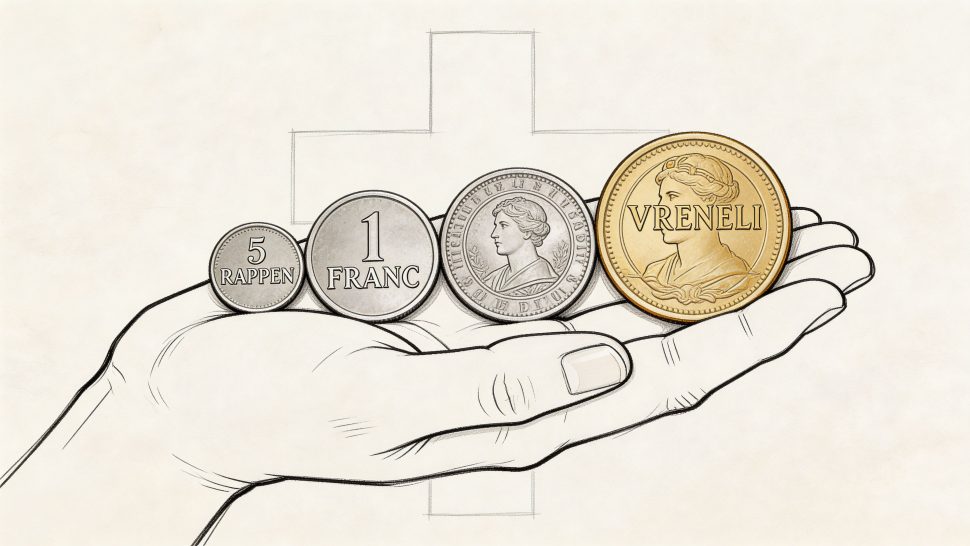
The Famous Swiss Gold Coins Vreneli and Helvetia
Swiss gold coins sit in a separate lane from circulation money. If silver francs can hide in a mixed jar, gold Vreneli and Helvetia pieces usually arrive through inheritance, family keepsakes, older collections, or travel accumulations that were never properly sorted.

The specifications that matter
For a genuine Swiss 20 franc gold coin, the key technical profile is very clear. These coins weigh exactly 6.45 grams, are struck in .900 fine gold, and contain 0.1867 troy ounces of pure gold. Their standardisation allowed them to circulate interchangeably with other European gold coins under the Latin Monetary Union (Blanchard guide to Swiss gold francs).
Those details aren’t collector trivia. They’re the basis of authentication and valuation.
Why these coins are trusted
The Vreneli and earlier Helvetia pieces are so well known because they combine three useful qualities:
- Recognisable specifications
- Historic bullion status
- Broad market familiarity
That last point is important. A beginner often worries that a gold coin needs specialist buyers only. In practice, a recognised standard coin is far easier to assess than an obscure medal or novelty token.
What to check before doing anything else
If you think you may have a Swiss gold coin, don’t polish it and don’t treat it as ordinary foreign currency.
Focus on these checks first:
- Read the denomination. A 20 franc gold coin is a classic type recognized by many.
- Check the weight. The verified standard is 6.45 grams.
- Inspect the design carefully. The look should be crisp and coherent, not soft or oddly spaced.
- Keep it separate from all base-metal coins. Even basic handling mistakes can cause problems.
What works and what doesn’t
What works is calm, non-destructive checking. Weight is useful. Careful visual review is useful. Keeping provenance, envelopes, or family notes is useful.
What doesn’t work is relying on guesswork from internet photos alone. Gold-coloured souvenirs, replicas, or jewellery-mounted pieces can confuse people very quickly. The fact that a coin says “20 FR” doesn’t settle the matter by itself.
If a Swiss gold coin turns up in a mixed foreign coin tin, stop sorting around it casually. Handle it as a distinct item from that point onward.
For anyone holding one, the key point is simple. A Vreneli is not “leftover holiday money”. It’s a standardised gold coin with intrinsic value and often collector interest as well.
Numismatic Value vs Face Value What Are Your Coins Really Worth
The number stamped on a Swiss coin tells only part of the story. A 5 franc coin can be current spending money, an older withdrawn piece, a silver coin whose metal matters, or something a collector wants for reasons that have little to do with face value.
That’s why value needs to be separated into types.
Face value is the starting line
Face value is the official denomination. It’s the amount the coin represents in normal monetary use. For current coins, that’s often the figure that matters most.
For older Swiss coins, face value can be the least useful number in the room. A withdrawn silver franc might still have an official exchange route somewhere at denomination level, but that doesn’t mean it’s the best outcome.
Bullion value changes the picture
Bullion value is the worth of the precious metal in the coin. This matters for Swiss silver francs and especially for gold 20 franc pieces. In practical terms, bullion value can make an obsolete coin more attractive than its printed denomination suggests.
Many only discover this after they’ve nearly handed old Swiss coins over as ordinary foreign change. That’s the wrong approach for metal-bearing pieces.
Numismatic value is different again
Numismatic value comes from collector demand. Rarity, condition, date, design type, and market interest all matter. Some Swiss coins have very little collector premium. Others can attract stronger attention because they are scarcer, better preserved, or more desirable.
The tricky part is that bullion and numismatic value can overlap. A silver or gold coin may have metal value plus collector appeal. If you want a broader sense of which foreign pieces can surprise people, this guide to foreign coins that are worth money is a useful companion read.
A practical way to think about it
Use this comparison:
| Value type | What it means | Best used for |
|---|---|---|
| Face value | The amount printed on the coin | Current circulating coins |
| Bullion value | The metal content’s market worth | Silver and gold coins |
| Numismatic value | What collectors may pay | Scarcer or better-preserved pieces |
A common decision individuals need to make
Readers generally aren’t building a museum-grade Swiss type set. They want to know whether to spend, keep, or exchange foreign coins. For that purpose, the best rule is straightforward:
- Current coins are usually handled as money.
- Older silver coins should be checked before any face-value exchange.
- Gold coins should always be treated as bullion-level items first.
- Unusual or especially old pieces deserve a second opinion rather than a quick disposal.
That distinction saves people from the most common loss. Not theft. Not counterfeits. Just accepting the wrong type of value for the coin in hand.
How to Identify and Date Your Swiss Coins
Good identification is mostly about method. You don’t need laboratory tools to sort the coins of the swiss franc into sensible groups. You need light, patience, and a clear order.

Start with the date
The date is usually the fastest way to decide whether a coin belongs in the “ordinary current money” pile or the “check further” pile. On Swiss coins, the date is normally clear once the coin is held under good light.
If you only do one thing, do this first. Date drives most of the practical decisions.
Then sort into three groups
I recommend three trays, envelopes, or small piles:
- Modern circulating coins for recent everyday Swiss change.
- Older silver candidates for anything that may carry metal value.
- Unusual pieces for anything gold-coloured, very old, withdrawn, or different.
This structure keeps the job calm. Individuals get overwhelmed when they try to identify every coin to catalogue standard on the first pass.
Use visible clues, not assumptions
When you inspect each coin, look for:
- Denomination
Read the value first. Large denominations deserve more attention. - Colour and surface
Don’t treat this as proof, but do use it as a clue. Older silver coins often look different from modern copper-nickel pieces. - Edge style
Lettering, milling, and general finish can help distinguish one type from another. - Any mint-related marks
Swiss coins are often associated with Bern production, and mint details can matter for identification.
A coin that “looks normal” can still be an older issue. Date beats first impression every time.
What beginners often get wrong
The biggest mistake is mixing all foreign coins together and deciding by size alone. The second is cleaning coins before reading them properly. Dirt can be inconvenient, but heavy rubbing often does more harm than good.
Another common issue is overconfidence from one matching photo online. Swiss coinage has continuity in design, so a quick visual match can be misleading if the date is missed or the metal isn’t checked.
A sensible home workflow
If you’re working through a jar at the kitchen table, this is efficient:
| Step | What to do | Why it helps |
|---|---|---|
| 1 | Separate Swiss coins from other countries | Reduces confusion |
| 2 | Group by denomination | Makes visual comparison easier |
| 3 | Read the dates | Flags coins needing closer attention |
| 4 | Pull out old silver-looking pieces and any gold coins | Prevents face-value mistakes |
| 5 | Keep all uncertain items aside | Better to pause than misclassify |
You don’t need perfect expertise to make good decisions. You just need to stop treating every Swiss coin as identical.
The Easiest Way to Exchange Swiss Franc Coins in the UK
Once Swiss coins have been identified, the next problem is practical. Where do you take them in the UK? For many people, that’s where the process stalls.
Banks often won’t handle foreign coins at all. General currency counters tend to focus on current banknotes. Obsolete coins, mixed lots, and metal-value issues are where ordinary options start to fall apart.

The gap often encountered
UK residents and businesses often hold withdrawn Swiss coins, including pre-1968 silver francs, without realising there are UK-based exchange options. The Swiss National Bank may exchange certain obsolete coins at face value, but that can miss the higher intrinsic metal value of some pieces. Postal services using weight-based quotes for unsorted collections can fill that gap (American Numismatic Association page on Switzerland money).
That single point explains a lot of frustration. The official route isn’t always the best-value route for the coin owner.
Why sorting everything yourself often isn’t worth it
People assume they need to become part-time coin dealers before sending anything off. Usually they don’t.
What works well in practice is this:
- Keep obviously valuable items separate if you want extra reassurance. Gold coins are the obvious example.
- Leave mixed ordinary foreign change unsorted if the service accepts it that way.
- Use a weight-based system when dealing with jars, donation tins, travel leftovers, or tills.
That approach is especially useful for charities, airports, retailers, and households with a mix of currencies rather than a neat single-country collection.
What a smooth exchange process should look like
A practical UK service for Swiss coins should make these things easy:
| What you need | Why it matters |
|---|---|
| Acceptance of coins as well as notes | Swiss leftovers are often coin-heavy |
| Support for obsolete currency | Many Swiss pieces in UK homes are older issues |
| Clear rates before sending | Avoids uncertainty |
| Postal handling | No need to travel to specialist premises |
| Charity donation option | Useful for leftover holiday money and fundraising |
| Return option if unhappy | Reduces risk |
What usually doesn’t work
A few routes sound sensible but disappoint in practice:
- High-street banks. Fine for some mainstream note exchanges, poor for mixed foreign coin pots.
- Saving the coins for another trip. This often just means another few years in the drawer.
- Face-value thinking for older silver. That’s the classic way to undersell the lot.
- Trying to sell everything one by one. It’s slow, fiddly, and rarely worth the effort for ordinary accumulations.
If your Swiss currency is mixed, unsorted, and partly obsolete, convenience matters almost as much as price. A complicated process is exactly why so many coin jars never get converted at all.
What makes a service useful
The best option for most UK customers is one that lets you exchange foreign coins, convert foreign coins and banknotes, and even donate foreign coins to charity without sorting every last piece yourself. A strong service should be transparent, simple by post, and comfortable with current, withdrawn, and obsolete money in the same parcel.
For Swiss currency specifically, it helps if the platform understands the difference between ordinary current francs and older pieces that shouldn’t be treated casually. It also helps if the process is built for real households and organisations, not just specialist collectors.
If you’re ready to turn Swiss francs into pounds, this dedicated page to exchange Swiss francs to pounds shows the practical route.
Why this matters for more than travellers
This isn’t just about holiday leftovers. Swiss coins turn up in:
- Charity collections
- Airport and airline donations
- Retail tills receiving foreign coins in error
- Inherited foreign coin boxes
- Mixed business holdings from international customers
That’s why the easiest method is usually the one that removes friction. No drawn-out identification burden. No need to visit a branch. No need to split current from obsolete coinage if the service can handle the full lot responsibly.
Your Questions Answered and Next Steps
A few Swiss coins can be easy to ignore. A larger accumulation often feels too awkward to start. Once you know the difference between current francs, older silver issues, and possible gold pieces, the next step is much simpler.
Common questions
Is it worth sorting my coins before sending them
Not usually. If you’re using a service built for mixed foreign currency, unsorted coins are fine. That’s especially helpful for leftover foreign currency from travel, charity tins, and inherited jars of mixed change.
Can old Swiss silver francs still be spent
Older withdrawn pieces aren’t something to rely on for everyday spending in shops. The more important point for UK holders is that face value may not be the best outcome if silver content gives the coin stronger value.
Can I donate Swiss coins instead of cashing them out
Yes. That can be one of the most practical uses for small holdings. It’s a neat way to turn forgotten travel money into something useful without trying to spend awkward coins on a future trip.
The best next step is usually the simplest one. Separate any obvious gold pieces, keep everything else together, and use a service that can handle the lot without forcing you into expert-level sorting.
If your Swiss coins have been sitting untouched for months or years, they’re not doing anything useful where they are. They can become pounds in your account or a donation to a good cause once they’re properly processed.
Turn your Swiss coins, notes, and mixed foreign currency into something useful with We Buy All Currency. The service is fast, easy, hassle-free, and 100% guaranteed. You don’t need to sort coins first, and you can convert current, old, withdrawn, or obsolete money by post with clear rates and no hidden charges. It’s trusted by major brands, including charities, supermarkets, airports, and police forces. If you’d rather support a good cause, you can also donate foreign coins to charity through the same simple process.