
Currency Croatia Kuna: Exchange Leftover HRK in UK 2026
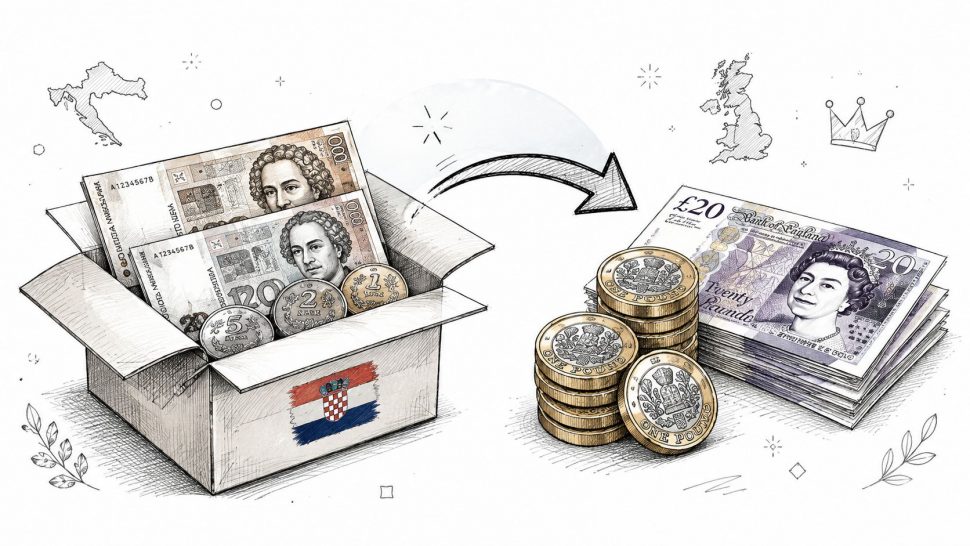
Posted by: Ian Stainton • 17 Jun 2026
You get home from Croatia, unpack weeks later, and find a few kuna notes in a wallet pocket or a jar of mixed coins in a drawer. That's a common problem. The currency changed, your trip is over, and now the money feels awkward rather than useful.
If you're searching for currency Croatia Kuna because you want to know whether your old HRK still has value in the UK, the short answer is yes. But the route is different now. Kuna is no longer a live travel currency, so the practical option is usually a specialist service that can handle leftover foreign currency, including coins, notes, and withdrawn money.
What to Do With Leftover Croatian Kuna

Finding old Croatian kuna usually leads to the same question. Can you still spend it, or is it only a souvenir now?
Quick answer
Quick answer: Croatia switched to the euro in January 2023, and Travelex UK states that the kuna is the former currency, which means HRK should now be treated as an obsolete currency, not a live one for current spending in Croatia. For UK travellers, that means old kuna may still be worth converting, but usually through specialist exchange routes rather than ordinary holiday spending or standard retail exchange channels. See Travelex UK's guide to Croatia's currency.
That distinction matters. Obsolete doesn't mean worthless. It means the currency is no longer used day to day, so your decision changes from “Where can I spend this?” to “Where can I sell or redeem it?”
Your practical options
If you have HRK at home, a sensible checklist is:
- Check what you have. Separate banknotes from coins, even if you don't know the denominations yet.
- Treat it as old currency. Don't expect shops, hotels, or taxis in Croatia to take it now.
- Avoid assuming your bank will want it. Many high street channels focus on current notes only.
- Use a specialist route if you want to exchange foreign coins in the UK, especially if your money is mixed, unsorted, or includes coins.
Where people get confused
Most confusion comes from one simple idea. People remember the kuna as a familiar holiday currency, so they assume it works like leftover euros or dollars. It doesn't.
If your goal is to turn old HRK into pounds, think in terms of redeeming old value, not preparing spending money for another trip. That shift makes the whole process much easier to understand.
The Story of the Kuna and Croatia's Switch to the Euro

A lot of UK travellers have the same reaction when they find old Croatian money in a drawer. The notes still look official. The coins still look usable. So why does nobody want them?
The answer starts with what the kuna was. According to the Croatian kuna reference entry, the Croatian kuna was the country's national currency from 30 May 1994 until 1 January 2023, and it was divided into 100 lipa. If your leftover holiday cash includes both kuna notes and lipa coins, you are looking at two parts of the same former currency system.
That matters because many people misread lipa coins as some separate money. They are not. Lipa worked like pence to the pound. Kuna was the main unit, and lipa was the smaller unit underneath it.
Why the kuna felt familiar and easy to use
For years, the kuna felt like a normal, dependable holiday currency to British visitors. Prices in Croatia were set in kuna, cash machines gave out kuna, and travellers got used to converting it back into pounds or euros without much effort.
By the time Croatia was preparing to join the euro, the kuna was already trading at a near-fixed relationship to the euro. For travellers, that made holiday budgeting feel more predictable. A stable-feeling travel currency often leaves a misleading impression later. People remember that it was easy to use, so they assume it should still be easy to exchange after it has been withdrawn.
That is where old HRK causes confusion.
What changed in 2023
Croatia adopted the euro on 1 January 2023. From that point, the kuna stopped being Croatia's current currency.
The practical effect is simple. Kuna changed from spendable travel money into withdrawn money that needs a redemption or specialist exchange route. That is a very different category. It helps explain why ordinary bank counters and post office exchange services often reject it, even when the notes look clean and genuine.
For a UK traveller, the easiest way to understand this is to compare it with an old train ticket. It may represent something that once had value, but you cannot use it in the same way after the system has changed. You need the right process.
Why this history matters if you still have HRK
The story is not just background. It explains your next move.
If you still hold Croatian kuna, the question is no longer whether it was once real money. It was. The question is whether it is current money or obsolete money. Since Croatia moved to the euro, leftover HRK falls into the obsolete category, which is why this article focuses on selling or redeeming it rather than spending it on a future trip.
Here is the simplest way to frame it:
| Question | While kuna was in use | After Croatia switched to the euro |
|---|---|---|
| Could you spend it in Croatia? | Yes | No |
| Could a standard travel money desk treat it like current cash? | Usually yes | Often no |
| Could it still hold value? | Yes | Sometimes, but only through the right route |
That small change in status explains nearly every problem people face with old kuna today.
Why Banks and Post Offices Wont Exchange Your Old Kuna
People often assume a bank counter can handle any foreign money. In reality, most mainstream exchange channels are built for current banknotes that they can easily resell, recirculate, or process in volume. Old Croatian kuna doesn't fit that model neatly.
The practical problem became sharper after the euro changeover. The European Central Bank states that kuna notes and coins could be exchanged free of charge only up to 100 banknotes and 100 coins per transaction through 31 December 2023, while the Croatian National Bank continues to exchange banknotes indefinitely and coins until 31 December 2025. You can review those rules on the ECB page about Croatia's euro cash changeover. For someone in the UK, that makes local specialist handling more practical than relying on ordinary travel money channels.
Why standard exchange desks often say no
A refusal usually comes down to operations, not mystery. Common reasons include:
- It's not current spending money. Once a currency is withdrawn, demand drops sharply in normal retail exchange.
- Coins are awkward to process. Foreign coins are heavy, low value per item, and expensive to sort.
- Old notes need specialist handling. Staff need clear acceptance rules, authenticity checks, and a resale or redemption route.
- Branches want simplicity. Most high street desks prefer active currencies with straightforward buy-back demand.
Practical rule: If a service mainly sells travel money for upcoming holidays, it usually isn't designed to handle withdrawn coins and notes from old trips.
UK exchange options for Croatian Kuna
| Currency Type | High Street Bank / Post Office | Airport Bureau de Change | Specialist Service (We Buy All Currency) |
|---|---|---|---|
| Current foreign banknotes | Sometimes accepted | Usually focused on current travel money | Accepted depending on service scope |
| Old Croatian kuna notes | Often limited or refused | Commonly refused | Designed for withdrawn and obsolete currency |
| Croatian lipa and kuna coins | Commonly refused | Commonly refused | Can handle foreign coins and mixed lots |
The key point is simple. Standard providers are built for convenience at the start of a trip. Specialist providers are built for currency clean-up at the end of one.
How to Exchange Croatian Kuna for Cash in Four Simple Steps
If you want to exchange foreign coins and notes, the easiest process is usually postal and quote-based. That works well for old HRK because it removes the need to find a local branch willing to inspect obsolete money one item at a time.

A useful starting point is checking a live Croatian kuna exchange rate guide so you understand how the currency is being treated before you send anything.
Step 1 Get a quote
Start by selecting the currency and the form you have. Notes only, coins only, or a mixed lot. If your collection includes other leftovers from past trips, many specialist services let you include those too.
This part matters because old currency isn't priced like active holiday money. The quote reflects withdrawal status, handling, and the route used to recover value.
Step 2 Pack the currency securely
Place your kuna in a secure package and follow the service instructions. If you've got mixed coins and banknotes, specialist systems are often much easier than branch counters because they're designed for unsorted currency.
That's especially helpful if your HRK has been sitting in a drawer with euros, old pennies, or miscellaneous foreign change from several trips.
Step 3 Send it for verification
Post the package using the method recommended by the service. Once it arrives, the currency is checked and verified.
This stage answers a common worry. You usually don't need to be an expert in Croatian denominations before sending. The verification process is there to identify what's in the parcel and value it correctly under the provider's acceptance rules.
Step 4 Receive payment
After verification, payment is issued by the method offered by the service, typically bank transfer or PayPal. With a specialist, the process is built around handling leftover foreign currency rather than expecting you to spend time finding a rare in-person counter that still deals with obsolete money.
If you've got coins, old notes, or a mixed travel collection, the easiest system is usually the one that lets you send everything together rather than sorting it into “probably accepted” and “probably rejected” piles.
Why this route suits UK travellers
In the UK, convenience often stands out as the main advantage. You don't need to plan a trip around central bank rules, carry foreign coins to a branch that may refuse them, or treat small old balances as too much effort to bother with.
That's why specialist exchange has become the practical answer for people who want to exchange leftover currency without turning a simple clean-up job into a research project.
Common Mistakes to Avoid When Selling Old Currency
You get home, empty your suitcase, and find a few Croatian notes and coins at the bottom of a side pocket. Months later, they are still there because the situation feels unclear. They are real money, but not money you can use. That confusion leads to the mistakes below.
A common misunderstanding among UK travellers is assuming old kuna should still be exchangeable through an ordinary bank or post office. That was a reasonable assumption when the currency was current. It is much less useful once a currency has been withdrawn and replaced. Obsolete money sits in a grey area. It is no longer spendable, but it may still have resale or exchange value through the right specialist route.
Mistakes that waste time or reduce what you get back
- Leaving it in a drawer for years. If you want pounds back, delay rarely improves the outcome. It usually just makes the task easier to forget.
- Trying high street banks first and expecting the old rules to apply. Many travellers lose time visiting branches that do not handle withdrawn foreign notes and almost never take foreign coins.
- Lumping obsolete kuna in with current travel money. It creates confusion fast, especially if you also have euros, lipa, or other leftover holiday cash in the same jar.
- Focusing only on notes and ignoring coins. Coins are often the part people assume is hopeless, yet they can still matter if you are clearing a mixed stash.
- Treating all old currency as worthless. Withdrawn does not always mean valueless. It often means the exchange route has changed.
One simple way to think about it is this. Current travel money works like an active bank card. Obsolete kuna works more like an expired gift card. You cannot use it in the usual place, but that does not automatically mean the remaining value has disappeared.
The souvenir mistake
Kuna notes are distinctive, and many travellers keep them because they remember a particular trip to Split, Dubrovnik, or the islands. That is completely reasonable.
Problems start when a keepsake becomes an excuse to avoid a decision. If you want a souvenir, keep one note or coin on purpose. Then separate the rest and deal with it properly. That small step removes the emotional fog from what is really a simple money question.
If you would not choose to keep £20 in a drawer for years, it helps to ask why old foreign cash should be treated differently.
A practical way to avoid these mistakes
Use a quick sorting rule:
- Set aside any piece you want to keep.
- Put all remaining kuna, notes and coins, in one place.
- Decide whether you want cash back or whether you would rather donate foreign coins to charity.
- Choose a service that accepts obsolete currency, rather than spending time testing mainstream counters that are likely to refuse it.
For UK travellers, that approach is usually faster, clearer, and less frustrating. It also matches the primary issue this article is addressing. Not how to spend euros in Croatia today, but what to do with old kuna that banks usually reject.
Real-World Scenarios for Exchanging Kuna
One family returns from a long-forgotten Adriatic holiday and finds kuna notes mixed with euro cents, a few lipa coins, and some old sterling in a kitchen jar. None of it is useful for current spending. Instead of sorting every piece by hand and testing different counters, they send the lot through a specialist route that can exchange foreign coins and notes together.
Another common case involves charity collections. A donation tin gets emptied and contains all sorts of foreign change from travellers, including obsolete Croatian money. A specialist service can help the organisation donate foreign coins to charity by converting mixed leftover currency into something usable.
Three typical situations
- The returning traveller. You've got leftover HRK from a trip before Croatia moved to the euro and want pounds, not souvenirs.
- The household coin jar. Your drawer contains mixed currencies from several holidays, and you want to exchange leftover currency in one go.
- The charity or business collection. Foreign cash comes in through donations or customer tills, and some of it is old or withdrawn.
Why specialist handling helps
These situations all have one thing in common. The money isn't neat. It's mixed, inconvenient, and often includes coins. That's exactly where ordinary exchange services struggle.
If your goal is to exchange leftover currency without sorting every item into perfect categories, a specialist route is usually the most realistic fit.
Frequently Asked Questions About Exchanging Kuna
You get home from Croatia, empty your wallet, and find a few kuna notes and coins at the back of a drawer. The obvious question is simple. Can any of it still be turned into pounds?
Can I still use Croatian kuna in Croatia
No. Croatia uses the euro for everyday spending now, so kuna is old currency rather than current travel money.
Is old Croatian kuna worthless
No, but it helps to label it correctly. Old kuna is obsolete currency. That means shops will not take it, and many banks will not process it, but it may still have exchange value through a specialist service or an official redemption route.
Can I exchange kuna coins as well as notes in the UK
Often, yes, if you use a specialist buyer. That is the key point many travellers miss.
Standard travel money counters usually only deal with current banknotes. Coins, especially withdrawn foreign coins, are the first thing they reject.
Why don't banks want withdrawn foreign currency
Banks are set up for simple, current transactions. Old foreign money creates extra work because it may need manual checking, separate counting, and a different resale or redemption process.
A good way to understand it is to compare it with an expired ticket. It may still have some route to value, but not through the usual fast queue.
Can I exchange leftover foreign currency from more than one country together
In many cases, yes. That is useful if your kuna is mixed in with old euros, Swiss francs, or holiday coins from other trips.
This matters for UK travellers because leftover travel money rarely sits in neat piles by country. It usually ends up in one jar, one drawer, or one travel wallet.
Is donating old kuna a sensible option
Yes, if getting cash back is not your priority. Donating can be a practical option for small amounts, especially coins, if you would rather turn them into something useful than keep them sitting at home.
How common is leftover foreign cash
A large number of UK travellers come home with foreign notes or coins they never exchange. The pattern is even more common with obsolete currencies like Croatian kuna, because people assume banks will take them and only learn later that they will not.
What's the easiest way to convert foreign coins and banknotes
For many people, the simplest route is a specialist postal service. You request a quote, send the currency, and receive payment after it has been checked and counted.
That approach suits obsolete kuna because it deals with the exact problem high street providers tend to avoid. Mixed coins. Old notes. Small leftover amounts.
If you've still got Croatian kuna at home, don't leave it forgotten in a jar or travel bag. You can convert foreign coins and banknotes through We Buy All Currency, including coins, notes, and withdrawn currency, with a straightforward postal process and no need to sort coins first. It is a practical option for travellers, charities, and businesses that want to turn old currency into cash or a donation.