
Dutch Guilder: The Currency in the Netherlands Before the Euro

Posted by: Ian Stainton • 2 Dec 2025
Before the euro, the currency you'd find in your pocket in the Netherlands was the Dutch guilder, or as the locals called it, the gulden. For centuries, it was more than just money; it was a powerful symbol of Dutch economic clout and national pride.
Unlocking the Value in Old Dutch Guilders
Ever found an old jar of coins from a long-ago trip to Amsterdam? Or maybe you've inherited a collection with some unfamiliar, colourful notes? You could be sitting on a stash of Dutch guilders, the historic currency of the Netherlands before the euro.
This guide will walk you through the fascinating story behind these old coins and notes. More importantly, we’ll provide helpful advice on how that forgotten currency can be turned back into spendable cash. It’s a common myth that old, obsolete currency is worthless. That couldn’t be further from the truth—even though banks won’t touch them, your guilders still hold real value.
A Currency Steeped in History
The Dutch guilder wasn’t just a fleeting currency; it was a cornerstone of the nation's identity for an incredible 568 years before the euro arrived on 1 January 2002. Back in the 17th and 18th centuries, its stability and wide acceptance made it a powerhouse in European finance, pretty much acting as a global reserve currency of its day. You can dive deeper into the guilder's long history and its role in Europe here.
Finding old currency like the guilder is like uncovering a piece of history. But what do you do with it now? Our service provides a practical and valuable next step for your discovery.
From Forgotten Coins to Real Cash
If you're looking to exchange foreign coins and notes, we’ve designed our process to be as fast, easy, and hassle-free as possible. We know dealing with old money can seem like a chore, so we’ve made it simple. There’s no need to spend hours trying to identify or sort coins; just send us all your leftover foreign currency.
Our 100% guaranteed service is built on trust and credibility. We are the chosen currency exchange partner for major UK organisations, including:
- Leading charities
- Supermarkets
- Airports
- Police forces
We make it completely straightforward to convert foreign coins and banknotes into cash. Whether you want to pocket the funds yourself or donate foreign coins to charity, we provide a reliable, real-world solution.
The Story of the Dutch Guilder Through History
The Dutch guilder wasn’t just the money the Netherlands used before the euro; for centuries, it was the nation’s financial heartbeat. Its story kicks off way back in the 15th century, but it really hit its stride during the Dutch Golden Age—a remarkable time of economic, artistic, and scientific progress.
Back then, the guilder was more than just local cash. It grew into a powerhouse of international trade, respected far and wide for its stability. Merchants from all over the world put their trust in it, which helped turn Amsterdam into the financial centre of the globe. Every old coin you find is a small piece of that powerful legacy.
Navigating Economic Turmoil
The guilder’s long history certainly had its ups and downs. When the Dutch Republic first gained its independence from Spain, it went through some rocky periods of currency debasement and pressure from other nations. Things finally settled down after some crucial monetary reforms in the late 17th century.
The 1694 mint ordinance was a game-changer. It officially recognised the guilder as a valid coin for the entire Dutch Republic and standardised its use. Later, during the Napoleonic Wars, France took over from 1810 to 1814, and the guilder was temporarily swapped out for the French franc. You can find more fascinating details about these historical monetary shifts on netherlands-tourism.com.
Understanding this rich history transforms a handful of old coins from simple leftover currency into tangible pieces of Europe’s economic past. This context makes the prospect of exchanging them for today's money even more rewarding.
This ability to bounce back from conflict and reform is what cemented the guilder's reputation. It became more than just a way to pay for things; it was a symbol of Dutch independence and economic smarts. Finding these coins today connects you right back to those pivotal moments in history.
Turning History into Value Today
While the history is fascinating, what does it mean for those old guilders you might have stashed away? It means you're holding more than just obsolete money—you have artefacts from a powerful economic story. The good news is, that story doesn’t have to end in a dusty old box.
We offer a fast, easy, and hassle-free way to convert foreign coins and banknotes from this era into usable cash. Our process is designed to be as simple as possible for you.
- No Sorting Needed: Don't worry about separating different denominations or types of currency. Just gather all your leftover foreign money, and we'll take it from there.
- 100% Guaranteed Service: We ensure a transparent and reliable transaction from the moment you send your currency to the moment you get paid.
- Trusted by Major Brands: Our credibility is proven through our partnerships with leading UK charities, police forces, airports, and supermarkets.
Whether you want to exchange foreign coins for your own pocket or donate foreign coins to charity, we provide a simple and secure way to do it. Our service turns historical relics into modern value, effortlessly. Ready to see what your piece of Dutch history is worth? Find out how simple it is on our homepage.
How to Identify Your Old Dutch Guilder Coins and Notes
So, you’ve found a stash of old foreign money. Could you be holding Dutch guilders? Figuring out what you have is the first, most exciting part of the process. The last series of guilder banknotes, in particular, were famous for their stunningly modern and colourful designs, making them a real standout.
Unlike the stuffy portraits you see on most banknotes, the Dutch decided to celebrate their national icons. You might spot the bright yellow 50-guilder note with a sunflower, or the deep blue 100-guilder note featuring a great snipe bird. One of the most recognisable was the red 250-guilder note, showcasing a lighthouse.
These artistic, nature-inspired images make them pretty easy to identify. For a closer look, you can see the unique design of the Dutch 5-guilder banknote from 1966. If your notes look like miniature works of art, there's a good chance you’ve got guilders.
To give you a clearer idea of what to look for, here’s a quick rundown of the final series of banknotes and coins that were in circulation right before the Netherlands switched to the euro.
Final Series of Dutch Guilder Banknotes and Coins
| Denomination | Type | Main Colour/Material | Key Design Feature |
|---|---|---|---|
| ƒ10 | Banknote | Blue | Kingfisher bird |
| ƒ25 | Banknote | Red | Robin bird |
| ƒ50 | Banknote | Yellow/Orange | Sunflower |
| ƒ100 | Banknote | Blue/Green | Great snipe bird |
| ƒ250 | Banknote | Red/Purple | Lighthouse |
| ƒ1000 | Banknote | Green | Lapwing bird |
| 5 cents | Coin | Bronze | “Stuiver” with Queen Beatrix |
| 10 cents | Coin | Nickel | “Dubbeltje” with Queen Beatrix |
| 25 cents | Coin | Nickel | “Kwartje” with Queen Beatrix |
| ƒ1 | Coin | Nickel | “Gulden” with Queen Beatrix |
| ƒ2.5 | Coin | Nickel | “Rijksdaalder” with Queen Beatrix |
| ƒ5 | Coin | Nickel/Bronze | “Vijfje” with Queen Beatrix |
This table should help you quickly sort through your collection and confirm if you're holding onto this beautiful old Dutch currency.
Identifying Dutch Guilder Coins
The coins that were used just before the euro are just as distinctive, though a bit more traditional. The final series all featured a portrait of Queen Beatrix, who reigned from 1980 until 2013. That’s the main thing you need to look for.
The most common denominations you’ll come across are:
- 5 cents (stuiver)
- 10 cents (dubbeltje)
- 25 cents (kwartje)
- 1 guilder (gulden)
- 2.5 guilders (rijksdaalder)
- 5 guilders
Just look for Queen Beatrix’s profile on one side and the value on the other. Once you spot one, you’ll find the others are easy to pick out.
What to Do Once You've Identified Your Currency
Right, so you've confirmed you have old Dutch guilders. What next? Many people think getting them valued and exchanged will be a headache, but it really doesn't have to be.
The great news is that you don't need to be an expert or spend hours sorting through every single piece. Our service is designed to make exchanging your leftover foreign currency completely hassle-free.
We’ve set up a fast and easy system that takes all the guesswork out of it. There’s no need to separate your coins from your notes; just send it all to us. We offer a 100% guaranteed service trusted by major organisations across the UK, including police forces, airports, and leading charities.
We’ll handle all the identification and valuation for you, making sure you get a fair and transparent payment for your old guilders and any other foreign money you might have. It really is the simplest way to convert foreign coins and banknotes into cash.
The Netherlands' Switch from Guilder to Euro
For the people of the Netherlands, saying goodbye to the familiar guilder and welcoming the euro was a massive change, both for daily life and the national economy. If you've stumbled upon some old guilder notes or coins, understanding this transition is the first step to figuring out what they're worth today.
The whole process hinged on one crucial number: the fixed conversion rate. This was set in stone at 2.20371 guilders to one euro. Think of this as the official, final exchange rate that locked in the guilder's value the moment it was retired. It’s the starting point for calculating the baseline value of any old Dutch currency you might have.
Key Dates in the Changeover
The move to the euro didn't happen overnight. It was a carefully planned, gradual process that started long before the new notes and coins ever hit people's pockets.
- 1 January 1999: The euro officially launched, but only as a ‘book money’ currency for electronic payments and financial markets. For the next three years, the guilder was still in circulation but was technically just a subdivision of the euro.
- 1 January 2002: This was the big day. Euro banknotes and coins were finally released into circulation, beginning a short period where both guilders and euros were accepted in shops.
- 28 January 2002: Just four weeks later, the guilder was no longer legal tender. The euro became the one and only currency in the Netherlands.
This change meant waving goodbye to some truly iconic designs, like the famous lighthouse and sunflower notes.
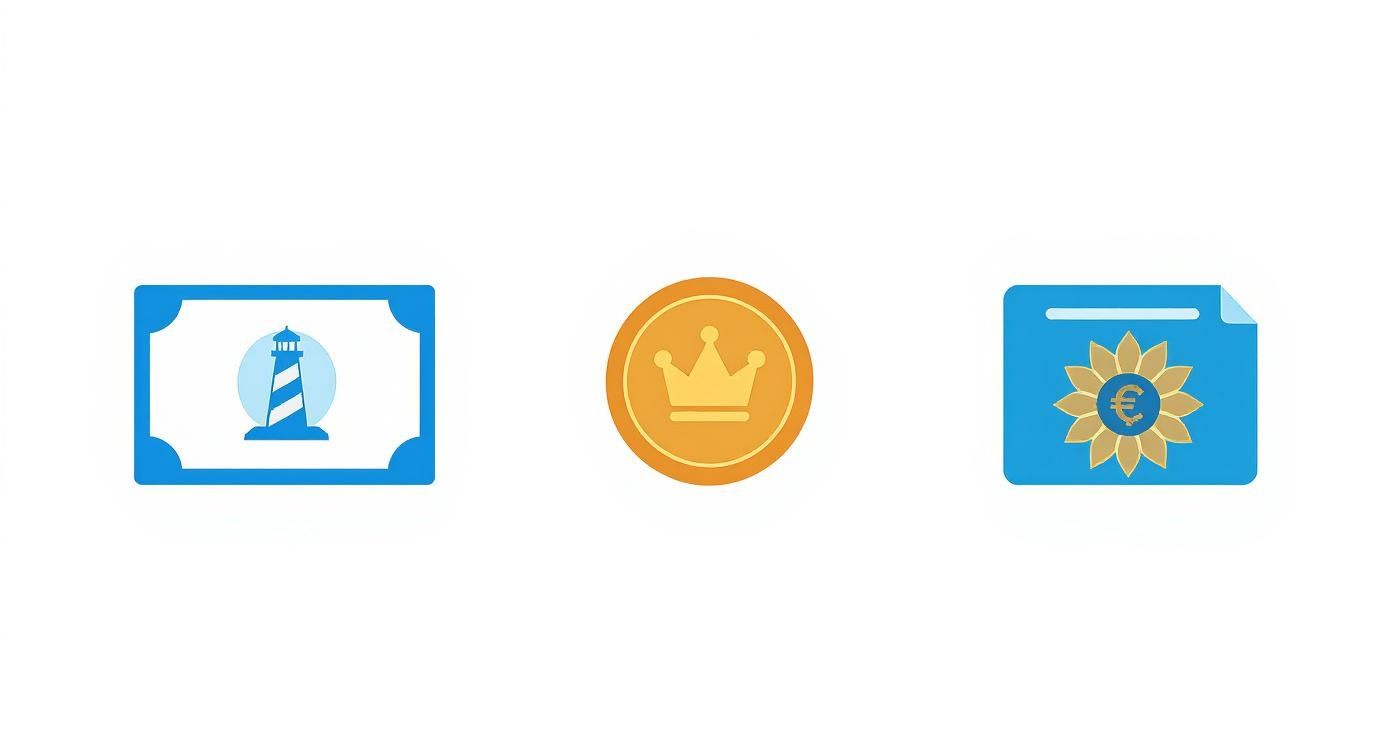
These beautiful, uniquely Dutch designs were officially replaced by the standardised euro, bringing an end to centuries of national currency art.
What Happened After the Transition?
The Dutch central bank, De Nederlandsche Bank, was actually quite generous with its exchange deadlines compared to other countries. You could exchange your old guilder coins right up until 2007. For banknotes, they offered a surprisingly long 30-year window, meaning they can theoretically be exchanged until 2032.
But there’s a catch. While the banknote deadline sounds comfortably far off, actually using this service is a huge hassle for anyone not in the Netherlands. And the window for coins slammed shut years ago. This is the main problem for anyone finding old guilders today.
Official channels for exchanging leftover Dutch currency are now either closed or impractical to access. That’s why a specialised exchange service is the most realistic—and often the only—way to convert these obsolete coins and notes back into cash you can actually use.
Our service provides a fast, easy, and 100% guaranteed solution. You don't need to worry about sorting your currency or dealing with expired deadlines. We are trusted by major UK brands, including charities, police forces, and airports, to handle the exchange of foreign coins and notes efficiently.
We turn your leftover foreign currency into a simple payment, making the entire process completely hassle-free. For a bigger picture, have a look at our guide on the various currencies that existed before the euro.
How Much Are My Old Dutch Guilders Worth Today?
So, you've dug out some old holiday money and confirmed they're Dutch guilders. The big question now is, what are they actually worth? It's a common myth that once the banks stopped officially exchanging them, they became worthless. That's simply not true. Your old currency absolutely still holds value, but it's important to understand how that value is calculated.
There are two ways to look at the worth of old guilders: their original face value, and their potential value to a collector. For the vast majority of coins and notes tucked away in jars or found in old wallets, their true worth is tied to the original exchange rate, not a high price on the collector's market.
Face Value vs Collector Value
Most of the guilders you'll find are just normal, everyday currency that was once in circulation. Their value is based on the fixed rate set when the Netherlands switched to the euro: 2.20371 guilders to one euro. This gives us a starting point, but the actual cash you'll get in your pocket depends on current market rates for obsolete currency.
Now, a tiny fraction of coins or notes might be worth more to collectors. This usually only applies if the item is:
- Extremely rare or from a very small batch.
- In perfect, crisp, uncirculated condition.
- An error print or has a unique story behind it.
For the average person, trying to navigate the complex and often slow world of collectors isn't practical. It means finding an expert for an appraisal and then hunting for a specialist buyer, which can be a long and uncertain process.
For most people, the simplest and most rewarding way to unlock the value in leftover Dutch guilders is to exchange them for spendable cash. This sidesteps the hassle of the niche collector's market and gives you a guaranteed return.
Our service is designed for exactly this. We offer a fast, easy, and hassle-free way to convert foreign coins and banknotes into money you can use today. There's no need to sort through your coins or spend hours researching obscure collector prices.
We provide a 100% guaranteed service built on years of trust and credibility. As the chosen currency exchange partner for major UK brands, including police forces, national charities, supermarkets, and airports, we offer a reliable and straightforward process. You simply send us your leftover currency—guilders and anything else you have—and we turn it into a prompt payment. It’s the easiest way to exchange foreign coins and notes. Find out how to get started on our homepage.
Exchange Your Old Dutch Guilders the Easy Way
So, you’ve discovered a stash of old Dutch guilders. Ready to turn that forgotten currency into real money? Good news – the next step is incredibly simple. We offer a fast, easy, and completely hassle-free way to exchange your guilders and any other foreign currency you might have lying around.
The best part? There’s absolutely no need to sort through your coins and notes. Forget spending hours separating different denominations or trying to figure out if they’re still valid. Just gather up all your leftover currency, pop it in a package, and we'll handle the rest. It’s the most straightforward way to convert foreign coins and banknotes.
A Trusted and Guaranteed Service
We get it. Sending money to someone you don’t know requires a lot of trust. That’s why we offer a 100% guaranteed service, making sure the whole process is transparent and secure from the moment your currency leaves your hands to the moment you get paid. Our reputation is built on being reliable, which is why we're a trusted currency exchange partner for some of the UK’s biggest organisations.
Our partners include:
- Major national charities
- Well-known supermarkets
- UK airports
- Police forces across the country
These aren't just names on a list; they're a testament to our professional and dependable service. When you choose us, you can be confident you're in safe hands.
Our goal is to make exchanging your currency as simple as possible. We cut out all the usual headaches, like sorting fiddly coins or trying to find a local exchange that will take them. What you get is a fast and efficient solution for your leftover holiday money.
Your Options for Exchange
We give you a flexible and convenient way to deal with your leftover foreign currency. Once we receive your coins and notes, we'll quickly work out their value. From there, you get to decide what happens next. You can get a fast payment sent straight to your bank or PayPal account, turning that dusty money into funds you can actually use.
Alternatively, if you're feeling generous, you can donate foreign coins to charity through our network of trusted partners. It’s a wonderfully simple way to make a difference with your leftover change. Whether you've found a pile of Dutch guilders or a mix of currencies from years of travel, our platform is the perfect place to exchange old currency. Just follow our simple steps and unlock the value hidden in that old coin jar today.
Still Have Questions?
Found some old Dutch guilders and not sure what to do? You're not the only one. Here are the answers to a few common questions we get all the time.
Can I Still Exchange Old Dutch Guilder Coins?
Even though you can’t pop into a bank anymore to swap your guilder coins, they absolutely still have value. We provide a simple, 100% guaranteed way to turn them back into cash.
Our service is designed to be fast and easy, so you don't have to worry about old deadlines.
How Much Is 100 Dutch Guilders Worth?
The value of 100 guilders is worked out from its original fixed exchange rate to the euro. We then adjust this based on the current market rates for obsolete currency.
You don’t need to get bogged down in the calculations; we handle all of that for you and make sure you get a fair and clear payment.
What Is the Best Way to Convert Foreign Coins and Notes?
Our process is the perfect solution to exchange foreign coins and notes. Just gather up your Dutch guilders and any other leftover currency you might have and send them to us.
The best part? There’s absolutely no need to sort your coins. Our whole service is built around making it as easy as possible for you. We’re the trusted currency exchange partner for major UK brands, including police forces, airports, supermarkets, and leading charities.
That trust is why you can be confident you’ll get a fast and secure payment every time.
Ready to unlock the value in your old currency? We offer a fast, easy, and hassle-free way to turn your forgotten coins and notes into cash. Our service is 100% guaranteed and trusted by major brands, so you can exchange with confidence. Visit us at https://www.webuyallcurrency.com to get started today and give your leftover holiday money a new life.