
Currency of Nicaragua: A UK Traveller’s Exchange Guide
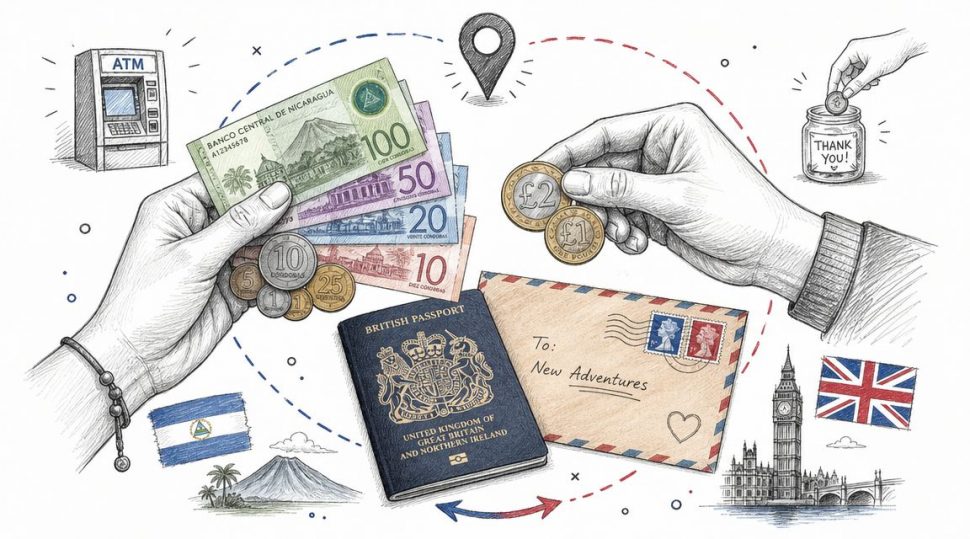
Posted by: Ian Stainton • 25 May 2026
The Nicaraguan córdoba, symbol C$ and ISO code NIO, is the official currency of Nicaragua, and it's divided into 100 centavos. Since January 2024, the official fixed rate has been 36.6243 córdobas to 1 US dollar, and in tourist areas you'll often see the córdoba used alongside US dollars.
If you've just come back from Nicaragua with a few notes in your wallet and coins in a kitchen drawer, you're not alone. Many UK travellers encounter this issue. You can identify the currency easily enough, but turning leftover Nicaraguan cash into pounds is often the harder part, especially when coins, small notes, or older issues are involved.
An Introduction to the Currency of Nicaragua
For most travellers, the currency of Nicaragua only becomes a real question twice. First, before the trip, when you're deciding what cash to take. Second, after the trip, when you realise the change in your bag isn't something most high street banks want to handle.
The basics are simple. Nicaragua uses the córdoba, written as C$ and coded internationally as NIO. It's the country's official unit of account, and if you're spending money in local shops, markets, smaller cafés, or transport settings, this is the currency you'll usually need.
What confuses people is that Nicaragua also has a practical link to the US dollar. In many tourist-facing settings, dollars may be accepted. That can make first-time visitors wonder whether they need córdobas at all. In reality, most travellers are better prepared when they understand both sides of the picture: local spending often works more smoothly in NIO, but you may still encounter US dollars in pricing or payment habits.
Practical rule: Take the time to learn the local currency before you travel, but also plan for what happens when you come home with a mix of notes and coins.
What most UK travellers need to know
If you're searching for the currency of Nicaragua, these are the key points:
- Official currency: Nicaraguan córdoba
- Currency symbol: C$
- ISO code: NIO
- Minor unit: 100 centavos
- Used with USD in some areas: Yes, especially in tourist settings
Why leftover Nicaraguan cash becomes a problem
This is the part travel guides often skip. Once you're back in the UK, leftover foreign currency can be awkward to deal with. Banks and airport desks often focus on mainstream notes in active demand. Small-value currencies, coins, mixed bundles, and withdrawn notes are a different story.
That's why specialist services exist. If you need to exchange foreign coins, exchange leftover currency, or convert foreign coins and banknotes from a trip, a specialist route is usually far more practical than assuming your local bank will sort it.
For many people, the sensible approach is simple. Spend what you can before flying home, keep any remaining notes and coins together, and use a service that accepts mixed foreign cash rather than leaving it in a drawer for years.
A Closer Look at Nicaraguan Córdoba Banknotes and Coins
The córdoba has a long history. Nicaragua's currency, the córdoba, was created in 1912, is named in honour of Francisco Hernández de Córdoba, and remains the country's official unit of account. It is divided into 100 centavos, and the Central Bank of Nicaragua has maintained a fixed exchange rate of 36.6243 córdobas to 1 US dollar since January 2024, as noted in this overview of the Nicaraguan córdoba.

If you're holding Nicaraguan cash at home, it helps to separate two things. First, what the currency is called. Second, what form your money is in: notes, coins, or a mix of both.
How the denominations work
Because the córdoba is a decimal currency, values are counted in whole córdobas and centavos. That makes the money easy to understand once you know that 100 centavos make 1 córdoba.
You'll usually come across:
- Banknotes: notes in córdoba denominations for everyday spending
- Coins: smaller change, including centavo values and whole córdobas
If you've returned with a mixed pocketful of change, don't assume the coins are too awkward to identify. The key is recognising that centavo coins are the fractional part of the currency, in the same way that pence sit under pounds.
What travellers often notice first
Notes are generally remembered before coins. Notes are easier to keep flat, easier to count, and more likely to survive the trip home in usable condition. Coins, by contrast, end up in bags, pockets, and travel jars.
Here's the practical distinction:
- Notes are usually what travellers try to exchange first
- Coins are the part people forget
- Mixed bundles are common after a longer trip or family holiday
That's important because the value of your leftover cash often sits across both. If you only look at the notes, you may miss a meaningful part of what you brought back.
The most useful habit is to treat every denomination as part of one total, not as “spendable money” and “souvenir change”.
Why history matters when you exchange it
The history of the córdoba affects how people think about it. A currency with a long-established official status and a managed exchange structure feels more recognisable than a loosely traded travel token. But that doesn't automatically mean it's easy to exchange in the UK.
For travellers, the takeaway is straightforward. You don't need to become a collector or researcher. You just need to recognise the córdoba as a real national currency with standard denominations, a decimal system, and a value that can still be converted when handled through the right channel.
Essential Money Tips for Travellers in Nicaragua
One of the biggest practical questions before travel is whether to carry US dollars, córdobas, or both. The most realistic answer is usually both, because Nicaragua's local currency is for everyday local spending, while US dollars may still be accepted in some tourist areas.

Recent rate data show 1 NIO is about US$0.02718, which underlines that the córdoba is a low-value, tightly managed currency. For UK travellers, that matters because it makes leftover notes and coins easy to underestimate, even though they can still add up across a trip, as explained in this guide to Nicaragua currency.
Should you take dollars or córdobas
If you're heading to a resort-heavy route or well-known tourist area, carrying some US dollars can be convenient. But that doesn't replace the need for local cash.
Use córdobas for the kinds of payments where local currency tends to work best:
- Small purchases: snacks, drinks, local shops, market stalls
- Everyday transport: short rides and minor cash payments
- Change handling: paying in local money avoids awkward mixed-currency change
Use dollars more carefully:
- Tourist-facing businesses: some may accept USD
- Backup cash: useful if you want a second cash option
- Not a full substitute: smaller local businesses may still expect córdobas
Why small leftovers happen so easily
Because the córdoba has a low unit value, travellers often end up with more physical cash than they expected. A few notes here, some coins there, and a final handful of change on departure day can quickly become your post-holiday problem.
That's why pre-trip planning matters. Don't get more local cash than you're likely to spend in cash-only situations. If you can, top up gradually rather than carrying far more than you need from the start.
Buy enough local currency for daily spending and flexibility, but not so much that your last day turns into a scramble to offload notes and coins.
Practical payment habits on the ground
You don't need a complicated system. A simple split usually works well:
- keep smaller local cash for day-to-day use
- keep backup money separate
- avoid carrying all your notes in one place
- hold onto coins during the trip instead of treating them as throwaway change
Card use may be easier in larger urban or visitor-focused settings than in smaller or more local ones. That means cash still matters, especially when you want smoother day-to-day transactions.
A simple pre-trip checklist
Before you go, it helps to ask yourself:
- Where will I be spending most of my time? Tourist hubs and smaller local areas can feel very different in payment habits.
- Will I need cash for minor purchases? Usually yes.
- What will I do with leftovers when I return? This is the part people forget.
Planning that last point in advance makes a real difference. If you already know how you'll exchange foreign coins and notes or donate foreign coins to charity when you get home, you won't treat the leftover cash as a nuisance. You'll treat it as something with a clear next step.
UK Exchange Options for Your Leftover Nicaraguan Currency
Returning with leftover Nicaraguan money often exposes a gap between travel advice and reality. Travel articles tell you what to carry abroad. They rarely tell you what happens when you come home with a mixture of notes, coins, and maybe an older issue that a standard bureau doesn't want.
Why banks and bureaus often fall short
Most traditional exchange points are set up for straightforward transactions. They prefer popular currencies, current banknotes, and predictable demand. Foreign coins are harder to process, and older or withdrawn notes can create extra handling work.
That's why travellers often hear some version of the same answer:
- Coins aren't accepted
- Only selected banknotes are eligible
- Small or unusual currencies may not be supported
- Older issues may be refused outright
This isn't always because the money has no value. It's often because the institution doesn't want the cost and complexity of sorting, storage, verification, and resale.
Comparing UK currency exchange options
| Exchange Option | Accepts NIO Coins? | Accepts Old NIO Notes? | Best For |
|---|---|---|---|
| High Street Bank | Sometimes not | Sometimes limited | Customers exchanging standard current notes |
| Airport Bureau | Usually focused on notes | Often limited | Last-minute travel money needs |
| Specialist postal currency service | Often yes | Often yes, depending on currency type | Mixed leftover holiday money, coins, notes, and older currency |
If you want a broader overview of how specialist exchange works, this guide on exchange foreign currency shows how postal services differ from the high street model.
What usually works best
For leftover Nicaragua travel money, the most practical route is usually a specialist service that accepts mixed foreign currency. That matters if you want to exchange foreign coins and notes, not just clean current banknotes.
One example is We Buy All Currency, which handles foreign coins, banknotes, and withdrawn currency by post. That type of service is designed for the exact situation many travellers face after returning home: a small, mixed collection that mainstream outlets won't touch.
How to Convert Foreign Coins and Banknotes into Pounds
If you've got leftover córdobas in a drawer, the simplest approach is to treat them as one bundle and convert them through a service built for mixed foreign cash. You shouldn't need to split everything into neat piles before you even know whether it can be exchanged.

Step 1 Collect your currency
Start by gathering everything in one place:
- Current notes: the obvious starting point
- Loose coins: often forgotten in bags or drawers
- Older travel money: mixed with cash from other trips
- Withdrawn or obscure items: still worth checking rather than assuming they're useless
You don't need a collector's eye. Just bring together all your leftover foreign cash and see it as one exchange job instead of a pile of separate problems.
If you want to understand specialist coin handling in more detail, this page on coin conversion to cash is useful for mixed and unsorted currency.
Step 2 Choose a practical exchange method
For many people, posting the currency is easier than visiting branches that may still turn them away. A specialist platform typically lets you get a quote, choose a payout method, and send the currency for checking.
This works well when you want to:
- exchange leftover currency from one trip
- convert foreign coins and banknotes from several countries
- donate foreign coins to charity instead of taking the proceeds yourself
Services in this category are also used by individuals, charities, and businesses, including organisations that receive foreign change through collections, customer donations, and public-facing cash handling.
If the money is mixed, unsorted, or awkward for the high street, that's usually the moment a specialist process becomes worthwhile.
Step 3 Get paid in pounds
Once the currency is checked and verified, payment is issued in pounds using the method you selected. According to the publisher information provided for this article, payments are issued within five working days by bank transfer or PayPal, and customers can also choose to direct the proceeds to a partnered UK charity.
That's what makes the process more manageable than holding onto leftover travel cash indefinitely. Instead of trying one bank after another, you use a route designed for foreign notes, coins, and even withdrawn currency.
A real-world example
A typical traveller comes home with a few Nicaraguan notes, a handful of centavo and córdoba coins, and other leftovers from a previous trip. A bank may only be interested in selected current notes, if any.
A specialist service solves the full problem in one go. You send the lot, receive a valuation based on the accepted currency, and either take the pounds or turn the value into a charity donation.
Common Mistakes to Avoid When Exchanging Holiday Money
The biggest mistakes happen after the trip, not before it. People don't usually lose value because they misunderstood the name of the currency. They lose it because they delay, assume, or discard money too quickly.
Four mistakes that cost travellers money
Assuming coins are worthless: NIO is a decimal currency with symbol C$ and a minor unit of 1/100 centavos, which means mixed amounts can be valued accurately down to centavo level, as shown in Xe's NIO currency overview. Coins may be awkward to exchange, but that doesn't make them meaningless.
Only checking one exchange route: A bank saying no doesn't mean your currency has no exchange value. It usually means that provider doesn't handle that type of item.
Leaving it in a drawer for years: Leftover foreign currency often gets mixed with receipts, adapters, and old passports. Once that happens, it's easy to forget what you have.
Thinking small amounts don't matter: One trip's leftovers may feel minor. Several trips' leftovers often tell a different story.
A better habit after every trip
Count your leftover travel money soon after you return. Separate local currency from everything else, check whether you have coins as well as notes, and decide quickly whether you want pounds back or whether you'd rather donate the value.
That matters with Nicaragua in particular because low-value units can create a false impression. A larger number of notes and coins may still look insignificant because the figures on them aren't familiar to you.
The mistake isn't bringing home small change. The mistake is treating exchangeable money as if it were only a souvenir.
Your Questions Answered About Exchanging Foreign Currency
Can I exchange Nicaraguan currency in the UK
Yes, but the route matters. Standard banks and bureaus may be limited, especially for coins or less commonly handled currencies. Specialist services are often the practical option.
Can I exchange foreign coins in the UK
Yes. Not every provider accepts them, but specialist services are built for people who need to exchange foreign coins rather than just current banknotes.
Do banks accept foreign coins and notes
Banks may accept some foreign notes, but coins are often a different matter. Policies vary, and less common currencies can be harder to place through mainstream channels.
What if I have old or withdrawn Nicaraguan notes
Don't assume they're worthless. Some specialist services accept old or withdrawn currency as well as current issues, so it's worth checking before you throw anything away.
Do I need to sort coins and notes first
Not always. Some specialist services can handle mixed, unsorted currency, which is helpful if your travel money has been sitting in jars, drawers, or storage boxes.
Is it safe to send foreign currency by post
Use the provider's instructions carefully and package the money properly. Postal exchange is a normal method for specialist foreign currency services.
How long does payment take
It depends on the provider. For the publisher referenced in this article, payment is issued within five working days after verification.
Can I donate leftover foreign currency instead of exchanging it for myself
Yes. Some services let you convert the value and send the proceeds directly to a UK charity, which is a practical option for coins and small leftovers you don't want to keep.
If you're ready to stop storing old holiday money and do something with it, the simplest next step is to use a service that accepts coins, banknotes, and older currency in one process.
If you've come back with Nicaraguan notes, centavo coins, or a mixed pouch of travel money from several trips, We Buy All Currency gives you a straightforward way to exchange foreign coins and notes, convert leftover currency into pounds, or donate the value to charity without the usual high street hassle.