
Understanding the Currency of the Cook Islands for 2026
Posted by: Ian Stainton • 30 May 2026
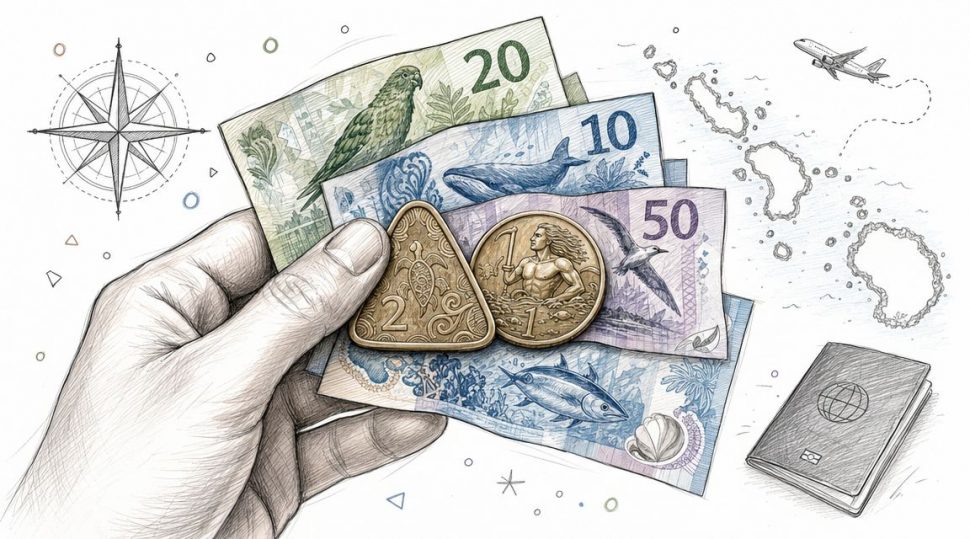
The Cook Islands use the New Zealand dollar (NZD), and the currency is divided into 100 cents. You may also come across Cook Islands-issued coins and banknotes that trade 1:1 with NZD locally, but they generally aren't exchangeable outside the islands.
That's where most travellers get stuck. You come home with a few notes, some unusual coins, maybe a souvenir piece you didn't even realise was local issue, and then discover that the money in your drawer isn't as straightforward as normal leftover holiday cash.
For UK travellers, the currency of the Cook Islands can be confusing because it works on two levels. One part is familiar and widely recognised. The other part is local, collectible, and often rejected by banks and standard travel-money counters. If you're trying to exchange foreign coins, exchange foreign coins and notes, or deal with leftover foreign currency after a trip, understanding that split makes all the difference.
Your Guide to Cook Islands Currency
You might have landed back in the UK with what looks like New Zealand money, only to notice that some coins or notes don't quite match. That's a common problem with the currency of the Cook Islands.

The simple answer
The Cook Islands use NZD as their official currency, and visitors also encounter Cook Islands-issued notes and coins worth 1:1 with NZD for local use, as explained by Cook Islands Pocket Guide.
That sounds simple until you try to exchange it in Britain.
A bureau may accept standard New Zealand notes. It may refuse Cook Islands pieces. A bank may not want the coins at all. So the practical question isn't only "what currency do they use?" It's "which part of it can I turn back into pounds?"
Practical rule: Treat Cook Islands money as a mixed bundle until you've checked which items are standard NZD and which are local Cook Islands issues.
Why travellers get confused
For day-to-day spending on holiday, the system works smoothly. You pay, receive change, and everything seems interchangeable. The problem only appears after the trip, when acceptance matters more than face value.
That's why leftover holiday money from the Cook Islands often sits in a jar for years. People assume all of it should exchange like ordinary travel money. In practice, some of it falls into the awkward category of foreign coins, local notes, or non-standard issues that mainstream providers don't handle well.
If your goal is to convert foreign coins and banknotes without wasting time, the key is simple. Separate the idea of spendable on the islands from exchangeable in the UK.
The Two Currencies Used in the Cook Islands
The Cook Islands have a dual-currency setup. Once you understand that, the rest of the puzzle becomes much easier.
NZD is the main currency
The main currency used there is the New Zealand dollar, and it is subdivided into 100 cents, as noted by Wise's Cook Islands currency guide. For a UK traveller, that means exchange-rate comparisons usually relate to NZD rather than to a separate global Cook Islands currency code.
In other words, if you're buying travel money before a trip, you're usually looking at New Zealand dollars.
Local Cook Islands notes and coins also circulate
Alongside NZD, the islands continue to issue their own distinctive local currency. This arrangement gives the country a stable monetary base while keeping a visible local identity through its own designs and denominations.
A useful UK comparison is Scottish or Northern Irish banknotes. They may have the same face value as other pound notes, but people outside their usual area sometimes hesitate to accept them. The Cook Islands situation is even narrower because local Cook Islands notes and coins are mainly for use within the islands themselves.
Spendability and exchangeability aren't the same thing. A note can work perfectly well on holiday and still be awkward to cash in later.
Why this matters when you get home
This is the point where many people mix up "same value" with "same acceptance".
Locally, a Cook Islands-issued note may circulate at the same value as NZD. Back in the UK, the issue is whether a bank, bureau, or specialist recognises it and has a process for handling it. Standard providers tend to focus on mainstream notes in mainstream currencies. They're not set up to process unusual local issues, mixed coin bags, or older designs.
That creates a very specific problem for returning travellers:
- Standard NZD notes may be easier to exchange.
- Cook Islands local notes may be refused outside the islands.
- Coins of any kind are often the hardest part to exchange.
- Mixed holiday money slows things down if you don't know what you have.
So inquiries about the currency of the Cook Islands often reveal a more practical underlying question. "Which part of this money can I still use, exchange, sell, or donate?"
A Guide to Cook Islands Coins and Banknotes
Some of the most memorable money from the Pacific comes from the Cook Islands. Even people who aren't collectors tend to notice that these coins and notes look different from ordinary travel cash.

Why these pieces stand out
Travellers often remember the unusual shapes, bright colours, and island-specific designs more than the exact denominations. That's one reason people bring them home instead of spending every last coin before departure.
Some pieces also feel more like souvenirs than spending money. A note or coin can sit halfway between currency and collectible, which is exactly why it confuses normal exchange desks.
The local notes aren't standard NZD notes
The Cook Islands' tourism guidance states that local notes and coins are not legal tender outside the Cook Islands, and it also highlights that they are sought after by collectors worldwide. The same guidance notes the launch of a new $3 banknote on 3 August 2021, replacing the previous 1987 design. You can see that detail in the official Cook Islands travel tips.
That single fact changes how you should think about leftover money from the islands.
A New Zealand note is usually just travel money. A Cook Islands-issued note may be local currency, a collectible object, or both. If it's older, distinctive, or from a denomination people don't expect, face value may not be the only thing that matters.
Some leftover holiday money is best treated as currency. Some is better treated as a specialist item.
What that means in practice
If you've got Cook Islands banknotes or unusual coins, don't assume a normal bank counter will know what to do with them. Equally, don't assume they're worthless just because a high street branch says no.
This is especially relevant if you have:
- Cook Islands-issued notes rather than ordinary New Zealand notes
- Mixed coins and notes from several trips
- Older designs you've had in a drawer for years
- Withdrawn or unusual pieces that look different from current travel money
For many people, the right move is not to spend time trying every bank in town. It's to find a route designed to handle non-standard money, whether your aim is to exchange leftover currency or donate foreign coins to charity.
Where to Exchange Leftover Currency Back in the UK
Theory becomes a practical decision.
When people try to exchange leftover foreign currency from the Cook Islands, they usually start with the obvious options. A bank. A travel-money bureau. Maybe the airport. Then the limitations appear.
Why banks and bureaux often say no
Banks usually focus on current banknotes in widely traded currencies. They generally aren't built around sorting foreign coin bags, identifying local island issues, or dealing with withdrawn designs. Travel bureaux tend to be even narrower. They want currencies they can quickly price, resell, and process.
Cook Islands money creates two separate obstacles:
- Foreign coins are commonly refused because they're bulky, costly to process, and awkward to recirculate.
- Cook Islands-specific notes may be rejected because they aren't standard NZD legal tender outside the islands.
If you've got a mix of standard NZD notes and local Cook Islands pieces, a mainstream outlet may only accept part of it.
Comparing Your UK Currency Exchange Options
| Exchange Option | Accepts NZD Notes | Accepts Cook Islands Notes | Accepts Foreign Coins |
|---|---|---|---|
| High street bank | Sometimes | Usually no | Usually no |
| Travel-money bureau | Often current notes only | Usually no | Usually no |
| Specialist currency buyer | Often yes, depending on item | Often yes, depending on item | Often yes |
That's why specialist services exist. They deal with the part of the market that ordinary providers leave behind, including people trying to exchange leftover currency from old trips, mixed collections, charity drives, business tills, and donation jars.
A better fit for awkward currencies
A specialist service is usually the more practical route if you want to exchange foreign coins and notes in one go, especially when the money includes odd local issues, obsolete notes, or small-value coins that no bank wants.
This matters beyond personal travel too. Charities, supermarkets, airports, and businesses often end up with assorted overseas coins and notes that standard channels won't process cleanly. A specialist setup is designed for exactly that kind of mixed, unsorted, hard-to-place currency.
Common sense matters here. If a provider is built for mainstream travel cash, it probably won't be the right place for the non-standard portion of Cook Islands money.
How to Convert Foreign Coins and Banknotes into Cash
If your wallet, drawer, or change jar contains mixed holiday money, the easiest route is usually a specialist postal process. That works particularly well when you want to convert foreign coins and banknotes together instead of trying to separate the easy items from the awkward ones.

A straightforward way to handle mixed currency
One example is We Buy All Currency, which accepts coins, banknotes, and withdrawn currency by post. It's used by individuals, charities, and businesses, and it offers a route for people who want to exchange foreign coins and notes without relying on a bank branch or travel bureau.
The basic process is simple.
Gather everything together
Pull out all your foreign cash, including coins, notes, and older pieces from previous trips.Check the quote before sending
A specialist platform will usually show rates or values in advance, so you know what you're sending for.Pack the currency
You generally don't need to sort every coin by hand. That's useful if your Cook Islands money is mixed with euros, dollars, or other leftover foreign currency.Post it securely and wait for verification
The provider checks what arrives against the submission.Receive payment or choose donation
Some people cash out. Others use the same process to donate foreign coins to charity.
If you have a mixed bag from several holidays, don't wait until you've identified every last coin. A specialist service can often handle the sorting stage for you.
Common mistakes to avoid
Assuming all Cook Islands money is standard NZD
Some items are local issues, and that changes where they can be exchanged.Taking coins to a normal bank first
Many travellers lose time on a route that was never likely to work.Throwing in old notes without checking
Withdrawn currency can still have value through the right specialist channel.Forgetting about charity options
Small amounts of leftover foreign currency can still be useful if you'd rather donate than cash out.
Real-world examples
A traveller returns from Rarotonga with a few NZD notes, local coins, and one unusual banknote kept as a souvenir. A standard bureau may only want the NZD note.
A family empties a holiday jar and finds Cook Islands money mixed with euros, US coins, and old pre-euro pieces. Sorting it all manually becomes the biggest barrier, so they use a service that accepts unsorted currency.
A charity receives assorted overseas coins in a donation tub. Instead of trying to bank them, it uses a specialist route that can convert foreign coins and banknotes into usable funds.
Your Cook Islands Currency Questions Answered
Is the Cook Islands dollar the same as the New Zealand dollar
Not exactly. NZD is the main official currency used in the islands, while local Cook Islands-issued notes and coins circulate locally at the same value. The important difference is acceptance outside the islands.
Can I spend New Zealand money in the Cook Islands
In practical day-to-day use, NZD is the main currency there. For most travellers, that's the money they'll recognise most easily before and during the trip.
Can I exchange Cook Islands coins in the UK
Often not through banks or standard bureaux. Foreign coins are one of the least accepted forms of leftover holiday money, especially when they come from a niche destination.
Why won't my bank accept Cook Islands banknotes
Banks usually deal in mainstream, current banknotes that fit their regular foreign-exchange systems. Local Cook Islands notes sit outside that normal workflow, so many branches won't process them.
Do old or withdrawn Cook Islands notes still have value
They can. Some older or unusual notes may still be exchangeable through a specialist, and some may also interest collectors depending on the item.
What if my Cook Islands money is mixed with other currencies
That's common. Many people keep all their leftover travel cash together. A specialist service can be useful when you want to exchange foreign coins, notes, and older currency in one submission.
Can I donate leftover Cook Islands coins instead of exchanging them
Yes, if the service you use supports charity donations. That can be a practical option for small coin amounts that you don't want to keep.
How long does payment usually take
It depends on the provider's process, but specialist postal services usually explain payment timing up front before you send anything.
If you've got Cook Islands coins, local banknotes, standard NZD notes, or a mixed pile of leftover holiday money from several trips, the simplest next step is to use a specialist service that can handle the awkward items banks leave behind. You can start with We Buy All Currency to exchange leftover currency, convert foreign coins and banknotes, or turn small amounts into a charity donation.