
Do Post Office Exchange Euro Coins? Your 2026 UK Guide
Posted by: Ian Stainton • 30 Apr 2026
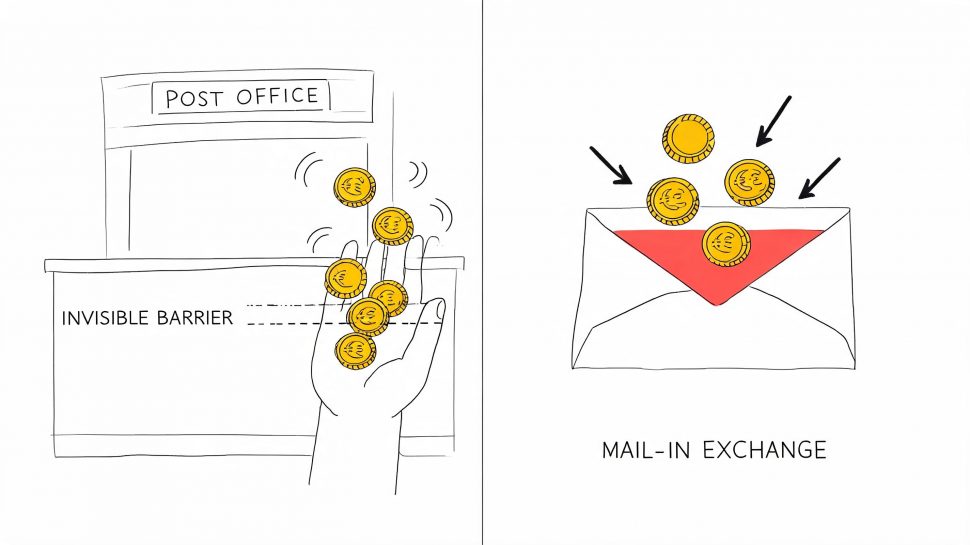
No, the Post Office doesn’t exchange euro coins. It only exchanges euro banknotes at select branches with bureaux de change, so if you’ve come home with a pocket of cents and €1 or €2 coins, a specialist online service is the practical alternative.
That’s the situation many UK travellers run into. You get back from a city break, beach holiday, school trip or work travel with leftover foreign currency, assume the Post Office will sort it, and then find out the coins aren’t accepted at all. The same problem comes up for charities, retailers, airports, and anyone collecting small amounts of mixed foreign change.
Your Guide to Exchanging Euro Coins in the UK
If you're searching do post office exchange euro coins, the answer is simple. They don't.
UK Post Offices exchange euro banknotes only, not euro coins. That position is clearly confirmed by specialist exchange guidance, including Leftover Currency, which states: “No, you won’t be able to exchange euro coins at the post office. If your local post office has a bureau de change, you will only be able to exchange euro banknotes, not euro coins” in its foreign coin exchange FAQ.
What this means in practice
If you have:
- Loose euro coins from a holiday
- A jar of mixed leftover foreign currency
- Charity collections with small denomination coins
- Euro coins mixed with notes and older currency
a standard branch visit won't solve the problem.
What does work is using a specialist postal exchange service that accepts foreign coins and notes together, including mixed and unsorted amounts. That matters because individuals typically don't just have neat bundles of current banknotes. They have a mixture of coins, old notes, small denominations, and sometimes withdrawn currency from trips spread over years.
Practical rule: If your leftover euros are mainly coins, don't waste time queuing at a bureau de change first. Start with a service that handles coins from the outset.
Why people get caught out
The confusion is understandable. People associate the Post Office with travel money, so they expect the reverse service to cover everything they brought home. It doesn't.
A better way to think about it is this:
- Post Office for buying travel money and changing back certain banknotes.
- Specialist online exchange for coins, mixed currency, older issues, and awkward leftovers.
That distinction saves a wasted trip and makes it much easier to exchange foreign coins, exchange foreign coins and notes, and convert foreign coins and banknotes in one go.
The Official Post Office Policy on Foreign Currency
The Post Office does offer foreign currency buy-back, but there’s a clear limit to it.

As of 2026, UK Post Offices explicitly refuse all euro coins for exchange, even though over 2,500 branches offer a buy-back service for euro banknotes, as explained in this comparison of what the Post Office can and can’t exchange.
What the Post Office will and won't take
In practical terms, the Post Office sits in the middle ground. It can help with certain current foreign banknotes, but not with coins and not with the awkward categories that travellers often bring back.
Typically accepted
- Current euro banknotes
- Other supported foreign banknotes
- Walk-in or standard buy-back at bureau branches
Not accepted
- Euro coins
- Other foreign coins
- Mixed loose change
- Old or withdrawn currency that falls outside standard branch buy-back rules
Why coins are excluded
This isn't just a policy quirk. It's mostly an operations issue.
Coins are harder to handle than notes. Staff have to sort them, verify them, count them, store them securely, and ship low-value, heavy items through the cash handling chain. That’s awkward enough with sterling coinage. It gets much more complicated with foreign coin denominations, multiple issuing countries, and worn holiday change that arrives in small mixed batches.
Coins create work at every stage. The value can be modest, but the handling effort isn't.
That’s why bureaux and banks tend to focus on current banknotes. Notes are faster to inspect, simpler to process, and easier to move in volume. For the customer, that means a frustrating gap. The money is real, but the high street often treats it as unusable.
What works better for coin-heavy leftovers
If your leftover currency is mostly coins, or a mix of coins and notes, the smoother route is a specialist postal exchange service. Those services are designed for the exact problem branch counters try to avoid.
They're also a better fit for real-life collections such as:
- Holiday wallets with mixed euros
- School or club trip leftovers
- Retail tills with foreign change taken in error
- Charity tubs full of small denomination coins
Comparing Your Options to Exchange Leftover Currency
When you want to exchange leftover currency, the right route depends on what you possess, not what the provider advertises on the front page. A handful of current notes is one thing. A bag of coins, older banknotes and odd leftovers is another.
Currency Exchange Options in the UK
| Provider | Accepts Euro Coins? | Accepts Withdrawn Currency? | Process | Best For |
|---|---|---|---|---|
| Post Office | No | Not generally the right option for older or unusual leftovers | In branch at bureaux de change | Current foreign banknotes |
| High street banks | Usually not the practical option for foreign coins | Often limited | In branch, policy varies | Existing customers with straightforward needs |
| Specialist postal currency service | Yes | Yes | Quote online, pack, post, receive payment | Coins, notes, mixed currency, leftover holiday money, charity collections |
A specialist service is usually the only route that properly covers the full lifecycle of leftover travel money. That includes current notes, loose coins, withdrawn issues, and mixed bags from several trips.
If your priority is convenience, the difference is even clearer:
- Post Office works for supported banknotes only.
- Banks often have tighter policies and less appetite for foreign coin handling.
- Specialists are built for the messy stuff people have in drawers, jars and collection tins.
Best option by situation
If you’re holding a few euro notes, the Post Office may be fine.
If you need to exchange foreign coins, or you have a mix of notes, coins and older currency, a postal specialist is usually the more complete option. It removes the branch roulette problem, where you travel to a counter only to be told your money falls outside policy.
Most leftover currency isn't neatly organised. The best exchange method is the one that accepts mixed reality, not just ideal cases.
That matters for families, charities and businesses because foreign currency tends to build up in layers. One trip leaves coins. Another leaves notes. A fundraiser adds mixed change. Before long, you need a service that can handle the lot.
How to Exchange Foreign Coins and Notes from Home
The easiest way to exchange foreign coins and notes is usually by post. That sounds less familiar than walking into a branch, but for coin-heavy leftovers it's often much simpler.

Step 1 Get your quote
Start online. If you’ve got mixed coins and notes, use a service that lets you declare what you have without needing perfect sorting first. A weight-based tool is especially useful for jars, bags and holiday leftovers where everything has ended up together.
The big practical advantage is speed. You can deal with the whole pile from home instead of separating the “maybe accepted” items from the “probably rejected” ones.
Step 2 Pack the currency properly
Put coins and banknotes into secure packaging. If you’re sending both, keep notes flat and stop coins from moving around freely inside the envelope or parcel.
You don't need to make it look like a bank deposit. You do need to make sure the contents can't tear the packaging or leak out in transit.
Step 3 Send it by post
Once packed, send the package using the provider’s instructions. This is the point where postal exchange becomes more convenient than branch exchange. You’re not tied to bureau opening hours, queue times, or a particular branch’s service setup.
Step 4 Currency is checked and verified
On arrival, the currency is counted and verified. A specialist service can handle:
- Current foreign banknotes
- Foreign coins
- Withdrawn or obsolete currency
- Mixed and unsorted leftovers
- Combined personal or charity collections
The specialist model is essential. It’s designed around sorting and processing awkward currency rather than refusing it at the counter.
Step 5 Receive payment
After verification, payment is issued. According to the publisher information for the service behind this article, postal exchanges are processed with payment issued within five working days by bank transfer or PayPal, with no hidden charges and free returns if the customer doesn't want to proceed.
What makes home exchange easier
The main benefits are generally straightforward:
- No branch visit
- No need to split coins from notes just to discover coins aren't accepted
- One route for current, old, and mixed currency
- A better option for people trying to convert foreign coins and banknotes together
That’s especially useful if your leftover foreign currency has been sitting around for months and has become a “sort out later” job.
Practical Tips for Packing and Sending Your Currency
How you pack your money matters. Coins are dense, notes crease easily, and badly packed envelopes can split in transit.

Packing advice that prevents problems
Use a padded envelope or small parcel. Loose coins can tear thin paper envelopes, especially if the package is handled through automated mail systems.
Bag coins inside the outer packaging. Small grip bags, paper wraps, or sealed inner pouches help stop movement and make the package easier to process.
Keep banknotes flat and dry. Put notes in a separate sleeve or envelope within the package so they don't get bent around the coins.
Tape internal bags closed. This isn't about making the package difficult to open. It's about stopping small coins from escaping if the inner bag shifts.
Send it as though the package will be turned upside down several times. Because it probably will.
When tracked post makes sense
For modest amounts, standard post may feel sufficient. For larger collections, many people prefer tracked or signed-for delivery for peace of mind. That's particularly sensible if you're sending mixed foreign coins from a charity box, business collection, or several holidays combined.
If you want practical mailing guidance, this advice on sending cash in the post covers the common-sense precautions worth following.
A simple packing checklist
- Separate notes from coins
- Use sturdy outer packaging
- Seal inner bags carefully
- Include any required order details
- Choose a postal method you're comfortable with
Good packing doesn't make the exchange more complicated. It makes the process smoother and reduces the chances of delay.
Turn Your Leftover Coins into Charitable Donations
Not everyone wants the payout for themselves. A lot of leftover foreign currency ends up in donation boxes, airport collections, school campaigns, church fundraising, or office drives.

That matters because over 500 UK charities handle more than £10 million in foreign currency donations annually, yet institutions such as the Post Office accept note donations, not coins, creating a real gap for fundraisers, according to the Post Office currency buy-back information referenced here.
Why coin donations get stuck
The problem is familiar. A supporter donates holiday change. A volunteer empties the collection tin. Then someone discovers that the coins can’t be exchanged at the usual high street counter.
At that point, the donation still has value, but it needs a route that can process:
- Mixed euro coins
- Foreign coins from multiple countries
- Notes bundled in with coins
- Older or withdrawn money from previous trips
Good uses for foreign coin donation schemes
This approach works well for more than one-off charity tins. It also suits organisations that collect small amounts repeatedly and need a practical way to turn them into usable funds.
Examples include:
- Charities running travel money appeals
- Airports collecting leftover change from passengers
- Airlines gathering in-flight donations
- Retailers inviting customers to donate foreign coins
- Schools after exchange trips or tours
Small foreign coins look insignificant on their own. In organised collections, they become useful fundraising income.
For individuals, donating can also be the simplest answer if the amount is small and you’d rather clear the drawer than chase the highest possible return. For charities and businesses, the key is using a service that accepts coins as they come, rather than one that only handles notes.
Common Mistakes When You Exchange Leftover Currency
People lose value on leftover money in very ordinary ways. Usually it isn't because the currency is worthless. It's because they assume the wrong exchange route will accept it.
The scale of the issue is larger than commonly understood. UK households are estimated to hold around £1.2 billion in unused foreign currency, with euros making up about 35%, and a large share is in coins that people dismiss because high street exchanges refuse them, according to ECB-linked circulation context referenced here.
Mistakes that come up again and again
Assuming the Post Office takes euro coins
This is the most common one. People treat the Post Office as the obvious answer for all travel money and only discover the coin restriction after making a trip.
Thinking small amounts aren't worth dealing with
One purse of coins may be minor. Several trips' leftovers, a family’s combined change, or a workplace collection can become worth converting.
Throwing old currency in with no plan
Older and withdrawn currency often needs a specialist route. If you leave it sitting for years, it becomes harder to identify and easier to forget.
Sorting everything more than necessary
A lot of people overcomplicate the job because they expect providers to reject mixed currency. Specialist services exist precisely because real leftover foreign currency is rarely neat.
A better habit
Keep all your leftover travel money together, then use one specialist route to exchange foreign coins and notes in a single send-off. That avoids the classic split where notes get exchanged, coins get abandoned, and older currency stays in a drawer for another year.
Frequently Asked Questions
Can I exchange euro coins at a UK Post Office?
No. UK Post Offices exchange euro banknotes at select bureau branches, but not euro coins. If you have coin leftovers, you’ll need a specialist service rather than a standard branch counter.
Can I exchange foreign coins at a UK bank?
Sometimes people assume banks will do what the Post Office won’t, but foreign coin exchange is usually limited or unavailable on the high street. Policies vary, and coins are often the first thing excluded. For mixed or awkward leftover currency, specialist exchange services are usually more practical.
Can I exchange foreign coins and notes together?
Yes, with a specialist provider. That’s often the easiest option because real-life leftover currency is rarely just one type. Travellers often have coins, notes, and sometimes older issues from several trips.
Do I need to sort coins before sending them?
Not always. Some specialist services accept mixed and unsorted currency, including coins and banknotes together. That’s useful if you want to exchange leftover currency without spending ages separating small denominations.
What about old or withdrawn currency?
Old or withdrawn currency can still have value, but it usually falls outside normal bureau or bank policies. A specialist provider is the better option if you want to convert unusual or discontinued money rather than just current travel cash.
Is it worth exchanging only a small amount?
Often, yes. Small amounts are exactly what get stranded because high street providers refuse them. If the money has been sitting unused, converting it or donating it is usually better than leaving it forgotten in a drawer.
Can I donate foreign coins to charity?
Yes. Specialist services can make that practical even when high street exchanges won’t take the coins. This is especially useful for charity collections, airport donations, school fundraising, and business campaigns involving mixed foreign currency.
How long does payment take with a postal specialist?
For the publisher behind this article, payment is issued within five working days after verification. Exact timing can depend on the provider and the method you choose, so it’s worth checking the service terms before sending.
Is sending currency by post safe?
It can be, if you pack it properly and use a provider with clear instructions. Secure inner bags, sturdy packaging, and a postal method that suits the value you’re sending all help reduce risk.
What’s the simplest way to deal with leftover holiday money?
Gather everything in one place first. That includes coins, notes, and any older foreign currency. Then choose the exchange route based on what you have. If it’s mostly notes, a standard buy-back service may be enough. If it includes coins or older money, a specialist is usually the easier route.
If you’ve been turned away by a branch counter or you’ve got a mix of coins, notes, and older travel money sitting at home, We Buy All Currency is built for that exact job. You can exchange foreign coins, exchange leftover currency, or convert foreign coins and banknotes by post without needing to sort everything perfectly first.