
Dutch Guilder to Pounds: Exchange & Value Guide 2026
Posted by: Ian Stainton • 7 Jun 2026
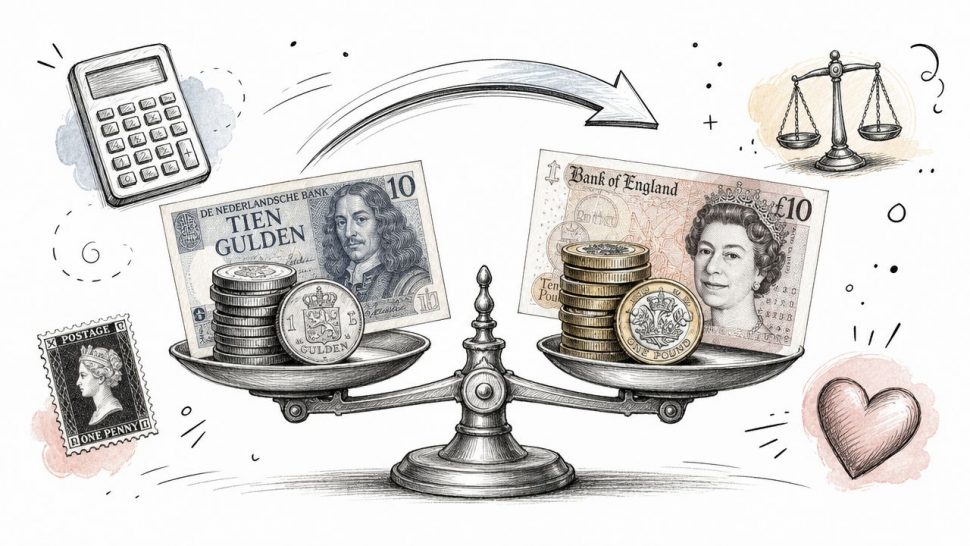
Old Dutch guilders are usually worth roughly £0.39 per guilder when converted into pounds, with reference pages showing 1 NLG around 0.392606 to 0.395979 GBP. Because guilders are a withdrawn currency, most banks won't take them, but a specialist online service that accepts obsolete coins and banknotes can still convert them into pounds.
You find them during a clear-out. A small tin of Dutch coins, a few colourful old banknotes, maybe leftover holiday money from Amsterdam, or cash tucked into family papers that nobody dealt with at the time. The immediate question is simple: can these still be turned into money in the UK?
In many cases, yes. The challenge isn't whether the guilder had value. It's that the normal places people try first, such as banks, bureaux de change, and the Post Office, usually don't handle old foreign currency, especially coins and withdrawn notes. That leaves people assuming the money is useless when it often isn't.
If you're trying to work out the practical route from Dutch guilder to pounds, the answer is to treat this as a specialist exchange job, not a standard travel-money transaction. That applies whether you want to exchange foreign coins, exchange foreign coins and notes together, or deal with a bag of leftover foreign currency without sorting every piece.
What to Do with Old Dutch Guilders
A common situation is this: someone empties a drawer, finds old Netherlands money, and isn't sure whether to keep it, bin it, or take it to the bank. The bank says no. A travel money counter says it only accepts current notes. The coins get pushed back into a cupboard.
That's the wrong outcome for the majority.
Start by separating use value from sentimental value
If the guilders are ordinary leftover money, the sensible move is to exchange them through a specialist that handles withdrawn currency. If they were inherited, or they look unusual, old, pristine, or commemorative, pause before sending them anywhere. Some pieces may have collector appeal that sits outside normal exchange value.
Practical rule: If the note or coin looks standard and worn, think exchange value first. If it looks rare, unusual, uncirculated, or part of a set, check collector interest before exchanging.
Few possess a rare numismatic item. They have ordinary travel leftovers or old family cash. In that case, the main job is convenience. You want a service that can handle coins, notes, and obsolete currency without sending you from one provider to another.
Why traditional options usually don't work
High-street providers are built for active travel currencies. They want current notes they can resell quickly. Dutch guilders don't fit that model because they're legacy currency. Coins are even more awkward, because mainstream exchange counters almost never want foreign coins at all.
That's why specialist routes matter for anyone trying to exchange leftover currency. They're designed for the diverse mix of currency individuals possess, such as loose coins, folded notes, mixed denominations, and withdrawn money from pre-euro Europe.
The practical answer
For most UK customers, the best next step is simple:
- Check what you have: Coins, notes, or both.
- Set aside anything that looks collectible: Particularly older or high-grade items.
- Use a specialist exchange service: One that accepts withdrawn currency, not just current travel money.
- Send everything in one batch if possible: That's usually easier than trying to place each item separately.
If your guilders have been sitting untouched for years, you don't need to overcomplicate it. The key is choosing the right type of provider from the start.
How Much Are Dutch Guilders Worth in Pounds
The starting point for valuation is not guesswork. For Dutch guilder banknotes, De Nederlandsche Bank uses a fixed conversion rate of EUR 1 = NLG 2.20371, which means 1 NLG is worth about EUR 0.45378. That works out to roughly £0.39, depending on the euro to pound rate at the time, as shown on the De Nederlandsche Bank guilder exchange page.
The useful pound benchmark
For UK users, the most practical benchmark is the sterling range shown by live and historical converter pages. One UK-facing converter showed 1 NLG = GBP 0.392606 to 0.395979, while another historical reference placed the guilder within a broader band. The important takeaway is that the guilder's pound value sits close to the £0.39 to £0.40 area in the available snapshots.
That helps answer the first question people ask. A guilder isn't worthless. But it also isn't an active travel currency with a single shop-window rate you can rely on forever. Obsolete currency has to be priced using historical series, fixed legacy conversion logic, and a current payout method.
Exchange value and collector value are not the same
People often misunderstand a key difference. Exchange value means what a specialist currency service can pay based on the note or coin as currency. Collector value means what a numismatic buyer might pay because the item is scarce, unusual, or desirable.
Use this quick test before you convert foreign coins and banknotes:
- Ordinary circulated notes and coins: Usually best treated as exchange items.
- Unusual designs, proofs, sets, or very crisp banknotes: Worth a collector check first.
- Inherited bundles with old paperwork or albums: Review before sending.
- Mixed loose holiday money: Normally exchange, not collectable.
A rare note can be worth more to a collector than to a currency exchanger. An ordinary guilder note usually isn't.
Dutch Guilder Exchange Options Compared
| Exchange Provider | Accepts Guilder Banknotes? | Accepts Guilder Coins? | Best For |
|---|---|---|---|
| High-street bank | Usually no | Usually no | Current account services, not obsolete foreign cash |
| Travel money bureau | Sometimes current currencies only | Usually no | Active holiday money |
| Specialist currency exchange service | Yes, where supported | Yes, where supported | Withdrawn notes, coins, and leftover foreign currency |
The table is the practical reality. If you want to exchange foreign coins and notes, specialist services exist for exactly that purpose. Mainstream providers generally don't.
What affects the final amount you receive
Even when the benchmark is clear, the final quote can still vary. The provider has to deal with handling, verification, legacy pricing, and the fact that guilders are no longer a live traded retail currency in the way euros are.
That's why the best approach is to get a fixed quote before sending anything. A transparent quote matters more than staring at a stale converter screen.
A Step-by-Step Guide to Exchanging Your Guilders
You find an old envelope of Dutch guilders while clearing a drawer, then hit the obvious question. Can these still be turned into pounds, and if so, how?
The practical route is straightforward. First identify what you have. Banknotes, coins, or a mixed batch all follow slightly different handling, and that affects how you submit them. If the money is jumbled together with other old travel cash, leave it that way unless the exchange service asks for detailed sorting. Specialist providers such as We Buy All Currency can process mixed foreign currency, including withdrawn money, without expecting you to separate every denomination by hand.
That saves time, especially if the guilders came from an inherited tin, a holiday wallet, or a bag of assorted coins that has been sitting untouched for years.

Getting your valuation
Start with the service's quoting process and choose the option that matches what you hold. If you know the denominations, enter them accurately. If you have a mixed coin lot or unsorted foreign cash, use the option designed for that. The goal is not to create a museum-grade inventory. The goal is to get your old guilders into a process that ends with pounds paid to your UK account.
Check one thing before you send anything. If a note looks unusually crisp, older than the rest, part of a set, or different in design, pause and get a collector opinion first. Ordinary circulated guilders are usually exchange items. The outliers need a quick second look.
Packing and sending your currency
Once you accept the valuation route, pack the currency properly. This part matters because old money is easy to damage in weak packaging, and heavy coin parcels can split if they are packed badly.
A practical packing checklist:
- Use strong outer packaging: Coins can tear thin envelopes.
- Keep notes flat and dry: Avoid tight folds and elastic bands that mark the paper.
- Add your reference details clearly: This helps the provider match the parcel to your submission.
- Separate anything you may keep for collectors: Do not send rare-looking items by accident.
If you are posting more than one currency, group each type together. That makes checking faster and reduces the chance of hold-ups during verification.
Verification and payment
After the parcel arrives, the provider checks the contents against the submission and confirms what can be exchanged. That step is where specialist handling makes a real difference. Obsolete currencies are not treated like live travel money, so the provider needs to recognise old guilder notes, process mixed coin bags correctly, and verify withdrawn issues without sending you back to a bank that already said no.
According to the publisher information provided for this service, payment is issued within five working days after verification, with options including bank transfer or PayPal.
A common concern is posting cash. The sensible way to reduce risk is to pack it well, include the right reference information, and use a service with a clear verification and payment process.
Common mistakes to avoid
Common mistakes to avoid include:
- Stopping after a bank refuses the currency: Banks often do not handle obsolete foreign cash. That does not mean the guilders are worthless.
- Over-sorting mixed leftovers: If the service accepts mixed foreign currency, detailed sorting often adds effort without improving the result.
- Missing collector clues: A single better note in an inherited bundle can change what you should do next.
- Using an old online converter as your decision point: The only figure that matters is the live quote or valuation route you can use.
- Discarding coins: Specialist exchange services may accept coins as well as notes, which is why they are often the only workable option for old guilders.
The cleanest process is simple. Check for anything that looks collectable, submit the right valuation type, pack the currency securely, and send it to a provider that handles obsolete notes and coins properly.
Real-World Examples and Tips to Maximise Your Return
A common real-life case is a kitchen drawer full of travel leftovers. You find a few Dutch guilder notes, some coins, and a mix of other old currencies that no shop or bank will touch. In that situation, the practical move is to send the lot through a specialist that accepts mixed foreign cash, rather than spending an evening sorting low-value coins by country.
Small amounts still add up.
People often leave them for years because the bundle looks too minor to bother with. In practice, those are exactly the parcels specialist exchange services handle every day, and combining them with other leftover currencies usually makes the job easier.

A different case needs more care. Inherited Dutch guilders often come in envelopes, albums, or carefully labelled bundles. That presentation can be a clue. Ordinary circulated notes are usually candidates for exchange, but older issues, uncirculated notes, replacement notes, and presentation sets can carry collector value that is higher than their exchange value.
Condition matters here. A folded, handled note is usually treated very differently from a crisp note with sharp corners. If anything looks unusually well kept or out of the ordinary, pause before sending it for standard exchange.
A few habits can improve the outcome:
- Send guilders together with any other obsolete or leftover foreign cash you want to clear. One parcel is simpler to manage and often more worthwhile than several separate ones.
- Keep notes flat and dry. Creasing, staining, or taping them can reduce value and slow down checking.
- Do not polish or scrub coins. Cleaning can hurt collector appeal.
- Separate anything that looks unusual before you post the rest. A commemorative set or older note should be reviewed on its own.
- If the amount is too small to justify a personal payout, consider a route that lets you donate foreign coins to charity instead of leaving them unused.
Timing also affects results, but not in the way many people assume. With obsolete currency, the key question is rarely whether a historical chart once showed a slightly better rate. The key question is whether you have a live route that will accept Dutch guilders and pay you in pounds. Banks usually do not. A specialist service does.
The practical rule is simple. Check first for collector pieces, then exchange the ordinary notes and coins while you still know where they are and what they came from. Delaying tends to create more friction, not more value.
Turn Your Old Guilders into a Charitable Donation
Not everyone wants the pounds paid back to them. Sometimes the amount is modest, or the money was found during a house clearance, or it feels easier to put it to good use. In that case, you can donate foreign coins to charity instead of cashing them personally.

The practical process is much the same. The currency is submitted, checked, and exchanged, but the proceeds go directly to a charity partner rather than to your own account. For many people, that's the easiest way to deal with small amounts of leftover foreign currency that would otherwise sit unused.
This option also solves a common problem with coins. Coins are awkward to spend, awkward to bank, and awkward to separate by country if you've got a mixed travel jar. A donation route lets you clear the lot and still create some value from it.
If that appeals, it's worth looking at ways to donate foreign coins to charity rather than leaving them in storage. Services in this space are used not only by individuals but also by charities, retailers, airports, and other organisations that collect foreign money over time.
For anyone who doesn't need the cash personally, it's a tidy solution. The guilders leave your drawer, and the value goes somewhere useful.
Frequently Asked Questions About Dutch Guilders
Can I still exchange Dutch guilders in the UK?
Yes, but usually through a specialist that handles obsolete foreign currency. High-street banks and travel money counters generally do not process old guilders, especially coins or older withdrawn notes.
Do UK banks accept Dutch guilder notes or coins?
In practice, usually no. Banks are set up for current currencies and standard banking products, not old foreign cash that needs manual checking, specialist pricing, and separate resale routes.
That is why people often assume their guilders are worthless when the underlying issue is that the usual banking route does not handle them.
Are guilder coins worth anything?
Often, yes. Some have exchange value through a specialist service, and some have collector value if the date, denomination, minting, or condition makes them more desirable.
The key point is to separate spendable currency value from collector value. A common circulated coin may still be exchangeable even if it is not rare enough for a coin dealer to pay a premium.
Are old guilder banknotes better than coins?
For straightforward exchange, notes are usually simpler to process than coins. They are lighter to post, easier to count, and easier to identify.
That said, coins should not be written off. If a service accepts obsolete foreign coins, they can still be turned into pounds or included with other leftover currency in one submission.
How do I know whether to exchange or sell to a collector?
Start with condition and rarity. If the guilder note or coin looks like ordinary leftover travel money, exchange is usually the practical option. If it is uncirculated, part of a set, very old, misprinted, or visually unusual, get a collector opinion before sending it for currency exchange.
That extra check can make a real difference. I would always pause before exchanging anything that looks especially crisp or uncommon.
Is it safe to post old foreign money?
Yes, if you pack it properly and use a tracked postal service. Notes should be kept flat and dry inside a sturdy envelope. Coins need much stronger packaging so they do not tear through the parcel in transit.
Include clear contact details and a summary of what is inside. That helps the verification process once the package arrives.
Can I exchange other old currencies at the same time?
Usually yes. That is often the most practical way to clear a drawer of mixed pre-euro notes, foreign coins, and leftover holiday money in one go.
It also saves time compared with trying to sort each currency through different providers.
What if I have only a small amount?
A small amount can still be worth sending if you combine it with other foreign currency. If the value is too low to bother with personally, donating it is often the cleaner option.
Who can actually help if the bank will not?
A specialist service such as We Buy All Currency can assess old notes, coins, and withdrawn currency, then convert the accepted value into pounds paid to your bank account, or pass the proceeds to charity if that is your preference.
That is usually the practical route people need. The bank says no, the travel counter says no, and the money stays in a drawer unless a specialist handles obsolete currency.