
5 Australian Pounds (1938 – 1952 Series)
£3.503380
1 AUP = £0.700676
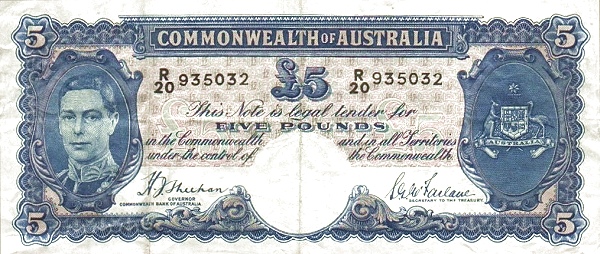
The 5 Australian Pounds banknote issued between 1938 and 1952 belongs to Australia’s historic pre-decimal currency system, used before the introduction of the Australian dollar in 1966. Produced by the Commonwealth Bank of Australia, the note reflects the formal engraving style typical of British Commonwealth banknotes of the mid-20th century. Rich ornamentation, detailed linework, and symbolic imagery combine to create a design that emphasises stability, authority, and national identity during a period spanning the Second World War and the early post-war years.
On the front of the banknote appears a portrait of King George VI, framed within an elaborate oval cartouche. The engraving captures uniform detail and facial structure using finely layered lines, while complex guilloché patterns fill the surrounding background. The inscription Commonwealth of Australia runs prominently across the upper centre, and the promise of payment — This note is legal tender for five pounds — appears in formal script across the middle. Signature panels sit below the central text, and a large watermark window occupies the centre of the design. The denomination “5” is repeated within decorative panels to ensure clear recognition.
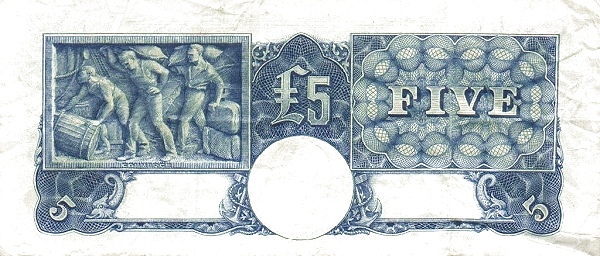
The reverse presents a dynamic industrial vignette showing workers handling cargo, symbolising Australia’s trade and labour economy during the period. The figures are rendered in detailed engraved style, surrounded by geometric frames and patterned panels that mirror the structure of the front. The dominant blue colour palette provides visual clarity while maintaining the restrained tone characteristic of banknotes from this era.
As a withdrawn pre-decimal issue, the 5 Australian Pounds (1938–1952) is no longer accepted by banks or high-street exchange bureaux and is often discovered in inherited collections, estate clearances, or long-kept travel memorabilia. If you have historic Australian banknotes and would like a simple way to exchange foreign coins, our UK-based service provides a convenient option.
• Indicate the quantity of 5 Australian Pound banknotes you want to exchange
• Click the ‘Add to your account’ button
• Your online account now shows the exchange value
Older overseas banknotes frequently fall outside the policies of traditional exchange providers due to age, withdrawal status, or limited demand. We exchange leftover currency for individuals, charities, and businesses throughout the UK, offering a reliable route to convert obsolete foreign banknotes into pounds securely — without needing a collector, auction sale, or specialist dealer.
Fast turnaround
We send your money within 5 working days of receiving your currency.
We’ll send your money by bank transfer, PayPal or cheque. You can also donate your exchange to a charity of your choice.
Easy and convenient
Get paid quickly
After counting your leftover coins and banknotes we’ll pay you within 5 working days. Get your payment quickly via PayPal or bank transfer.
No hidden charges
We don’t have any hidden charges, you will see our rates before you send any notes or coins. You receive the full value of the calculated exchange.
Get rid of currency that’s no longer in circulation
We also exchange discontinued foreign money. You can cash in all pre-euro currency as well as most obsolete currencies from outside the Eurozone.
Benefit from the best exchange rates online
Exchange rates change daily, that’s why we stay on top of the rate fluctuations so we can offer you the best rates for foreign money.
Happiness guarantee
We check your foreign currency and produce a formal quote, if you’re not happy we guarantee to send your currency back to you, absolutely free of charge.
Help out a charity with your exchange
We partner with many of the UK’s amazing charities. If you’d like to turn your old foreign money into a charitable donation, we can help.