
20 Dollars XCD Banknote (2003 ‘Silver Foil’ Issue) 2003
£3.909912
1 XCD = £0.195496
20 Dollars Dollar (Issued 2003)
The Eastern Caribbean Central Bank’s 20 Dollar note of 2003 channels the collective identity of eight island nations through its vivid imagery of colonial architecture, native flora, and the shared geography that binds the Eastern Caribbean Currency Union together. Issued at a time when the ECCB was reinforcing regional cohesion through updated security features, the note celebrates both the natural richness and the civic heritage of the member states. The distinctive silver foil element marks this issue apart from earlier printings, lending it a distinctly modern security profile. Together, the design elements speak to the pride each participating territory takes in belonging to a wider, unified Caribbean community.
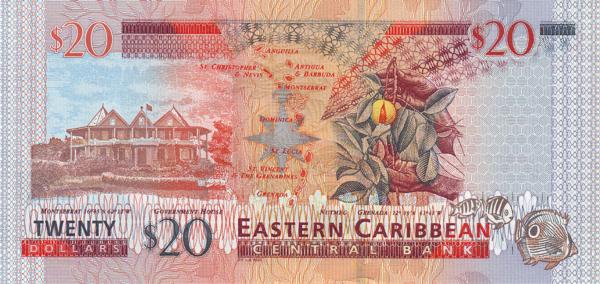
On the front, the note is dominated by a warm palette of orange, red, peach, and pale blue, interwoven with intricate guilloché patterning that provides a continuous fine-line background across the entire field. To the left of centre, a detailed engraved vignette depicts a grand colonial-style timber building set within manicured grounds and beneath a flagpole — identified by the caption beneath as Government House, Montserrat. The building is rendered with considerable architectural precision, its multi-gabled roof, broad verandas, and surrounding tropical vegetation captured in fine intaglio line work. To the right of centre, a large cartographic illustration shows the island chain of the Eastern Caribbean, with individual islands labelled in small text including Anguilla, St. Christopher and Nevis, Antigua and Barbuda, Montserrat, Dominica, St. Lucia, St. Vincent and the Grenadines, and Grenada. Overlapping the map to the right is a richly detailed botanical engraving of the nutmeg plant — associated with Grenada — showing the fruit, leaves, and flowering elements in deep green and brown tones against the lighter background. In the lower right corner, an engraved illustration of a tropical fish adds further natural symbolism. The denomination “TWENTY DOLLARS” is stated prominently in bold red lettering across the lower left, with the numeral “$20” appearing in red at both the upper left and upper right corners. The issuing authority name, “EASTERN CARIBBEAN CENTRAL BANK,” runs in bold red capital letters across the lower portion of the note, providing a strong typographic anchor to the composition. A red band of fine repeating geometric pattern runs across the very bottom of the note. Text along the lower edge references “MONTSERRAT GOVERNMENT HOUSE” to the left and “NUTMEG GRENADA” to the right, identifying the two principal vignettes. The silver foil security element, the identifying feature of this 2003 issue, is visible as a reflective strip integrated into the design, adding a metallic sheen that distinguishes it from standard printed areas.
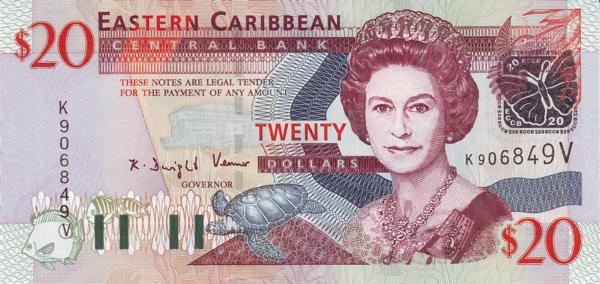
The reverse of this note presents a strikingly different composition centred on a portrait of Queen Elizabeth II rendered in fine engraved detail, positioned to the right of centre against a pale background enriched with subtle guilloché rosette work. The Queen is shown in a formal pose wearing a tiara and pearl jewellery, her likeness executed with the precision characteristic of high-quality intaglio currency printing. To the left, the Eastern Caribbean Central Bank’s administrative building is depicted in a detailed architectural vignette, showing a modern multi-storey structure set within its surroundings. The denomination “$20” and “TWENTY DOLLARS” are clearly stated in the note’s typography, with the issuing bank name repeated. The colour scheme on the reverse shifts toward cooler blue and green tones, complemented by the warm orange and red elements carried over from the front, maintaining visual consistency across both faces of the note. Watermark and security thread elements are embedded within the paper substrate, visible when held to the light, as is standard for Eastern Caribbean Central Bank issues of this period.
If you have a 20 Dollars Eastern Caribbean States banknote to exchange, Webuyallcurrency.com takes it as part of its leftover currency service, combining your Eastern Caribbean Dollars banknotes with other world coins and banknotes in one easy payout.
• Indicate the quantity of 20 Dollars Dollar banknotes you want to exchange
• Click the ‘Add to your account’ button
• Your online account now shows the exchange value
Exchange foreign coins and banknotes the easy way — Webuyallcurrency.com buys Eastern Caribbean Dollars banknotes, current or discontinued, and combines them with the rest of your leftover currency for one simple payment.
Fast turnaround
We send your money within 5 working days of receiving your currency.
We’ll send your money by bank transfer, PayPal or cheque. You can also donate your exchange to a charity of your choice.
Easy and convenient
Get paid quickly
After counting your leftover coins and banknotes we’ll pay you within 5 working days. Get your payment quickly via PayPal or bank transfer.
No hidden charges
We don’t have any hidden charges, you will see our rates before you send any notes or coins. You receive the full value of the calculated exchange.
Get rid of currency that’s no longer in circulation
We also exchange discontinued foreign money. You can cash in all pre-euro currency as well as most obsolete currencies from outside the Eurozone.
Benefit from the best exchange rates online
Exchange rates change daily, that’s why we stay on top of the rate fluctuations so we can offer you the best rates for foreign money.
Happiness guarantee
We check your foreign currency and produce a formal quote, if you’re not happy we guarantee to send your currency back to you, absolutely free of charge.
Help out a charity with your exchange
We partner with many of the UK’s amazing charities. If you’d like to turn your old foreign money into a charitable donation, we can help.