

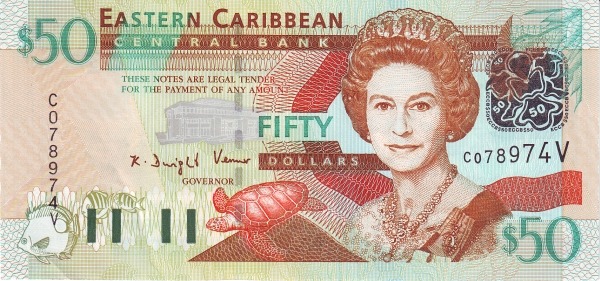
50 Dollars XCD Banknote (2003 ‘Silver Foil’ Issue) 2003
£9.678000
1 XCD = £0.193560
50 Dollars Dollar (Issued 2003)
The Eastern Caribbean Dollar stands as a shared emblem of regional unity, binding together eight island nations under a single monetary authority and a common visual language of natural splendour and historical heritage. The 50 Dollar denomination of the 2003 Silver Foil issue reflects the Eastern Caribbean Central Bank’s commitment to celebrating the landscapes and colonial fortifications that define the archipelago’s identity. Issued as legal tender across member states including Anguilla, Antigua and Barbuda, Dominica, Grenada, Montserrat, Saint Kitts and Nevis, Saint Lucia, and Saint Vincent and the Grenadines, this note carries the geographic soul of the Eastern Caribbean within its design. The 2003 issue introduced enhanced security features, including the distinctive silver foil element that gives this series its identifying name.
On the front, the note is dominated by a warm palette of teal, aquamarine, and earthy red-browns, with the large bold denomination numeral “$50” appearing prominently in the upper left and upper right corners in green and teal tones. The issuing authority’s name, “EASTERN CARIBBEAN CENTRAL BANK,” is printed in clear, bold capital lettering across the lower central portion of the note, with “FIFTY DOLLARS” rendered in a contrasting red band below the central vignette area. The central design features a detailed aerial or elevated illustrative vignette of what appears to be Brimstone Hill Fortress on Saint Kitts, rendered with fine engraved linework showing the fortified stone walls, ramparts, and surrounding landscape with considerable architectural precision. To the right of this fortress vignette, a dramatic rendering of the Pitons — the twin volcanic spires of Saint Lucia — rises in rich reddish-brown engraving against a lighter background, their distinctive conical peaks rendered with careful shading and cross-hatching to convey geological drama. A map of the Eastern Caribbean island chain occupies the upper central area of the note, with the names of member territories — including Anguilla, St. Christopher and Nevis, Antigua and Barbuda, Montserrat, Dominica, St. Lucia, St. Vincent and the Grenadines, and Grenada — printed in fine serif typography at their respective geographic positions. Compass rose detailing is visible at the centre of the map. In the lower right corner, a brightly coloured illustrative vignette depicts tropical marine life, including what appears to be a vividly rendered tropical fish with blue, yellow, and orange colouring, accompanied by coral or shell motifs. The note features a series of fine guilloché geometric patterns across its background, providing security through complex interlocking wave and rosette forms. Red and teal colour bands run along the top and bottom borders of the note, framing the central design within a structured compositional border. Coordinate references for specific island locations are printed in small text beneath the map, adding cartographic detail consistent with the note’s regional identity theme.
The reverse of the note bears the portrait side of the 2003 issue, featuring Queen Elizabeth II in a formal, dignified engraved portrait rendered in fine intaglio linework, as was standard for Eastern Caribbean Central Bank notes of this period. The portrait is framed by intricate guilloché rosette patterns and fine-line background security printing in complementary teal and green tones. The denomination “$50” appears again in the upper corners, and the silver foil security element — the identifying feature of this 2003 issue — is visible as a reflective metallic strip or patch integrated into the note’s design. Watermark areas are present within the paper, visible when the note is held to light, providing an additional layer of anti-counterfeiting protection consistent with the standards applied by the Eastern Caribbean Central Bank at this time of issue.
Whether it is a single 50 Dollar Eastern Caribbean States banknote or a mix of leftover currency, Webuyallcurrency.com exchanges Eastern Caribbean Dollars banknotes and other foreign coins and notes for cash in one straightforward process.
• Indicate the quantity of 50 Dollars Dollar banknotes you want to exchange
• Click the ‘Add to your account’ button
• Your online account now shows the exchange value
Webuyallcurrency.com buys and exchanges foreign currency of every kind, so your Eastern Caribbean Dollars banknotes — withdrawn or current — can be sold for cash together with the rest of your leftover coins and notes.
Fast turnaround
We send your money within 5 working days of receiving your currency.
We’ll send your money by bank transfer, PayPal or cheque. You can also donate your exchange to a charity of your choice.
Easy and convenient
Get paid quickly
After counting your leftover coins and banknotes we’ll pay you within 5 working days. Get your payment quickly via PayPal or bank transfer.
No hidden charges
We don’t have any hidden charges, you will see our rates before you send any notes or coins. You receive the full value of the calculated exchange.
Get rid of currency that’s no longer in circulation
We also exchange discontinued foreign money. You can cash in all pre-euro currency as well as most obsolete currencies from outside the Eurozone.
Benefit from the best exchange rates online
Exchange rates change daily, that’s why we stay on top of the rate fluctuations so we can offer you the best rates for foreign money.
Happiness guarantee
We check your foreign currency and produce a formal quote, if you’re not happy we guarantee to send your currency back to you, absolutely free of charge.
Help out a charity with your exchange
We partner with many of the UK’s amazing charities. If you’d like to turn your old foreign money into a charitable donation, we can help.