
1 Pound FLK Banknote (1960–1975 ‘Elizabeth II’ Issue) 1967-1982
£0.757500
1 FKP = £0.757500
1 Pound Falkland Islands Pound (Issued 1967-1982)
The Government of the Falkland Islands withdrew this one pound note from circulation as the territory’s currency evolved through the latter decades of the twentieth century, with the note’s issue period spanning from 1967 to 1982. Its replacement came as part of broader updates to the Falkland Islands’ monetary arrangements, particularly in the period following the 1982 conflict, which prompted significant administrative and institutional changes across the territory. The note had originally entered circulation under the authority of the Government of the Falkland Islands and carries a printed date of 2nd January 1967. Today it exists as a withdrawn legal tender issue that can still be submitted for exchange through specialist currency services operating in the United Kingdom.
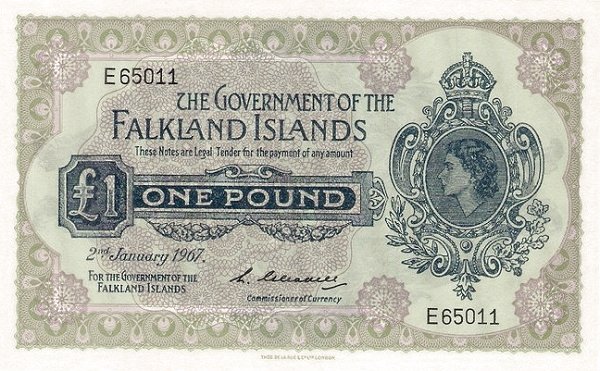
On the front, the note is dominated by a cool blue-grey and pale green palette laid over cream-toned paper, with the overall design displaying a restrained elegance typical of mid-twentieth century British colonial currency production. The heading “THE GOVERNMENT OF THE FALKLAND ISLANDS” is prominently printed in bold, capitalised serif lettering across the upper portion of the note, beneath which the legal tender declaration reads “These Notes are Legal Tender for the payment of any amount.” To the centre-left, a dark navy rectangular panel bears the sterling pound symbol “£1” on the left and the words “ONE POUND” in large, bold capital letters to the right, creating a strong focal denomination statement. The serial number E 65011 appears twice — once in the upper left area and again in the lower right — printed in dark ink against the note’s lighter background. The date “2nd January 1967” is printed in italic script in the lower central portion, accompanied by the authority line “For the Government of the Falkland Islands” and a manuscript signature above the printed title “Commissioner of Currency.” To the right of the note sits an elaborately engraved portrait medallion framed by an ornate scrollwork cartouche surmounted by a royal crown. Within this oval frame is a right-facing portrait of Queen Elizabeth II, depicted in a youthful likeness consistent with her early reign portraiture, rendered in fine intaglio engraving with detailed shading around the face, neck and shoulders. Surrounding the entire composition is an intricate guilloché border of repeating floral and geometric rosette patterns in a soft lavender-grey tone, which frames the note on all four sides with a lace-like precision. At the very base of the note, small text indicates production by a security printer in London. The overall engraving throughout is of fine line work consistent with high-security banknote printing of the era.
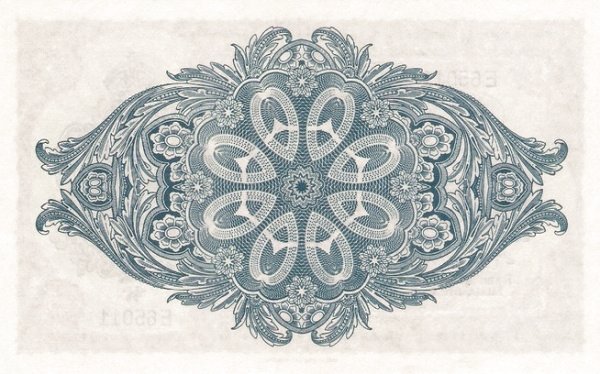
The reverse presents a spectacular central guilloché medallion executed entirely in steel blue-grey ink against the cream paper ground. The design is built around a large oval panel filled with a densely layered, radially symmetrical pattern of interlocking scrollwork, foliate tendrils and floral rosettes, all radiating outward from a central six-pointed star motif encircled by further petal and leaf forms. The outermost ring of the medallion resolves into acanthus-style leaf scrolls and symmetrical floral clusters at the cardinal points, lending the composition an almost architectural formality. Beyond the central oval, the design extends into broad, sweeping baroque-influenced scroll forms at the left and right edges, terminating in additional floral and foliage details. The mirror symmetry of the entire reverse design is precise and unbroken, a hallmark of the guilloché printing techniques employed by specialist security printers of the period. Faint show-through from the front of the note is visible in the background, and the serial number E 65011 can be discerned in ghost form through the paper, confirming the single-ply composition of the note. No denomination text, issuing authority wording or pictorial vignette appears on the reverse — the design relies entirely on the intricate geometric and floral engraving to fill the space with visual authority.
If you have a 1 Pound Falkland Islands banknote to exchange, Webuyallcurrency.com takes it as part of its leftover currency service, combining your Falkland Islands Pounds banknotes with other world coins and banknotes in one easy payout.
• Indicate the quantity of 1 Pound Pound banknotes you want to exchange
• Click the ‘Add to your account’ button
• Your online account now shows the exchange value
If you have leftover currency to exchange, Webuyallcurrency.com accepts Falkland Islands Pounds banknotes and a wide range of other foreign coins and notes, paying out for the lot in a single straightforward transaction.
Fast turnaround
We send your money within 5 working days of receiving your currency.
We’ll send your money by bank transfer, PayPal or cheque. You can also donate your exchange to a charity of your choice.
Easy and convenient
Get paid quickly
After counting your leftover coins and banknotes we’ll pay you within 5 working days. Get your payment quickly via PayPal or bank transfer.
No hidden charges
We don’t have any hidden charges, you will see our rates before you send any notes or coins. You receive the full value of the calculated exchange.
Get rid of currency that’s no longer in circulation
We also exchange discontinued foreign money. You can cash in all pre-euro currency as well as most obsolete currencies from outside the Eurozone.
Benefit from the best exchange rates online
Exchange rates change daily, that’s why we stay on top of the rate fluctuations so we can offer you the best rates for foreign money.
Happiness guarantee
We check your foreign currency and produce a formal quote, if you’re not happy we guarantee to send your currency back to you, absolutely free of charge.
Help out a charity with your exchange
We partner with many of the UK’s amazing charities. If you’d like to turn your old foreign money into a charitable donation, we can help.