
100 Israeli Lirot Banknote (Type 1968)
£0.041000
1 ILP = £0.000410
100 Lirot Israeli Lira (Issued 1968)
In 1968, a 100 Lirot note represented a substantial sum in the Israeli economy — the kind of banknote that would have passed through the hands of merchants, civil servants, and families making significant purchases in the markets and banks of Tel Aviv and Jerusalem. Issued during a period of rapid national development, this note circulated through a young country building its financial infrastructure from the ground up. It would have been carefully folded into wallets, lodged in till drawers, and counted across bank counters as Israel expanded its economy throughout the late 1960s. Today it survives as a tangible record of the Israeli Lira era, before the currency was eventually replaced by the Shekel in the late 1970s and early 1980s.
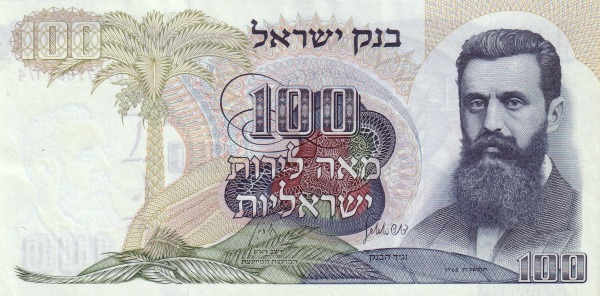
On the front, the dominant feature is a precisely engraved portrait of Theodor Herzl, the founder of modern political Zionism and one of the most symbolically important figures in the history of the State of Israel, positioned to the right of the note in a detailed intaglio style rendered primarily in deep blue-grey tones. Herzl is depicted in his characteristic formal attire with a full dark beard, his gaze directed slightly away from the viewer, the engraving capturing fine detail in the texture of his jacket and the contours of his face. To the left of the note, two tall palm trees rise against a pale background, their fronds fanning outward in a stylised but naturalistic manner, rendered in soft green and ochre tones. Centrally placed, the denomination “100” appears in bold, ornate numerals surrounded by swirling guilloché scrollwork in shades of red, green, and purple, creating a vivid multi-tonal centrepiece. Above this central motif, the text “בנק ישראל” — Bank of Israel in Hebrew — is printed in bold lettering across the upper portion of the note. Below the denomination numerals, the words “מאה לירות ישראליות” — meaning “One Hundred Israeli Pounds” — are set in clear Hebrew script. A signature appears beneath the central design, accompanied by additional small Hebrew text identifying the bank’s authorisation. The numeral “100” also appears in the lower right corner in a contrasting style, and the overall ground of the note carries a subtle pale blue and cream tint with fine background printing visible across the entire surface.
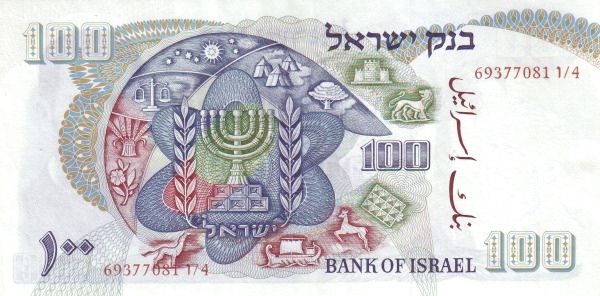
The reverse presents an elaborate and richly detailed compositional design centred on a large oval cartouche filled with an intricate arrangement of Israeli national and cultural symbols rendered in blue, green, red, and purple inks over a pale ground. Prominently at the centre of this oval stands the Menorah — the seven-branched candelabrum and official emblem of the State of Israel — depicted in green with olive branches framing either side, directly echoing the national coat of arms. Surrounding the Menorah within the oval are multiple vignette images drawn from Jewish history and Israeli national life: a stylised depiction of what appears to be ancient stone walls or fortifications, a leaping stag or deer rendered in fine line engraving, a lion in profile, a sailing vessel, a chalice or ceremonial cup, a floral motif, and what appears to be a stylised sun or star symbol at the upper portion of the oval. The word “ישראל” — Israel — appears in Hebrew script within the lower section of the central oval. The denomination “100” is printed twice on the reverse, once in the lower left corner and once to the right of centre, in bold blue numerals. The serial number “69377081 1/4” appears twice — once in the lower left and once in the upper right — in red numerals, providing a clear security and tracking reference. The text “BANK OF ISRAEL” is printed in Roman lettering along the lower centre of the note, and “בנק ישראל” appears again in Hebrew at the top. The borders of the reverse carry fine guilloché wave patterns and interlocking decorative lines in blue and gold tones, framing the entire composition with a structured elegance typical of mid-twentieth-century security printing.
Webuyallcurrency.com buys foreign coins and banknotes for cash, including this 100 Lirot banknote from Israel. Send it in with any other Israeli Pounds banknotes you have and we will handle the exchange in a single straightforward process.
• Indicate the quantity of 100 Lirot Israeli Lira banknotes you want to exchange
• Click the ‘Add to your account’ button
• Your online account now shows the exchange value
From leftover holiday money to inherited collections, Webuyallcurrency.com will exchange or buy your Israeli Pounds banknotes and other foreign currency, handling old and withdrawn pieces in the same simple process.
Other Israeli Pounds you can exchange: 0.5, 1, 5, 10, 50, 500.
Fast turnaround
We send your money within 5 working days of receiving your currency.
We’ll send your money by bank transfer, PayPal or cheque. You can also donate your exchange to a charity of your choice.
Easy and convenient
Get paid quickly
After counting your leftover coins and banknotes we’ll pay you within 5 working days. Get your payment quickly via PayPal or bank transfer.
No hidden charges
We don’t have any hidden charges, you will see our rates before you send any notes or coins. You receive the full value of the calculated exchange.
Get rid of currency that’s no longer in circulation
We also exchange discontinued foreign money. You can cash in all pre-euro currency as well as most obsolete currencies from outside the Eurozone.
Benefit from the best exchange rates online
Exchange rates change daily, that’s why we stay on top of the rate fluctuations so we can offer you the best rates for foreign money.
Happiness guarantee
We check your foreign currency and produce a formal quote, if you’re not happy we guarantee to send your currency back to you, absolutely free of charge.
Help out a charity with your exchange
We partner with many of the UK’s amazing charities. If you’d like to turn your old foreign money into a charitable donation, we can help.