
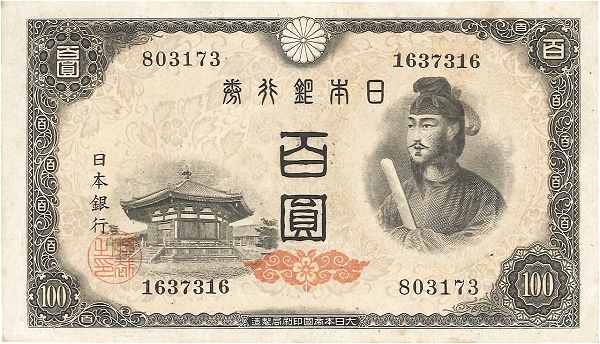
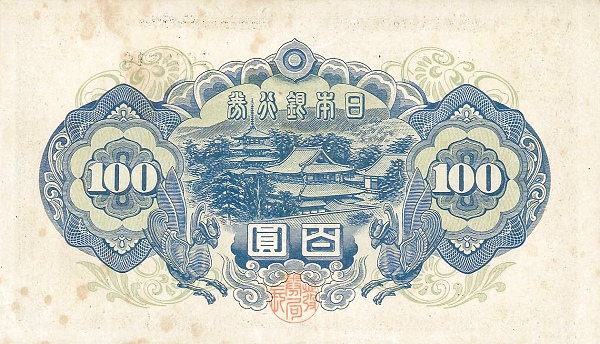
100 Japanese Yen banknote (Prince Shotoku)
£0.296296
1 JPY = £0.002963
100 Yen (Issued 1946)
Prince Shotoku, the seventh-century regent and statesman credited with spreading Buddhism and Confucian governance throughout Japan, became one of the most enduring figures to appear on Japanese currency across the twentieth century. His presence on this 100 Yen note spoke directly to the cultural pride and historical continuity that the Bank of Japan sought to project during the post-war reconstruction era. Alongside him, the architectural heritage of Japan’s ancient capital is rendered with quiet reverence, connecting everyday commerce to centuries of national identity. For the Japanese public of the mid-twentieth century, handling this note was a daily encounter with the deep roots of their civilisation.
On the front, the central right portion of the note is dominated by a finely engraved portrait of Prince Shotoku, depicted in traditional court dress with his hair swept upward and secured in the classical style, holding a ceremonial baton or shaku in his right hand. The engraving is executed with exceptional precision, capturing subtle tonal gradations across the face, robes, and accessories using intaglio line work characteristic of the period. To the left of the portrait, a detailed vignette depicts a traditional Japanese temple building with a prominent multi-tiered roof, identifiable as the Yumedono, or Hall of Dreams, at Horyu-ji in Nara — one of the oldest surviving wooden structures in the world and intimately associated with Prince Shotoku himself. The central denomination is rendered in large Japanese script characters reading one hundred yen, printed boldly in dark ink at the centre of the note. Above, the issuing authority text in Japanese script identifies the Bank of Japan, while a stylised imperial chrysanthemum emblem appears at the top centre of the note. Serial numbers appear in two positions — 803173 and 1637316 — printed in red ink, providing two separate reference sequences as was standard for this series. A red seal of the Bank of Japan appears on the left side of the note, printed in a deep vermillion red. The border of the note features repeating geometric guilloche patterns framing the entire composition, with the denomination numeral 100 appearing in the lower left corner in Arabic numerals. Japanese script text along the lower margin identifies the printing authority. The overall colour palette of the front is predominantly grey-black on cream, with the red serial numbers and seal providing the only chromatic contrast.
The reverse is printed in a rich blue and pale green-teal colour scheme, presenting a considerably more decorative composition than the front. A large central vignette depicts a traditional Japanese temple complex set amongst mature trees, rendered in detailed engraving with fine line work capturing the layered rooflines and surrounding garden landscape. This scene is widely associated with the Kinkaku-ji, the famed Golden Pavilion in Kyoto, though the engraving renders it in the monochromatic tones of the blue ink. Flanking the central vignette are large ornamental rosette patterns on both the left and right sides, executed in pale green tonal printing beneath the dominant blue, giving depth and layering to the design. The denomination numeral 100 appears on both the left and right sides of the reverse in bold numerals, and Japanese script characters in the centre below the vignette repeat the denomination as one hundred yen. At the top centre, the Bank of Japan name is rendered in Japanese script, with the imperial chrysanthemum crest positioned directly above it. Elaborate scrollwork, cloud-form decorative elements, and floral motifs fill the remaining space around the central vignette, creating a densely ornamented composition consistent with the engraving traditions of mid-twentieth-century Japanese banknote printing. A red Bank of Japan seal is stamped at the lower centre of the reverse. The paper shows some age-related toning consistent with a note of this vintage, and faint show-through from the front design is visible where the paper has thinned slightly over the decades.
Webuyallcurrency.com accepts this 100 Yen banknote as part of its Japanese Yen exchange service, combining it with any other coins and banknotes you hold for a single cash settlement.
• Indicate the quantity of 100 Yen banknotes you want to exchange
• Click the ‘Add to your account’ button
• Your online account now shows the exchange value
Let Webuyallcurrency.com do the work: your Japanese Yen banknotes are exchanged alongside your other leftover and foreign currency and paid out in a single settlement.
Fast turnaround
We send your money within 5 working days of receiving your currency.
We’ll send your money by bank transfer, PayPal or cheque. You can also donate your exchange to a charity of your choice.
Easy and convenient
Get paid quickly
After counting your leftover coins and banknotes we’ll pay you within 5 working days. Get your payment quickly via PayPal or bank transfer.
No hidden charges
We don’t have any hidden charges, you will see our rates before you send any notes or coins. You receive the full value of the calculated exchange.
Get rid of currency that’s no longer in circulation
We also exchange discontinued foreign money. You can cash in all pre-euro currency as well as most obsolete currencies from outside the Eurozone.
Benefit from the best exchange rates online
Exchange rates change daily, that’s why we stay on top of the rate fluctuations so we can offer you the best rates for foreign money.
Happiness guarantee
We check your foreign currency and produce a formal quote, if you’re not happy we guarantee to send your currency back to you, absolutely free of charge.
Help out a charity with your exchange
We partner with many of the UK’s amazing charities. If you’d like to turn your old foreign money into a charitable donation, we can help.