
100 Malagasy Ariary banknote (Ravenala palm)
£0.000500
1 MGA = £0.000005
100 Ariary (Issued 2004)
Madagascar’s natural world takes centre stage on this 100 Ariary banknote, issued in 2004 by the Banky Foiben’i Madagasikara, reflecting the island nation’s deep connection to its extraordinary and unique landscapes. Rather than depicting a political figure, this note celebrates the raw geological and botanical character of the country, from its iconic tsingy limestone formations to its endemic flora. The imagery conveys a quiet national pride rooted in the natural heritage that sets Madagascar apart from every other nation on earth. This dual-language note — carrying text in both Malagasy and French — speaks to the country’s layered cultural identity.
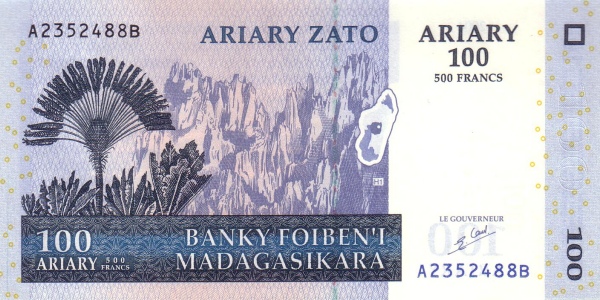
On the front, the dominant central composition features a dramatic engraving of jagged tsingy rock formations, the distinctive limestone pinnacles found in western Madagascar, rendered in finely detailed intaglio work against a pale blue and grey background. To the left of this geological tableau stands a strikingly engraved traveller’s palm, the Ravenala madagascariensis, its fan-shaped crown of leaves spread wide and rendered with considerable botanical precision. A small outline map of Madagascar is visible in the upper-central area of the note, subtly positioned within the rock landscape. The overall colour palette is dominated by cool blues and muted purples, with the lower register shifting into a deeper navy band containing the denomination text. In this dark horizontal panel, “100 ARIARY 500 FRANCS” appears in bold white lettering on the left, whilst “BANKY FOIBEN’I MADAGASIKARA” is printed in prominent white capital letters at the centre, identifying the issuing central bank. To the upper right, “ARIARY 100” and “500 FRANCS” are printed in blue on the lighter field, with a small unfilled square security device visible at the far right margin. The serial number A2352488B appears in blue typeface both in the upper left and lower right corners. A governor’s signature appears on the right side of the note beneath the text “LE GOUVERNEUR.” Guilloché patterning is present in the background fields, providing texture and anti-counterfeiting complexity throughout the design. A vertical strip of yellow dots runs along the right-hand edge of the note, forming part of the note’s border decoration.
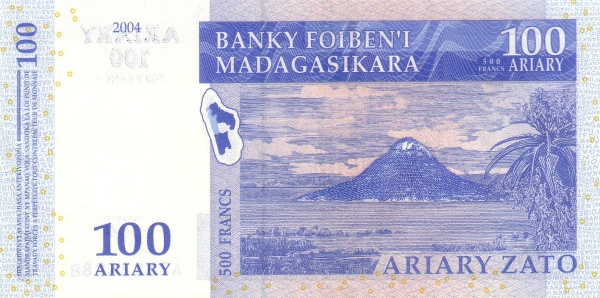
The reverse carries the year 2004 printed in blue numerals in the upper left corner, clearly establishing the issue date. The central vignette on the reverse depicts a serene landscape scene showing twin volcanic peaks rising above a calm body of water, engraved in fine blue linework that conveys depth and atmosphere through careful cross-hatching and tonal variation. A narrow shoreline with low-lying vegetation is visible in the foreground, and a single tall palm tree stands to the right of the scene. A small inset map of Madagascar appears in the upper portion of the central vignette, mirroring the motif used on the front. The issuing bank name “BANKY FOIBEN’I MADAGASIKARA” is printed in bold blue letters across the upper section of the reverse, with “100” and “500 FRANCS ARIARY” to its right. Along the lower register, “100 ARIARY” appears in large bold type on the left, and “ARIARY ZATO” is printed on the right, providing the denomination in Malagasy. The left margin of the reverse carries a vertical strip of fine printed text forming a security border, and show-through from the front design is visible in the left-hand portion of the note, including a ghost impression of the front denomination and design elements. The overall colour of the reverse remains consistent with the front, working predominantly in blue and violet tones on cream-white paper.
If you have a 100 Ariary banknote from Madagascar’s 2004 dated issue, it can be exchanged through Webuyallcurrency.com as part of a straightforward currency exchange transaction. Webuyallcurrency.com handles a wide range of current and withdrawn world banknotes, making it simple to convert your Malagasy Ariary into British pounds without the need to visit a bureau in person.
• Indicate the quantity of 100 Ariary banknotes you want to exchange
• Click the ‘Add to your account’ button
• Your online account now shows the exchange value
Now demonetised, this little Ravenala-palm note is easily cleared through Webuyallcurrency.com, which pays out for retired Malagasy Ariary alongside whatever other currency you are clearing.
Other Malagasy Ariary you can exchange: 200 ariary (thatch gateway), 500 ariary (Ambohimanga), 1,000 ariary (Kamoro bridge), 2,000 ariary (Lemur), 5,000 ariary (Whale Tail), 10,000 ariary (Silver Palace).
Fast turnaround
We send your money within 5 working days of receiving your currency.
We’ll send your money by bank transfer, PayPal or cheque. You can also donate your exchange to a charity of your choice.
Easy and convenient
Get paid quickly
After counting your leftover coins and banknotes we’ll pay you within 5 working days. Get your payment quickly via PayPal or bank transfer.
No hidden charges
We don’t have any hidden charges, you will see our rates before you send any notes or coins. You receive the full value of the calculated exchange.
Get rid of currency that’s no longer in circulation
We also exchange discontinued foreign money. You can cash in all pre-euro currency as well as most obsolete currencies from outside the Eurozone.
Benefit from the best exchange rates online
Exchange rates change daily, that’s why we stay on top of the rate fluctuations so we can offer you the best rates for foreign money.
Happiness guarantee
We check your foreign currency and produce a formal quote, if you’re not happy we guarantee to send your currency back to you, absolutely free of charge.
Help out a charity with your exchange
We partner with many of the UK’s amazing charities. If you’d like to turn your old foreign money into a charitable donation, we can help.