
200 Piso PHL Banknote (Standard Issue) 2020
£1.858000
1 PHP = £0.009290
200 Piso Peso (Issued 2020)
Few banknotes in Southeast Asian circulation combine ecological advocacy with political history as compellingly as the Philippine 200 Piso note, and a currency expert examining this 2020 issue would immediately be drawn to the unusually vivid green palette that dominates the entire design. The denomination sits at an interesting position within the New Generation Currency series, representing a deliberate effort by the Bangko Sentral ng Pilipinas to celebrate both national leadership and the country’s extraordinary biodiversity. The combination of a former president’s portrait alongside one of the world’s most distinctive mammals makes this note stand out sharply from its regional contemporaries. Collectors and exchange specialists alike would note the clean, high-contrast engraving and the crisp typography characteristic of this post-2010 Philippine series.
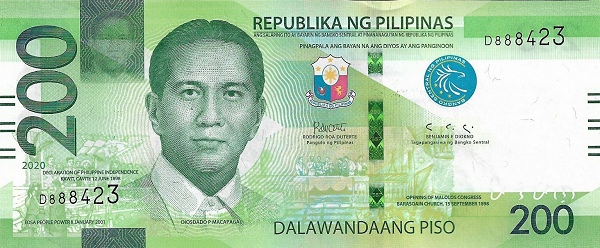
On the front, the central portrait depicts Diosdado Macapagal, the eighth President of the Philippines, rendered in fine intaglio engraving against a light green background. His portrait is positioned to the left of centre, showing him in a suit with a composed and authoritative expression, the engraving conveying clear tonal depth in his facial features and jacket. The text “REPUBLIKA NG PILIPINAS” is printed prominently across the top of the note in bold dark lettering, with a line of smaller Filipino-language text reading “PANGANGA AT BAYAN NA ANG DIYOS AY ANG PANGINOON” appearing immediately below. The large numeral “200” appears in the lower left in deep green, alongside the serial number “D888423” printed in dark ink. The denomination in Filipino, “DALAWANDAANG PISO,” runs along the lower edge of the note. Two facsimile signatures appear across the centre of the note — one attributed to Rodrigo Roa Duterte, identified as Pangulo ng Pilipinas, and one to Benjamin E. Diokno, identified as Tagapamahala ng Bangko Sentral — each rendered in printed script above their respective titles. The year “2020” is printed in the lower left area alongside a reference to the Declaration of Philippine Independence. To the right of the portrait sits an oval security element featuring what appears to be a circular emblem or seal, rendered in teal and blue tones, alongside an architectural vignette that references the Opening of Malolos Congress, with a small caption visible near the lower right of the design area. The overall colour scheme is a bright, confident green with lighter tonal variations across the field, and the note incorporates subtle guilloché patterning in the background providing texture and anti-counterfeiting complexity.
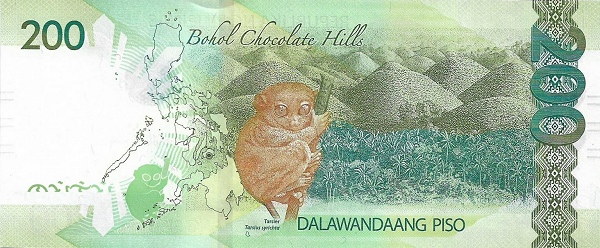
The reverse of the note is dominated by a rich and detailed landscape scene centred on the Bohol Chocolate Hills, a UNESCO-recognised geological formation of perfectly conical limestone hills that roll across the background in warm brown and green tones, with palm trees visible at the base of the hills. The text “Bohol Chocolate Hills” is printed in clear green lettering across the upper portion of the reverse. Occupying the foreground is a large, beautifully detailed illustration of a Philippine tarsier, Tarsius syrichta, clinging to a branch and facing the viewer with its characteristic enormous eyes, rendered in warm chestnut brown against the green background. A small caption below the tarsier reads “Tarsier / Tarsius syrichta” in fine print. To the left of the central imagery sits a detailed outline map of the Philippine archipelago, highlighting the island of Bohol in green. The large denomination numeral “200” appears on the far left in green, and the text “DALAWANDAANG PISO” is printed centrally in the lower half of the note. On the far right, a vertical band of intricate woven or geometric patterning in green provides both decorative interest and a security-related design element. The overall colour palette of the reverse blends greens and warm browns in a naturalistic composition that reflects the Philippines’ unique ecological heritage.
This 200 Piso banknote can be exchanged through Webuyallcurrency.com, where current Philippine Peso banknotes are bought alongside other foreign currency — ideal for clearing a drawer of mixed coins and notes at once.
• Indicate the quantity of 200 Piso Peso banknotes you want to exchange
• Click the ‘Add to your account’ button
• Your online account now shows the exchange value
If you have leftover currency to exchange, Webuyallcurrency.com accepts Philippine Peso banknotes and a wide range of other foreign coins and notes, paying out for the lot in a single straightforward transaction.
Fast turnaround
We send your money within 5 working days of receiving your currency.
We’ll send your money by bank transfer, PayPal or cheque. You can also donate your exchange to a charity of your choice.
Easy and convenient
Get paid quickly
After counting your leftover coins and banknotes we’ll pay you within 5 working days. Get your payment quickly via PayPal or bank transfer.
No hidden charges
We don’t have any hidden charges, you will see our rates before you send any notes or coins. You receive the full value of the calculated exchange.
Get rid of currency that’s no longer in circulation
We also exchange discontinued foreign money. You can cash in all pre-euro currency as well as most obsolete currencies from outside the Eurozone.
Benefit from the best exchange rates online
Exchange rates change daily, that’s why we stay on top of the rate fluctuations so we can offer you the best rates for foreign money.
Happiness guarantee
We check your foreign currency and produce a formal quote, if you’re not happy we guarantee to send your currency back to you, absolutely free of charge.
Help out a charity with your exchange
We partner with many of the UK’s amazing charities. If you’d like to turn your old foreign money into a charitable donation, we can help.