
5 Piso PHL Banknote (Modern Issue) 1995
£0.046450
1 PHP = £0.009290
5 Piso Peso (Issued 1995)
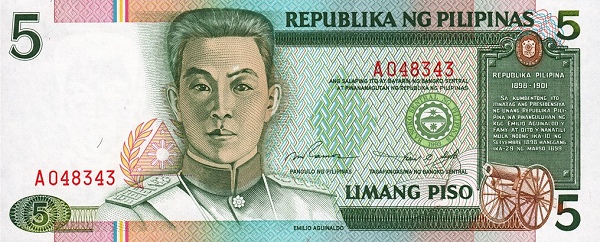
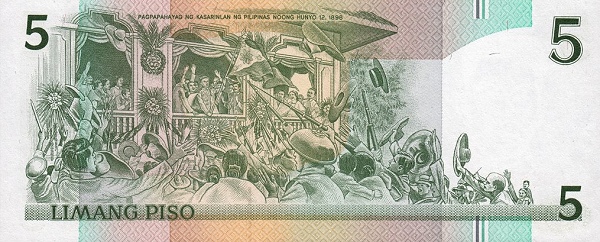
Few banknotes capture the spirit of national liberation as directly as the Philippine five piso note of 1995, which places the founding struggle for independence at the very heart of its design. Issued by the Central Bank of the Philippines, this note honours the revolutionary era that shaped the modern Filipino state, presenting its imagery with the dignity and gravity that the subject demands. Both the portrait on the front and the historical scene on the reverse speak to a nation that regards its fight for sovereignty as a defining point of cultural identity. The note thus functions not merely as a medium of exchange but as a pocket-sized declaration of national pride.
On the front, the dominant feature is a finely engraved portrait of Emilio Aguinaldo, the revolutionary general and first President of the Philippines, positioned to the left of centre against a lightly tinted background. Aguinaldo is depicted in his military uniform, his gaze directed slightly away from the viewer, rendered with careful intaglio line work that gives the portrait depth and texture. The overall colour palette of the front face is a warm reddish-brown and pale cream, with subtle guilloché patterning forming the background field across the central and right-hand portions of the note. At the top of the note, the issuing authority is stated in Latin-alphabet text reading “REPUBLIKA NG PILIPINAS,” printed clearly in dark ink. The denomination numeral “5” appears prominently in the upper right corner and is repeated in a stylised form at the lower left, where it sits within an ornamental oval vignette rendered in green. The serial number “A048343” appears twice in red ink — once in the upper left area and once below the portrait — providing a key security and identification feature. To the right of the portrait, a rectangular panel contains Latin-alphabet text describing the note’s legal tender status, set within a decorative border. Below this panel, a small engraved vignette depicts what appears to be a cannon or artillery piece, a clear reference to the revolutionary period. Two authorising signatures appear across the lower central area, accompanied by their respective titles in Latin-alphabet text: “PANGULO NG PILIPINAS” and “TAGAPAMAHALA NG BANGKO SENTRAL.” The denomination in word form, “LIMANG PISO,” is printed in bold black lettering across the lower portion of the note, and the name “EMILIO AGUINALDO” is captioned beneath the portrait in small but legible type. A vertical security strip is embedded within the paper, visible as a thin metallic line running through the body of the note, and the paper itself carries a watermark area to the right of the portrait.
The reverse of the note is printed predominantly in shades of green, depicting a large and detailed historical scene that fills almost the entire face. The central illustration portrays the proclamation of Philippine independence on 12 June 1898, with a group of figures gathered on a raised balcony or platform, one of whom appears to be reading a declaration to the assembled crowd below. The scene is rendered in a richly detailed intaglio style, with fine cross-hatching and line engraving conveying depth, movement, and the drama of the occasion. Flags and banners are visible being raised or displayed among the figures, while the crowd below is shown in animated celebration. Latin-alphabet text appears above the scene, referencing the declaration of Philippine independence and the date in June 1898. At the bottom of the reverse, the denomination in word form “LIMANG PISO” is repeated in bold lettering, and the numeral “5” appears in the upper right corner. The background of the reverse features a delicate guilloché pattern in a lighter green tone, providing contrast against the darker engraved central scene and adding a layer of counterfeit deterrence through its intricate geometric repetition.
Webuyallcurrency.com makes it easy to exchange old coins and banknotes — a 1995 Philippine five piso banknote from Philippines is accepted with other current Philippine Peso banknotes and converted into cash in one go.
• Indicate the quantity of 5 Piso Peso banknotes you want to exchange
• Click the ‘Add to your account’ button
• Your online account now shows the exchange value
Got a mix of old coins and banknotes? Webuyallcurrency.com will exchange your Philippine Peso banknotes alongside other leftover and foreign currency, settling the whole lot in one straightforward transaction.
Fast turnaround
We send your money within 5 working days of receiving your currency.
We’ll send your money by bank transfer, PayPal or cheque. You can also donate your exchange to a charity of your choice.
Easy and convenient
Get paid quickly
After counting your leftover coins and banknotes we’ll pay you within 5 working days. Get your payment quickly via PayPal or bank transfer.
No hidden charges
We don’t have any hidden charges, you will see our rates before you send any notes or coins. You receive the full value of the calculated exchange.
Get rid of currency that’s no longer in circulation
We also exchange discontinued foreign money. You can cash in all pre-euro currency as well as most obsolete currencies from outside the Eurozone.
Benefit from the best exchange rates online
Exchange rates change daily, that’s why we stay on top of the rate fluctuations so we can offer you the best rates for foreign money.
Happiness guarantee
We check your foreign currency and produce a formal quote, if you’re not happy we guarantee to send your currency back to you, absolutely free of charge.
Help out a charity with your exchange
We partner with many of the UK’s amazing charities. If you’d like to turn your old foreign money into a charitable donation, we can help.