
1 South African Rand Banknote (Van Riebeeck Large Type)
£0.029570
1 ZAR = £0.029570
1 Rand Rand (Issued 1961-1965)
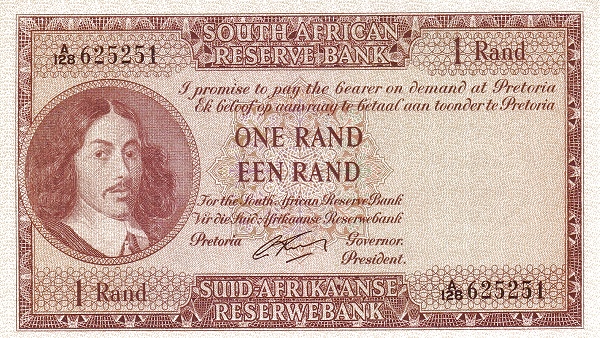
Printed on paper that carries a warm, cream-toned ground, this One Rand note from South Africa’s inaugural Rand series presents itself in a rich reddish-brown palette that speaks to the engraving conventions of early 1960s banknote production. The note has a compact, rectangular format typical of the period, and its surface bears the fine intaglio detail characteristic of security printing houses working to the highest standards of the era. The overall colouration — a deep terracotta moving into softer rose tones across the background — gives the note an immediately recognisable warmth. These physical qualities place it firmly within the transitional moment when South Africa adopted the Rand in 1961, replacing the Pound sterling as the country’s monetary unit.
On the front, the left-hand side is dominated by a finely engraved circular portrait of Jan van Riebeeck, the Dutch East India Company commander who established the first European settlement at the Cape of Good Hope in 1652 and whose image became the defining face of South African banknotes throughout the first Rand series. The portrait is rendered with considerable engraving depth, showing van Riebeeck in period dress with a wide lace collar and shoulder-length dark hair, the circular frame surrounding him composed of fine guilloché linework. To the upper centre, the issuing authority is declared in bold serif capitals: “SOUTH AFRICAN RESERVE BANK” in English, with the Afrikaans equivalent “SUID-AFRIKAANSE RESERWEBANK” appearing along the lower border. The denomination is stated twice in the centre of the note — “ONE RAND” in English above “EEN RAND” in Afrikaans — both in large, clear display type. A bilingual promise to pay runs across the upper body of the note reading “I promise to pay the bearer on demand at Pretoria” in English, followed immediately by the Afrikaans “Ek beloof om aanvraag te betaal aan toonder te Pretoria.” Below the central denomination text, the note carries a further bilingual line attributing the note to the bank and naming Pretoria, followed by a manuscript signature above the title “Governor” in English and “President” in Afrikaans, reflecting the bank’s dual-language governance structure. The serial number A/28 625251 appears in reddish-brown print at both the upper left and lower right, flanking the portrait and denomination. The background field behind all these elements is covered in intricate geometric guilloché patterns — small repeating rosette and lattice formations — printed in the same reddish-brown ink, providing both visual texture and an anti-counterfeiting function. The denomination “1 Rand” also appears in the lower left corner in a smaller panel, completing a well-structured, symmetrical layout.
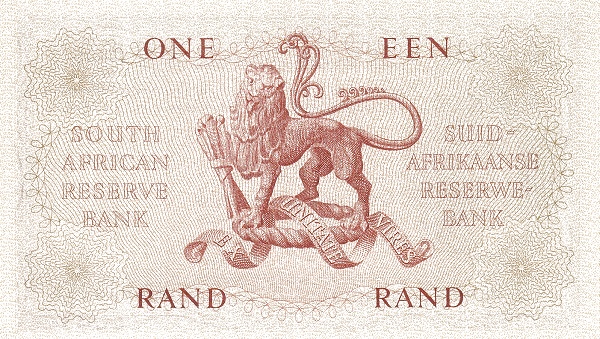
The reverse of the note is printed in the same warm reddish-brown and cream palette and is dominated by a large, boldly engraved heraldic lion at its centre. The lion is depicted in a passant or rampant posture, standing over a ribbon or scroll banner bearing partially legible Latin text, which forms part of the South African coat of arms symbolism. The animal is rendered with strong intaglio lines, giving the mane, musculature, and tail considerable three-dimensional presence. To the left of the lion, in stacked uppercase lettering, the English bank name “SOUTH AFRICAN RESERVE BANK” is printed, while the corresponding Afrikaans “SUID-AFRIKAANSE RESERWEBANK” appears in the same format to the right. Above the lion, the denomination word “ONE” appears to the left and “EEN” to the right, with “RAND” and “RAND” repeated below on either side in the same bilingual arrangement. The entire central composition is set within an outer border of fine guilloché rosette work and geometric lace patterns, echoing the ornamental framework seen on the front. The cream paper ground is visible through the lighter areas of the print, and the overall reverse design conveys a formal, heraldic dignity suited to the founding issue of a new national currency.
Got a 1 Rand banknote sitting unused? Webuyallcurrency.com will exchange it for cash alongside your other South African Rands banknotes and any leftover foreign currency, in one convenient online step.
• Indicate the quantity of 1 Rand Rand banknotes you want to exchange
• Click the ‘Add to your account’ button
• Your online account now shows the exchange value
Webuyallcurrency.com brings all your foreign currency together: exchange or sell South African Rands banknotes and other old, withdrawn or modern coins and notes for cash, with no specialist knowledge needed.
Other South African Rands you can exchange: 2, 5, 10, 20, 50, 100, 200.
Fast turnaround
We send your money within 5 working days of receiving your currency.
We’ll send your money by bank transfer, PayPal or cheque. You can also donate your exchange to a charity of your choice.
Easy and convenient
Get paid quickly
After counting your leftover coins and banknotes we’ll pay you within 5 working days. Get your payment quickly via PayPal or bank transfer.
No hidden charges
We don’t have any hidden charges, you will see our rates before you send any notes or coins. You receive the full value of the calculated exchange.
Get rid of currency that’s no longer in circulation
We also exchange discontinued foreign money. You can cash in all pre-euro currency as well as most obsolete currencies from outside the Eurozone.
Benefit from the best exchange rates online
Exchange rates change daily, that’s why we stay on top of the rate fluctuations so we can offer you the best rates for foreign money.
Happiness guarantee
We check your foreign currency and produce a formal quote, if you’re not happy we guarantee to send your currency back to you, absolutely free of charge.
Help out a charity with your exchange
We partner with many of the UK’s amazing charities. If you’d like to turn your old foreign money into a charitable donation, we can help.