

100 South Korean Won Banknote (Sejong The Great)
£0.034000
1 KRW = £0.000340
100 Won Won (Issued 1965)
Surviving examples of the 1965 South Korean 100 Won banknote are genuinely scarce, with relatively few well-preserved specimens having endured the decades since South Korea’s rapid economic transformation rendered them obsolete and withdrawn from circulation. The combination of ordinary daily handling, the humid climate of the Korean peninsula, and the widespread indifference to preservation that typically accompanies high-velocity circulation notes means that pristine examples are seldom encountered today. South Korea’s extraordinary economic rise through the 1960s and 1970s — a period of intense industrialisation — meant these notes passed through countless hands at great speed, leaving few unscathed survivors. Historians and currency researchers have long regarded this issue as an important primary document of the Won reform era, capturing the transitional identity of a nation redefining itself on the world stage.
On the front, the note is dominated by an intaglio-engraved portrait of Yi Hwang, the celebrated 16th-century Korean Confucian scholar and philosopher, occupying the right-hand portion of the design. He is depicted in traditional dress, wearing a dark gat — the characteristic wide-brimmed horsehair hat of the Joseon literati class — and a flowing pale robe, with a long white beard rendered in fine, precise line engraving that conveys considerable dignity and scholarly gravitas. The overall colour palette of the front is a soft sage green with grey-green tonal variation across the field. To the left of centre, a large denomination inscription reading 백 원 is printed in bold Korean Hangul script, flanked by decorative guilloché rosette patterns in lilac and pale green, which serve both an aesthetic and an anti-counterfeiting function. The central area carries the issuing authority name in Korean characters — 한국은행권 — printed across the upper field, with a further inscription 한국은행 appearing below, identifying the Bank of Korea. A prominent red circular official seal stamp is visible to the lower left of the central text panel. The serial number 나 010766731 appears twice, once in the upper left area and once along the lower right, printed in dark ink. The numeral 100 appears in the upper left and lower right corners of the note in both Korean and Western numerals, and the word 백, the Korean character for one hundred, is printed vertically along the left and right margins. Fine border patterns incorporating stylised floral and scrollwork motifs frame the entire composition, with intricate geometric lathe-work filling the background fields to deter reproduction. The paper has a pale cream-white quality with a slightly textured surface consistent with the security printing standards of the period.
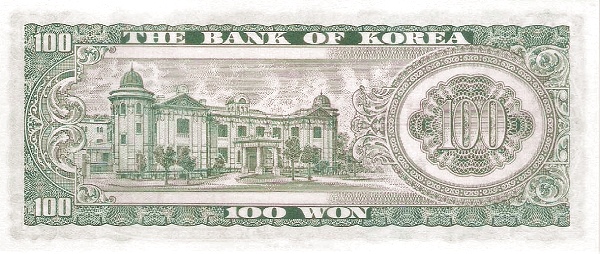
The reverse is printed in a consistent mid-to-dark green ink across the entire composition, giving the note a distinctly monochromatic but richly detailed character. Dominating the centre-left of the reverse is a finely engraved architectural vignette depicting the main building of the Bank of Korea, a grand neo-classical stone structure with a prominent domed roof, colonnaded entrance, arched windows, and flanking wings visible in precise perspective. Trees and the surrounding grounds are rendered in delicate linework that adds depth to the architectural scene. To the right of the building vignette, a large circular denomination panel features the numeral 100 enclosed within an ornate guilloché border of petals and scrollwork, providing a bold focal counterpoint to the architectural image. The words THE BANK OF KOREA are printed prominently in Roman capital letters along the upper margin of the reverse, and the denomination 100 WON is inscribed along the lower margin in English, establishing the note’s international legibility. Decorative border panels incorporating scrollwork and geometric patterning run along all four edges, and the denomination numeral 100 appears in the upper left corner in smaller type. The overall engraving quality on the reverse reflects the detailed intaglio craftsmanship typical of mid-20th-century security printing, with fine cross-hatching and linework building tonal depth throughout the architectural scene.
Have a 100 Won banknote you no longer need? Webuyallcurrency.com lets you sell foreign coins and banknotes for cash, taking your South Korean Won banknotes and other leftover currency in one simple exchange.
• Indicate the quantity of 100 Won Won banknotes you want to exchange
• Click the ‘Add to your account’ button
• Your online account now shows the exchange value
Webuyallcurrency.com makes it easy to sell foreign coins and banknotes for cash, taking South Korean Won banknotes along with modern and withdrawn currency so everything is converted in one step.
Other South Korean Won you can exchange: 0.1, 0.5, 1, 5, 10, 50, 500, 1000, 2000, 5000.
Fast turnaround
We send your money within 5 working days of receiving your currency.
We’ll send your money by bank transfer, PayPal or cheque. You can also donate your exchange to a charity of your choice.
Easy and convenient
Get paid quickly
After counting your leftover coins and banknotes we’ll pay you within 5 working days. Get your payment quickly via PayPal or bank transfer.
No hidden charges
We don’t have any hidden charges, you will see our rates before you send any notes or coins. You receive the full value of the calculated exchange.
Get rid of currency that’s no longer in circulation
We also exchange discontinued foreign money. You can cash in all pre-euro currency as well as most obsolete currencies from outside the Eurozone.
Benefit from the best exchange rates online
Exchange rates change daily, that’s why we stay on top of the rate fluctuations so we can offer you the best rates for foreign money.
Happiness guarantee
We check your foreign currency and produce a formal quote, if you’re not happy we guarantee to send your currency back to you, absolutely free of charge.
Help out a charity with your exchange
We partner with many of the UK’s amazing charities. If you’d like to turn your old foreign money into a charitable donation, we can help.