

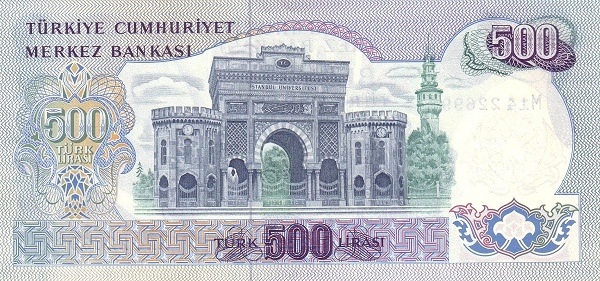
500 Türk Lirası TUR Banknote (Late Old Lira) 1970
£0.000000
1 TRL = £0.000000
500 Türk Lirası Turkish Lira (Issued 1970)
The Türkiye Cumhuriyet Merkez Bankası, the Central Bank of the Republic of Turkey, was established in 1930 as the sole authority responsible for issuing currency and managing monetary policy across the Turkish Republic. By 1970, the bank had become the cornerstone of Turkey’s evolving financial infrastructure, overseeing a currency system that reflected both national identity and economic ambition. The 500 Türk Lirası note issued under its authority represented the highest denomination in everyday circulation during this period, carrying considerable weight in both practical and symbolic terms. That this institution placed its full name and authority prominently on each note underscored the importance of public trust in the currency during a transformative era for the Turkish economy.
On the front, the dominant feature is a finely engraved portrait of Mustafa Kemal Atatürk, the founder and first President of the Turkish Republic, rendered in a three-quarter facing right position on the right-hand side of the note. The portrait is executed with exceptional intaglio detail, capturing the strong jawline, prominent brow, and characteristic formal suit with collar and tie that appear across Turkish banknotes of this era. The overall colour palette of the front is a blend of soft purples, muted greens, and warm ochre tones, giving the note a layered, complex appearance. Across the upper portion of the note, the text “Türkiye Cumhuriyet Merkez Bankası” is printed in clean serif typography, with the large central denomination title “Beşyüz Türk Lirası” displayed prominently in bold lettering. The numeral “500” appears in the upper left and upper right corners as well as in a larger format towards the lower centre of the note. The serial number M14 226992 appears twice — once in the upper left area and once in the lower right — printed in a contrasting dark ink. The central left portion of the note features intricate guilloché patterning alongside stylised floral and foliate motifs rendered in green and purple, including what appear to be tulip-like forms and an ornamental design suggestive of traditional Turkish decorative arts. A small text block in the centre of the note references the legislative authority under which the note was issued, citing a date in January 1970, and below this appear two signature lines labelled in Latin-script Turkish as “Baskan” and “Baskan Yardimcisi,” denoting the Governor and Deputy Governor of the bank respectively. The borders of the note are framed with fine guilloché scrollwork and repeating geometric patterns in purple and green, providing both decorative function and an anti-counterfeiting structure.
The reverse features a detailed engraved illustration of the monumental entrance gate of Istanbul Üniversitesi — Istanbul University — depicted in blue-grey and green tones with considerable architectural precision. The gateway, a grand neo-classical stone arch flanked by crenellated towers, is rendered with fine line engraving that captures the stonework, the large archway, and the inscription panel above the entrance. To the right of the gate, a slender minaret rises into the upper field of the illustration, providing vertical balance and contextualising the building within the Istanbul skyline. The text “Istanbul Üniversitesi” is visible on the illustrated facade of the building itself. The upper left of the reverse carries the denomination “500 Türk Lirası” in bold block typography beside guilloché oval patterning in gold and green. The bank name “Türkiye Cumhuriyet Merkez Bankası” is printed across the top of the reverse in the same serif typeface used on the front. A wide decorative border of repeating geometric and interlocking pattern runs horizontally across the lower section of the reverse, rendered in blue and red tones, with a stylised floral rosette motif positioned in the lower right corner. The numeral “500” appears in the upper right corner, and the denomination “Türk Lirası 500” is repeated in the lower centre field. A ghost impression of the serial number from the front is faintly visible as show-through due to the note’s paper construction, a characteristic common to banknote papers of this period.
Whether it is a single 500 Türk Lirası banknote or a mix of leftover currency, Webuyallcurrency.com exchanges Turkish Old Lira banknotes and other foreign coins and notes for cash in one straightforward process.
• Indicate the quantity of 500 Türk Lirası Turkish Lira banknotes you want to exchange
• Click the ‘Add to your account’ button
• Your online account now shows the exchange value
Turn forgotten Turkish Old Lira banknotes into money: Webuyallcurrency.com lets you exchange foreign coins and notes — even withdrawn ones — as part of one clear transaction, no specialist knowledge required.
Fast turnaround
We send your money within 5 working days of receiving your currency.
We’ll send your money by bank transfer, PayPal or cheque. You can also donate your exchange to a charity of your choice.
Easy and convenient
Get paid quickly
After counting your leftover coins and banknotes we’ll pay you within 5 working days. Get your payment quickly via PayPal or bank transfer.
No hidden charges
We don’t have any hidden charges, you will see our rates before you send any notes or coins. You receive the full value of the calculated exchange.
Get rid of currency that’s no longer in circulation
We also exchange discontinued foreign money. You can cash in all pre-euro currency as well as most obsolete currencies from outside the Eurozone.
Benefit from the best exchange rates online
Exchange rates change daily, that’s why we stay on top of the rate fluctuations so we can offer you the best rates for foreign money.
Happiness guarantee
We check your foreign currency and produce a formal quote, if you’re not happy we guarantee to send your currency back to you, absolutely free of charge.
Help out a charity with your exchange
We partner with many of the UK’s amazing charities. If you’d like to turn your old foreign money into a charitable donation, we can help.