
100 UAE Dirhams banknote (no date)
£11.372280
1 AED = £0.113723
100 Dirhams (Issued 1982)
Banknote design has shifted dramatically since the early 1980s, with modern issues incorporating polymer substrates, colour-shifting inks, and sophisticated holographic foil elements that were entirely absent from the printing technology of this era. The 100 Dirhams note from 1982 belongs to a generation of currency where security relied on fine intaglio engraving, intricate guilloché work, and carefully composed architectural imagery rather than digital print techniques. Yet the enduring design language of this note — its bold denomination panels, bilingual typography, and strong central vignette — reflects principles that continue to anchor contemporary UAE banknote design. The balance between Arabic script and English text, and the use of nationally symbolic imagery, remains a constant thread from this first Central Bank series through to present-day issues.
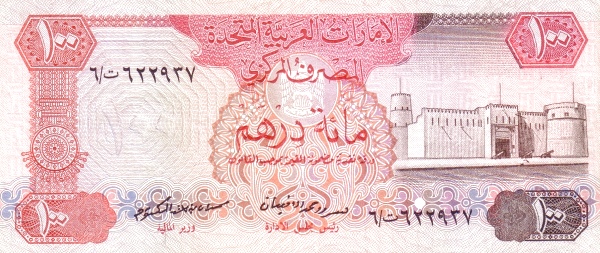
On the front, the note is dominated by warm rose-pink and pale red tones overlaid on a cream ground, with soft blue and lilac guilloché patterning visible across the background field. To the right of centre sits a detailed engraved vignette of a traditional Arabian fort, rendered with considerable architectural precision — its thick stone walls, crenellated battlements, rounded corner towers, and arched gateway are all clearly depicted, conveying the heritage architecture of the UAE. The left side of the note carries an ornate vertical border panel filled with intricate geometric and arabesque engraving, incorporating a circular medallion motif in deep red and blue. Across the upper portion, the issuing authority name is printed in Arabic script — reading as the United Arab Emirates Central Bank — alongside a decorative header band. The denomination “مائة درهم” (One Hundred Dirhams) appears prominently in large Arabic numerals and script in the centre of the note, printed in deep red. Hexagonal denomination panels bearing the numeral “100” appear in the upper left and lower right corners, engraved with fine line borders. The serial number 6/ت 622937 appears twice — once in the upper left field and once in the lower right — printed in dark ink. Two signature lines are present in the lower central area, with Arabic text below each indicating the respective signatories’ titles: وزير المالية (Minister of Finance) and رئيس مجلس الإدارة (Chairman of the Board). A faint watermark ghost is visible through the paper in the left-hand portion of the note, consistent with the security paper used in this series.
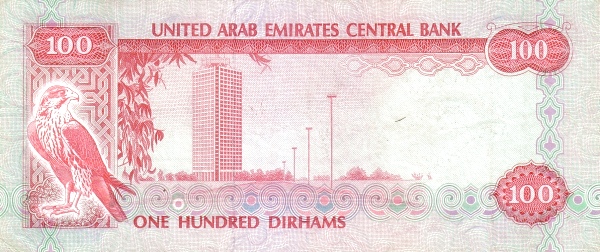
The reverse of the note is printed predominantly in deep crimson-red on a pale cream ground, with green guilloché scroll patterns running along the lower border and in the corner panels. The issuing authority name “UNITED ARAB EMIRATES CENTRAL BANK” is printed in clear serif capitals along the top of the note in red, with the English denomination “ONE HUNDRED DIRHAMS” appearing in matching type along the lower edge. The central vignette depicts a modern high-rise tower block — a tall, rectangular multi-storey building rendered in a fine engraved style — set against a background that includes street lighting poles and what appears to be landscaped open ground, conveying the rapid urban development that characterised the UAE at the time of issue. To the left of the building, a falcon is depicted perched and facing right, rendered in detailed engraving with its plumage, talons, and proud bearing clearly visible — the falcon being a deeply significant national symbol of the UAE. Behind the falcon, palm fronds are faintly visible. Denomination numerals “100” appear in engraved panels in the upper left and upper right corners of the reverse, each framed within ornate border cartouches. The overall composition of the reverse balances national symbolism — through the falcon — with contemporary national development, represented by the modern tower block.
If you have a 100 Dirhams banknote from the 1982 series, it can be exchanged through Webuyallcurrency.com alongside other old or withdrawn UAE Dirham notes in a single straightforward transaction. Webuyallcurrency.com accepts withdrawn banknotes from the United Arab Emirates, making it simple to convert legacy currency into a usable value without the need to visit a bureau in person.
• Indicate the quantity of 100 Dirhams banknotes you want to exchange
• Click the ‘Add to your account’ button
• Your online account now shows the exchange value
This undated Central Bank of the UAE hundred dirham note is long out of circulation, yet Webuyallcurrency.com still buys it back, converting your old Emirati currency into cash with the rest of your leftover notes.
Fast turnaround
We send your money within 5 working days of receiving your currency.
We’ll send your money by bank transfer, PayPal or cheque. You can also donate your exchange to a charity of your choice.
Easy and convenient
Get paid quickly
After counting your leftover coins and banknotes we’ll pay you within 5 working days. Get your payment quickly via PayPal or bank transfer.
No hidden charges
We don’t have any hidden charges, you will see our rates before you send any notes or coins. You receive the full value of the calculated exchange.
Get rid of currency that’s no longer in circulation
We also exchange discontinued foreign money. You can cash in all pre-euro currency as well as most obsolete currencies from outside the Eurozone.
Benefit from the best exchange rates online
Exchange rates change daily, that’s why we stay on top of the rate fluctuations so we can offer you the best rates for foreign money.
Happiness guarantee
We check your foreign currency and produce a formal quote, if you’re not happy we guarantee to send your currency back to you, absolutely free of charge.
Help out a charity with your exchange
We partner with many of the UK’s amazing charities. If you’d like to turn your old foreign money into a charitable donation, we can help.