
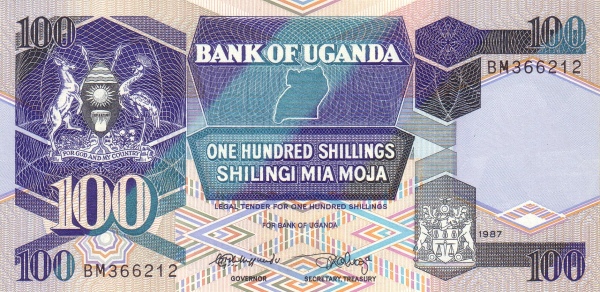
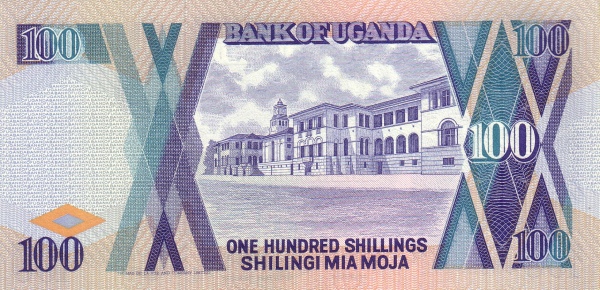
100 Ugandan Shillings Banknote (High Court Building)
£0.002010
1 UGX = £0.000020
100 Shillings / Shil Ugandan Shilling (Issued 1987-1998)
Uganda’s currency reform of 1987 came under the newly consolidated government of President Yoweri Museveni, who had seized power in January 1986 following the conclusion of the brutal Bush War. The National Resistance Movement’s rise to power marked a decisive turning point in Ugandan history after years of catastrophic misrule under Milton Obote and the lingering devastation of the Idi Amin era. To stabilise a collapsed economy and rein in rampant inflation, the government introduced a revalued shilling at a rate of 100 old shillings to one new shilling, making this series of banknotes a direct physical product of that sweeping monetary reform. The notes issued from 1987 through to 1998 under the Bank of Uganda represent the financial foundation of Uganda’s post-conflict reconstruction.
On the front, the note is presented in a palette dominated by deep indigo-blue and violet, accented by teal and lavender tones across its geometric framework. The layout is structured around a series of bold hexagonal and angular guilloche panels that frame the central design elements with considerable intricacy. To the left, the coat of arms of Uganda is prominently rendered in detailed intaglio engraving, depicting a crested crane and kob flanking a shield, with the national motto “FOR GOD AND MY COUNTRY” inscribed on the ribbon below. At the centre of the note sits a teal-tinted cartouche containing a simplified outline map of Uganda, surrounded by elaborate geometric latticework. The denomination text “ONE HUNDRED SHILLINGS” appears in bold capital lettering directly beneath this central cartouche, followed by the Swahili equivalent “SHILINGI MIA MOJA,” and the legal tender declaration “LEGAL TENDER FOR ONE HUNDRED SHILLINGS FOR BANK OF UGANDA” is printed in smaller type below. The issuing authority, “BANK OF UGANDA,” is displayed prominently in large serif capitals across the top of the note. To the lower right, a secondary vignette features what appears to be a decorative emblem or seal rendered in fine line engraving within a rectangular panel, alongside the year “1987” printed in plain numerals. Two facsimile signatures appear across the lower centre, attributed to the Governor and the Secretary to the Treasury respectively. The serial number BN366212 appears in two positions — lower left and upper right — printed in dark ink against the light ground. The numeral “100” is repeated four times across the corners in large, bold typeface, with the lower left corner numeral rendered in a particularly deep, layered intaglio style. The paper ground beneath all these elements carries a fine, pale multicoloured security underprint with interlocking geometric and diagonal patterns.
The reverse of the note is rendered primarily in violet-purple and teal-green, anchored by a large central engraved vignette depicting a substantial colonial-era building identified as the Uganda Parliament building in Kampala, portrayed with considerable architectural detail including a prominent clock tower, colonnaded façade, and formal open grounds before it. The engraving captures the stonework, window detailing, and spatial depth of the structure through fine crosshatching and tonal variation. Flanking the central building vignette on both left and right are bold, overlapping diagonal bands forming large X-shaped cross patterns in deep teal and green, which give the reverse a strong graphic geometry. An orange diamond-shaped motif sits at the lower left corner, providing a vivid colour contrast against the cooler tones. The inscription “BANK OF UGANDA” runs along the top edge in serif capitals, while “ONE HUNDRED SHILLINGS” and “SHILINGI MIA MOJA” are printed in two lines across the lower centre beneath the building. The numeral “100” appears in three positions across the reverse — upper left, upper right, and mid-right within the geometric banding. The overall background paper carries a pale latticework underprint consistent with the front, and faint show-through from the front design’s geometric elements is visible across the paper surface.
Wondering who buys foreign coins and notes? Webuyallcurrency.com does — a 100 Shillings banknote like this is accepted alongside other old or withdrawn Ugandan Shillings banknotes, so you can exchange the lot for cash at once.
• Indicate the quantity of 100 Shillings / Shil Ugandan Shilling banknotes you want to exchange
• Click the ‘Add to your account’ button
• Your online account now shows the exchange value
Whether you want to sell foreign coins and notes or exchange leftover currency from past trips, Webuyallcurrency.com accepts Ugandan Shillings banknotes alongside modern money and settles everything in a single, easy transaction.
Other Ugandan Shillings you can exchange: 5, 10, 20, 50, 200, 500, 1000, 2000, 5000, 10000.
Fast turnaround
We send your money within 5 working days of receiving your currency.
We’ll send your money by bank transfer, PayPal or cheque. You can also donate your exchange to a charity of your choice.
Easy and convenient
Get paid quickly
After counting your leftover coins and banknotes we’ll pay you within 5 working days. Get your payment quickly via PayPal or bank transfer.
No hidden charges
We don’t have any hidden charges, you will see our rates before you send any notes or coins. You receive the full value of the calculated exchange.
Get rid of currency that’s no longer in circulation
We also exchange discontinued foreign money. You can cash in all pre-euro currency as well as most obsolete currencies from outside the Eurozone.
Benefit from the best exchange rates online
Exchange rates change daily, that’s why we stay on top of the rate fluctuations so we can offer you the best rates for foreign money.
Happiness guarantee
We check your foreign currency and produce a formal quote, if you’re not happy we guarantee to send your currency back to you, absolutely free of charge.
Help out a charity with your exchange
We partner with many of the UK’s amazing charities. If you’d like to turn your old foreign money into a charitable donation, we can help.