
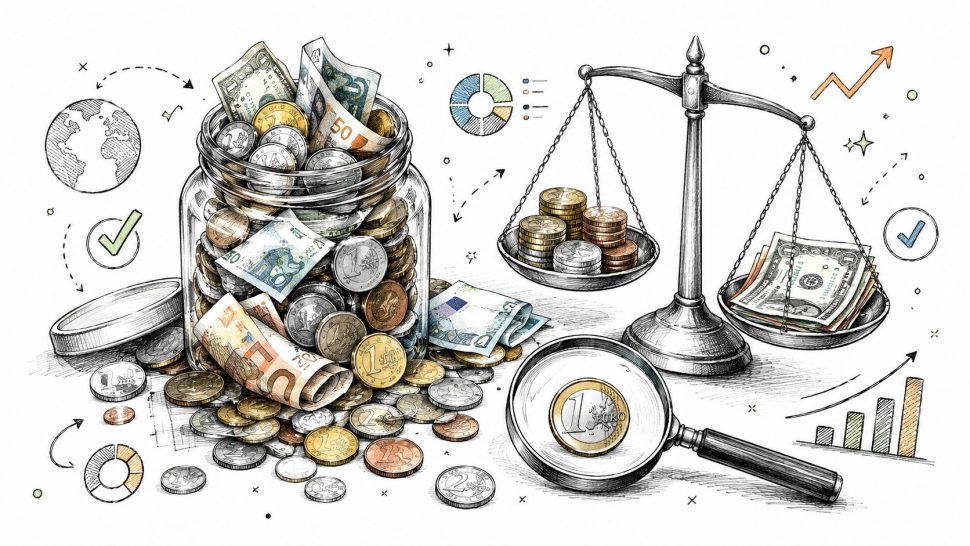
You come home from holiday with a small mountain of coins in your bag, a few notes you forgot to spend, and maybe a couple of old bills that no longer feel current. The local bank says it won't take the coins. The exchange bureau at the airport only wants clean notes. Now you're left wondering what that jar of mixed foreign money is worth.
That's where fair value assessment stops being an accounting phrase and starts being useful in real life. Whether you're trying to exchange foreign coins, exchange foreign coins and notes, or decide whether to donate foreign coins to charity, the same basic question comes up, what is this currency worth today, not what did I once pay for it?
Why Leftover Foreign Currency Raises a Fair Value Question
A lot of UK travellers recognise the same post-holiday mess, euros in one pocket, dollars in another, and a few odd coins that nobody wants to count. The instinct is usually to treat it as spare change, but that can be misleading. A mixed pile of leftover foreign currency is still an asset, and its worth depends on what someone will reasonably accept for it now.
That is exactly the kind of thinking behind a fair value assessment. You are not asking what the money meant when you bought it, or what it felt like to spend abroad. You are asking what a willing buyer would pay for it today, given the currency type, condition, and the fact that some notes may be current while others are old or withdrawn.
A simple holiday example
Say you return with a few crisp notes, a handful of coins, and one older bill from a trip years ago. A high street bank may happily discuss the notes and ignore the coins. A specialist currency buyer looks at the full mix, including convert foreign coins and banknotes collections that banks tend to reject. That matters because the same bag can contain items with very different practical value.
Practical rule: fair value is about the best realistic outcome for the money you hold, not the face value printed on every item.
For travellers, charities, and businesses, this matters because the right route depends on what is in the parcel. Mixed collections, withdrawn notes, pre-euro cash, and old British or Irish coins can all be part of the same assessment. A simple “banks won't take it” answer is not enough when the currency may still have value elsewhere.
If you want a specialist route that handles mixed currency without turning the process into admin, it helps to think in fair value terms from the start. That usually leads to a better decision, whether you want cash back or want to turn the same bundle into a donation.
What a Fair Value Assessment Really Means
A fair value assessment starts with a practical question. If a buyer handed over cash for the currency you are holding today, would the amount be reasonable for what they are getting back? That is the same sort of question a person asks when sorting through leftover foreign coins, old banknotes, and a few notes that are still current but awkward to spend.
In UK financial services, the FCA has made fair value a formal requirement under Consumer Duty. Firms must show that the expected total price customers pay, including fees and charges across the relationship, is reasonable compared with the benefit they receive. Consumer Duty applied to open products and services from 31 July 2023, so this is a live compliance issue, not theory (FCA review of fair value frameworks).
The accounting version uses the same basic logic, but with a different emphasis. Under IFRS 13, fair value is an exit price, meaning the price that would be received to sell an asset or paid to transfer a liability in an orderly transaction at the measurement date, not what you originally paid for it (KPMG summary of IFRS 13 fair value measurement). A second-hand car is a simple example. The receipt you kept from buying it is not the same thing as the amount a buyer would pay now.
Why the input quality matters
The strength of any fair value conclusion depends on the quality of the evidence behind it. IFRS-style guidance uses a three-level hierarchy of inputs. Level 1 is quoted prices in active markets for identical items. Level 2 uses other observable inputs. Level 3 relies on unobservable inputs when market data is thin.
HMRC makes the same practical point in its corporate finance manual. Quoted market prices in an active market are the best evidence of fair value, and where markets are less active, valuation techniques should make the most of market inputs such as recent arm's-length transactions and discounted cash flow analysis. That is why a currency bag with active demand is easier to price than a small pile of withdrawn notes or obscure coins, where judgement does more of the work (HMRC corporate finance manual).
For currency exchange, the hierarchy is easy to visualise. Current notes with visible market rates sit near the top. Old or withdrawn currency pushes the assessment lower down the ladder, where assumptions matter more and the process needs clearer records.

The FCA view adds another layer for regulated firms. The price paid must be reasonable relative to the benefits received, and the evidence should be strong enough to explain outcomes at a segment level, not just as broad averages. Averages can hide a poor deal for a specific group, which is where a weak assessment tends to break down (Consumer Duty fair value framework guide).
The Three Valuation Approaches Explained With Currency Examples
A used note in your hand, a tray of mixed coins, and a quote from a buyer all point to the same question, what is this currency worth? The answer depends on where the evidence comes from.
Market approach
A pair of clean current euros or US dollars is the easiest place to start. You can look at quoted exchange rates, recent trades, and the price a buyer is prepared to pay right now. A crisp note with steady demand is simpler to value than a random coin from a country that rarely trades through your local branch.
For everyday exchange work, this is usually the clearest route because the price is tied to something you can see and compare. It also matches HMRC's view that quoted prices in an active market are the strongest evidence of fair value (HMRC corporate finance manual).
Income approach
Physical cash does not usually fit the income approach very well, because notes and coins are not designed to produce a future stream of cash flow. The method matters more when the item being valued is expected to generate receipts over time.
A charity that receives regular currency donations may look at the likely benefit of that flow in present terms. The same logic sits behind the approach, you are asking what future money is worth today, not just what is in the envelope now.
Cost approach
Withdrawn currency and obsolete coins become harder to price when there is no active market to point to. In that setting, the estimate may depend on replacement cost, reproduction cost, or even the value of the material itself. That does not mean the item has no value. It means the figure is less obvious because there are fewer market clues and more room for judgement.
Quoted market data gives you the firmest footing. Once that disappears, the valuation becomes more model-driven and more sensitive to judgement.
That is why old banknotes, pre-euro money, and discontinued coinage need special handling. A specialist route is often better here because it can assess mixed collections without pretending every item has the same kind of value.
How to Run a Fair Value Assessment Step by Step
A practical fair value assessment for leftover currency can be done in seven simple moves. Think of it as a way to stop guessing and start comparing like with like.

1. Identify the currency
Sort the pile into current notes, older notes, coins, and anything that may be withdrawn currency. You do not need to make it perfect, but you do need to know what you have.
2. Check whether it is still straightforward to trade
Some money is easy to exchange because it remains current and widely recognised. Other items need a specialist because the market is thinner.
3. Research market value
Compare the currency against an observable rate or a specialist quote. Fair value starts to become visible.
4. Compare exchange options
Look at at least two routes, such as a bank, an airport bureau, and a specialist buyer. A fair assessment only makes sense if you have alternatives.
5. Factor in condition
Bent notes, mixed coins, and old issues may still have value, but the route to realise that value can change. Condition affects what you can reasonably expect to get back.
6. Document the outcome
Write down the expected return, any fees, and whether the quote is net or gross. This mirrors the FCA's focus on evidence and on explaining limitations in the data (Global FinReg Blog summary of FCA Consumer Duty fair value guidance).
7. Decide the action
Choose cash back or a charity donation, then set a review point if you are handling currency regularly. Businesses and charities do this because value changes over time, and a one-off assumption is rarely enough.
Comparing Banks, Bureaus and Specialist Currency Buyers
Different providers do not handle leftover currency in the same way. That matters because a service can only be called good value if it accepts what you have and tells you what you will receive.
| Option | Current notes | Foreign coins | Old or withdrawn currency | Transparent rate | Charity-friendly |
|---|---|---|---|---|---|
| High-street bank | Sometimes | Often no | Often no | Varies | Limited |
| Airport or high-street bureau | Usually yes | Often no | Sometimes limited | Sometimes limited | Limited |
| Specialist currency buyer | Usually yes | Yes | Yes | Usually clear | Yes |
For many travellers, the specialist route is the only realistic way to exchange leftover currency that includes coins or obsolete notes. Banks and bureaux often avoid those items because the handling cost is high relative to the value of each piece, especially when collections are mixed and need sorting. That creates a gap between the face value printed on the money and the amount a provider can practically return.
There is also a fairness angle. If a provider refuses coins or withdrawn notes, the customer never gets a proper comparison. That makes it harder to evidence fair value, because the quote is shaped by what the provider is willing to process, not necessarily by what the currency is worth. For mixed parcels, a specialist route often gives the clearest answer.
If you want to compare exchange routes in more detail, a useful starting point is this foreign currency exchange comparison.
Common Mistakes When Valuing Leftover or Withdrawn Currency
People often lose value because they make one of a few predictable assumptions. The biggest one is believing that if a bank did not mention it, it must be worthless. Banks do not process every type of currency, so silence is not the same thing as a valuation.

Four errors to avoid
- Assuming old currency has no value. Withdrawn money can still be exchangeable or saleable through a specialist route.
- Ignoring coins completely. Foreign coins are often the hardest part to place, but they may still contribute to the total return.
- Trusting a board at the airport without checking the rate. A headline rate is not the same as the amount you'll receive.
- Mixing up collector value and exchange value. Rare items can be worth more than face value, but most leftover currency is valued by practical exchange demand.
The FCA's fair value thinking helps here. If a quote hides fees, averages very different items together, or ignores the evidence that is available, it is not giving you a clean basis for comparison. That is why a simple “my money's probably worthless” assumption can cost you.
Do: ask whether the rate is net of fees. Don't: assume the printed amount on the note is the amount you'll get back.
If you still have a box of old bills from a trip years ago, it is worth checking them properly before writing them off. The same applies if you have coins from several countries in one envelope.
Actionable Tips for Sellers and Charities Converting Leftover Currency
If you're an individual seller, start with a quick inventory. Separate current notes from coins and old or withdrawn items, then compare the quote against at least one alternative so you can judge the return on the same basis. That simple habit helps you avoid accepting a vague offer that looks convenient but pays less than it should.
For charities and fundraisers, the priority is often simplicity. A single parcel of mixed currency can be the easiest route, especially when the aim is to turn donations into usable funds rather than sort every item by hand. If the provider can show rates before you send, accept withdrawn and pre-euro currency, and pay after verification by bank transfer or PayPal, the process is usually easier to trust.
You can also route proceeds to a partnered charity when that suits the cause. If that is your goal, this page on where to donate foreign coins is a useful place to start.
A specialist service is most useful when the collection includes coins, banknotes, and withdrawn currency in one go. That's the point where banks and bureaux usually fall short, and where a cleaner fair value comparison becomes possible. If you want to exchange foreign coins, exchange leftover currency, or convert foreign coins and banknotes without the usual hassle, a specialist route is often the most practical answer.
We Buy All Currency helps people, charities, and businesses turn leftover foreign coins and banknotes into cash or donations with a simple postal process. If you've got mixed currency, old notes, or withdrawn money sitting in a drawer, visit We Buy All Currency to see how it works and decide whether cash back or a charity donation makes the most sense for you.