
Fake Pound Coins: How to Spot and Handle Them (2026 Guide)
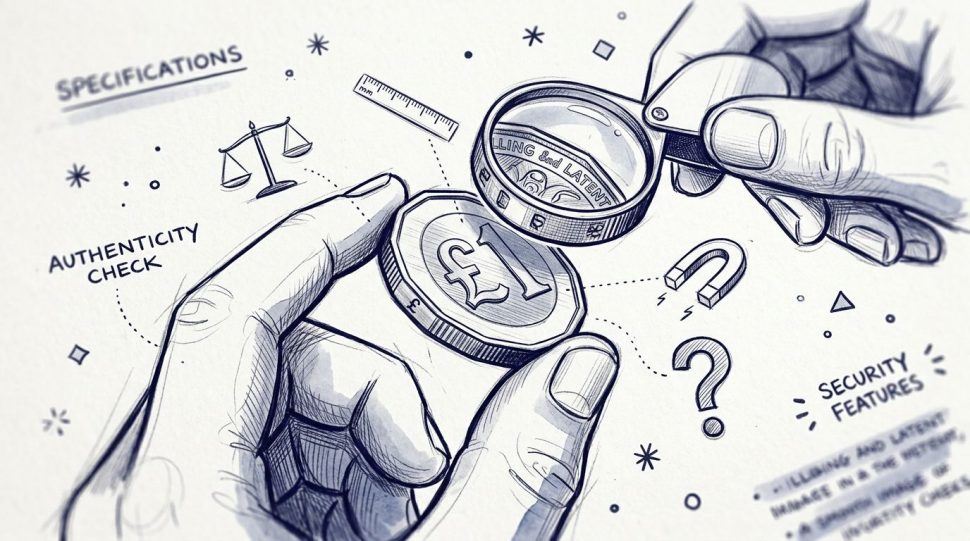
Posted by: Ian Stainton • 2 Jun 2026
You empty your pocket after a shop run, glance down, and one pound coin stands out straight away. The colour looks slightly odd. The edge lettering seems soft. It feels wrong in the hand, but not wrong enough to make you certain.
That uncertainty is exactly why fake pound coins have caused so much confusion over the years. Some are crude and easy to reject. Others are good enough to pass a quick glance, especially when you're busy, the light is poor, or you're sorting a pile of mixed change. Older reporting based on Royal Mint figures suggested the UK had issued at least 1.6 billion pound coins since 1983, and analysis put the counterfeit total in circulation at roughly £10 million to £15 million (reported here). That explains why so many people still ask the same question: what do I look for, and what should I do if I find one?
That Coin in Your Change Doesn't Feel Right
A suspicious pound coin usually gives itself away in one of two ways. It either looks visibly poor, or it passes the visual test and fails on the finer details. The problem is that awareness often focuses solely on the obvious checks, and these aren't always enough.
The round £1 coin is the one that caused the biggest headaches. It was widely copied, and public advice often became muddled. Some guides focused too much on appearance. Others pushed myths that sounded helpful but weren't reliable in practice. If you're handling an older coin, the best starting point is a mix of design checks, edge checks, and simple physical checks, not a single magic sign.
Quick answer
If you think you have a fake pound coin, check these first:
- Look at the design and date pairing: On older round pounds, the reverse design should match the year it was issued. A mismatch is a warning sign.
- Inspect the edge lettering: Poor depth, uneven spacing, and soft or messy milling are common faults on counterfeit coins.
- Don't trust appearance alone: Better fakes can copy the colour and general relief well enough to fool a quick visual check.
- Use simple physical checks where possible: Weight, thickness, and general dimensions are often more reliable than a glance.
- Ignore the orientation myth: The alignment of one side against the other isn't proof on its own.
If you're unsure how a genuine modern pound should measure, it helps to compare against published UK pound coin dimensions.
Practical rule: If a coin fails on more than one feature, treat it as suspicious and stop passing it on.
The primary difficulty isn't spotting an obviously bad fake. It's knowing when a coin is merely worn, damaged, oddly struck, or counterfeit. That's where a more structured check helps.
Your Step-by-Step Guide to Spotting Fake Pound Coins
A suspicious £1 coin is easier to judge once you stop treating all pound coins as the same thing. The old round pound and the current 12-sided pound fail in different ways, so the checks should be different too.

How to check an old round pound
The round £1 was widely copied. If you still find one in a till, collection bucket, cash bag, or old change jar, start with the details counterfeiters often got wrong.
Match the reverse design to the year
Round pounds used specific reverse designs in specific years. If the date and design do not belong together, treat the coin as highly suspicious.Read the edge lettering properly
Look for clean, even lettering with consistent depth. Many fakes have weak, patchy, crowded, or poorly spaced edge text. Wear can soften a genuine coin, but the lettering should still look intentional rather than crude.Check the basics by touch and comparison
A side-by-side comparison with a known genuine coin is often more useful than memory. Suspicious pieces can feel slightly off in weight, thickness, or finish even before you measure them.Use a simple magnet check as a filter, not a verdict
Magnet response can help rule out some bad counterfeits, but it does not settle the question on its own.
One practical point often missed in shorter guides. People still uncover old round pounds in charity storage, shop float tins, inherited coin jars, and back-office cash counts. The issue is not just spotting them. It is deciding what to do with them once they look wrong.
How to check a 12-sided pound
The newer £1 coin is more precise. That makes sloppy copies easier to catch if you check methodically.
Start with the overall shape. The twelve edges should look regular and well formed, not lumpy or uneven. Then inspect the finish. A fake may show soft relief, blurred details, rough joins between metals, or an overall appearance that looks dull and poorly struck.
Measurements help more with the modern coin than with the old one. If you have scales or a coin gauge at work, compare the piece against the official 12-sided coin specifications already noted earlier in the article. Small differences do not always mean counterfeit, especially on worn or damaged coins, but obvious variation should not be ignored.
If your staff or volunteers also receive other suspect UK coins, the warning signs often overlap. Our guide to spotting a fake £2 pound coin covers similar faults in finish, edge work, and overall build quality.
A quick feature comparison
| Coin type | Check first | Common warning signs |
|---|---|---|
| Old round £1 | Date and reverse pairing | Wrong design for the year, messy edge lettering, poor finish |
| Old round £1 | Edge detail | Shallow text, uneven spacing, weak milling |
| New 12-sided £1 | Shape and strike quality | Irregular edges, blurred relief, poor bimetal join |
| New 12-sided £1 | Weight and dimensions | Noticeably wrong size, thickness, or weight |
A coin that fails one check may only be worn. A coin that fails two or three checks deserves to be set aside.
If you need higher confidence
Visual checks generally suffice for individuals sorting change at home or handling routine cash in a business. Larger organisations sometimes need more certainty, especially when staff are checking batches of coins from multiple sources.
Laboratory methods can separate genuine and counterfeit alloys more accurately than a visual inspection. The practical takeaway is simple. If the design looks wrong and the physical feel is wrong, stop there. Do not put the coin back into circulation, and do not ask a cashier, volunteer, or colleague to make a guess under pressure.
That measured approach works best for both individuals and organisations. Check the right features for the type of pound coin in front of you, record anything suspicious if you handle cash professionally, and move the rest of your unwanted currency through a proper exchange route where it can be dealt with cleanly.
Common Mistakes to Avoid When Checking Coins
The biggest mistake people make is looking for a single trick that settles the question immediately. Fake pound coins rarely work like that. A coin can pass one test and still be wrong.

Don't rely on the orientation myth
One of the most repeated claims is that the orientation of the Queen's head compared with the reverse proves whether a coin is genuine. It doesn't. Technical guidance confirms that edge-letter orientation is not definitive proof, because orientation can vary even on genuine coins (discussion of the orientation myth).
That doesn't mean orientation is meaningless in every context. It means it is not enough on its own. If someone tells you a coin is fake purely because the two sides don't line up the way they expected, that's poor advice.
Don't use a quick glance as your only test
Many suspicious coins are rejected for the wrong reason, and many convincing fakes are accepted for the same reason. A fast look can miss:
- Soft edge lettering
- Poor spacing in the milling
- Slight dimensional problems
- Design and date mismatches
Poor lighting makes all of that worse.
Don't damage the coin trying to prove a point
Home-made tests can create more confusion than clarity. Scratching, filing, bending, or aggressively cleaning a coin won't help an ordinary person reach a reliable conclusion, and it may remove useful signs that a bank, police officer, or specialist examiner would want to see.
Better approach: Handle the coin as little as possible once you're seriously suspicious, then keep it separate and note where it came from.
Don't treat wear as proof of forgery
A battered coin isn't automatically counterfeit. Circulation damage, grime, and weak-looking relief can all appear on genuine coins that have been through years of use. What matters is the pattern of failure. One worn feature is not the same as several inconsistent features lining up together.
Common mistakes at a glance
- Trusting only feel: Useful, but too subjective on its own.
- Following social media myths: Many popular tips are incomplete or flatly wrong.
- Skipping the edge: The edge often tells you more than the face.
- Checking in bad light: Detail disappears quickly under dim lighting.
Most false confidence comes from over-simplifying the job. Coin checking gets easier once you accept that it isn't one test. It's a short checklist.
What to Do If You Find a Counterfeit Coin
Once you think a pound coin is counterfeit, the next step matters more than people realise. The wrong move is trying to spend it anyway and hoping someone else takes it. If you believe a coin is fake, take it out of circulation and deal with it properly.

First, stop passing it on
If a customer gives you a suspicious coin, or you find one in your own change, don't put it back into circulation. That only shifts the problem to the next person and can create a bigger issue if the coin is later traced back through your business or collection point.
If you're in a retail setting, train staff to set suspicious coins aside rather than argue at the till unless they are confident in the check. A calm process is better than a public stand-off over a coin that may be damaged.
Then record the basics
Write down what you know while it's still fresh:
- Where you received it
- When you received it
- Who handed it over, if known
- Why you think it's suspicious
Those details are useful if the coin is handed to a bank or police.
Keep the coin separate
Place the coin in a small envelope, bag, or clearly marked container. The goal isn't forensic perfection. It is to avoid mixing it back into genuine change and to preserve its condition for anyone who may examine it later.
Suspected counterfeit coins are easier to handle properly when your process is boring and repeatable. Separate, label, record, submit.
Submit it through the proper route
That typically means taking the coin to a bank or local police station and explaining that you believe it may be counterfeit. Policies can vary in practice, so it's sensible to check before you travel, but the principle is straightforward: hand it in through an official channel rather than trying to dispose of it informally.
You may not get the value reimbursed. That's frustrating, but it is still the right route. Counterfeit currency has no legitimate spending value, and passing it on knowingly is not a solution.
Why official checks can go further than home checks
At home, you're limited to what you can see and measure. Official verification can use more advanced methods. Some counterfeit coins contain alloys with lead, and authorities can use spectral analysis to confirm a fake more definitively, as shown in the Aberdeen research already discussed in this guide.
That matters because some of the better fake pound coins aren't obvious from appearance alone. If a coin has reached the stage where you're uncertain, formal examination is the sensible end point.
A simple workflow
- Set the coin aside
- Don't spend it
- Note where it came from
- Keep it separate from genuine cash
- Hand it to a bank or police contact for review
For households, this is usually a one-off annoyance. For businesses and charities, it needs to become routine.
Real-World Scenarios for Businesses and Charities
A suspect pound coin in your own pocket is a nuisance. A suspect coin in a till float, a donation bucket, or a counted cash bag creates a process problem.

That is why this issue looks different for organisations. Staff and volunteers are not just deciding whether one coin seems wrong. They need a repeatable way to deal with older round pound coins, newer 12-sided pound coins, and all the other odd money that turns up alongside them.
Current public information on counterfeit circulation is patchy, especially if you want practical detail on where suspect coins are being found or how often machines reject them. A useful example of that wider problem appears in this commentary on the data gap for counterfeit circulation. In practice, businesses and charities cannot wait for perfect national reporting. They need a clear sorting rule in-house.
A small retailer at the till
A convenience shop gets busy at the exact moment a doubtful coin appears. The customer wants to pay quickly. The queue is building. The staff member has a few seconds to make a call.
Poor training shows. One team member accepts anything that roughly looks right. Another rejects genuine coins because they do not want to take the risk. Both create avoidable cost.
A better till routine is short and consistent:
- Pause if the coin's weight, shape, or finish seems wrong
- Check the edge and lettering before anything else
- Compare it with a known genuine coin from the till
- Set it aside for manager review if doubt remains
That approach works for both old and new pound coins. It also removes the pressure on frontline staff to act like counterfeit specialists during a rush.
A charity sorting donation buckets
Charities often deal with the widest mix of all. One bucket may contain current UK coins, old round pounds, foreign change, withdrawn notes, arcade tokens, washers, and damaged pieces that are hard to classify at a glance.
Volunteers usually do not need a lesson in coin metallurgy. They need simple handling rules and labelled trays.
| Situation | Best response |
|---|---|
| Suspicious old or new UK pound coin | Separate it from counted cash and note the source batch if known |
| Foreign coins and notes | Keep together for specialist exchange rather than mixing them into sterling |
| Old or withdrawn currency | Set aside for review. It may still hold value |
| Mixed loose collections | Sort by type first, then decide what can be banked, reviewed, or exchanged |
Charities often lose money without realising it, as suspect UK coins get mixed back into genuine takings, while perfectly real foreign or obsolete currency gets treated as worthless because nobody has time to deal with it properly.
An attraction, venue, or transport hub with mixed cash
Airports, museums, visitor attractions, and transport sites collect all sorts of money through tills, kiosks, lockers, and donation points. The counterfeit question matters, but the bigger operational issue is volume. Once mixed cash builds up, teams waste time deciding what is bankable, what is suspicious, and what needs a different route.
The cleanest setup separates cash into three groups from the start:
- Normal sterling for banking
- Suspect UK coins for internal review and hand-in
- Foreign, old, withdrawn, or miscellaneous currency for specialist processing
That third group is easy to ignore, especially when the main concern is fake pound coins. It should not be ignored. Organisations regularly end up with foreign coins, outdated notes, and small mixed balances that standard bank channels do not handle well. A specialist exchange service is often the practical answer for those non-standard items, which is why many businesses and charities send that category out rather than letting it pile up in a safe or storeroom.
Where time and cash leak out
The direct loss on one fake pound coin is small. The larger cost is the friction around it. Staff stop to debate it. Supervisors get called over. End-of-day balancing takes longer. Mixed foreign and obsolete currency sits untouched because nobody owns the job.
A tighter process fixes most of that:
- Train staff to spot concern signs without overcomplicating the check
- Treat old round pounds and newer pound coins as separate identification tasks
- Record repeated problem sources, such as one till, one machine, or one collection point
- Keep non-sterling and obsolete money out of the counterfeit workflow
- Assign one person or team to clear miscellaneous currency regularly
For households, a fake pound coin is usually a one-off annoyance. For businesses and charities, it is a handling issue. The organisations that cope best are the ones that separate suspect coins quickly and keep every other unwanted currency stream organised from the start.
Frequently Asked Questions About Currency Exchange
After dealing with a suspect pound coin, people often notice a second pile nearby. Foreign change from holidays, old notes from a drawer, or mixed currency collected by a shop, club, or charity. That money is a separate problem from counterfeit coins, and it needs a different route.
Can I exchange foreign coins in the UK?
Sometimes, but not usually through a bank branch or a standard travel-money counter. Foreign coins, small mixed amounts, and older notes often fall outside what those services handle. Specialist exchange providers are set up for that sort of awkward leftover currency.
Can I exchange old or withdrawn foreign currency?
Often, yes. It depends on the country, the series, and the condition, but withdrawn foreign notes and older coinage can still have value. That matters for organisations as much as individuals, because charity tins, cash offices, and donation points regularly pick up mixed and outdated currency that cannot go through the usual banking process.
Will a specialist exchange service accept fake pound coins?
No. A legitimate service should only handle genuine currency. Suspected counterfeit pound coins, whether they are the older round type or the newer 12-sided coin, need to be taken out of circulation and handed in through the proper official channel.
If the fake has been separated out and you still have genuine foreign coins, old banknotes, or obsolete currency to clear, a specialist exchange service is often the simplest way to deal with the rest. It saves trying to sort awkward money into something a bank might accept, and it helps households, businesses, and charities clear the genuine leftover currency that tends to build up alongside problem coins.