
What Is the Real Five Shillings Value Today?
Posted by: Ian Stainton • 2 Jan 2026
Ever found an old five shilling coin tucked away and wondered if it's worth anything? It’s a common question, and the answer is more interesting than you might think. While its face value was set at 25 new pence when the UK decimalised in 1971, that's just the starting point of its story. The real five shillings value often lies in its history, condition, and appeal to collectors.
Understanding Your Five Shilling Coin's Value
That old five shilling piece in your drawer is more than just a forgotten bit of metal. Often called a "Crown," it has a fascinating journey from everyday pocket change to a sought-after collector's item. To figure out what it's truly worth, you need to look beyond its simple face value.
It doesn't matter if it’s a single inherited coin or part of a bigger bag of leftover foreign currency. Understanding what drives its value is the first step. The process can feel overwhelming, especially if you have a mix of old coins and notes. You might think you have to sort through it all, research each piece, and then find different buyers. That's where a modern exchange service makes life a lot simpler.
Why Its History Matters More Than Face Value
The story behind your coin is what really matters. Was it minted for a special event, like a coronation? Is it made from real silver or a more common metal like cupro-nickel? These details can dramatically change how much a collector is willing to pay.
- Commemorative Issues: Many five shilling coins were made to mark big national events, but their value can swing wildly depending on how many were originally produced.
- Metal Content: Older Crowns were made of silver, giving them an intrinsic value that their newer, non-precious metal cousins just don't have.
- Condition and Rarity: A coin in perfect condition from a year when very few were made will always fetch a higher price. It's as simple as that.
Practical Tip: Our service is built to make this process fast, easy, and completely hassle-free. There's no need to sort your coins or become an expert in coin collecting. We offer a 100% guaranteed valuation for your entire collection of old and foreign currency.
We're trusted by major brands, including UK charities, supermarkets, airports, and even police forces, to provide a credible and straightforward way to convert foreign coins and banknotes. You can even choose to donate foreign coins to charity directly through our platform.
To learn more about the wider family of shillings, feel free to explore our guide on the value of shilling coins. This overview is just the beginning—let's dive deeper into what makes your specific coin special.
The Story of the British Five Shilling Coin
To get a real feel for the five shillings value, we need to step back in time. This iconic coin, much better known as the Crown, wasn't just pocket change. It was a hefty, substantial coin that carried genuine weight in British society—both literally and in what it could buy. Its story turns it from a simple metal disc into a tangible piece of history you can hold.
The Crown has a long and fascinating history, first minted during the reign of Henry VIII. For centuries, it was a workhorse of the British economy. Struck in silver, it was used for major daily transactions. Just imagine a single coin that could pay a week's rent or buy a family's groceries—that was the power of the Crown in its heyday.
This timeline gives you a glimpse into how the Crown's design evolved through different historical periods.
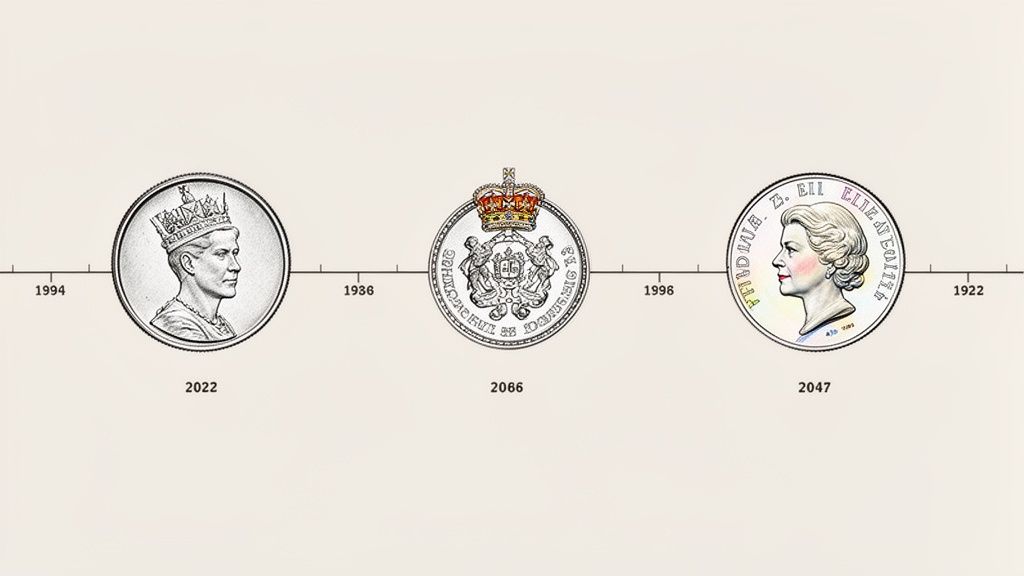
As you can see, the coin’s appearance shifted dramatically to reflect the monarch on the throne and the artistic styles of the time. Each version is a little snapshot of British history.
From Circulation to Commemoration
As the 20th century rolled on, the role of the five shilling coin started to change. It went from being a regular coin in circulation to one primarily minted to commemorate major national events. This is where most of the Crowns you'll find today come from, marking everything from coronations to festivals.
The British shilling, which was the foundation of the Crown's value, was a cornerstone of the economy right up until the UK went decimal on 15 February 1971. After World War II, coin production went into overdrive to meet the demands of a recovering nation. In 1948 alone, for example, the Royal Mint struck an incredible 45,576,923 English shillings and another 45,351,937 with the Scottish crest. That gives you an idea of its vital role in daily life. You can read more about the history of the shilling and its production) if you're curious.
The Modern Crown and Your Collection
This shift towards commemorative issues means that many five shilling coins from the reigns of George VI and Queen Elizabeth II are actually quite common. Events like the 1953 Coronation and the 1965 Churchill memorial saw millions of Crowns produced. While this makes them wonderful, accessible pieces of history, it often means their financial value to collectors is limited.
Our Promise: Fast, Easy, and Hassle-Free Exchange
Do you have a mix of these commemorative crowns, old shillings, and other leftover foreign currency? There’s no need to sort through them or figure out their individual histories. Our service is 100% guaranteed and trusted by major UK brands, including charities, supermarkets, airports, and police forces. We make it simple to exchange foreign coins and notes.
Whether you want to convert foreign coins and banknotes into cash or donate foreign coins to charity, our process takes away all the hassle. We provide a straightforward solution, turning your collection of historical curiosities into real, tangible value without any of the fuss.
Calculating Its Worth in Today's Money
To get a real feel for the five shillings value, we need to look beyond its simple decimal equivalent. When the UK went decimal in 1971, a five-shilling coin was officially pegged at 25 new pence. But that number doesn't tell you a thing about what it could actually buy. The real story is in its purchasing power, which reveals its true economic muscle back in the day.
Thinking about purchasing power is a bit like comparing a modern smartphone to one of those brick-like mobile phones from the 90s. The price tags might look similar if you adjust for inflation, but what you get for your money is worlds apart. And let me tell you, a five-shilling coin in the mid-20th century packed a surprising punch.
What Could Five Shillings Buy?
Back in the 1950s or 60s, five shillings was a decent amount of money for the average family. It could cover meaningful expenses and treats, which helps put its value into perspective. This kind of real-world insight helps explain why these coins were once so important.
- A Trip to the Cinema: A family could often see a film, complete with snacks, for around five shillings.
- A Gallon of Petrol: In the early 1960s, a gallon of petrol cost roughly five shillings, making it a key benchmark for daily costs.
- Weekly Groceries: While it wouldn't cover a full weekly shop, five shillings could easily buy essentials like a loaf of bread, a pint of milk, and a dozen eggs, with a bit of change left over.
This shows that five shillings was far from just pocket change; it represented real spending capability for everyday people. Understanding these economic factors is crucial when assessing old items. If you want to dive deeper into how this works, you can consult a practical valuation guide that explores similar principles for other collectibles.
Exchanging Yesterday's Value for Today's Cash
It's fascinating to figure out the historical purchasing power of a collection of old shillings or crowns you might have found. But when it comes to converting it into modern money—or even a jar of leftover foreign currency from your travels—it shouldn't feel like a history lesson.
Helpful Advice: Our service makes it fast and easy. You don't need to do any research or sort your coins. We offer a 100% guaranteed, hassle-free way to exchange foreign coins and notes.
As a trusted partner for major UK charities, supermarkets, airports, and police forces, we've stripped all the complexity out of the process. Whether you want to convert foreign coins and banknotes into cash for yourself or donate foreign coins to charity, we handle everything. Just send us your unsorted collection, and we’ll take care of the rest.
What Makes a Five Shilling Coin Valuable
Ever wondered why one five shilling coin is only worth its 25p decimal value, while another might fetch a serious price at auction? The answer isn't about what it could buy back in the day—it’s all about its numismatic value, which is just a fancy way of saying what a collector is willing to pay for it.
Understanding what drives this value is the key to spotting a hidden gem in your collection. Think of it a bit like judging a precious stone. A stunning Natural Yellow Diamond Crystal isn't valuable just because it's a diamond; its worth comes from its unique colour, clarity, and size. It’s the same with coins—the value is in the specific, individual details, not just its face value.
This breakdown shows how to think about a coin's worth, from its collector appeal all the way down to its simple decimal value.
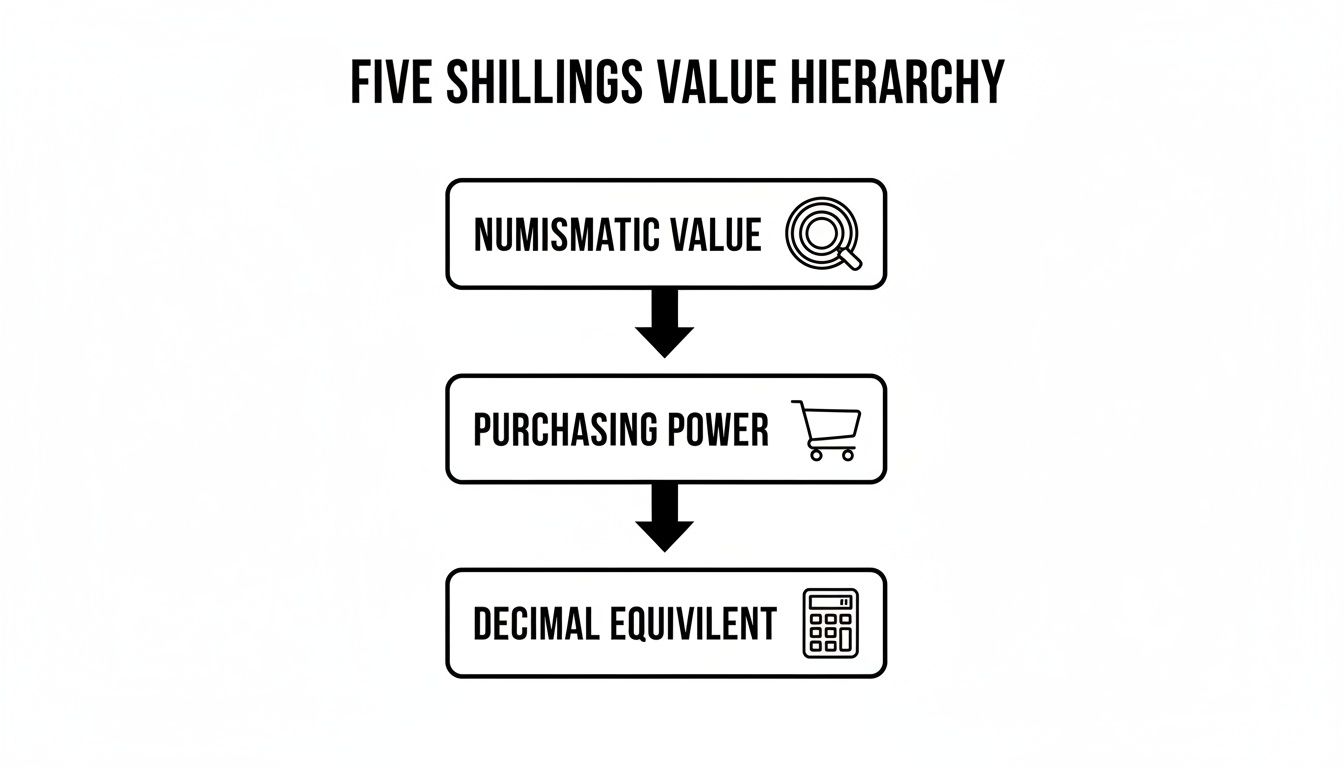
As you can see, the collector value is what really matters. It completely overshadows the coin’s old purchasing power or its modern 25p equivalent.
So, what are these key factors that collectors look for? Let's dive in.
Key Factors Influencing a Five Shilling Coin's Value
This table breaks down the crucial elements that determine whether a five shilling coin is just a common piece or a valuable collectible.
| Factor | Description | Impact on Value (Low to High) |
|---|---|---|
| Date & Rarity | The year the coin was minted and, more importantly, how many were made (the "mintage"). Low mintage years are always more sought-after. | Low mintage years or special commemorative dates significantly increase value. High mintage coins, like the 1965 Churchill Crown, are common and less valuable. |
| Metal Composition | What the coin is made of. Pre-1947 five shilling coins contain silver, giving them an inherent value based on the silver price. | Silver coins have a built-in "bullion" value. Post-1947 cupro-nickel coins are only valuable if they are rare or in exceptional condition. |
| Condition (Grade) | The physical state of the coin. An "uncirculated" coin looks brand new, while a circulated one shows wear and tear from being used. | An uncirculated coin is worth far more than a worn, scratched, or damaged one. The better the condition, the higher the price. |
| Errors & Variations | Mistakes made during the minting process, like off-centre strikes or misprinted details. "Proof" coins with a mirror-like finish are also highly prized. | Error coins can be incredibly rare and valuable. Proof versions, made for collectors, are produced in small numbers and command high prices. |
A coin that ticks several of these boxes—say, a rare date in uncirculated condition—is exactly what collectors are hunting for.
Condition and Special Variations Are Everything
Beyond the basics, it’s often the tiny details that can make a huge difference. Collectors get really excited about "error coins," which are pieces with mistakes made during the minting process.
They also hunt for "proof" versions. These coins were never meant for your pocket; they were struck using specially polished dies to create a stunning, mirror-like finish and were only made in very small numbers for collector sets. Finding one of these is a real win.
Our Service Is Fast, Easy, and 100% Guaranteed
Does this all sound a bit complicated? It can be. That’s why our service is designed to be completely hassle-free. There is no need to sort your coins or spend hours researching their numismatic value. Just send us your mixed collection of old shillings, leftover foreign currency, and obsolete banknotes.
As a trusted partner for major UK brands—including charities, supermarkets, airports, and police forces—we provide a straightforward way to exchange foreign coins and notes. Whether you want to convert foreign coins and banknotes into cash or donate foreign coins to charity, we handle all the complexity for you.
Valuable Five Shilling Coins to Look For
While knowing the theory is handy, nothing beats seeing real-world examples to get a feel for the true five shillings value. Not every crown is a hidden treasure; some are common commemorative pieces, while others are genuinely rare finds that collectors are eager to get their hands on. Here are a few practical tips on what to look for.
Two of the most common five shilling coins you'll come across are the 1953 Coronation Crown and the 1965 Churchill Crown. Both were produced in huge numbers to celebrate major national events, making them popular keepsakes for millions of people.
However, their massive mintage figures—over 5.9 million for the Coronation Crown and more than 19.6 million for the Churchill Crown—mean they aren't rare at all. In typical used condition, their value is often more sentimental than financial, usually hovering around their old 25p face value. You can dive deeper into this in our specific guide on the value of the 1953 five shilling coin.
Commemoratives and Mintage Figures
The story of the five shilling crown is closely tied to big national moments, which had a direct impact on how many were made. When the mint shifted from silver coins for circulation to cupro-nickel ones for special occasions, the production numbers skyrocketed.
Take the 1977 Silver Jubilee Crown, celebrating Queen Elizabeth II’s 25th year on the throne—an incredible 37 million coins were struck. It was a similar story for the 1981 Royal Wedding Crown for Charles and Diana, with nearly 27 million minted to capture the nation's excitement. These huge numbers ensured they became widely collected, but it also kept their individual financial value quite low.
Beyond the Common Crowns
To find the crowns with higher value, you need to look for coins with lower production numbers or those made from precious metals. Here are a few examples that really stand out from the crowd:
- 1934 'Wreath' Crown: A much harder coin to find, with a mintage of only 932. Its elegant design and sheer rarity make it highly sought-after, with values that can easily run into hundreds of pounds depending on its condition.
- 1951 Festival of Britain Crown: While still a commemorative piece, this coin had a much lower mintage of just over 2 million. Finding one in pristine, uncirculated condition can push its value well above its face value.
- Pre-1947 Silver Crowns: Any five shilling coin minted before 1947 contains silver. This gives it an inherent value based on its metal content, regardless of its condition or how many were made.
Real-World Insights: Figuring out which coins are valuable can be tricky and time-consuming. That's why our service is designed to be completely hassle-free. There is no need to sort your coins. Just send us your mixed collection of old crowns, leftover foreign currency, and old banknotes. As a trusted partner for major UK charities, supermarkets, and police forces, we make it simple to exchange foreign coins and notes or donate foreign coins to charity.
How to Easily Exchange Your Old Coins and Notes
So, you've gone through your collection and figured out what you've got. The next question is, what do you do with it all? Turning a pile of old shillings, leftover holiday money, and forgotten banknotes into actual cash can feel like a daunting task. That’s where we come in. Our entire service is built to make this process simple, quick, and completely hassle-free.
Forget spending hours trying to separate your coins. There’s absolutely no need to sort anything. Just gather up your entire collection—whether it’s old pre-decimal British coins or a mix of foreign currency—and send it all to us. We’ll handle all the sorting and valuing, making sure you get something back for every single piece.
A Simple, Guaranteed Process
We’ve built our entire process on simplicity and trust. For mixed and unsorted collections, we use a straightforward weight-based system. This makes it easy to exchange foreign coins even if you have no idea what’s in the jar. It's this transparent approach that has made us a trusted partner for major UK organisations, including charities, supermarkets, airports, and even police forces.
Our service is 100% guaranteed. We’ll give you a clear valuation for your currency, and if you’re not completely happy with it, we will return everything to you free of charge. We’re committed to being a reliable and credible way to turn forgotten money into real cash.
From Old Currency to New Opportunities
Whether you're looking to cash in on a historic find or finally convert foreign coins and banknotes from trips you took years ago, we offer a streamlined solution. Our platform is also perfect if you want to donate foreign coins to charity, giving you an effortless way to support a good cause.
We handle everything, so you can unlock the value hidden away in your drawers and jars without any of the usual stress. For a closer look at how we handle older British currency, you can find more details in our post about the easy way to exchange old British coins and notes.
Ready to get started? Head over to our homepage and turn that old money into new possibilities today.
Have a Question About Your Old Coins?
When you stumble upon old currency, a few questions usually pop up straight away. Whether you're wondering what a specific coin is worth or what to do with a mixed bag of money from different countries, getting some clear answers makes everything much simpler. Here is some helpful advice.
One of the coins we get asked about most is the 1965 Churchill Crown. It's not surprising, as over 19 million of them were minted, making it incredibly common. In the condition you usually find them in, their value is mostly sentimental—think of it as being worth its old 25p face value. Our service takes the guesswork out of it by valuing your entire collection at once.
It's also important to remember that five shilling coins, just like all pre-decimal currency, are no longer legal tender. You can't spend them in shops. The only way to get any value from them is by finding a collector or using a specialist service like ours that can exchange foreign coins and notes.
What to Do with Mixed and Foreign Currency
So, what if you have a jumble of old British shillings mixed in with leftover foreign currency from past holidays? This is where our service really comes in handy.
Our process is designed to be fast, easy, and completely hassle-free. There is absolutely no need to sort your currency. You can send us your entire collection of old coins, obsolete notes, and foreign money in one go.
We're trusted by major UK brands—including charities, supermarkets, airports, and police forces—because we make it simple to convert foreign coins and banknotes. We handle all the fiddly sorting and provide you with a single, 100% guaranteed payment.
Lots of people also ask how they can donate foreign coins to charity. We've made this incredibly easy. During our secure exchange process, you have the option to donate the full value of your currency directly to one of our trusted charity partners. It's a fantastic way to turn your old money into a meaningful contribution.
Ready to unlock the value in your forgotten currency? At We Buy All Currency, our fast, easy, and 100% guaranteed service is the simplest way to exchange foreign coins, notes, and your leftover holiday money. Visit our homepage to get started now at https://www.webuyallcurrency.com.