
Five Yen Coin Guide: History, Design & Exchange 2026
Posted by: Ian Stainton • 22 Jun 2026
The five yen coin is the Japanese coin with the hole in the centre. It carries a symbolic design linked to rice, water, and industry, and while most UK banks won't take it, specialist services make it easy to exchange foreign coins online for cash.
If you've emptied a holiday wallet, sorted a charity tin, or found old travel money in a drawer, this is one of the coins people most often recognise but don't know what to do with. It looks distinctive, it feels worth keeping, and it often gets left behind because high street exchange options rarely handle foreign coins well.
That's where a bit of clarity helps. Once you know what the coin is, why it has a hole, and why traditional exchange routes usually reject it, the next step becomes much simpler.
What Is a Five Yen Coin and Can You Exchange It in the UK
You empty a coat pocket after a trip, or sort through a jar of old holiday money, and one coin stands out straight away. It is brass-coloured, it has a hole in the middle, and it clearly is not something a UK vending machine or bank counter is likely to want. In many cases, that coin is a Japanese five yen coin.
The five yen coin, often called the go-en coin, is part of everyday Japanese currency. For a UK resident, the practical question is usually not "What does it buy in Japan?" but "Can I turn this into pounds here?" The short answer is yes, but usually through a specialist service rather than a bank or travel agent.
That difference matters because the coin's low face value, foreign origin, and coin format all work against it in the UK. Banks tend to deal in current banknotes. Standard exchange counters usually do the same. A small foreign coin sits outside the systems they are set up to handle.
How to recognise it
The centre hole is the quickest clue. If you are sorting mixed travel money, that hole makes the five yen coin much easier to spot than many other foreign coins. It is also light, brass-toned, and marked with Japanese characters rather than Latin letters, which can make first-time identification feel harder than it really is.
A good way to approach it is the same way you would sort old keys. You do not need to know the full history of each one first. You just need to separate the clearly identifiable pieces so you can choose the right place to deal with them.
Can you exchange it in the UK?
Yes, but not usually on the high street.
If you have one five yen coin, or a small pile of Japanese and other foreign coins, the simplest route is usually a specialist that accepts leftover travel money rather than a bank branch. If you want a clear starting point, this guide on where to exchange foreign coins explains how UK coin exchange services work.
That is why this coin often ends up sitting in drawers for years. People assume all currency exchange works the same way. It does not. Notes are easy for many providers to process. Coins, especially low-value foreign ones, usually need a service built for exactly that job.
So if you are holding a five yen coin and wondering whether it is exchangeable in the UK, the answer is simple. Yes, through a specialist service, and that is usually the quickest way to get value from leftover Japanese currency instead of leaving it unused.
The Story and Symbolism Behind the Go-en Coin
The five yen coin isn't just memorable because of the hole. It's also one of those coins people remember from Japan because it feels intentional. The design looks different from many Western coins, and in Japan it carries a cultural association that gives it more personality than its face value suggests.

Why people call it the Go-en coin
“Go-en” is the Japanese reading of five yen. Many travellers hear that name and remember it because the coin is often associated with good fortune or good connections. That's one reason people bring one home as a keepsake instead of spending it.
Even if you're not interested in symbolism, this helps explain why the coin turns up so often in UK drawers, memory boxes, and charity donations. People don't always treat it as ordinary loose change.
What the design is trying to say
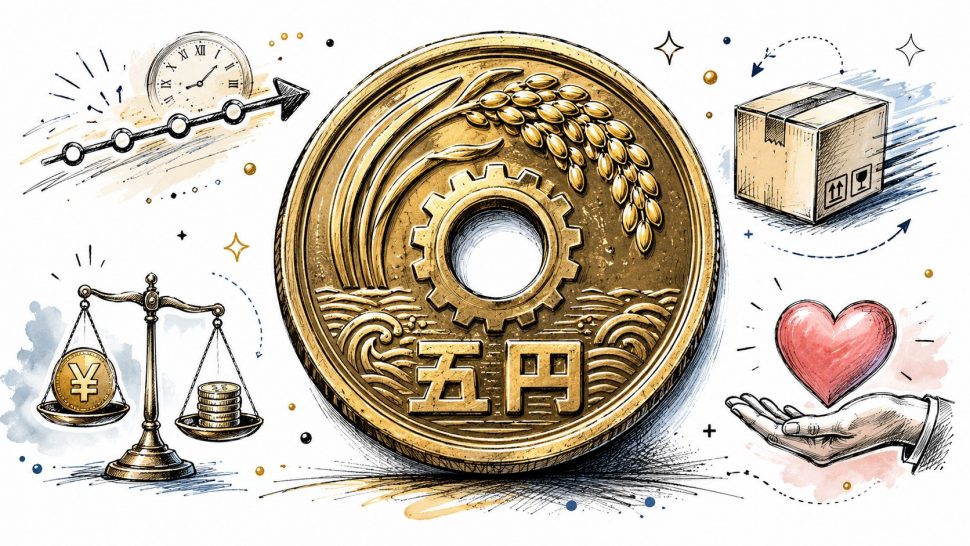
The front design is often where readers get confused because it doesn't look obvious at first glance. The imagery is generally understood as representing key parts of national life after the war:
- Rice stalks suggest agriculture
- Water elements point to fisheries
- The gear around the hole represents industry
Together, those features make the coin feel almost like a compact national emblem rather than a plain denomination marker.
The five yen coin is easy to recognise because its design is both symbolic and practical. That combination is part of why it has lasted so well in public memory.
A long history behind a small coin
The five-yen denomination goes back a long way. Its production history begins in 1870, when Japan first issued it as a gold coin. The modern version began in 1948, and the current design dates from 1959, remaining unchanged since then (five yen coin history and design timeline).
That long continuity matters for ordinary people in the UK more than you might expect. If you've inherited a small group of Japanese coins, or you're sorting foreign donations, the five yen piece is one of the easiest to spot and one of the most likely to have turned up over many decades.
How to Identify Your Five Yen Coin's Age and Value
Some people find a five yen coin and immediately ask, “Is this old?” Others ask the more practical question, “Is it worth exchanging?” Those are related, but they're not the same thing.
For most readers, identifying the coin is enough to decide what to do next. You don't need to become a collector to handle leftover travel money sensibly.

Start with the physical details
Japan's Ministry of Finance specifies the current circulating five yen coin as a brass alloy made from copper 600–700 parts and zinc 400–300 parts, with a 22.0 mm diameter and 3.75 g weight (Japanese Ministry of Finance coin specifications).
Those details help in two ways:
- They confirm identification if you're comparing several similar-looking coins
- They explain processing because size, shape, and the centre hole make the coin easier to sort mechanically
If your coin looks roughly right, feels light, and has the distinctive hole, you're usually dealing with a standard circulating piece rather than something unusual.
How to think about age
Japanese coins can show dates in Japanese characters, which is where many UK readers get stuck. If you can't read the date, don't panic. For exchange purposes, you often don't need an exact year to move forward.
What matters more is this distinction:
| Question | What it means in practice |
|---|---|
| Is it an identifiable five yen coin? | Good enough for most exchange decisions |
| Is it a rare collector piece? | A separate question that may need specialist coin expertise |
| Is it mixed in with other leftover coins and notes? | A weight-based or mixed-currency service is usually the practical route |
Value versus collector interest
A common mistake is assuming every older foreign coin is automatically valuable to collectors. Sometimes that happens, but those with leftover holiday money don't have a specialist rarity. They have normal circulation coins.
Worth checking: If a coin appears unusually old, exceptionally well preserved, or part of a curated collection, you may want a collector's opinion before exchanging it with general leftover currency.
For everyone else, the “value” question is simpler. It's less about rare-coin premiums and more about finding a service that can convert foreign coins and banknotes without expecting you to sort every last piece.
Why Banks and Bureaus Wont Touch Your Japanese Coins
You get home from Japan, empty your bag, and find a five yen coin at the bottom of a pocket. It is real money, it is clearly Japanese, and yet a bank counter in the UK will usually refuse it without much discussion.
The reason is practical, not mysterious. A 5 yen coin has very low face value, and handling foreign coins is expensive for banks and travel money shops. By the time staff have checked it, stored it, sorted it, and arranged somewhere for it to go, the work often costs more than the coin is worth to them.
Why standard exchange routes usually say no
High street banks and airport bureaus are built mainly for banknotes. Notes are faster to count, easier to verify, and simpler to send back into currency systems. Coins create the opposite problem. They are heavier, slower to process, and much harder to handle profitably when they come in mixed foreign batches.
The five yen coin adds another layer to that problem. It is a low denomination coin from outside the UK, so it has no spending use here and little appeal to mainstream exchange desks. In other words, the issue is not whether your coin is genuine. The issue is whether the service has a cost-effective way to process it.
Banks and bureaus often avoid foreign coins because they would need to deal with:
- manual checking for low-value pieces
- storage for mixed metal currency
- sorting by country and denomination
- shipping or resale routes that make financial sense
- coins they cannot put back into UK circulation
That is why people feel stuck. The coin is valid, but the usual exchange channels are set up for a different kind of currency handling.
Why specialist services can help
A specialist buyer works more like a recycling system for travel money than a retail cash desk. Instead of expecting crisp, current banknotes only, they are set up to receive mixed coins, older notes, and small leftover amounts that standard providers tend to reject.
That matters if your five yen coin is sitting with euros, dollars, old notes, or other holiday change. A specialist process is designed for the actual pile in the kitchen drawer, not the ideal bundle a bank prefers. If you want to understand that process before sending anything, this guide on how to exchange leftover foreign currency explains what to do.
Comparing your options
| Service | Accepts Foreign Coins? | Accepts Old or Withdrawn Notes? | Best For |
|---|---|---|---|
| High street bank | Usually no, or very limited | Sometimes, with restrictions | Current banknotes from major currencies |
| Travel money bureau | Often notes only | Usually limited | Buy-back of common holiday banknotes |
| Specialist currency exchange service | Yes, often including mixed coins | Yes, often including older currency too | Leftover travel money, mixed coin bags, unsorted foreign currency |
The cost most people miss
The exchange rate is only part of the decision. Time matters too.
A quick trip to a branch can turn into a wasted afternoon if you queue up only to be told that coins are not accepted. For a single five yen coin, or a larger bundle of leftover currency, the simplest option is usually the one built for small foreign coins from the start.
How to Exchange Five Yen Coins and Other Leftover Currency
Once you accept that banks usually aren't the answer, the process gets much easier. The practical goal is to turn mixed travel money into cash, or into a charity donation, without spending ages sorting and second-guessing everything.

A simple way to handle it
A specialist online process usually works well because you can deal with your coins from home. That matters if your five yen coin is just one item in a larger pile of leftover foreign currency.
Here's the usual flow.
Get an online estimate
Use an exchange tool or wizard to enter what you have. Good specialist systems are designed for coins, notes, and withdrawn currency, and they don't force you into a notes-only process.Pack the currency securely
Keep coins contained so they don't move around in transit. If you've got notes as well, separate them neatly inside the parcel.Send it for verification
The package is checked once received. Specialist handling matters at this point, because mixed foreign currency needs sorting and validation.Receive payment or donate the value
According to the publisher information for this service, payment is issued within five working days after verification, by bank transfer or PayPal.
If you want a step-by-step walkthrough, this guide explains how to exchange leftover currency.
When this is especially useful
This approach works well for several common situations:
- A family holiday clean-up where a few yen coins are mixed with euros and dollars
- A charity collection that includes lots of low-value foreign coins
- An inherited tin or jar containing old notes and coins from different countries
- Business takings in error where foreign money has been accepted at a till
If you don't want to sort every coin yourself, choose a service built to handle mixed currency. That saves the most time.
Can you donate instead of cashing out
Yes, that's often possible through specialist services. For many people, especially when the amount is small or the coins are mixed, the easiest route is to donate foreign coins to charity rather than leave them unused.
That can be a good option if the five yen coin has no sentimental value and you only want it to be useful again.
Common Mistakes to Avoid When You Find Foreign Coins
People usually don't lose money on foreign coins because the coins are worthless. They lose money because the coins sit untouched for years or get thrown away.
Here are the mistakes that come up most often.
The most common slip-ups
Throwing them in a junk drawer
This is how travel money disappears. One coin becomes a mixed pile, and the mixed pile becomes “too annoying” to deal with.Assuming banks will sort it out
That works far better for mainstream notes than for loose foreign coins. A trip to the branch often ends with the same bag coming home.Trying to identify every single coin first
If you've got a mixed handful from several trips, that effort usually isn't necessary. For standard exchange, the practical question is whether a service accepts unsorted coins and notes.Mixing foreign coins with UK change
This causes confusion later, especially with brass-coloured coins and small denominations. Keep foreign money separate as soon as you find it.
A better approach
Put all your leftover travel money in one place, check whether you've got any obviously special collector pieces, and then use a service designed to exchange foreign coins and notes together.
That's simpler than trying to solve every coin one by one.
Frequently Asked Questions About Exchanging Foreign Coins
Can you exchange foreign coins in the UK?
Yes, but usually through a specialist service rather than a standard bank counter. Coins are much harder to exchange than notes, especially when they're low denomination or mixed with other currencies.
Will a bank accept my five yen coin?
Usually not. Banks commonly limit foreign exchange to selected banknotes, and coins often fall outside what they handle.
Do I need to sort my coins before sending them?
In many specialist systems, no. That's one of the biggest advantages if you want to convert foreign coins and banknotes without spending hours organising them.
Can I exchange just one five yen coin?
You can, but in practice individuals typically send it along with other leftover foreign currency. A single coin on its own may not be the most efficient thing to process, so combining coins and notes usually makes more sense.
What if I also have old or withdrawn foreign notes?
Specialist services are often the best option for that too. They distinguish themselves most clearly from banks and travel bureaus, which often reject older or discontinued currency.
Is it safe to post foreign currency?
Reputable services are set up for postal exchange, and they provide guidance on how to package currency securely. The key is to follow the packing instructions carefully and use the recommended process.
Can I donate foreign coins to charity instead of receiving cash?
Yes. If the amount is small, or you prefer not to cash it out personally, charity donation can be a practical and satisfying option.
How long does payment take?
According to the publisher information provided for this article, payment is issued within five working days after verification, using bank transfer or PayPal.
What if I'm not sure the coin is five yen?
Start with the easiest clue. The five yen coin is the Japanese coin with the hole in the centre. If you're still unsure, compare it with a specialist exchange guide or submit it as part of a mixed foreign currency exchange rather than trying to identify every detail yourself.
If you've got a five yen coin sitting in a drawer along with old notes, mixed holiday change, or outdated currency from past trips, the easiest next step is to use a specialist service that accepts coins, notes, and withdrawn money in one place.
If you're ready to turn Japanese coins, old banknotes, or mixed holiday money into something useful, We Buy All Currency offers a straightforward way to exchange foreign coins, exchange leftover currency, or convert foreign coins and banknotes without the usual hassle.