
Florin Coin Value: A UK Guide to What Your Coins Are Worth
Posted by: Ian Stainton • 25 Jun 2026
You open a biscuit tin in the attic, or clear a drawer after a family house move, and there they are. A loose handful of old silver-coloured coins, maybe mixed with foreign change, pre-decimal pennies, and the odd old banknote. One of the most common finds is the British florin.
That usually leads to two questions. Is this coin worth anything? And just as important, what do I do with it if it isn't a pristine collector piece?
Most guides jump straight to rare museum-grade examples. Real life is messier. Most attic finds are mixed-date, circulated, scratched, or partly tarnished. That doesn't mean they're worthless. It means you need a practical way to judge florin coin value, especially if you want to exchange old coins, convert foreign coins and banknotes, or deal with leftover foreign currency and old UK money in one go.
What Is a Florin and Is It Still Worth Anything
A florin is a two-shilling British coin from the pre-decimal UK system. You will often find it in attic tins, old drawers, and mixed family collections because it was a very common coin in everyday use for many years.

Quick answer: Yes, a florin can still be worth money. You cannot spend it now, but that does not stop it having resale value to collectors or bullion buyers, especially in mixed old-coin finds.
For someone sorting a family collection, that distinction matters. A florin is no longer useful as spending money, yet it may still hold value for one of two practical reasons. It might be a collectable date or type, or it might have silver value even in worn condition.
That second point is where many attic finds get misjudged. Guides often focus on sharp, high-grade pieces in slabs. Individuals rarely discover coins of that caliber. More commonly, they encounter a small pile of circulated florins with fingerprints, scratches, dark toning, and a few better pieces hidden among them. Those coins can still be worth sorting properly.
Why florins still have value
Florins sit in two overlapping markets.
Some are bought by collectors, who pay for scarcer dates, better condition, stronger eye appeal, or a type they need to complete a set. Others are bought because older issues contain silver, which gives even a tired example a base level of interest. In practice, that means a coin can be ordinary numismatically and still not be worthless.
Age on its own does not decide much. I see this mistake all the time with inherited collections. A worn common florin from a heavily saved year may only sell modestly, while a scarcer date, a better portrait type, or a coin with less wear can stand out quickly.
What matters for an attic find
If you have one florin, the value may be small. If you have a mixed group, the total is what matters.
That is a better way to look at most household finds. A bag containing florins, old pennies, foreign coins, and withdrawn notes is rarely about one spectacular rarity. It is about identifying which pieces deserve individual attention, which have silver or exchange value, and which are best handled together through a specialist rather than left in a drawer.
Why banks usually will not help
High street banks and standard exchange counters usually deal with current currency. Old UK coins, pre-decimal pieces, and mixed foreign coin lots generally fall outside what they handle.
So the practical question is not only, “Is this florin rare?” It is, “What is this group of coins worth as found, and what is the easiest way to turn it into cash?” For many people, especially when the coins are circulated rather than pristine, a specialist service is the simplest route.
How to Determine Your Florin Coin Value
The fastest way to judge florin coin value is to look at four things together. Date, condition, metal content, and rarity. Miss one, and you can end up either underpricing a better coin or overestimating an ordinary one.
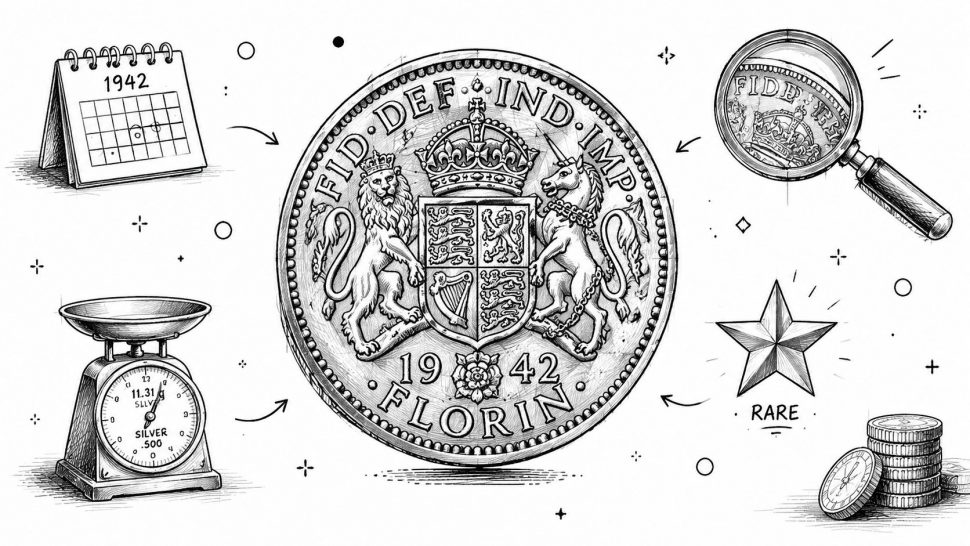
The broad reference point is useful. The British florin was issued from 1849 until 1967, carries 50% silver (0.500 fineness) at the relevant silver standard cited here, and weighs 11.31 grams. Common dates such as 1921 may be worth £5 to £15, while a 1932 George V florin in Fine condition can trade for £40 to £80, and Uncirculated examples have fetched over £1,500, according to My Coinage's florin values guide.

Date and mintage matter first
Start with the year.
Some years are more common than others, so collectors don't have to compete very hard for them. Others are key dates. A classic example is the 1932 George V florin, which is widely treated as a key date and needs more careful assessment than an ordinary later piece.
If you're sorting a pile, set aside any coin that looks earlier, less common, or visually different before you do anything else. That one habit saves a lot of mistakes.
Condition changes everything
Condition is where value spreads out sharply.
A collector pays for detail. Sharp lettering, strong portrait features, clear shield lines, and less wear all move a coin upward. Once the coin is rubbed flat, bent, cleaned harshly, or scratched, the collector premium falls away quickly.
For beginners, a useful rule is simple. Ask whether the design still looks crisp, or whether the high points look smoothed over. Crisp usually means further checking. Flat usually means a lower-value, bulk-type piece.
Practical rule: If two florins have the same date, the better-preserved one is usually the one worth your time.
Silver content gives some florins a floor
Not every florin should be treated purely as a collectable. Silver content can matter.
That doesn't mean every silver florin is valuable in a specialist sense, but it does mean a worn coin may still have some underlying worth rather than being dismissed as junk. For mixed attic finds, that's important because many collections contain average pieces rather than individually notable rarities.
Rarity and oddities come last
Rarity can mean a key date, a design type, a pattern, or something that specialist buyers actively chase. It can also mean a coin that looks unusual compared with the rest of your group.
That said, beginners often overestimate “odd-looking” coins. Tarnish, damage, or wear isn't rarity. True rarity usually sits in the date, design, issue status, or a recognised specialist variety.
A simple checking order
Use this order when you handle a mixed bag:
- Read the date clearly
- Separate coins by obvious condition
- Pull out anything that looks unusually old or sharp
- Treat damaged coins as bulk unless proven otherwise
- Compare the whole group, not just the best-looking single coin
That last point matters if you also want to exchange foreign coins, because mixed-value holdings are often better judged as a group than as a fantasy “best case” single-item price.
A Practical Guide to Identifying and Grading Your Florins
There's no need for professional jargon to make a decent first pass. You just need a calm look, good light, and a simple way to separate likely collector pieces from ordinary circulated coins.

How to identify a florin
A florin is a distinct British pre-decimal coin with a two-shilling denomination. Designs vary by monarch, but in practice it is often identified by the date, British styling, and its placement among other pre-decimal coins rather than modern decimal issues.
When you're unsure, sort by what you can read first. Separate obvious florins from pennies, halfcrowns, shillings, and mixed foreign coins. If you have a pile of old UK pieces, a dedicated pre-decimal coin values guide helps with side-by-side identification.
A simple grading method that works at home
You don't need to assign a technical grade immediately. Use three practical buckets.
Average circulated
The coin has seen everyday use. Main design elements are visible, but the finer parts look soft. This is the category where many attic finds sit.Fine to very fine
The coin still shows decent detail. Lettering is clear, central features stand out, and the overall look is stronger than a normal “kept in a jar” coin.Extremely fine to uncirculated
Wear is light or minimal. The design remains sharp. These are the coins that deserve slow, careful checking.
What to look at on the coin
Instead of memorising grading codes, check visible wear points.
Portrait detail
Can you still make out finer hair detail, or has it smoothed into general shape?Lettering and rims
Are the words and edge details strong and readable, or are they fading into the field?Central design
Shields, emblems, and inner lines often reveal wear faster than outer lettering.Surface problems
Scratches, dents, cleaning marks, and bends can lower appeal even when the date is better.
A good illustration of how much condition matters comes from the specialist market. An 1854 Gothic florin in Fine condition may be worth £800 to £3,000, while a 1932 George V florin in Extremely Fine can reach £120 to £250. That spread shows how wear can create a multiplier of 20x or more over base silver value, according to NGC's pricing reference for Great Britain florins.
Handle coins by the edges. Once fingerprints, rubbing, or polishing alter the surface, you can't undo it.
Florin Coin Value Examples and Typical Price Ranges
This is the key information. What are florins worth when you find them in normal household condition?
The answer depends less on the headline rarity stories and more on whether you have one special coin or a mixed bag of everyday pieces. In ordinary collections, common-date coins often sit in lower price bands, while standout dates or stronger grades pull the average up.
Typical UK florin value ranges
| Monarch / Era | Years | Average Circulated Value | Good / Uncirculated Value |
|---|---|---|---|
| Victoria rarities | 1849 and 1854 benchmark issues | Qualitatively variable, often specialist-only | 1854 Gothic florin in Fine can trade at £800 to £3,000 |
| Edward VII and other common earlier types | Early 20th century examples | Common dates such as 1902 trade around £15 to £50 in average grades | Matte Proof examples can command much higher specialist premiums |
| George V common dates | 1911 to 1936 | Common-date George V florins in average circulated grade trade for £2.50 to £30 | Better dates and stronger grades can rise materially |
| George V key date | 1932 | £40 to £80 in Fine | £120 to £250 in Extremely Fine, with uncirculated pieces much higher |
| Edward VIII pattern | 1937 pattern only | Not a normal circulation coin | Can exceed £30,000 when available |
The key lesson is that average household finds rarely match the prices attached to exceptional single coins. According to All Coin Values on common-date George V florins, common-date George V florins in average circulated grade trade for £2.50 to £30, and heavily worn or damaged examples drop to near-scrap value.
The attic-find problem most guides ignore
A lot of people don't have one carefully stored florin. They have a bag.
That changes the question from “What's the top price for the best example?” to “What's the realistic aggregate value of this lot?” That's the right way to think if the coins are mixed in date and condition, or bundled with old foreign change and withdrawn notes.
A pile of ordinary coins can still have useful value, but the total is usually built from aggregation, not from a single dramatic rarity.
One verified example shows the difference clearly. A collection of 50 mixed George V florins in common dates and average condition might yield only £75 to £100 total, rather than a collector-style headline figure for every coin. That's often far closer to real outcomes for inherited lots than glossy guide prices.
What works in practice
If your group includes:
- A few sharper early pieces, separate them for closer inspection
- Common worn dates, think in bulk value rather than wishful per-coin pricing
- Bent, cleaned, or damaged florins, assume lower realised value unless a specialist identifies something unusual
- Foreign coins and old notes mixed in, assess the whole holding as a currency-clearance job, not just a coin-collector exercise
For people trying to exchange foreign coins and notes as well as old British money, that broader approach is usually more efficient than trying to retail every item individually.
How to Exchange Your Florins and Other Leftover Currency
Once you've got a rough idea of florin coin value, the next question is practical. Where do you turn old coins into cash?
Three realistic routes exist: a local coin dealer, an auction platform, or a specialist online currency service that accepts coins, notes, and withdrawn money. Each has trade-offs.

Comparing your options
| Option | Best for | What works well | What usually doesn't |
|---|---|---|---|
| Local coin dealer | Better single coins | Immediate in-person opinion, useful for scarcer dates | Often less convenient for mixed low-grade lots or foreign change |
| Auction site or specialist auction | Strong collector pieces | Wider buyer interest for key coins | Slower, more effort, less suited to ordinary household accumulations |
| Specialist online exchange service | Mixed coins, notes, old and withdrawn currency | Simple process, practical for unsorted holdings, accepts more than banks do | Not the right route if you're chasing a top-end auction result for a major rarity |
Why banks and bureaus fall short
Banks and exchange desks usually focus on current currency. They're not built around tubs of old coins, mixed foreign change, or pre-decimal British issues. That's why people trying to exchange leftover currency, convert foreign coins and banknotes, or deal with inherited coin jars often end up looking beyond the high street.
That's also why charity collections, supermarkets, airports, and other organisations often use specialist solutions when coins and obsolete notes build up. The normal retail exchange system is not designed for that type of material.
How the process usually works
If you use a specialist postal service for old coins and notes, the process is straightforward.
Check what you have
Pull together your florins, foreign coins, banknotes, and withdrawn currency. You usually don't need to sort everything into collector categories.Get an indication of value
Many services let you estimate holdings before sending. This is especially useful when you want to exchange foreign coins and notes in one shipment.Pack the currency securely
Use a padded envelope or small box. Keep obviously better coins separate inside the package if you want them checked more carefully.Send it for verification
The recipient checks the contents, confirms the valuation method, and verifies what can be exchanged.Receive payment or donate the proceeds
Some people take cash payment. Others prefer to donate foreign coins to charity, especially when the holding came from travel or fundraising.
For old British coins specifically, a practical overview of specialist options is available in this guide on the easy way to exchange old British coins and notes.
When this route makes the most sense
This route is usually the easiest fit when your collection is:
- Unsorted
- Mixed between coins and notes
- Partly foreign
- Old or withdrawn
- Not strong enough to justify an auction-by-auction approach
If your main goal is convenience, this tends to work better than trying to split a box of low-to-mid value material between multiple buyers.
Common Mistakes to Avoid When Selling Old Coins
The biggest mistakes happen before the coin ever reaches a buyer. Most of them come from trying to “improve” the coin or assuming only the rarest-looking examples matter.
Don't clean the coin
Cleaning is one of the fastest ways to strip away collector appeal. A polished florin may look brighter to you, but many buyers read that as damage. Leave dirt, tone, and age alone unless a professional gives specific advice.
Don't assume worn means worthless
A poor-looking coin may still have exchange or collector interest, especially in a mixed lot. That's why it's a mistake to throw damaged or tired-looking florins in with general scrap without checking what the group contains.
Older coins often disappoint as single pieces and still do perfectly fine as part of a bulk valuation.
Don't rely on asking prices
Online listings can be wildly optimistic. What matters is realised value, especially for average circulated material. A seller can ask anything. That doesn't mean anyone pays it.
Don't take everything to the bank
Banks are useful for modern banking. They're usually not useful for old coins, pre-decimal currency, or odd mixtures of foreign change and obsolete notes. If you want to exchange foreign coins, exchange leftover currency, or handle withdrawn money, specialist services tend to be far more practical.
Don't ignore convenience costs
Selling coin by coin sounds clever until you account for time, packing, messages, relisting, and low-value items that never move. For many households, a clean bulk solution produces the least hassle.
Your Florin and Old Currency Questions Answered
Can I exchange florins in the UK?
Yes. You usually exchange them through a specialist buyer, coin dealer, or currency service rather than trying to spend them or pay them into a bank. For attic finds, that matters because the practical value often sits in the whole bundle, not just in one tidy collector coin.
Will banks or the Post Office accept florins?
No. Florins were withdrawn from everyday use long ago, so banks and Post Office counters do not take them as spendable money. If you have a few worn pieces mixed in with old pennies, sixpences, foreign change, or withdrawn notes, a specialist service is normally the more realistic route.
Are all old florins valuable?
No. Date, minting, silver content on older pieces, rarity, and condition all affect value. In real household collections, many florins are ordinary circulated coins with modest individual prices, but a mixed group can still add up to a worthwhile total.
What if my florins are scratched, bent, or mixed with other coins?
That is very common.
I see far more mixed bags than neat album collections. A scratched or tired florin may have little value on its own, but that does not mean the lot should be dismissed. The sensible approach is to check whether anything needs separating out, then value the rest as a group.
Can I exchange foreign coins and notes at the same time as florins?
Usually, yes, if you use a specialist service. That is often the easiest option for households clearing a drawer full of old British coins, leftover holiday money, obsolete notes, and odd foreign coins in one go.
Can I donate foreign coins to charity instead of taking payment?
Yes. That can suit low-value mixed currency, especially after travel or a house clear-out. If the collection is more about tidying up than maximising every last pound, donation is a practical option.
How long does payment usually take?
It depends on the provider. With a postal service, payment is usually made after the coins and notes have been received, checked, and processed. Before sending anything, read the terms, check how they handle identification, and confirm whether payment is by bank transfer, cheque, or another method.
What should I do if I think I have a rare florin?
Set it aside first. Hold it by the edges, keep it dry, and leave the surface alone.
A quick clean or polish can reduce collector interest fast. If one coin looks better, older, or less common than the rest, get that piece looked at separately before you include it with a bulk exchange.
If you've got florins, old British coins, foreign notes, or jars of leftover holiday money sitting unused, We Buy All Currency is the simplest way to turn them into value. It accepts coins, banknotes, and withdrawn currency, there's no need to sort coins first, and you can choose payment or donate the proceeds to charity. For anyone who wants to exchange foreign coins, exchange leftover currency, or convert foreign coins and banknotes without the usual hassle, it's a practical place to start.