
Foreign Currency Exchange Trading: UK Holiday Money 2026
Posted by: Ian Stainton • 21 Jun 2026
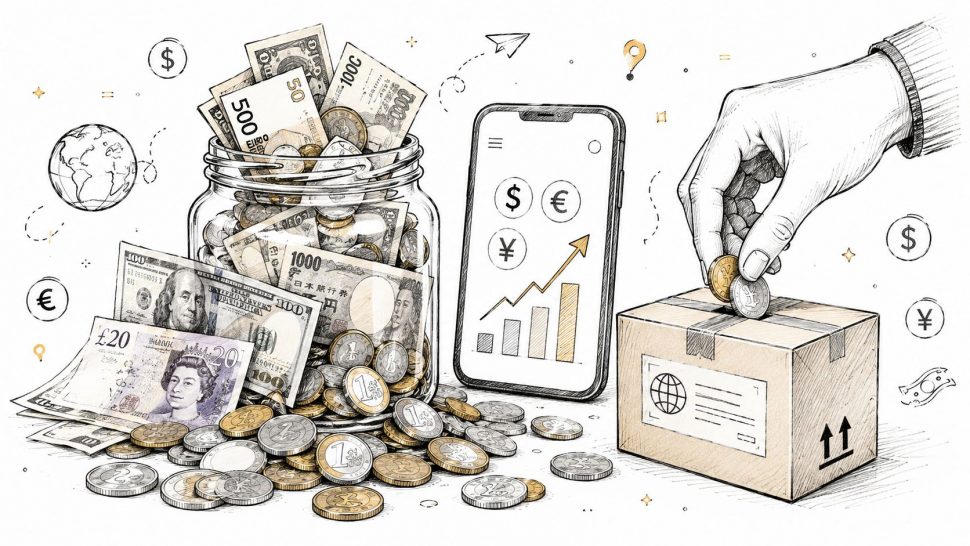
The simplest answer is this: if you’ve got leftover holiday money in a jar, a drawer, or an old travel wallet, the most practical route is usually a specialist online service that accepts coins, notes, and older currency types that banks and high street bureaux often won’t handle. That matters because the UK sits at the heart of the wider foreign exchange market, accounting for 38.1% of global foreign exchange turnover in the BIS 2022 survey, yet that enormous trading system is very different from the everyday problem of changing physical cash back into pounds (BIS market share figures summarised here).
Travelers often don’t think about foreign currency exchange trading until they come home with a mix of euros, dollars, coins from a stopover, and one odd old note they forgot to spend. Then the frustration starts. Your bank may take some notes but not coins. The airport desk may offer convenience, but not much flexibility. Old or withdrawn currency can feel especially confusing.
If that sounds familiar, you’re not dealing with a trading problem in the Wall Street sense. You’re dealing with a practical conversion problem. You want to know what still has value, where to exchange foreign coins and notes, and how to avoid wasting time sorting a pile of small change.
Your Guide to Leftover Foreign Currency
That little collection of leftover foreign currency often grows by accident. A few coins from Spain. A banknote from the US. Some pre-euro cash from a relative’s drawer. A handful of mixed coins from airport security trays and hotel change.
Individually, each piece may seem too minor to bother with. Together, they can become a surprisingly awkward problem because physical foreign money sits outside the systems typically used day to day.
The practical answer for most people
If you want to convert foreign coins and banknotes, the easiest route is usually a specialist service built for mixed and awkward currency. That’s especially true when your money includes:
- Coins from more than one country
- Small-value banknotes
- Withdrawn or obsolete currency
- Unsorted travel leftovers
- Older collections from family members
Practical rule: If your money isn’t clean, current, note-only travel cash, a specialist option is usually more realistic than a bank branch or walk-up bureau.
The phrase foreign currency exchange trading sounds technical because, in finance, it refers to the global market where currencies are bought and sold continuously. But most readers searching that term aren’t looking to speculate on sterling or learn chart patterns. They want to solve a simple household problem: how to exchange leftover currency without hassle.
Why this gets confusing so quickly
People usually run into the same points of friction:
- Banks handle limited formats. Some may only accept certain banknotes, often only for account holders.
- Coins are the sticking point. Even where notes are accepted, coins usually aren’t.
- Old money creates doubt. If a currency has changed design or been withdrawn, many people assume it’s worthless.
- Mixed bags feel hard to organise. Counting and sorting every denomination can feel like more trouble than the money is worth.
That’s why specialist services exist. They’re designed for the kind of currency people have after travel, not the idealised version. The useful question isn’t “How does the FX market work?” It’s “Can I exchange foreign coins and notes in one go, without wasting a Saturday afternoon?”
FX Trading vs Exchanging Your Holiday Money
You get home from a trip, empty your pockets, and tip a handful of coins and a few crumpled notes into a kitchen drawer. Months later, you search foreign currency exchange trading and land in a world of charts, rates, and trading jargon. That mismatch is the problem. You are trying to solve a very ordinary household task with a term borrowed from professional finance.

What foreign currency exchange trading usually means
In finance, foreign currency exchange trading refers to buying and selling currencies as prices move. It is a digital market used by banks, funds, businesses, and active traders. The goal is usually to manage risk or profit from changes in exchange rates.
That world works like a live auction running all day on screens. Prices move constantly. Orders are placed electronically. Speed matters.
Your leftover holiday cash is a different kind of job entirely.
Why physical travel money is not a trading problem
A jar of coins is not a position on a trading platform. Old notes from a family drawer are not part of a market strategy. They are physical items you already own, and your goal is simple. Turn them into usable value.
This is why trading language often creates more confusion than help. Terms such as spread, volatility, and market timing belong to people deciding when to buy or sell currency exposure. Someone holding leftover euros, dollars, or dirhams usually needs a service that accepts physical money and processes it fairly.
A practical comparison helps:
- FX trading is about price movement.
- Holiday money exchange is about recovering value from unused cash.
- Trading platforms are built for digital positions.
- Currency exchange services are built for notes, and in some cases coins and older issues.
The easiest way to tell the difference
Ask one question: Are you trying to predict currency prices, or are you trying to clear out leftover money?
If you are clearing out leftover money, you do not need charting software, market alerts, or a brokerage account. You need a provider that handles real-world currency, including the awkward stuff people bring home from trips.
That is also why comparing providers matters more than reading about trading strategies. A good foreign currency exchange comparison for UK customers helps you focus on what affects you directly, such as whether coins are accepted, whether old banknotes are allowed, and how the process works from start to finish.
What this means for a normal customer
Plenty of people use the phrase foreign currency exchange trading when what they really mean is, “How do I turn this leftover travel money into pounds?”
That is a sensible question. It deserves a practical answer.
If your money is sitting in a jar, envelope, or drawer, the useful next step is not learning how traders operate. It is choosing a service designed for physical foreign currency, especially if your bundle includes mixed coins, small notes, or older banknotes that ordinary exchange counters may refuse.
Comparing Your UK Currency Exchange Options
A jar of leftover euros, a few US dollars, some coins from Turkey, and an old note from a country that changed currency years ago all look like “travel money.” In practice, UK exchange options treat them very differently.
That is why this choice matters. The question is not merely where to exchange foreign currency. It is which provider is designed to handle the awkward mix people bring home.
UK foreign currency exchange options compared
| Feature | High Street Bank | Travel Money Bureau | Specialist Online Service |
|---|---|---|---|
| Current banknotes | Often limited, sometimes account-holder only | Commonly accepted for selected currencies | Commonly accepted across a wider mix |
| Foreign coins | Usually not accepted | Usually not accepted | Often accepted |
| Old or withdrawn currency | Rarely handled | Rarely handled | Often the main reason to use one |
| Mixed currencies in one batch | Usually inconvenient | Often restricted | Usually designed for it |
| Need to sort everything yourself | Often yes | Usually yes | Often no, depending on provider |
| Walk-in convenience | Good if accepted | Good if accepted | Postal rather than walk-in |
| Best for | Simple current notes | Immediate travel money tasks | Leftover foreign currency, coins, old notes |
Why so many providers say no
Banks and travel money counters are usually set up for straightforward transactions. They work best when a customer brings in current banknotes from a major currency and wants a quick exchange.
Coins are different. They are heavier to transport, slower to count, and often worth too little individually to justify the handling time. Old or withdrawn notes create another problem because the provider may need specialist routes to verify them or send them back through overseas banking channels.
A useful comparison is airport security versus a specialist repair shop. One is designed for speed and standard cases. The other is designed to deal with awkward items that need extra attention. Leftover holiday money, especially mixed coins and older notes, often falls into that second category.
Which option suits your situation
A high street bank or bureau can still work well if your situation is simple. For example, if you have a few current euro or dollar notes and want an in-person exchange, a local counter may be enough.
A specialist service is usually the better fit if your bundle includes the things standard providers tend to reject or limit, such as:
- Foreign coins
- Coins and notes packed together
- Older, withdrawn, or pre-euro currency
- Several currencies in one batch
- Money you would rather send once than sort in detail yourself
If that sounds familiar, a foreign currency exchange comparison for UK customers helps you check the practical differences between providers, including what they accept and how the process works.
Choosing the right option early saves the most frustration. If your money has been sitting in a drawer because every obvious route seems to exclude part of it, that usually points to a specialist service rather than another trip to the bank.
How to Convert Foreign Coins and Banknotes into Cash
The process is usually much simpler than people expect. Most hesitation comes from uncertainty, not complexity. People worry they’ll need to count every coin, identify every issue date, or know whether a note is still current.
In practice, specialist exchange is built around the fact that ordinary customers often don’t know those details.

A simple step by step process
-
Gather everything in one place
Empty the travel wallet, the kitchen drawer, the coat pocket, and the old keepsake box. Include coins, notes, and older foreign currency you’ve been meaning to check. -
Get a quote online
A specialist service will normally let you identify your currencies, or estimate by type and weight if the money is mixed and unsorted. Doing so makes the process far easier than trying branch after branch. -
Pack the currency securely
Use the provider’s instructions. The aim is to keep the package tidy, protected, and easy to verify on arrival. There’s no need to make the parcel look fancy. It just needs to be sensible and secure. -
Send it using a tracked postal method
Tracked delivery gives you a record of dispatch and delivery. That matters with any item of value, including physical currency. -
Receive payment or donate the proceeds
After verification, the provider pays out according to its process. Some also offer the option to donate the value to charity instead.
Where people often overthink it
You usually don’t need to do all of the following:
- Perfectly sort every denomination
- Research every withdrawn design yourself
- Split one batch into separate country piles
- Discard low-value coins as “not worth it”
- Assume mixed currency can’t be processed
That’s why specialist services are used not only by travellers, but also by charities and businesses that end up with assorted foreign cash from donation points, tills, or collection pots.
A few packing tips that help
Pack notes flat where possible, keep coins contained, and follow the provider’s instructions rather than inventing your own system.
A straightforward checklist helps:
- Check for obvious non-currency items such as buttons, tokens, or receipts.
- Keep different loose groups together if that’s easy, but don’t turn the job into an audit.
- Use tracked post so you can follow the parcel.
- Keep your quote confirmation until payment is complete.
If your goal is to exchange leftover currency with the least friction, the best process is usually the one that removes sorting and branch visits from the equation.
Common Risks and Mistakes to Avoid
Some risks sit in the trading world. Others affect people with nothing more dramatic than a pot of change from past trips. Both are worth understanding, because confusion around “forex” often mixes them together.

Trading scams and social media promises
If someone messages you about forex profits, guaranteed returns, or exclusive signals, treat that as a warning sign, not an opportunity. The CFTC warns that many forex scams begin on social media and move to private messaging apps such as WhatsApp or Telegram, often with promises of guaranteed high returns and pressure to act quickly or pay for “exclusive” signals (consumer warning from the CFTC).
That has nothing to do with safely converting holiday cash. But the terminology overlap causes people to lower their guard.
Everyday mistakes with physical foreign money
The more common losses are quieter and far more ordinary.
-
Leaving it for years without checking
People often assume they can deal with it later. The longer money sits around, the more likely it is that designs change, notes are withdrawn, or the amount gets forgotten. -
Accepting the first convenient option
Airport counters and last-minute exchanges feel easy, but convenience isn’t the same as suitability, especially for mixed or low-value cash. -
Throwing away coins
Many people assume coins can’t be exchanged anywhere in the UK. Standard providers often won’t take them, but specialist routes exist for those who want to exchange foreign coins. -
Assuming old notes are worthless
Some are. Some aren’t. The mistake is assuming before checking.
The expensive part is often not a visible fee. It’s the value people give up because they decide the money is “probably useless” and stop there.
One more practical caution
Keep the problem simple. If your aim is to convert physical cash into pounds, don’t get drawn into speculation, trading apps, or anyone selling excitement. Leftover holiday money is an admin problem. Solve it with a practical process.
From Clutter to Cash or Charity
A mixed pile of foreign money doesn’t have to stay as clutter. For many people, the best outcome is turning it into something useful at last.
One common scenario is the frequent traveller who has built up a small but messy collection over the years. Not enough of any one currency to bother with at a bureau. Too many coins for a bank. Too annoying to sort. A specialist exchange route fits that exact situation because it treats the bundle as a real asset, not an inconvenience.
Another is the community fundraiser or local organisation with a tin full of coins and notes from holidays abroad. That money often sits untouched because nobody wants to sort it by hand or argue with branch staff about what’s accepted.

When donating makes more sense
Sometimes you don’t want the money back yourself. You just want the leftover value to do some good.
That’s where the option to donate foreign coins to charity becomes especially useful. It gives purpose to money that would otherwise remain forgotten in a bowl or be thrown away during a clear-out.
Good uses for old travel money
- Clear household clutter and turn it into cash
- Support a charity with money you won’t use again
- Process donation tins collected by schools, groups, or shops
- Deal with inherited foreign currency without trying to research every piece yourself
The nicest part is that even awkward leftover foreign currency can still become something practical, whether that’s pounds in your account or a donation made with money you’d otherwise never touch again.
Frequently Asked Questions
Can you actually exchange foreign coins in the UK?
Yes, but usually not through ordinary banks or typical travel money counters. Coins are the part most mainstream providers avoid, so specialist services are often the practical option.
Why won’t my bank or the Post Office take foreign coins?
Coins are costly and awkward to process. They’re bulky, low-value, and harder to handle operationally than notes. That’s why many mainstream providers restrict what they accept.
Can I exchange foreign coins and notes together?
Often, yes, through a specialist service. That’s one of the main advantages if you have a mixed collection from several trips.
Is old or withdrawn currency always worthless?
No. Some old or withdrawn currency may still hold exchange value through specialist channels. The key point is to check before assuming it’s useless.
Do I need to sort and count everything first?
Not always. Many people think they must organise every coin and note before sending anything off. Some specialist services are built specifically for unsorted or mixed currency.
Is it safe to send currency in the post?
It can be, if you follow the provider’s instructions and use a tracked postal method. The sensible approach is the same as sending any item of value. Pack securely, keep records, and use tracking.
How do I know whether the rate is fair?
Look for clarity before sending. A trustworthy service should explain its process and show you the exchange value in a way that’s easy to understand, rather than relying on vague promises.
How long does payment usually take?
It depends on the provider’s process. Some specialist services pay after the currency is received and verified. Check the service terms before posting so you know what to expect.
Can I donate leftover foreign currency instead of cashing it in?
Yes. Some services allow you to convert the value into a charity donation, which is especially useful for low-value coins, mixed holiday money, or collection tins.
If you’re tired of keeping a jar of unusable travel money around the house, We Buy All Currency offers a straightforward way to exchange foreign coins, notes, and withdrawn currency without the usual hassle. It’s designed for the money banks and bureaux often won’t take, and it gives you a clear route to convert foreign coins and banknotes into cash, or turn them into a charity donation instead.