
German currency before the euro: From Deutsche Mark to Reichsmark explained
Posted by: Ian Stainton • 31 Dec 2025
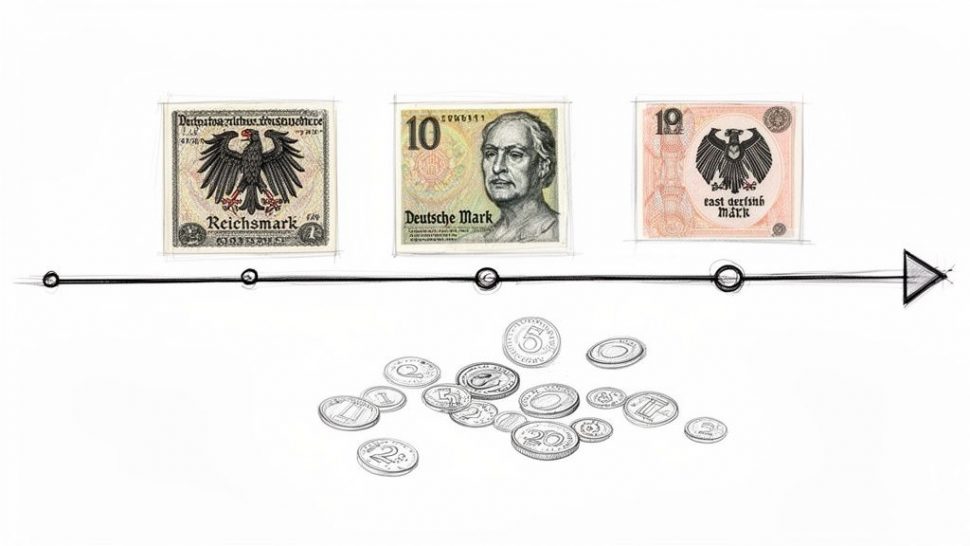
Before the euro, Germany's official currency was the Deutsche Mark. You'll often see it abbreviated as DM. For over half a century, this sturdy currency was a powerful symbol of the nation’s post-war economic recovery and stability before it took its final bow.
Uncovering Germany's Pre-Euro Currency
Ever found a handful of unfamiliar coins or notes while clearing out a drawer? Or maybe while sorting through items you’ve inherited? You might just be holding onto a piece of history—the German Deutsche Mark. For many, this currency is a tangible link to Germany's "Wirtschaftswunder," or economic miracle, representing a period of incredible growth and stability.
Working out what you have is the first step. Realising it could still be valuable is even better. Our fast, easy, and hassle-free service helps you do just that.
This is the classic logo for the Deutsche Mark, instantly recognisable to anyone who used the currency.
The strong, clean design perfectly reflects the currency's global reputation for reliability.
To give you a clearer picture, here’s a quick summary of the Deutsche Mark.
The Deutsche Mark At A Glance
| Attribute | Details |
|---|---|
| Full Name | Deutsche Mark |
| Abbreviation | DM |
| Introduced | 1948 |
| Replaced By | Euro (€) |
| Final Circulation | 2002 |
| Symbolism | Economic stability, "Wirtschaftswunder" (economic miracle) |
| Euro Conversion Rate | 1.95583 DM = €1 |
It was a currency that truly defined an era for Germany before the country joined the single European currency.
From Deutsche Mark To Euro
The switch from the Deutsche Mark to the euro wasn't an overnight affair; it was a carefully planned process. The DM had maintained incredible stability throughout its 54-year history, right from its introduction in 1948 until its replacement.
When Germany officially adopted the euro, the exchange rate was permanently locked in. You can learn more about how pre-euro currencies were valued, but for Germany, the rate was fixed at 1.95583 Deutsche Marks to one euro.
Here’s a quick rundown of the key dates:
- Official Euro Adoption: 1st January 1999 (but only for electronic transactions at first).
- Euro Banknotes & Coins Enter Circulation: 1st January 2002.
- Dual Circulation Period: For a short time, Germans could use both Deutsche Marks and euros for payments until late February 2002.
After that point, the Deutsche Mark was no longer legal tender. This left a lot of people holding onto leftover currency, unsure what to do with it.
Key Insight: Even though the Deutsche Mark is now obsolete, it hasn't lost all its value. Those old coins and notes can still be converted into cash, offering a surprising return on what might seem like forgotten money.
What Does This Mean For Your Old Currency?
If you have old German coins and banknotes, you’ve got a valuable asset on your hands. The great news is you don't need to be an expert to unlock its worth. Our service is designed to be fast, easy, and completely hassle-free—no need to spend hours sorting through piles of coins or trying to identify every single note yourself.
We offer a 100% guaranteed service to exchange foreign coins and notes, turning that obsolete currency into cash you can actually use. We're trusted by major UK brands, including national charities, supermarkets, airports, and police forces, who all rely on our professional and credible process. Whether it’s leftover holiday money or a collection of old European currency, we make it simple to convert foreign coins and banknotes.
Ready to find out what your old currency is worth? Visit our homepage for a fast, free, and no-obligation quote today.
A Journey Through Germany's Monetary Past
When you think of German currency before the Euro, the Deutsche Mark probably springs to mind. It was a powerhouse, a symbol of stability. But Germany's monetary history is far more dramatic than just one currency. It's a story of empires, devastating hyperinflation, and the immense social fallout from two world wars.
Before the Deutsche Mark, Germany cycled through several currencies that perfectly mirrored its turbulent times. The German Empire’s Goldmark gave way to the Weimar Republic's Papiermark, a currency now infamous for the catastrophic hyperinflation of the early 1920s. After that came the Reichsmark, which saw the country through the Great Depression and the Nazi era.
Each of these currencies tells a piece of the story, and the old notes and coins are tangible bits of history you can hold in your hand.
The Aftermath Of War And A New Beginning
The end of World War II left Germany’s economy completely shattered. The Reichsmark was virtually worthless, decimated by inflation and the collapse of the country’s infrastructure. Trust in official money had completely evaporated, which led to a fascinating, grassroots solution.
Out of the devastation, Germans created the Zigarettenwährung (cigarette currency). For a time, cigarettes became the most reliable medium of exchange. This informal system is a stark reminder of how people create their own forms of value when official currency fails. It wasn't until the pivotal currency reform on 20 June 1948, that a new chapter began. West Germany introduced the Deutsche Mark, issuing every citizen an initial DM 60 to kickstart the new economy.
Real-World Insight: The 'cigarette currency' is a powerful example of how value is based on trust and utility. When the official Reichsmark failed, people turned to something they could universally trade and rely on, demonstrating that currency is only as strong as the faith people have in it.
This bold move wiped the financial slate clean. It paved the way for Germany's incredible post-war recovery, often called the Wirtschaftswunder or economic miracle.
This visual timeline shows the journey from the Deutsche Mark's introduction to the arrival of the Euro.
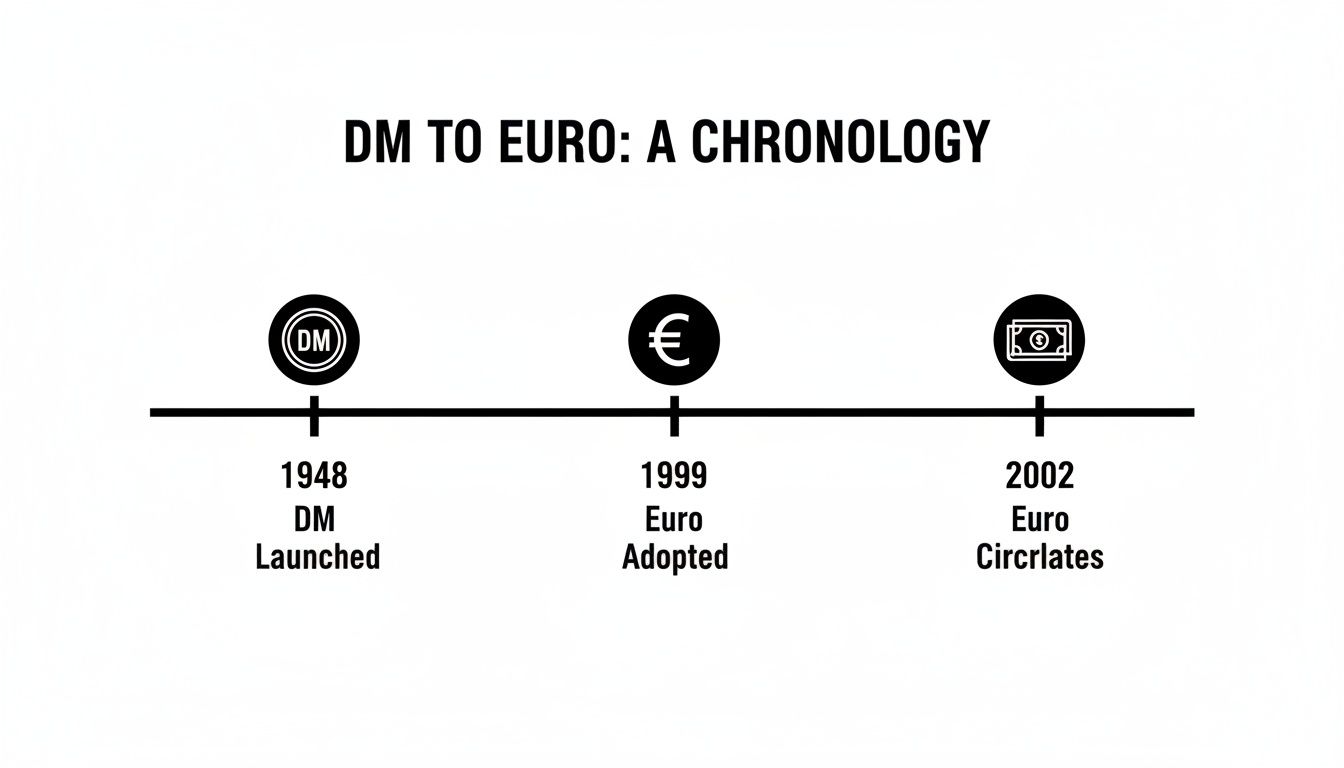
As you can see, the Deutsche Mark had a long and stable reign for over 50 years before the carefully managed switch to the Euro.
What This History Means For Your Old Currency
Knowing this rich backstory adds a whole new dimension to any old German notes or coins you might have. They aren't just leftover holiday money; they're pieces of a complex and compelling story of economic collapse and rebirth. Whether you have Reichsmarks from a turbulent past or Deutsche Marks from an era of prosperity, each one has a tale to tell. We've actually put together a comprehensive guide on the many different currencies before the Euro which you might find interesting.
The best part? You don’t need to be a historian to unlock their value. Our service makes it incredibly easy to exchange foreign coins and notes.
- Fast and Easy Process: We've designed our service to be completely hassle-free.
- No Sorting Needed: Don't worry about separating different denominations or currencies. Just send it all to us.
- 100% Guaranteed Service: We promise a transparent and reliable exchange, turning your old money into usable cash.
We are trusted by major brands, including charities, supermarkets, airports, and even police forces, who rely on our credible service to convert foreign coins and banknotes. From leftover holiday money to inherited collections, we provide a simple way to give your old currency a new life. You can even choose to donate foreign coins to charity through our platform.
How To Identify Your Old German Currency
Ever found a stash of old foreign money, maybe tucked away in a drawer or an old travel wallet? It’s a common discovery, and that jumble of unfamiliar notes and coins often includes the German currency that came before the euro: the Deutsche Mark. Learning to spot what you have is a fantastic glimpse into a country's history.
While it's fascinating to figure out what you're holding, the best part about our service is its sheer simplicity. We make the process fast, easy, and completely hassle-free—that’s a 100% guarantee. You don’t even need to worry about sorting through it all; just send us your collection, and our experts will handle the entire identification and valuation for you.
A Visual Guide to Deutsche Mark Banknotes
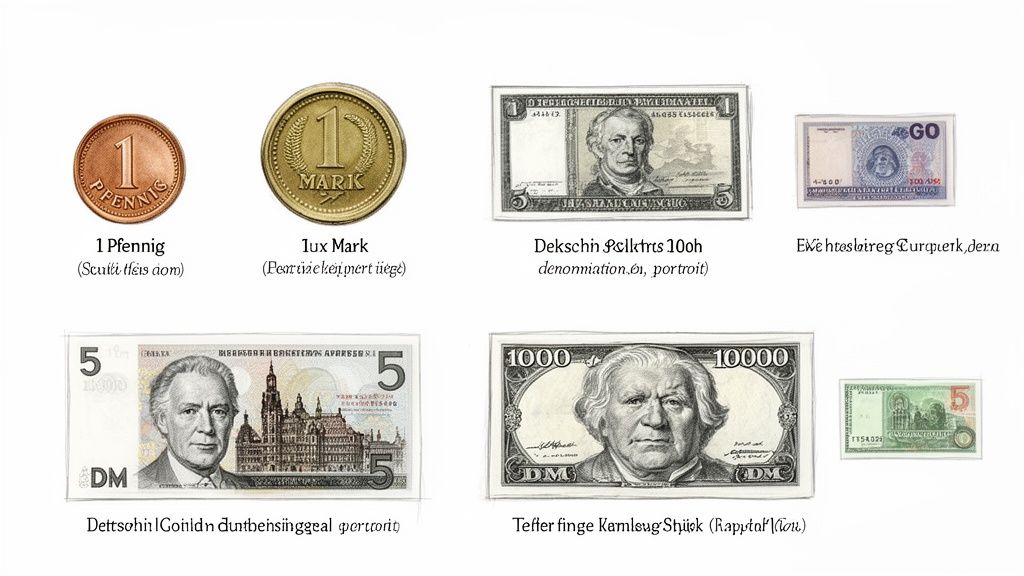
The banknotes you're most likely to find are from the final series of Deutsche Marks, issued from 1989 onwards. They're well-known for their colourful designs, which feature prominent figures from Germany's rich artistic and scientific history.
Here’s a quick rundown of what to look for on the most common denominations:
- 10 DM Note: This vibrant blue and violet note features the portrait of Carl Friedrich Gauss, a brilliant mathematician, alongside a graphic of the Gaussian distribution curve.
- 20 DM Note: A greenish-blue note showcasing the writer Annette von Droste-Hülshoff, one of Germany’s most important female poets.
- 50 DM Note: You can't miss its yellowish-brown hue. This one honours Balthasar Neumann, a famous Baroque and Rococo architect, with images of his architectural plans.
- 100 DM Note: As the most widely circulated banknote, this dark blue note features the pianist and composer Clara Schumann.
You might also spot higher denominations like the 200, 500, and 1000 DM notes, but they are much less common. Each one is a small piece of German culture, celebrating the country's intellectual heritage. To see more examples, check out our visual guide to old coins from Germany.
Identifying Deutsche Mark and Pfennig Coins
The coins are just as distinctive. The Deutsche Mark was divided into 100 Pfennig, and the coins themselves featured simple yet iconic German symbols.
- Pfennig Coins (1, 2, 5, 10, 50): Made from copper or nickel alloys, these smaller coins typically feature an oak leaf or an oak sapling—a traditional German symbol of stability and endurance.
- Mark Coins (1, 2, 5 DM): These larger coins are made of cupronickel. The 1 and 2 DM coins display the German eagle, which is the national coat of arms, while the 5 DM coin has a more stylised version of the eagle.
Helpful Tip: Have a look for the mint mark on your coins. It’s a tiny letter (A, D, F, G, or J) that tells you which of the five German mints produced it. While this detail rarely affects its exchange value, it’s a neat bit of trivia for collectors.
What About East German Marks?
There's a chance you might also have currency from the former German Democratic Republic (GDR), known as the East German Mark. These notes and coins often have a more socialist-realist design, featuring idealised images of workers, farmers, or landmarks like the Brandenburg Gate on later series. They look quite different from their West German counterparts and are another form of obsolete currency we can help you with.
Ultimately, whether you've got West German Deutsche Marks, East German Marks, or a whole mix of leftover foreign currency, our service is designed to make things easy for you. We’re trusted by major brands, including national charities, supermarkets, airports, and even police forces, to exchange foreign coins and notes. You can also donate foreign coins to charity directly through our platform.
Ready to see what your forgotten currency is worth? Head over to our homepage to start the simple process of turning that old money into cash.
Is Your Old Currency A Collector's Item Or Just Cash?
When you stumble across old German currency, it’s easy to get excited. Have you just found a rare treasure, or is that handful of Deutsche Marks simply worth its old face value? This is the big question for anyone holding onto obsolete money, and the answer decides the best way to get your cash back.
For a note or coin to be a true collector’s item, it needs to be special. Its value goes way beyond the number printed on it, driven instead by rarity and how much a collector is willing to pay. A few key things can turn a simple piece of cash into a sought-after collectible.
What Makes Old Currency Valuable to Collectors?
The world of coin and note collecting—numismatics—is a niche one, where certain features can make an item’s value skyrocket. It's fascinating, but it’s important to remember that most of the currency tucked away in drawers or old travel wallets won't have these rare qualities.
Here’s what collectors are hunting for:
- Mint Condition: A crisp, uncirculated banknote or a shiny, unscratched coin is always more desirable than one showing the wear and tear of daily life.
- Low Circulation Numbers: Some denominations or specific print runs were produced in much smaller quantities, making them naturally harder to find today.
- Printing Errors: Mistakes during production are a collector's dream. Things like misprints, off-centre designs, or the wrong colours can make a note or coin exceptionally rare.
- Historical Significance: Currency from a pivotal moment in history or from a very short-lived series can also attract a lot of interest.
Trying to navigate this market takes real expertise. Values can swing wildly, and it usually involves tracking down specialist dealers, paying for appraisals, and then waiting for the right buyer to come along. It’s definitely not a quick or easy process.
The Realistic Value of Your Leftover Currency
While we all hope to find that one rare note, the truth is that the vast majority of old currency, including most German currency from before the euro, doesn't have any special collector value. For most people, the real, guaranteed worth of their leftover foreign currency is its exchange value.
Our Promise to You: We offer a practical, no-fuss way to convert your old currency into money you can actually use. Our service is built on being upfront and honest, providing a 100% guaranteed exchange based on the currency's real value, not on risky collector speculation.
Think of it this way: selling to a collector is a bit of a gamble, but exchanging your currency with us is a sure thing. Our process is designed to be completely hassle-free. You don’t need to sort through coins, identify different notes, or worry about their condition. We handle all of that for you.
This simple, direct approach is why we’re trusted by major UK organisations, from well-known charities and national supermarkets to airports and even police forces. They rely on us for a credible and professional service to exchange foreign coins and notes.
If you're ready to convert foreign coins and banknotes without the headache of the collector's market, our service is the perfect fit. We make it easy to get paid for your old money. For a fast and simple way to see what your currency is worth, visit our homepage and get started today.
How To Exchange Old German Currency The Easy Way
So, you’ve found some German currency from before the euro tucked away in a drawer. The big question is, what can you do with it? Turning those old Deutsche Marks into cash you can actually spend is often a real hassle, but that’s where we come in. Our service is built to be fast, simple, and completely straightforward.
Forget the tedious job of sorting through piles of old coins or trying to identify every single banknote. Whether you have a few Pfennigs or a mixed bag of notes, you can send it all to us just as you found it.
Our simple mail-in process is designed to be accessible to everyone in the UK, taking all the usual stress out of the equation.
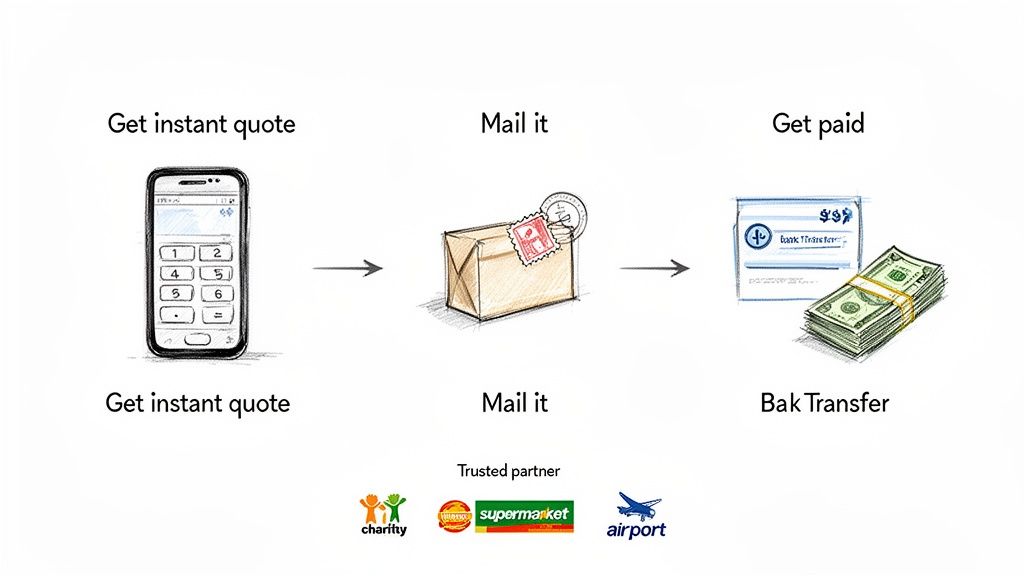
As you can see, it’s a simple journey in three steps: get a quote, post your currency, and get paid. It’s an open and honest way to turn obsolete money into usable cash.
A Simple, Guaranteed Process
We believe that to exchange foreign coins and notes should never be complicated. Our entire system is designed around that idea, ensuring you have a smooth and transparent experience from the moment you visit our website to the moment the money is in your account.
Here’s a quick look at how it works:
- Get Your Free Quote: First, pop over to our homepage and use the online calculator. It gives you an instant, no-obligation valuation so you know exactly what your currency is worth.
- Mail Us Your Currency: Next, just package up all your leftover foreign currency—no need to sort anything! We accept a massive range of coins and notes, including Deutsche Marks and plenty of other obsolete currencies.
- Get Paid Quickly: As soon as we receive and check your currency, we process your payment. It really is that simple. And for your peace of mind, we back it all with a 100% satisfaction guarantee.
We understand that sending money through the post requires a great deal of trust. Our service is built on reliability and transparency, so you can feel completely confident at every stage. We're committed to clear communication and a professional experience from start to finish.
Why Trust Us With Your Old Currency?
Trust is everything, especially when it comes to money. We’ve spent years building a solid reputation for being credible and reliable, and we’re proud to be the chosen partner for many of the UK's most recognised organisations. Our service is trusted by national supermarkets, airports, well-known charities, and even police forces.
These partnerships speak volumes about our professional and secure process. They count on us to convert foreign coins and banknotes honestly and efficiently, and we bring that exact same level of commitment to every customer, no matter the amount. We also provide a way to donate foreign coins to charity, turning forgotten cash into a meaningful contribution.
Not sure what your best option is? Here’s a quick comparison of the different ways you can deal with old German currency.
Exchanging Old Currency: Your Options Compared
| Method | Effort Required | Guaranteed Value? | Best For |
|---|---|---|---|
| We Buy All Currency | Low – just package and post. | Yes, based on our quote. | Anyone wanting a fast, hassle-free way to cash in on obsolete notes and coins. |
| Collector Shops/Dealers | High – requires research and negotiation. | No, value depends on rarity and condition. | People with rare or pristine-condition items who enjoy the collecting hobby. |
| Online Marketplaces (e.g., eBay) | High – need to photograph, list, and ship items individually. | No, value is subject to bidding and market demand. | Sellers who are comfortable with online platforms and managing individual sales. |
| Keeping as a Souvenir | None. | No monetary value. | Those who value the sentimental or historical aspect of the currency. |
Ultimately, our service is designed for people who just want to unlock the cash value of their old currency without any fuss.
We Make It Easy to Exchange Foreign Coins
Let’s be honest, old coins are often the biggest headache. They’re heavy, a pain to identify, and high-street banks won’t give them a second look. This is where our service really shines. Our hassle-free approach means you never have to worry about sorting them.
Just gather up all your leftover holiday money and obsolete currency, and let us do the heavy lifting. This unique benefit saves you a huge amount of time and effort, making it easier than ever to unlock the value in your old money. For a more detailed look, you can find out more about exchanging Germany’s old currency on our dedicated page.
Ready to see how simple it can be? Visit our homepage to get your instant quote and take the first step toward turning that old currency into new cash today.
Have Questions About Your Old German Currency?
We get a lot of questions about exchanging old German currency, and it's easy to see why. If you've found a stash of Deutsche Marks, you're probably wondering what to do next. Here are the answers to the questions we hear most often, showing you just how simple it is to turn that old money into cash.
Can I Still Exchange Deutsche Marks at a Bank?
Technically, yes, but there's a catch. Germany's central bank, the Deutsche Bundesbank, does still offer an exchange service, but this is really only practical if you live in Germany. For anyone in the UK, it’s a non-starter.
That's where our postal service comes in. It’s the perfect alternative for UK residents, giving you a fast and easy way to exchange foreign coins right from your own home. No flights to Frankfurt needed!
Do I Have to Sort My Coins and Notes Before Sending Them?
Absolutely not. We pride ourselves on offering a hassle-free service, and a big part of that promise is taking all the tedious work off your hands.
Just gather up all your unsorted leftover foreign currency—notes and coins all mixed together are fine—and pop them in a package. We’ll handle the sorting, counting, and everything else. It's why major national charities, airports, supermarkets, and even police forces trust us with their currency.
Our service is 100% guaranteed. You don’t need to be a currency expert or spend hours sifting through old coins. We make converting foreign coins and banknotes as simple as possible.
What Other Old European Currencies Can I Exchange?
We accept a huge range of obsolete pre-euro currencies, not just German Deutsche Marks. This is a great chance to finally clear out any of those old Spanish Pesetas, French Francs, or Italian Lira you might have tucked away.
You can send them all in one package, which makes it incredibly convenient to exchange foreign coins and notes from several different countries at once.
How Do I Know I’m Getting a Fair Exchange Rate?
Trust and transparency are at the heart of everything we do. We want you to feel completely confident in our service. That's why our online calculator gives you an immediate quote, so you’ll know what to expect before you even send us your currency.
We also back our service with a 100% satisfaction guarantee, ensuring you have complete peace of mind throughout the entire process.
Ready to unlock the value hidden in your old currency? We Buy All Currency offers a fast, easy, and secure way to get paid for your forgotten money. Visit https://www.webuyallcurrency.com to get your free quote today.