
German Currency Pre Euro Your Guide to Exchanging Old Deutsche Marks
Posted by: Ian Stainton • 28 Dec 2025
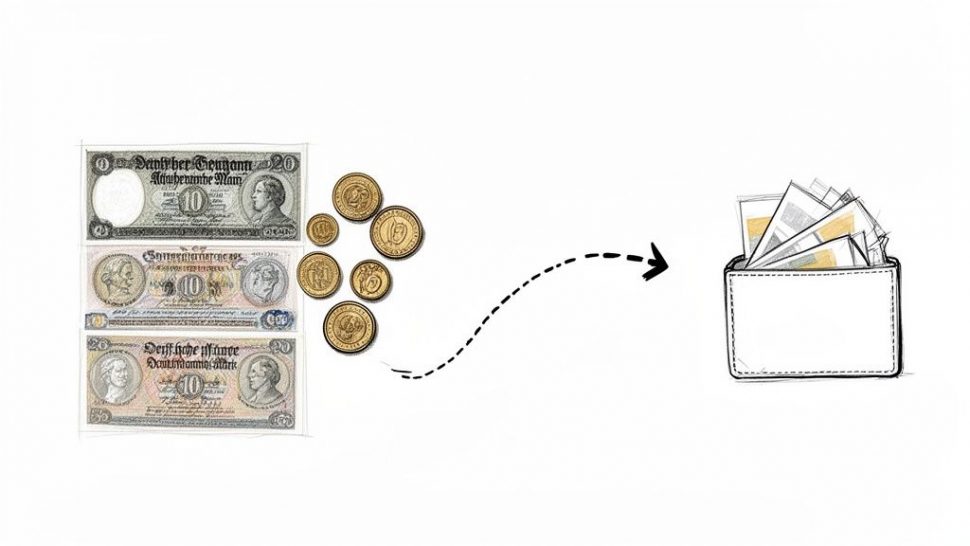
Found a stash of old German currency from before the euro? You might be wondering if it's just a souvenir or something more. The great news is those old Deutsche Mark banknotes and Pfennig coins still have real monetary value and can be exchanged for cash.
Your Guide to Exchanging Old German Currency
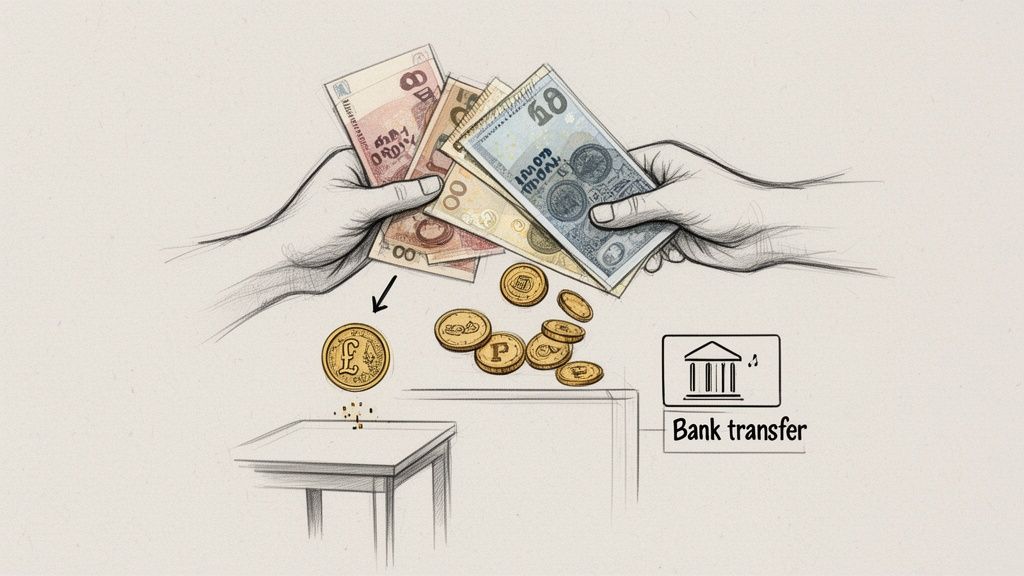
Finding forgotten travel money is more common than you’d think. That little collection of Deutsche Marks from a trip to Berlin or the coins inherited from a relative can be put to good use. While you can't just walk into a high street bank to swap them anymore, specialist services offer a straightforward way to unlock their value.
Why Exchange Your Leftover German Currency?
The Deutsche Mark was one of the world's most stable currencies before the Euro took its place in 2002. Thanks to this strength and Germany's ongoing policy, the old notes and coins are still exchangeable. So, instead of letting this obsolete currency gather dust in a drawer, you can easily convert it into spendable money. For many, this sounds like a complicated process, but our service makes it incredibly simple.
Our service is designed to be completely fast, easy, and hassle-free. We aim to get rid of all the usual headaches you might face when trying to exchange old foreign coins and notes.
We are trusted by major brands, including well-known charities, supermarkets, airports, and even police forces, to handle their foreign currency exchange needs. This trust is built on our reliability and a commitment to making the experience seamless.
A Simple and Guaranteed Process
We know you don't have the time to sit there identifying and categorising every single coin or banknote. That’s why our process is so simple: no need to sort coins. Just gather up all your leftover foreign currency, and we'll take care of the rest. Our service is 100% guaranteed, ensuring you receive a fair value for your collection without any of the fuss.
This approach is perfect for individuals with leftover holiday money, but it's also a fantastic tool for charities looking to turn collections into funds. A common and effective fundraising method is to donate foreign coins to charity. To learn more about what you can do with various old coins, check out our guide on what to do with old foreign coins.
In the next sections, we’ll dive into the history of the Deutsche Mark, show you how to identify the currency you have, and give you clear steps to start your exchange.
The Story of the Deutsche Mark
To understand why that old German currency in your drawer is still worth something, it helps to know a bit about its incredible history. The Deutsche Mark, or DM as it was known, wasn't just money. For Germany, it was a powerful symbol of recovery and strength, which explains why it became so trusted across the globe and why it’s still valuable today.
The Deutsche Mark first appeared in West Germany in 1948. It replaced the old Reichsmark, a currency that had become almost worthless due to hyperinflation after the Second World War. This move was a fresh start, paving the way for what became known as the Wirtschaftswunder—the German economic miracle.
A Symbol of Stability and Strength
For decades, the Deutsche Mark stood as one of the world's most stable and respected currencies. It was a familiar sight for millions of Brits heading to Germany for holidays or business, and a financial benchmark that other countries admired. This strength was no accident; it was built on very disciplined monetary policy.
The German central bank, the Bundesbank, was fiercely independent and obsessed with keeping inflation low. Because of this, the Deutsche Mark held its value exceptionally well, earning it a reputation for reliability far beyond Germany’s borders.
The German Deutsche Mark was a cornerstone of European stability, influencing everything from exchange trading to holiday money for decades. Thanks to the Bundesbank's strict policies, inflation averaged just 2.5% annually in the 1980s—a remarkably low figure compared to higher rates elsewhere. You can discover more insights about pre-euro currencies on IG.com.
It’s this rock-solid reputation that explains why the currency has retained its value. Unlike so many other old currencies that became worthless overnight, the Deutsche Mark’s legacy ensures it can still be converted into cash.
The Deutsche Mark in Everyday Life
The currency system was simple: 100 Pfennig made up 1 Mark. This will feel familiar to anyone who remembers Britain's pre-decimal money. The notes and coins themselves were like miniature works of art, featuring important figures from German history, science, and culture.
- Banknotes: Featured portraits of people like the Brothers Grimm and architect Balthasar Neumann.
- Coins: Pfennig coins often had simple, recognisable symbols like an oak leaf.
This isn’t just a history lesson; it's the foundation of the currency's lasting worth. The stability and trust baked into the Deutsche Mark are what give it value today.
From the Mark to the Euro: A Seamless Transition
When Germany switched to the Euro in 2002, the changeover was handled brilliantly. The Deutsche Mark was phased out, but the German government made a promise: old DM notes and coins could be exchanged indefinitely. That commitment is why, all these years later, your leftover foreign currency from a trip to Berlin or a business conference in Munich can still be turned into cash.
This smooth transition was a fitting end for a currency known for its dependability. It wasn’t just abandoned; it was honourably retired, with its value protected for the future.
This historical strength is exactly what makes our service possible. We offer a fast, easy, and hassle-free way to convert your forgotten Deutsche Marks. We’re trusted by major brands, including national charities, supermarkets, and police forces, so you can be confident in our 100% guaranteed process. There’s no need to sort through your old coins and notes; just gather them up and let us turn that rich history into real cash for you. Ready to get started? Visit our homepage to begin your exchange.
Identifying Your Old German Coins and Banknotes
Found a stash of old German money and wondering what you've got? Before the euro came along, Germany used the Deutsche Mark (DM) and its smaller Pfennig coins. The designs are quite distinctive, and it's easy to get a feel for what you're holding once you know the basics.
Of course, you don't need to become a currency expert to cash in. Our service is designed to be completely hassle-free. There’s no need to sort coins, so you won't spend hours trying to identify them; we handle all the valuation for you. It's the simplest way to convert foreign coins and banknotes into cash.
A Visual Guide to Common Banknotes
The last series of Deutsche Mark banknotes, used right up until 2002, featured some of Germany's most important cultural and scientific figures. Each note had a unique colour and portrait, making them easy to tell apart at a glance.
- 10 DM Note: This note had a blue-green colour and featured the brilliant mathematician and astronomer, Carl Friedrich Gauss.
- 20 DM Note: You can spot this one by its lilac hues. It depicted the celebrated writer Annette von Droste-Hülshoff.
- 50 DM Note: A warm, brownish-yellow note featuring the architect Balthasar Neumann, famous for his incredible Baroque designs.
- 100 DM Note: One of the most common notes in circulation, the dark blue 100 DM note showcased the pianist and composer Clara Schumann.
While these were the everyday notes, you might also come across 5, 200, 500, or even 1000 DM notes. No matter what you have, our 100% guaranteed service ensures you get value for every single one. If you think you might have something much older, you can learn more about antique German currency in our detailed guide.
To give you a quick reference, here are the most common Deutsche Mark and Pfennig denominations you're likely to find.
Common Pre-Euro German Currency Denominations
| Denomination | Type | Key Feature/Portrait | Years of Issue (Common) |
|---|---|---|---|
| 1, 2, 5 Pfennig | Coin | Copper-plated steel, oak leaf motif | 1949-2001 |
| 10, 50 Pfennig | Coin | Brass-plated steel, oak leaf motif | 1949-2001 |
| 1, 2, 5 Mark | Coin | Cupronickel, German eagle | 1950-2001 |
| 10 DM | Banknote | Carl Friedrich Gauss | 1991-2001 |
| 20 DM | Banknote | Annette von Droste-Hülshoff | 1991-2001 |
| 50 DM | Banknote | Balthasar Neumann | 1991-2001 |
| 100 DM | Banknote | Clara Schumann | 1990-2001 |
This table covers the currency most people have tucked away in drawers, but don't worry if yours looks different—we accept them all.
Recognising Pfennig Coins
The coins that went with the notes were the Pfennig, where 100 Pfennig equalled one Deutsche Mark. These were your everyday, practical coins, with simple yet memorable designs.
The smaller coins (1, 2, and 5 Pfennig) were made of copper-plated steel, which gave them a reddish look. The 10 and 50 Pfennig coins had more of a brassy, golden colour. A key symbol to look for on many of these is the oak leaf, a classic German emblem. The larger 1, 2, and 5 Mark coins were silver in colour and usually featured the German eagle.
This flowchart shows the journey of the Deutsche Mark, from its creation to becoming a symbol of economic strength.
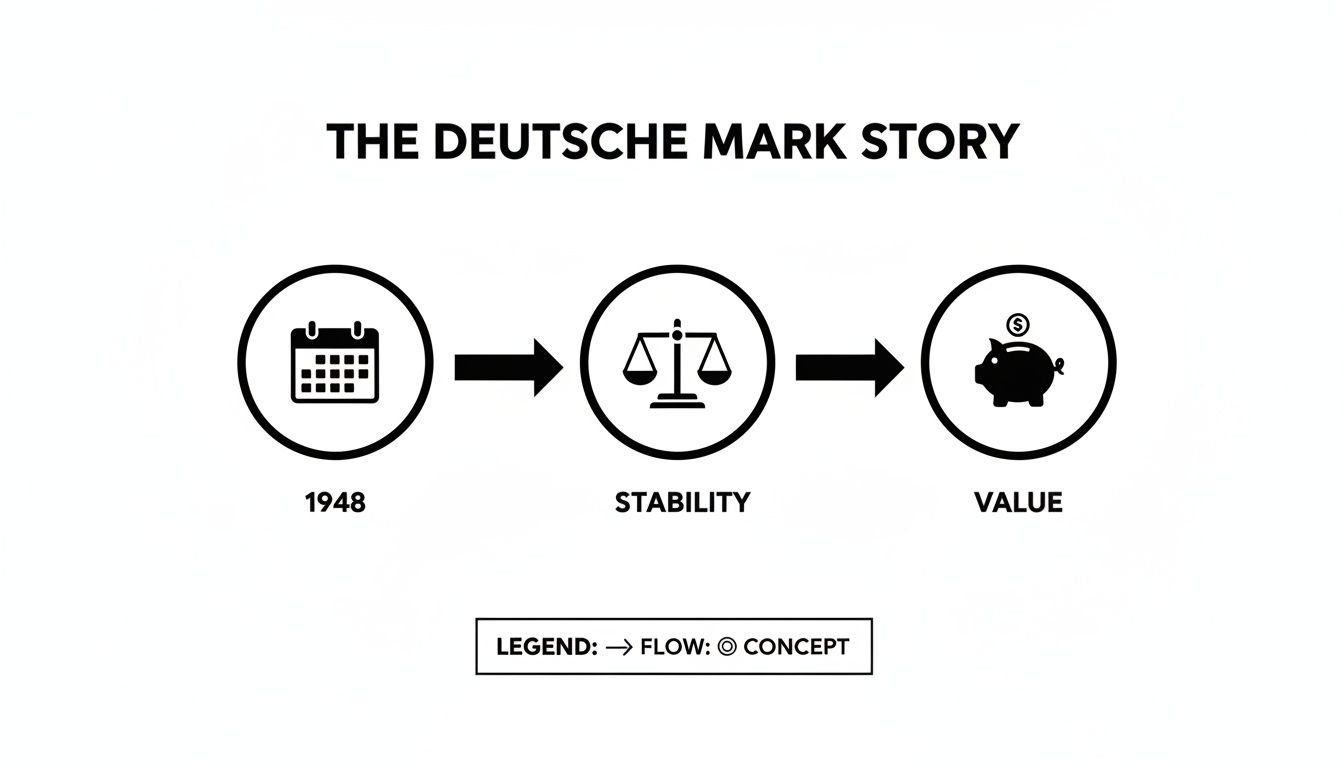
It’s this history of stability, right from its start in 1948, that helps explain why the currency has held its value so well over the years.
No Sorting Needed—A Fast and Easy Service
While it can be fun to identify old currency, it’s not something you need to do. Our service is built for convenience. You don't have to sort your coins or notes by country, denomination, or condition. This is a huge time-saver, especially if you have a big, mixed collection of leftover foreign currency.
Simply gather everything you have—Deutsche Marks, Pfennigs, and any other foreign money—and send it to us. Our expert team does all the hard work for you. It’s the most straightforward way to exchange foreign coins and notes.
Why the Deutsche Mark Mattered to the UK
For many in the UK, the Deutsche Mark brings back fond memories of city breaks in Berlin or business trips to Frankfurt. But this piece of German currency pre euro was far more than just holiday money. It was a financial titan, and its incredible strength directly shaped the British economy in a way few people forget.
This connection really came to a head during the UK's brief and turbulent membership in the European Exchange Rate Mechanism (ERM). The whole point of the ERM was to stabilise European currencies against each other, paving the way for the single currency we now know as the euro.
The Deutsche Mark was the undisputed anchor of this system. Backed by Germany's powerhouse economy and the fiercely independent Bundesbank, its stability made it the benchmark. All other currencies, including the British pound, had to measure up.
The Pound vs the Mighty Mark
When the UK joined the ERM in October 1990, the pound was pegged to the Deutsche Mark. The government’s job was to keep the pound’s value within a very narrow band of that target. If the pound weakened, the Bank of England had to jump in and buy pounds to prop it up. If it got too strong, they had to sell.
The problem was that the German economy was roaring ahead after reunification, which put huge upward pressure on the Deutsche Mark. This made it incredibly difficult—and expensive—for the UK to keep the pound locked to the surging German currency.
The UK's attempt to peg the pound to the Deutsche Mark culminated in one of the most dramatic events in modern British economic history, highlighting the sheer power the German currency wielded across Europe.
This growing tension set the stage for a massive financial showdown. Speculators, most famously George Soros, could see the pound was overvalued against the Mark. They started betting heavily against it, gambling that the UK government couldn’t defend the peg forever.
Black Wednesday: A Defining Moment
It all came crashing down on 16 September 1992, a day that went down in history as 'Black Wednesday'. In a last-ditch effort to keep the pound inside its ERM limits, the UK government threw everything it had at the problem. They hiked interest rates twice in a single day, and the Bank of England burned through billions trying to buy up pounds on the foreign exchange markets.
But the pressure was just too much. The UK was forced to admit defeat and pull out of the ERM, letting the pound float freely. The day was a political disaster, but it perfectly demonstrated the overwhelming strength of the Deutsche Mark. The government spent a staggering £6 billion (over £13 billion today) defending the pound, which was fixed around 2.95 DM per £1. You can find out more about the European Exchange Rate Mechanism on Wikipedia.
This bit of history isn’t just an interesting economics lesson; it’s the very reason your old Deutsche Marks still have value. The currency’s legendary stability is why it remains exchangeable today. If you've found some leftover notes or coins, our fast, easy, and hassle-free service can turn that piece of history into cash. Trusted by major UK brands, we offer a 100% guaranteed way to convert foreign coins and banknotes. Don't worry about sorting them—just visit our homepage to start your exchange.
How to Exchange Your German Currency for Cash
So, you’ve found a stash of old Deutsche Marks and Pfennig coins and are ready to turn them into cash you can actually spend? The whole idea might sound a bit complicated, but we've made our process the complete opposite. You can forget about confusing paperwork or endless queues; our service is designed to be incredibly fast, easy, and completely hassle-free.
Our goal is simple: to help you unlock the value sitting in your leftover foreign currency with total peace of mind. We've got a clear, straightforward plan that makes exchanging your old German money secure from the moment you send it to the moment you get paid.
Your Simple Three-Step Exchange Process
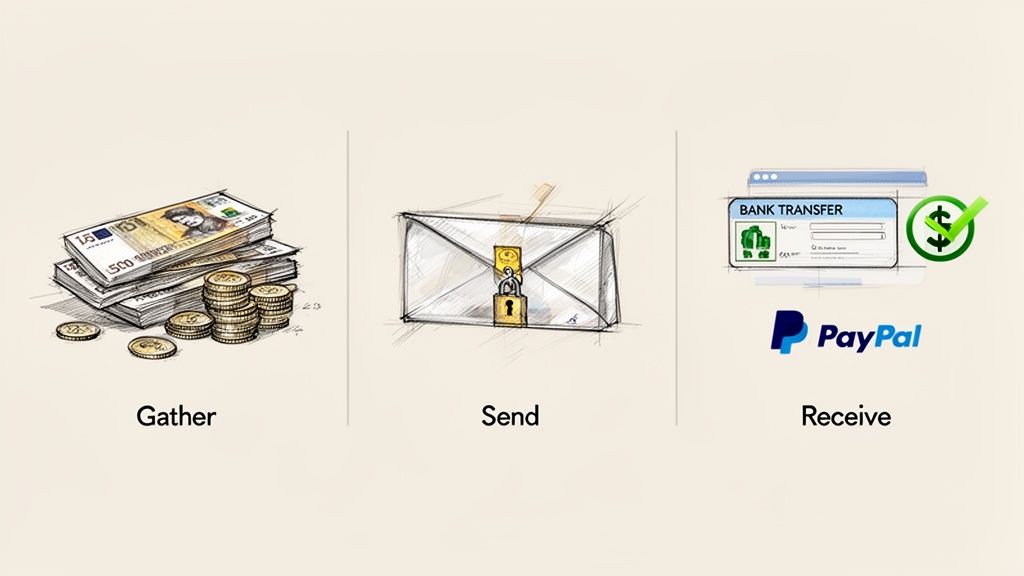
We've boiled our system down to just three easy steps. This guarantees a smooth ride from digging out your old currency to seeing the money in your account.
-
Gather Your Currency (No Sorting Needed!)
This is the easiest part. Just find all your old German money, whether it’s a pocketful of Pfennig coins or a bundle of Deutsche Mark banknotes. One of the best things about our service is that there's absolutely no need to sort your coins. Don't spend a single minute separating them by value or country—just pop everything together in a bag. -
Send It To Us Securely
Once you’ve got it all together, simply send it to us using a secure postal or courier service. We give you crystal-clear instructions on how to pack everything up safely, making sure it gets to our team without a hitch. It's a secure method trusted by thousands of customers all over the UK. -
Receive Your Payment Quickly
The moment your parcel arrives, our specialists get to work sorting and valuing its contents. We then send your payment straight to you using your preferred method, whether that's a bank transfer or PayPal. It really is that simple. No hidden fees, no frustrating delays, just your cash, paid fast. And it’s all backed by our 100% guaranteed service.
Why You Can Trust Our Service
We get it—sending money in the post requires a lot of trust. That's why we’re so proud to be a trusted partner for some of the biggest and most respected organisations in the UK.
We are the chosen currency exchange partner for major brands, including national charities, airports, supermarkets, and even police forces. They rely on us for our professionalism, security, and transparent service, and you can expect the same high standard.
This trust has been built over years of reliable service and a commitment to making currency exchange feel effortless. We treat every single package with the utmost care, ensuring you get the full value for what you've sent. Whether you're an individual with leftover holiday cash or a charity looking to donate foreign coins to charity collections, our process is designed for your complete peace of mind. For a more detailed walkthrough, you can learn more about how to exchange foreign currency with our guide.
A Currency with Enduring Value
For decades, the Deutsche Mark was a familiar sight for British travellers. If you look at the exchange rate archives, you’ll see that before the ERM period, from 1979 to 1990, the pound averaged around £1 = 2.8 D-Marks. UK tourists brought back huge amounts of this German currency pre euro every single year. In fact, estimates suggest that as much as £200 million in D-Marks came from tourism alone in the 1990s!
Even today, UK dealers report processing over 50,000 D-Mark items annually, which just goes to show how much is still hiding out there. You can discover more insights about historical exchange rates on MeasuringWorth.com.
This history proves there’s real value locked away in old drawers and collection jars across the country. Our fast and easy service is the most practical way to convert foreign coins and banknotes into money you can actually use.
Ready to cash in your old Deutsche Marks? Start your exchange today on our homepage and see just how simple it can be.
Give Your Old Currency a New Purpose
What if that old jar of Deutsche Marks and Pfennig coins could do more than just collect dust? Your leftover foreign currency, tucked away and forgotten after a trip, holds the power to make a real difference. Turning it into a charitable donation is a simple, meaningful way to support a cause you care about, giving your old money a new, powerful purpose.
For individuals, this is an incredibly straightforward way to contribute. Instead of letting that small collection of German currency pre euro sit in a drawer, you can put it to work helping others. It's a way of giving that costs you nothing from your current budget but provides vital funds for organisations doing important work across the UK and beyond.
A Fundraising Lifeline for Charities
For charities, our service is much more than just a way to exchange foreign coins and notes. It’s a complete, hassle-free fundraising solution. Think about it: many charities receive bags of mixed foreign coins through collections and fundraising events. Sorting this jumble of unusable currency is a logistical nightmare and often costs more in time and resources than the money is worth.
We completely eliminate that problem. Our process is designed to be fast and easy, with no need to sort coins. Charities can send us their entire collection of mixed foreign money, and we handle everything from there. We turn what was previously a difficult administrative headache into a valuable and reliable income stream, allowing charities to focus on what they do best.
We are proud to be the trusted currency exchange partner for numerous major UK charities. They rely on our professional, secure, and transparent service to convert unusable foreign coin collections into crucial funding for their projects.
How Businesses and Organisations Can Help
Businesses, retailers, airports, and other organisations can also play a huge role. Setting up a collection point for foreign currency is a fantastic way to engage with your customers and support charitable initiatives—a simple but powerful addition to your corporate social responsibility efforts.
Here’s how easy it is to get involved:
- Set up collection boxes: Place secure and clearly labelled collection boxes in high-traffic areas like till points, reception desks, or departure lounges.
- Team up with a charity: Choose a charity to support and let your customers know where their donations are going. This transparency builds trust and encourages more people to chip in.
- Use our service: Once your boxes start to fill up, our 100% guaranteed service makes the next step a breeze. Just send the entire unsorted collection to us, and we will process it and make sure the funds get to your chosen charity partner.
This is a powerful way to put forgotten money to work. To start converting your leftover foreign currency or to set up a collection, visit our homepage and see how simple it is.
Frequently Asked Questions
Have a few lingering questions about exchanging your old German currency pre-euro? We’ve put together some answers to the most common queries we get. Our goal is to make sure you feel completely comfortable before you start.
Can I Still Exchange Old German Deutsche Marks?
You certainly can. While your local high street bank probably won’t take them anymore, our specialised service is set up to convert foreign coins and banknotes, including old Deutsche Mark notes and Pfennig coins, back into cash.
We offer a fast, easy, and 100% guaranteed way to finally unlock the value hidden in that leftover foreign currency.
Do I Have to Sort My German Coins and Notes?
Not at all, and that’s one of the best parts. We designed our service to be completely hassle-free, so you don’t need to waste time sorting through everything. Forget separating coins by country or notes by denomination.
Just pop all your currency together in one package, and our experts will take care of the rest. It's truly the easiest way to exchange foreign coins and notes.
How Do I Know I'm Getting a Fair Exchange Rate?
We believe in being completely upfront. You can use our online calculator for an instant quote before you send anything, so you know exactly what to expect from the start.
We’re trusted by major brands, including national charities, airports, and even police forces, because we consistently offer fair rates. Plus, with our happiness guarantee, if you're not satisfied for any reason, we'll return your currency to you free of charge.
This commitment to our customers means you can cash in your old money without any risk.
Ready to turn that forgotten German currency into cash? Our process is fast, easy, and secure. We are trusted by major UK brands to exchange foreign coins and notes, making us a credible choice for your leftover currency. Visit our homepage to start your exchange today!