
German Currency Prior to the Euro Your Guide to the Deutsche Mark
Posted by: Ian Stainton • 8 Dec 2025
If you've ever stumbled upon some old German coins or notes while clearing out a drawer, you might be holding a piece of significant European history. Before Germany adopted the euro, its monetary system was dominated by one of the world's most stable and respected currencies of the 20th century.
Before being replaced by the euro, the main German currency prior to the euro was the renowned Deutsche Mark (DM). Introduced back in 1948, it quickly became the symbol of Germany's economic miracle, the Wirtschaftswunder, representing not just financial strength but also political stability right through the Cold War and beyond.
Understanding the Pre-Euro German Currency Landscape
Alongside the mighty Deutsche Mark, there was also the lesser-known East German Mark, used in the German Democratic Republic (GDR). For anyone looking to identify their leftover currency, it's crucial to distinguish between the two, as only one of them still holds exchangeable value today.
Many European nations had their own distinct money before adopting the single currency, and you can learn more about these fascinating currencies before the euro in our detailed guide.
Key German Currencies Before the Euro
Here’s a quick overview to help you figure out what you might have.
| Currency Name | Symbol / Abbreviation | Used in | Circulation Period |
|---|---|---|---|
| Deutsche Mark | DM, DEM | West Germany / Unified Germany | 1948 – 2002 |
| East German Mark | M, DDM | East Germany (GDR) | 1948 – 1990 |
As you can see, the East German Mark became obsolete after reunification in 1990, but the Deutsche Mark continued right up until the euro changeover.
The fixed and final exchange rate was set at €1 = 1.95583 DM. This rate is absolutely crucial because it permanently locked the value of the Deutsche Mark to the euro.
This means any old DM notes and coins you possess still have a defined worth today. While you can no longer spend them in shops, they haven't become worthless. Knowing this fixed rate is your starting point, allowing you to calculate the base value of any Deutsche Marks you've found. This is where our expertise comes in, providing a fast and easy way to convert these historical relics into usable cash.
A Journey Through German Currency History
The story of German money before the euro isn’t just about old coins and notes; it’s a direct reflection of a nation that went through incredible turmoil before achieving remarkable stability. To really understand the value of any Deutsche Marks you might have, you need to look at what came before them – a period that included one of the most famous economic meltdowns in history.
Back in the early 1920s, the Weimar Republic was brought to its knees by hyperinflation. The currency at the time, the Papiermark, became so worthless that people literally needed wheelbarrows full of cash just to buy a loaf of bread. It was a complete economic disaster. This crisis eventually led to the creation of the Rentenmark and then the Reichsmark, as the government desperately tried to restore some sense of order.
The Tale of Two Marks in a Divided Germany
After World War II, Germany was split in two, and its currency followed suit. For more than forty years, two very different Marks circulated, each representing a completely different political and economic world.
- The West German Deutsche Mark (DM): Introduced in 1948, the Deutsche Mark quickly became the powerhouse currency most of us remember. It was the foundation of the German Wirtschaftswunder (economic miracle) and a symbol of stability, reliability, and free-market success. It was so strong that it became one of the most respected currencies in the world.
- The East German Mark (M): At the same time, East Germany (the GDR) rolled out its own Mark. Known officially as the Mark der DDR, it was a closed, socialist currency that couldn’t be freely exchanged. Its value was set by the state, reflecting the isolated nature of the East German economy.
This financial split meant that for decades, two different currencies were used within one divided nation. The Deutsche Mark stood for strength and freedom, while the East German Mark was a symbol of a state-controlled, closed-off system.
This timeline gives you a great visual of the key moments in Germany's modern currency history, from the birth of the Deutsche Mark right through to the adoption of the euro.
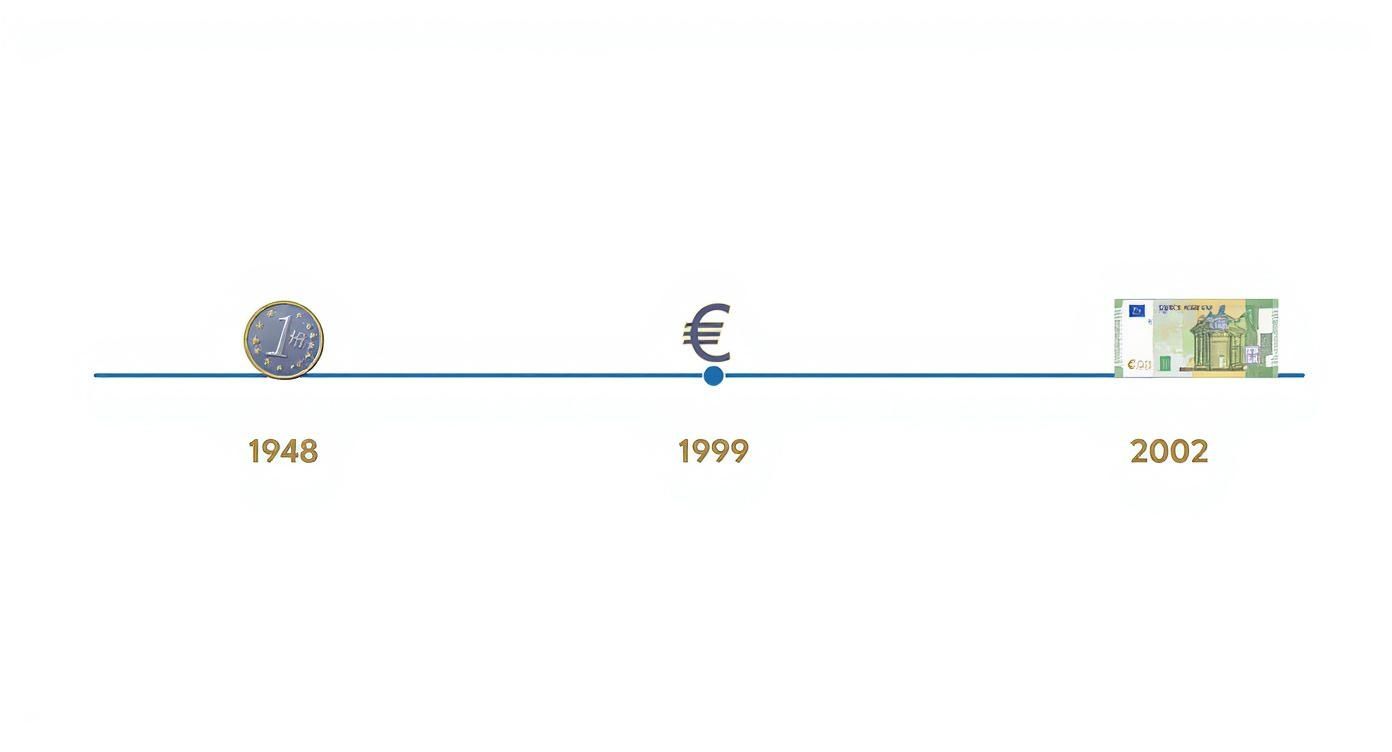
As you can see, the Deutsche Mark had a long and stable run for over 50 years before the euro arrived to create a single monetary system for much of Europe.
Reunification and a Single Currency
The fall of the Berlin Wall in 1989 was the beginning of the end for a divided Germany. By 1990, reunification was underway, and a crucial part of that was uniting the two economies. On 1 July 1990, the Deutsche Mark became the official currency for all of Germany, and the East German Mark was consigned to history.
That moment was huge. Adopting the Deutsche Mark across the whole country wasn't just a financial move; it was a powerful symbol that the nation was finally coming back together under one stable currency.
The Deutsche Mark served a unified Germany for another decade before the country fully embraced the euro. If you're curious about the collectable value of notes from these earlier, turbulent times, our guide to antique German currency has more details.
Understanding this rich history gives you a real appreciation for any old German money you might find. Those notes and coins aren't just obsolete currency; they're little pieces of a pivotal time in European history. If you have any leftover foreign currency, whether it’s Deutsche Marks or other old coins, we offer a fast, easy, and hassle-free exchange service. Our process is trusted by major organisations like charities, airports, and even police forces, and it’s 100% guaranteed. Don't worry about sorting anything; just send it all to us, and we'll handle the rest, turning your piece of history into cash.
Got Some Old Deutsche Mark Notes and Coins? Here's How to Spot What You've Got
Stumbled across a handful of old German money in a drawer or an old travel wallet? Let's figure out what you've got and turn that discovery into cash. The first, and most important, step is getting a clear idea of what you're holding. The Deutsche Mark was the main German currency before the euro, and its banknotes and coins have some really distinctive features that make them easy to identify.
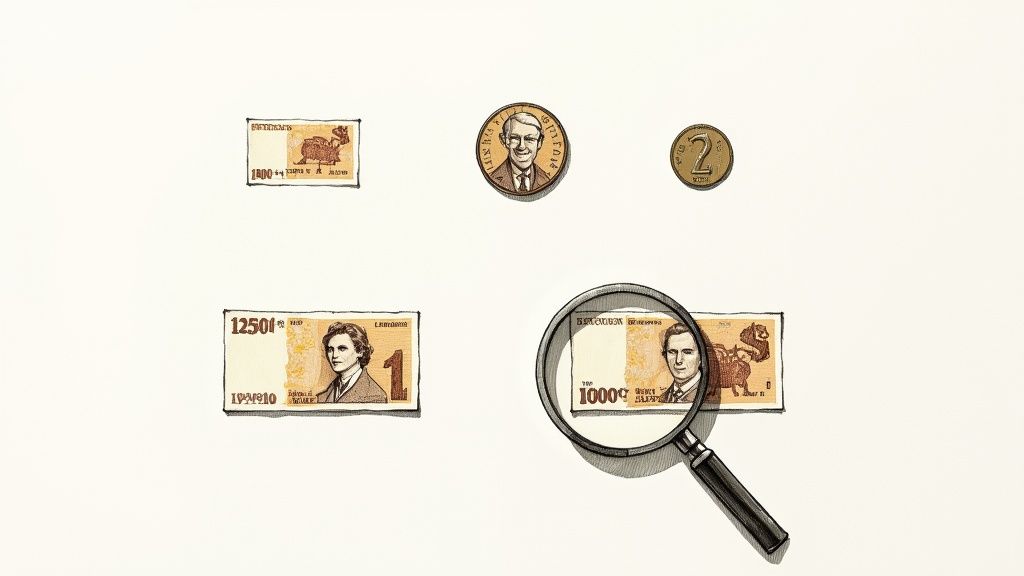
Holding one of these notes is like holding a little piece of history. The final series, which was issued from 1989 onwards, is the one you’re most likely to find kicking about. They were well-known at the time for their top-notch security features and beautiful designs honouring German arts and sciences.
A Closer Look at Deutsche Mark Banknotes
Each banknote featured a famous German cultural figure on the front, with a symbol of their work on the back. They were colourful, incredibly detailed, and designed to be as secure as they were beautiful.
Here’s a quick rundown of the most common notes you might find:
- 5 DM Note: A green note featuring the writer Bettina von Arnim.
- 10 DM Note: The blue one, showcasing the famous mathematician Carl Friedrich Gauss next to a bell curve.
- 20 DM Note: A purple-hued note honouring the poet Annette von Droste-Hülshoff.
- 50 DM Note: This brownish note depicted the architect Balthasar Neumann.
- 100 DM Note: A vibrant blue note celebrating the composer and pianist Clara Schumann.
- 200 DM Note: A reddish-orange note with Paul Ehrlich, a pioneer in immunology.
- 500 DM Note: This note featured the naturalist and artist Maria Sibylla Merian.
- 1000 DM Note: The big one, showcasing the Brothers Grimm, Jacob and Wilhelm.
Don't forget the fixed conversion rate: €1 is worth exactly 1.95583 DM. This rate is your key to understanding the base value of any notes or coins you have, connecting their historical design to real-world worth today.
Identifying the Coins: Pfennig and Mark
Alongside the notes, the coinage was simple and practical. The Deutsche Mark was split into 100 Pfennig. You'll find the coins are typically made of copper, brass, and nickel alloys, each with a clear, distinct design.
The most common coins you'll see are:
- Pfennig Coins: These came in denominations of 1, 2, 5, 10, and 50. The smaller ones often feature an oak leaf, a classic German symbol.
- Mark Coins: The bigger coins were valued at 1, 2, and 5 Marks. The 5 Mark coin is especially easy to recognise with its bold German eagle on one side.
For a more detailed look at individual pieces, our guide to old coins from Germany offers plenty more insight. If you're interested in the wider topic of looking after a coin collection, including historical foreign currency, resources on general coin collection management can be a great help.
Once you know what you’ve got, the next step is turning it into cash. While you could keep them as collectibles, they still have a guaranteed monetary value. That’s where our service makes things simple. We offer a fast, easy, and hassle-free way to exchange your foreign coins and notes.
We are trusted by major brands—including charities, supermarkets, airports, and even police forces—to handle their currency exchange. There’s no need for you to sort coins or worry about separating the different denominations. Our 100% guaranteed service means you can just send us all your leftover foreign currency, and we’ll sort it out, getting you paid quickly and efficiently. Ready to turn those old Marks into money? Head over to our homepage to get started.
Can You Still Exchange Old German Marks Today?
So, you've stumbled upon a stash of old Deutsche Marks and you're wondering if they're worth anything more than just a bit of nostalgia. The good news is a resounding yes. While you can’t pop into a shop and spend them anymore, those old German notes and coins are far from worthless.
Unlike many other European countries that set a firm deadline for converting their old currencies to the Euro, Germany made a unique promise. The Deutsche Bundesbank, Germany's central bank, guarantees that it will exchange unlimited amounts of Deutsche Mark banknotes and coins for euros, forever. That means your old currency still holds its value based on the official fixed conversion rate.
That all sounds great on paper, but actually going through the official channels can be a real headache if you live outside of Germany. You’re often faced with confusing paperwork, the cost and risk of international shipping, or even having to plan a trip to a Bundesbank branch in person.
The Official Route vs. a Simpler Alternative
Trying to exchange currency through official channels can be a slow, clunky process. You'd need to find and download the right forms, package everything up securely, and post it all to Germany, crossing your fingers that it gets there safely. This is exactly the kind of logistical nightmare that a specialised service is designed to solve.
Our entire goal is to offer a fast, easy, and hassle-free alternative. We get rid of all those barriers, letting you convert your leftover foreign currency right from your own home. No need to get your head around German postal rules or stress about your parcel going missing.
We provide a 100% guaranteed service built for your convenience. Just send us your old Deutsche Marks—along with any other foreign coins and notes you might have—and we’ll take care of the entire process for you.
It’s a bit like the difference between tackling your own complex tax return and just hiring an expert to sort it out. One way involves a lot of research, paperwork, and potential stress; the other is a straightforward, reliable service that gets the job done without any fuss.
Why Our Service Is the Easiest Option
We’ve built our whole process around making your life easier. We know you’ve got better things to do than sort through piles of old coins or fill out banking forms from another country. That’s why we’ve completely removed those steps.
- No Sorting Required: This is one of our most popular features—there's absolutely no need to sort your coins or notes. Whether you've got a bag full of mixed Pfennig coins or a bunch of different banknotes, just throw them all in together and send them over to us.
- Complete Transparency: We believe in being upfront and clear. You’ll know the exchange rates before you even send your currency, so you won't get any nasty surprises down the line.
- Trusted and Credible: We're proud to be the go-to currency exchange partner for a huge range of major UK organisations. Our clients include well-known charities, major supermarkets, airports, and even police forces who trust us for secure and efficient currency conversion.
This level of trust has been built over years of providing a reliable service. When you choose to exchange foreign coins and notes with us, you’re picking a partner with a proven track record. We make it simple to convert foreign coins and banknotes or even donate foreign coins to charity, turning that forgotten currency into real, usable cash. Find out just how easy it is on our homepage.
How to Exchange Your Old German Currency The Easy Way
So, you’ve found some old Deutsche Marks and realised they still have value. Fantastic! Now for the important bit: turning that old German currency prior to the euro into actual cash you can spend.
You could go the official route through Germany’s central bank, but that often means dealing with paperwork, expensive international postage, and a long wait. We offer a much simpler, modern alternative.
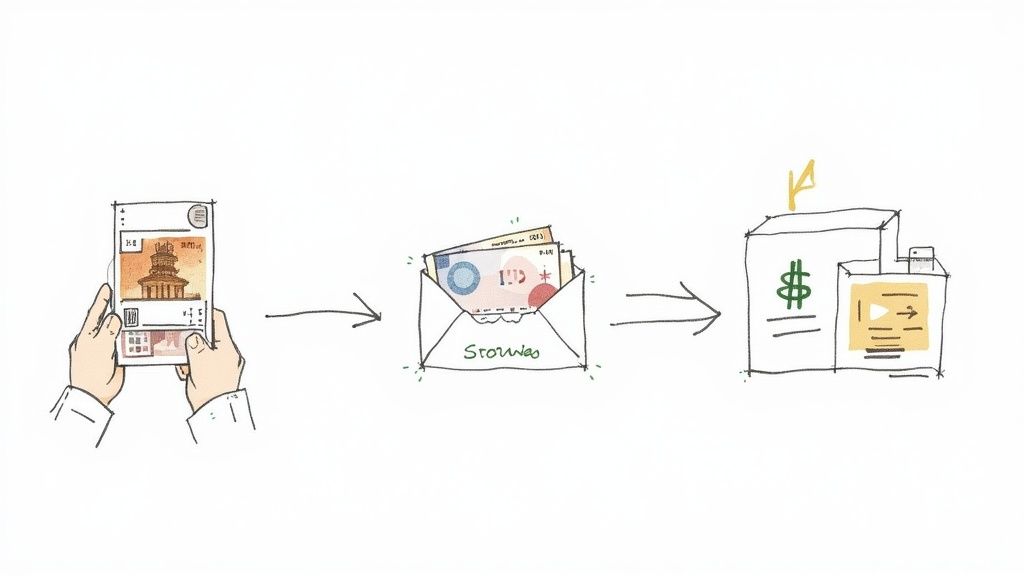
Our service is designed to be fast, easy, and completely hassle-free. We cut through the red tape, providing a secure process that anyone can use right from their home. Forget confusing forms or worrying about your package getting lost in the post; we make it simple to exchange foreign coins and notes.
Your Simple Four-Step Exchange Process
We’ve worked hard to make our process as straightforward as possible. There are no hidden steps or complicated rules. Just follow these four easy steps to convert your leftover foreign currency.
- Gather Your Currency: Collect all your Deutsche Marks, both banknotes and coins. There's no need to sort coins or separate them from any other foreign currencies you might have.
- Pack and Send: Pop everything into a secure package and post it to us. For your own peace of mind, we always suggest using a tracked service.
- We Process and Verify: As soon as your package arrives, our expert team gets to work. We handle all the sorting, counting, and checking for you, applying the correct exchange rates.
- Receive Your Payment: You get paid quickly! We’ll send the money using your preferred method, like a bank transfer or PayPal, usually within just a few working days.
It really is that simple. We believe getting value from old money shouldn’t be a chore. Our 100% guaranteed service ensures a smooth transaction from start to finish, letting you effortlessly convert foreign coins and banknotes into usable cash.
Why You Can Trust Our Service Completely
Trust is everything when you're dealing with money. We get that, which is why we've built our reputation on being reliable and credible. In fact, we are the chosen currency exchange partner for some of the UK’s most recognisable organisations.
We are trusted by major brands across various sectors, including leading UK charities, national supermarkets, major airports, and even police forces. These organisations rely on us for our secure, efficient, and transparent currency exchange services.
This network of partners is a testament to the high standards we keep. When you choose us, you're choosing a service with a proven track record of integrity and customer satisfaction.
Comparing Currency Exchange Options
To make it even clearer why our service is the go-to choice, let's put it side-by-side with the official Bundesbank route.
A quick look at the table below shows just how much easier our process is compared to handling it all yourself.
Comparing Currency Exchange Options
| Feature | Exchanging via Bundesbank (Official) | Exchanging with Our Service (Fast & Easy) |
|---|---|---|
| Sorting Requirement | You may need to sort and list currency. | No need to sort coins or notes—we do it all for you. |
| Paperwork | Requires completing official German forms. | No complicated forms to fill out. |
| Shipping | You manage costly and risky international postage. | Simple, domestic UK postage. |
| Speed | Can take weeks or even months to process. | Fast turnaround, with payment often in days. |
| Convenience | A complex, do-it-yourself process. | A hassle-free service designed for ease. |
| Guarantee | Risk of loss in transit falls on you. | Our service is 100% guaranteed for your peace of mind. |
| Other Currencies | Only accepts Deutsche Marks. | We exchange foreign coins from all over the world. |
The difference is clear. Our service removes all the usual obstacles, providing a practical solution for anyone with leftover foreign currency. You can also use our platform to donate foreign coins to charity, turning forgotten cash into a meaningful contribution.
Ready to finally cash in that old currency? Our process is built to be fast and effortless. Start today by visiting our homepage and discover just how easy it is to unlock the value in your old coins and notes.
Your Questions About Old German Currency, Answered
If you've stumbled across some old German money, you probably have a lot of questions. Whether it's Deutsche Marks or even older notes related to German currency prior to the euro, getting clear answers is the first step to figuring out what they're worth. We've put together the most common queries to give you the practical info you need.
Our goal is to make exchanging your old currency as simple and clear as possible, so you feel confident every step of the way.
When Did Germany Actually Switch to the Euro?
This is a common point of confusion, mainly because the changeover happened in two stages. Knowing these dates helps explain why the Deutsche Mark is no longer used but still has value.
- 1 January 1999: This was the day the euro became an official electronic currency. The exchange rates for the first 11 participating countries, Germany included, were permanently fixed against the euro. It was used for bank transfers and accounting, but you couldn't actually have euros in your wallet just yet.
- 1 January 2002: This is the date everyone remembers. Euro notes and coins finally hit the streets, and the Deutsche Mark started its farewell tour. For a short time, you could use both currencies, but the euro quickly became the only legal tender.
So, while the Deutsche Mark vanished from shops in early 2002, its value was locked in place three years earlier.
Can I Still Exchange My East German Marks?
This is another big question, especially for anyone who has found currency from the old German Democratic Republic (GDR). Unfortunately, the answer is a firm no. The window for exchanging the East German Mark, or 'Ostmark', closed a long, long time ago.
After German reunification in 1990, there was a brief period when you could convert Ostmarks into Deutsche Marks. That deadline has long since passed, and today the East German Mark is purely a collector's item with no monetary exchange value.
Do I Have to Sort All My Coins and Notes Before Sending Them?
Absolutely not! This is one of the best parts of our service and what makes it so fast, easy, and hassle-free. We know that sifting through a big bag of mixed foreign coins is the last thing anyone wants to do.
We designed our process specifically to save you that job. Just gather up all your leftover currency—Deutsche Marks, Pfennigs, and any other coins or notes you have from anywhere in the world—and pop it all in one package to send to us. We do all the sorting, counting, and checking for you.
This straightforward approach is central to our promise of convenience. We handle the fiddly bits so you don't have to, making it incredibly simple to convert foreign coins and banknotes into cash.
How Do I Know Your Service Is Trustworthy?
Trust is everything when you're sending money, and we've built our entire reputation on being a reliable partner. We get that you need complete peace of mind, which is why we're transparent about who we work with and offer a 100% guarantee on our service.
We're proud to be the currency exchange provider trusted by some of the UK's most recognised organisations. Our partners include:
- Major UK Charities: They rely on us to process foreign currency donations securely and efficiently.
- National Supermarkets: We partner with leading retailers to handle currency collected for good causes.
- Major Airports: We're the go-to service for dealing with currency from airport donation globes.
- Police Forces: Even law enforcement agencies trust us for secure currency management.
These long-standing relationships speak to our integrity and professionalism. When you exchange foreign coins and notes with us, you're choosing a service with a proven track record. We also make it easy to donate foreign coins to charity, turning that forgotten change into something that makes a real difference.
Ready to unlock the value of your old currency? At We Buy All Currency, our process is fast, easy, and 100% guaranteed. There's no need to sort your coins or fill out complex forms. Visit our homepage to learn more and get started today at https://www.webuyallcurrency.com.