
Guernsey Pound Notes: A UK Guide to Value & Exchange
Posted by: Ian Stainton • 18 Jul 2026
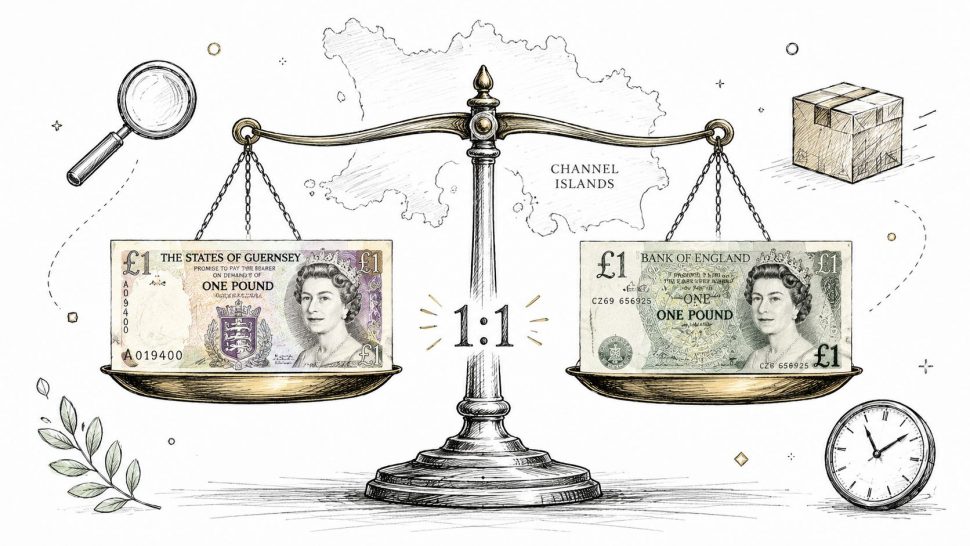
Guernsey pound notes are legal tender in Guernsey and they're pegged 1:1 with Pound Sterling, but they're not legal tender in the UK mainland, which is why shops, banks, and exchange counters often refuse them. If you've got a few notes left from a Channel Islands trip, a specialist online exchange service is usually the simplest way to turn them into spendable pounds.
That confusion catches people out all the time. The note says “pounds”, the value matches sterling, and yet it still gets declined at the till. If you're holding Guernsey notes in a drawer, a wallet, or a holiday envelope, the good news is that they aren't worthless. You just need the right route.
What to Do with Your Guernsey Pound Notes
You find Guernsey notes in a coat pocket after a trip, take them to a shop on the mainland, and get a puzzled look at the till. The notes are still worth face value, but that does not mean every UK business will handle them.
The practical answer is simple. If you want to turn Guernsey notes into spendable money without wasting time, use a specialist currency exchange service that accepts notes outside the usual high street process.
That approach saves a lot of dead ends. Common problems include:
- Trying to spend them in mainland UK shops. A retailer is free to refuse them.
- Taking them to a bank branch and expecting a routine deposit. Some staff will not process island-issued notes.
- Using a standard bureau de change. Many only deal with mainstream travel currencies.
- Putting them aside for later. The notes keep their local face value, but the practical problem stays the same.
Practical rule: If a note is tied to sterling but sits outside normal mainland acceptance, a specialist service is usually the quickest way to deal with it.
What works best is a service set up for awkward currency situations. That includes leftover holiday cash, island-issued notes, older banknotes, and mixed batches that traditional providers often decline.
What usually fails is relying on the high street to make an exception. Their systems are built for standard deposits and standard exchange lines. Guernsey notes often fall outside both.
If you have other Channel Islands cash as well, the same issue often comes up with Jersey money on the UK mainland. In practice, sending everything together is often the least hassle, especially if you also have old notes or foreign coins sitting in the same drawer.
What Are Guernsey Pound Notes
Guernsey pound notes are the local notes issued for use in the Bailiwick of Guernsey. They sit within the wider sterling world, but they are still their own local issue, which is exactly why so many people misunderstand them.

Their legal status
The key point is simple. The Guernsey pound operates as legal tender exclusively within Guernsey, but it circulates freely and is accepted at par in Jersey, while remaining pegged £1 Guernsey = £1 Sterling according to the background on banknotes of the pound sterling.
That creates a situation many travellers find odd:
- In Guernsey, the notes are normal everyday money.
- In Jersey, they're commonly encountered and accepted.
- On the UK mainland, they often meet resistance.
If you've dealt with Channel Islands cash before, the same practical issue often appears with Jersey money too. This guide on Jersey money in the UK helps show why island-issued notes can be perfectly valid in one place and awkward in another.
Modern notes are real, current, and secure
Some people assume mainland refusal means the notes are old-fashioned or unofficial. They aren't. Guernsey's current banknotes use advanced security printing.
In 2024, the States of Guernsey introduced notes with PUREIMAGE™, IGNITE®, and NEXUS™ security technologies in conjunction with De La Rue, as outlined by the States of Guernsey announcement on new banknote security features.
That tells you two useful things as a holder:
- Your notes are legitimate modern currency, not novelty money.
- Refusal in the UK is a system issue, not a question of whether the note is genuine.
A Guernsey note can be perfectly valid and still be inconvenient on the mainland. Those two things often exist together.
Why this causes so much confusion
People tend to use “worth”, “legal tender”, and “accepted everywhere” as if they mean the same thing. They don't.
A note can match sterling in value and still be outside the day-to-day systems used by mainland retailers and mainstream exchange counters. That's why specialist routes exist for people who need to exchange foreign coins and notes, convert island-issued currency, or deal with money that falls outside the usual till and banking workflow.
How Much Are Your Guernsey Pound Notes Worth
Generally, the answer is reassuring. Your Guernsey notes are generally worth their face value, in line with sterling parity, rather than some discounted amount.

Face value first
If you have ordinary circulating notes, think of them as spendable value that has become awkward to access, not value that has disappeared. The practical question is usually how to turn them into usable mainland money, not whether they still count.
That said, some holders should pause before sending everything off at face value.
When collector value matters
Collector interest usually depends on a few familiar factors:
- Condition matters. Crisp notes attract more attention than heavily used ones.
- Unusual serial numbers can matter. Some collectors pay attention to patterns and low numbers.
- Historical significance matters most. Guernsey's history makes it especially captivating.
A standout example is the 1921 “BRITISH” overprint issue. According to the detailed record on Guernsey overprints of 1921, British government overprints were applied to Guernsey banknotes in 1921, and only seven such specimens have been recorded in published literature and auction catalogues.
That's not normal collectible scarcity. That's a highly specialised niche.
A realistic way to judge what you have
For those in the first camp, their notes are current or relatively ordinary issues with practical exchange value rather than exceptional rarity.
Use this simple guide before you do anything:
| What you have | Likely view |
|---|---|
| Current everyday Guernsey notes | Usually treated at face value in practical exchange terms |
| Older but ordinary notes | May still be exchangeable, but usually not rare by default |
| Very unusual historic note | Worth checking with a specialist collector or numismatic expert first |
| Anything resembling a 1921 overprint | Do not treat as routine currency without expert review |
If a note looks old, unusual, or markedly different from standard modern Guernsey issues, pause before exchanging it as ordinary cash.
That's the trade-off. Most holders want speed and simplicity. A small minority may have something that belongs in a specialist valuation channel instead.
Comparing Your UK Exchange Options
Contrary to common belief, the refusal isn't really about “bad money”. It's about process. Guernsey pound notes are not withdrawn currency. They remain legal tender pegged 1:1 with sterling, which is why standard UK exchange services often don't offer a conversion rate for them and may still refuse them because they sit outside their normal systems, as explained in the BBC coverage of Channel Islands notes and exchange confusion.
Why banks and bureaus often say no
High street banks and travel money counters are usually set up for one of two things:
- standard UK banking deposits
- mainstream foreign exchange products
Guernsey notes fit awkwardly into both categories on the mainland. They're not a conventional foreign holiday currency in the usual retail sense, and they're not standard Bank of England notes either.
The same issue often gets worse if you also want to convert foreign coins and banknotes together. Coins are where many traditional providers stop helping altogether.
Where to Exchange Guernsey Pound Notes in the UK
| Exchange Option | Accepts Guernsey Notes? | Accepts Foreign Coins? | Convenience Level |
|---|---|---|---|
| High street bank | Sometimes, often inconsistent | Usually no | Low to medium |
| Post Office | Can be restrictive and process-led | Not suitable for most coin exchange needs | Medium |
| Specialist online currency service | Usually the most practical route | Yes, typically designed for this | High |
The Post Office also has process limits that matter in real life. A commonly cited exchange route has a minimum order of £100 and a maximum of £2,500, according to the details on Post Office exchange thresholds. That can immediately rule out someone holding just a small amount of leftover island currency.
For postal exchanges of old banknotes through the Bank of England, a copy of photo ID and proof of permanent address is required for exchanges exceeding £700, based on the Bank of England guidance for exchanging old banknotes by post. That process is important in the right context, but it isn't a clean answer for every kind of non-standard note people bring home.
What specialist services do better
A specialist provider is usually built for the exact problems mainstream channels dislike:
- Mixed currency rather than one neat bundle
- Small leftover amounts
- Coins and notes together
- Older or unusual issues
- People who don't want to sort everything by hand
If you're dealing with a wider pile of travel money rather than just Guernsey notes, a guide on how to exchange foreign coins and notes can help you choose the right route without wasting a trip to the high street.
A Simple Step-by-Step Exchange Process
You get back from Guernsey with notes that say "pounds" on them, then hit a problem at the first till or bank counter. The practical fix is to use a process built for currency that is valid in one place but awkward to place in another.

Step 1 Find your currency and get a quote
Gather everything first. Include Guernsey notes, other foreign banknotes, coins, and any older travel money you want to clear at the same time.
This saves time and reduces mistakes. Guernsey pounds are pegged to Sterling, but that does not mean every mainland cashier, branch, or machine will handle them confidently, so it makes sense to deal with the whole pile in one go instead of trying one awkward payment attempt after another.
A good specialist process should accept mixed submissions without expecting you to sort every item into neat batches at home.
Step 2 Pack and send it securely
Once you have your quote, pack the currency carefully and send it using the provider's recommended postal service. Follow the instructions closely, especially for wrapping, labelling, and keeping loose items contained.
Small details matter here. Notes should stay flat and dry, coins should not move around freely, and the parcel should be easy for the receiving team to check against your submission.
Send what you have as instructed. Do not turn it into a home counting exercise unless the provider asks for that level of detail.
Specialist postal exchange works well because it is designed for awkward cases, including island notes that are hard to spend locally, mixed coin-and-note bundles, and currencies that ordinary counters often turn away.
Step 3 Receive payment
After the currency is checked, payment is made using the options offered by the service. For We Buy All Currency, payment is issued by PayPal or bank transfer after verification, with the quoted exchange value paid in full and no hidden charges, based on the publisher's service information.
That suits different needs:
- Individuals clearing holiday leftovers
- Charities turning collections into usable funds
- Businesses handling foreign cash received in error
It also suits people who want certainty. Instead of relying on whether a local cashier recognises a Guernsey note, you use a channel set up to assess and process it properly.
Common mistakes to avoid
- Assuming a Sterling peg guarantees acceptance. It does not. Value equivalence and day-to-day acceptance are different things.
- Trying one shop or bank and stopping there. A refusal on the mainland is common with Guernsey notes.
- Over-sorting everything before you send it. Many specialist services can handle mixed currency without perfect preparation.
- Packing coins and notes loosely. That creates delays and avoidable risk in the post.
- Ignoring donation as an alternative for low-value leftovers. In some cases, that is simpler than exchanging every last coin.
Your Guernsey Currency Questions Answered
Can I use Guernsey pounds in the UK?
You might find a shop that accepts them, but you can't rely on it. Mainland retailers are free to refuse notes they don't handle through their normal systems.
Are Jersey and Guernsey pounds the same?
They are separate local issues, even though both are tied to sterling. In practice, that shared sterling link causes a lot of confusion for travellers.
Do Guernsey pound notes expire?
Current Guernsey notes aren't the same as withdrawn mainland banknotes that have fallen out of circulation. If you hold ordinary notes, the issue is usually acceptance, not expiry.
Why did a UK shop refuse my Guernsey note?
Because shop staff and tills are often set up for standard UK cash handling only. If a note falls outside that familiar process, many retailers decline it.
Can foreign coins be exchanged in the UK?
Yes, but usually not through ordinary banks or standard travel money counters. Specialist services are much better suited if you need to exchange foreign coins and notes together.
Do banks accept Guernsey notes?
Some may help in some situations, but it's inconsistent. That lack of consistency is exactly why people turn to specialist options when they want a cleaner outcome.
Can I donate foreign coins to charity instead of exchanging them?
Yes. If you've got mixed coins and low-value leftovers, donating can be a very practical alternative. It's especially useful when the pile includes several currencies and small amounts.
Is it safe to send cash in the post?
It can be, provided you follow the exchange service's packaging and postage instructions carefully. Use the recommended method, pack securely, and keep your proof of posting.
What if I have old or withdrawn currency as well?
That's often where specialists help most. Many mainstream providers won't touch older issues, but specialist services can usually assess a wider mix, including obsolete notes and coins.
How long does payment take?
It depends on the service. Some specialist providers issue payment after verification, and service terms should always be checked before you send anything.
If you're ready to stop leaving Guernsey notes, foreign change, or old travel money sitting unused, the simplest next step is to use a service built for awkward currency rather than forcing it through the high street.
If you want a straightforward way to convert Guernsey notes, old banknotes, or mixed holiday change, We Buy All Currency offers a simple route to exchange leftover currency, convert foreign coins and banknotes, or turn unwanted travel money into a charity donation. It's designed for the situations where banks and exchange bureaus usually fall short.